Best Dog Food for Poodles: Toy, Miniature, and Standard Options
Choose fresh food for toy, miniature, and standard Poodles with clear growth and adult options, measured portions, storage guidance, and calorie-based comparisons.

Three Poodles of different sizes stand together in a garden.
Petful is reader supported. As an affiliate of platforms like Amazon and Chewy, we may earn a commission when you buy through links on this page. There is no extra cost to you.
This article is sponsored by JustFoodForDogs. Petful maintains editorial control and may earn a commission from qualifying purchases, at no extra cost to you.
The best dog food for Poodles is a complete recipe that fits the individual dog's life stage, with a serving that matches their actual needs. Toy, miniature, and standard Poodles differ considerably in size, but a size label alone does not establish nutritional quality. Compare puppy suitability, calories per ounce, texture, and how comfortably you can measure and serve the food.
JustFoodForDogs provides fresh options that make those differences easy to examine. Chicken & Rice and Fish & Sweet Potato include growth in their nutritional adequacy statements. Beef & Russet Potato and JustFresh Home-Cooked Chicken are adult-maintenance choices. A suitable recipe may work for more than one Poodle size, while the individual portions remain different.
Choose complete daily nutrition with life stage suitability first. Toy, miniature, and standard Poodles can use the same calorie-density calculation with their individual allowances. Size affects the amount and serving practicality; it does not replace the nutritional adequacy statement.

Sign up for expert-backed reviews and safety alerts all in one place.
Food options for Poodles compared
Start by separating growing puppies from mature dogs. For a puppy, check growth eligibility on the exact recipe; for a healthy adult, compare appropriate adult-maintenance or all-life-stages choices. Then consider how the food fits your Poodle's routine.
This comparison uses current JustFoodForDogs label information. It is an analysis of recipe suitability and practical feeding features, not a hands-on taste test. It does not promise changes in coat quality, allergy treatment, or a universal veterinary ranking.
| Food | Useful fit | Label life stage | Calories per ounce | Practical consideration |
|---|---|---|---|---|
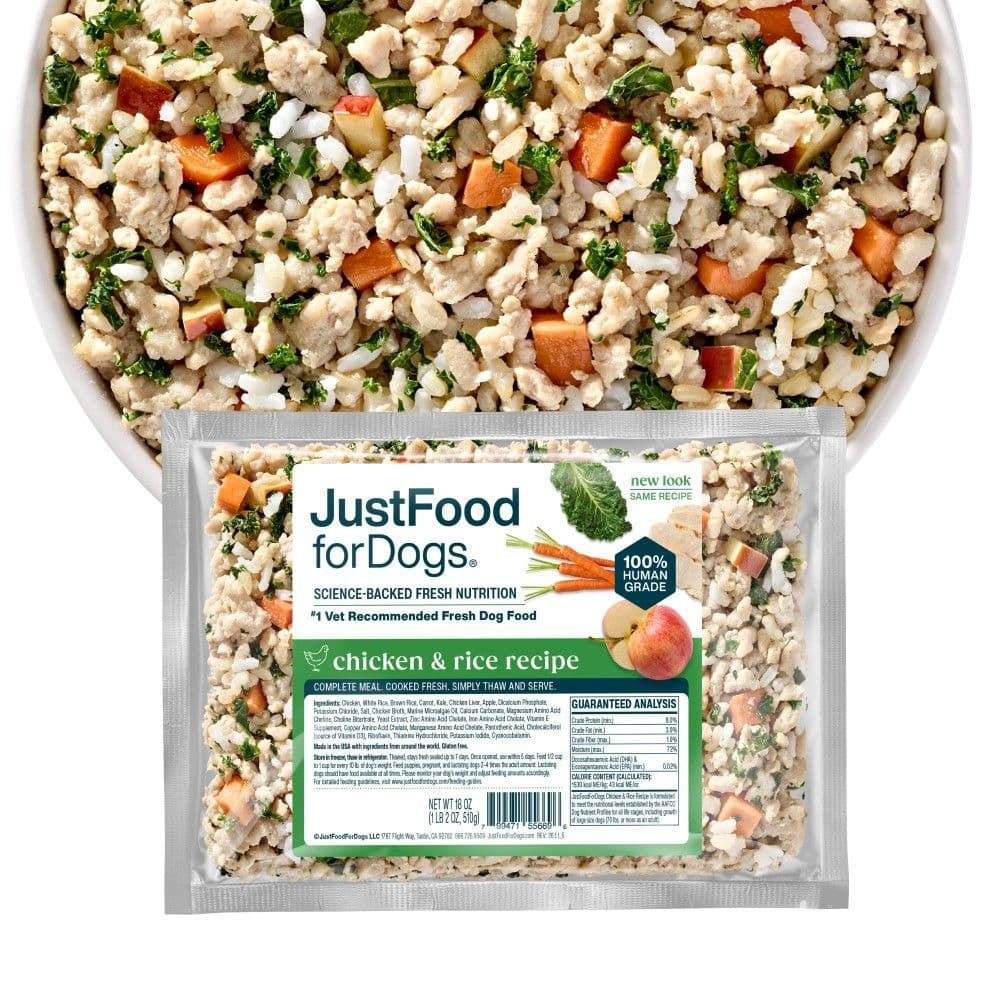
| JustFoodForDogs Chicken & Rice Fresh Frozen | Grain-inclusive fresh food for puppies and adults | All life stages, including large-size growth | 43 | Plan frozen storage and thawing |
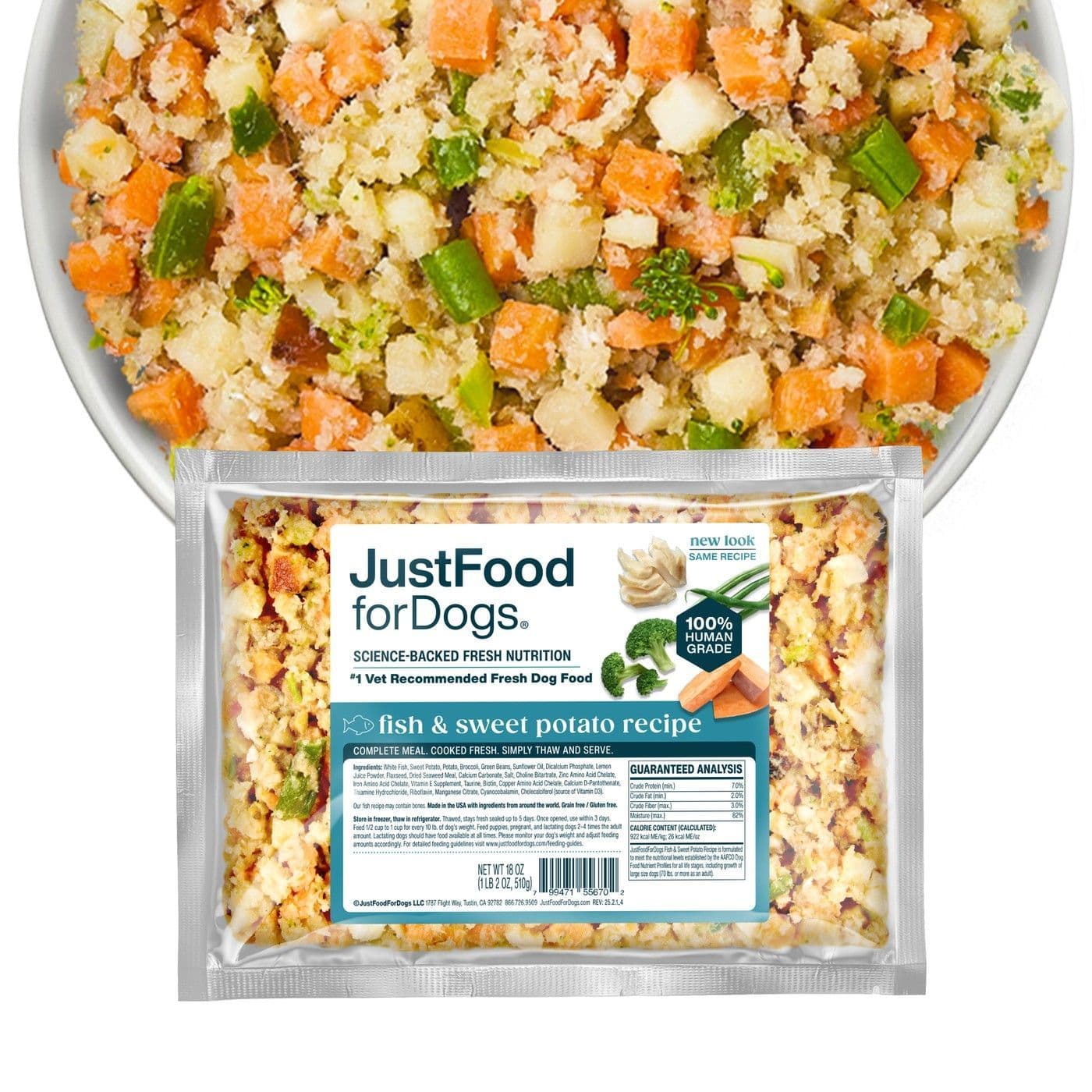
| JustFoodForDogs Fish & Sweet Potato Fresh Frozen | Fish-based food with a different meal volume | All life stages, including large-size growth | 26 | More ounces supply the same calories |
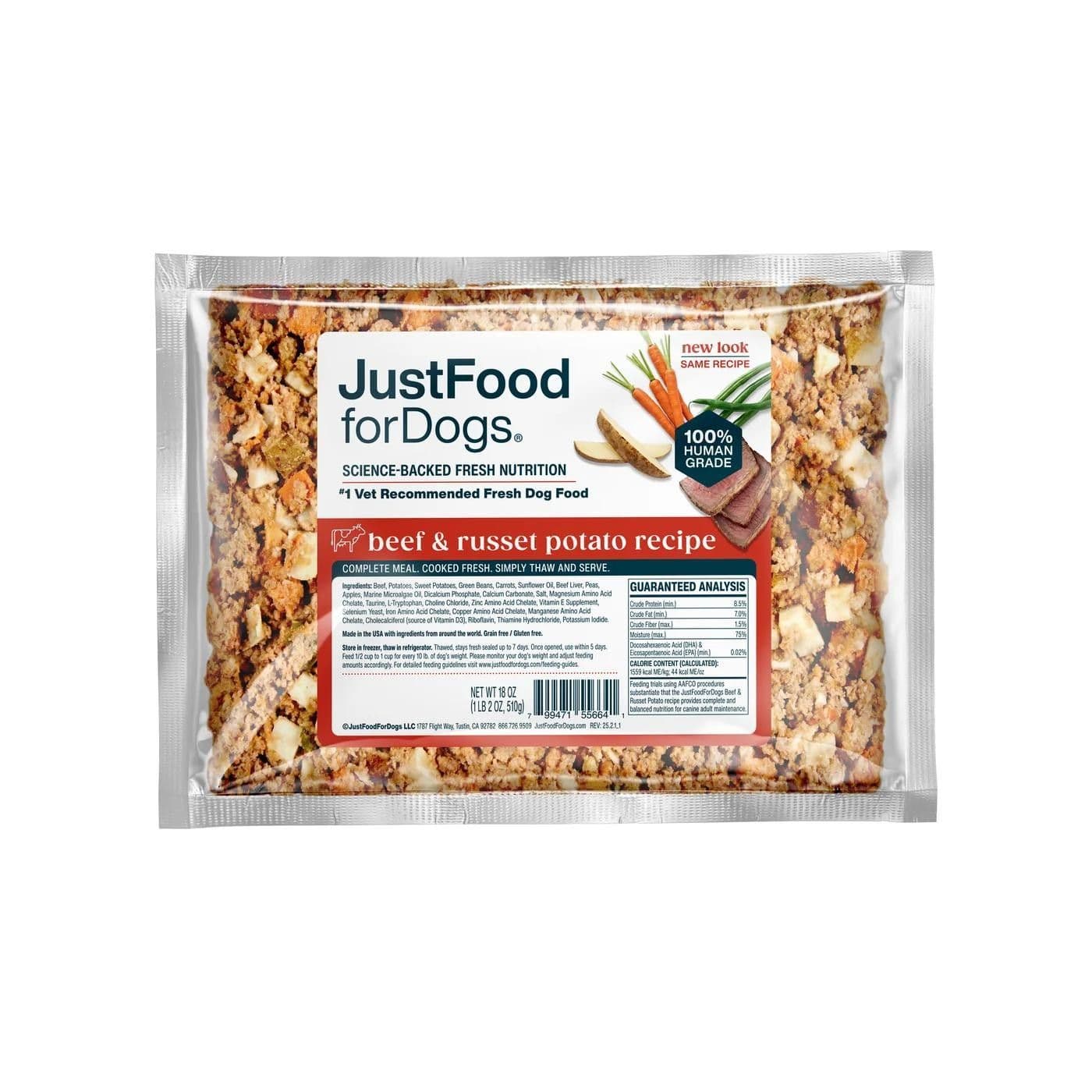
| JustFoodForDogs Beef & Russet Potato Fresh Frozen | Complete fresh food for mature Poodles | Adult maintenance | 44 | Keep separate from a puppy's growth diet |
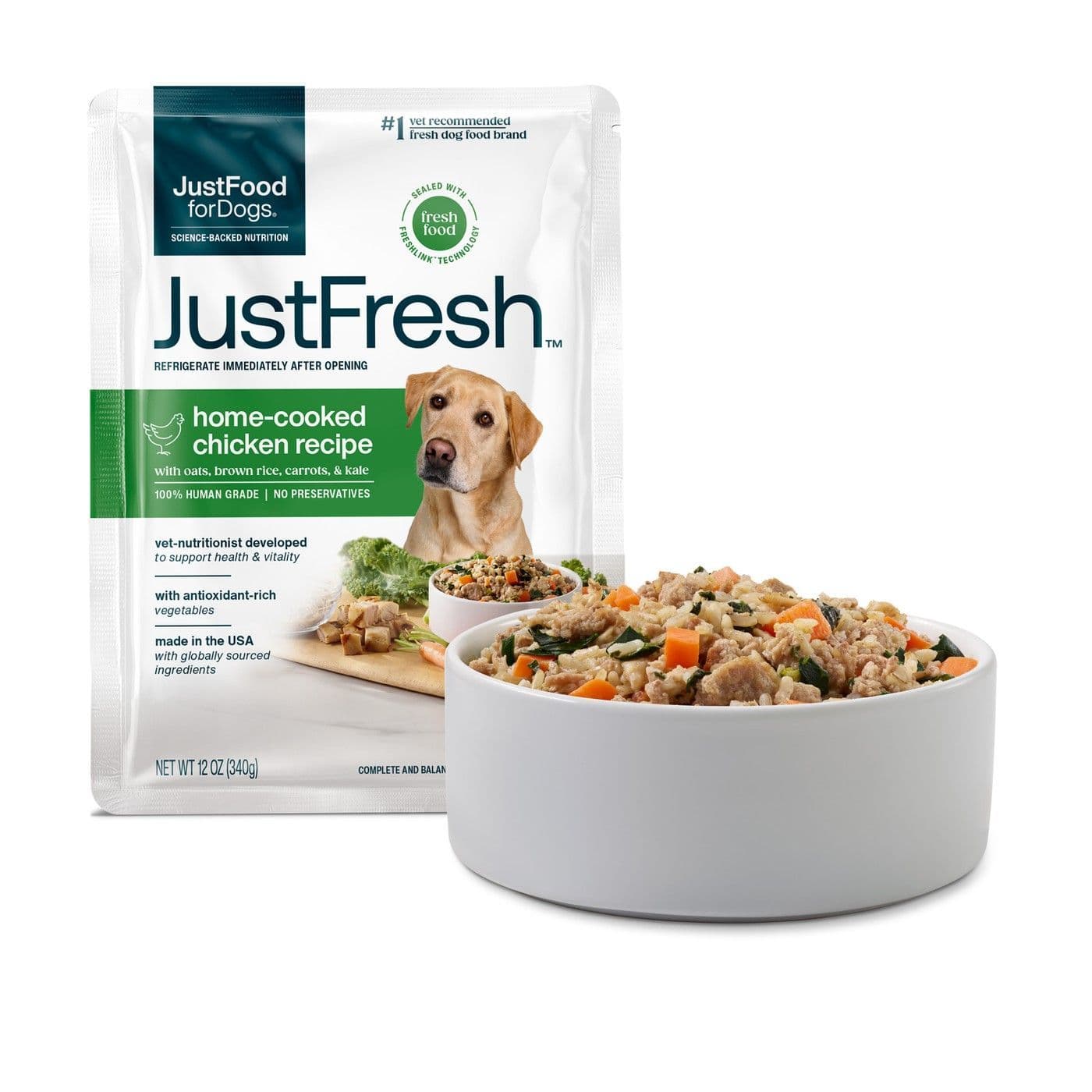
| JustFoodForDogs JustFresh Home-Cooked Chicken | Adult feeding with unopened pantry convenience | Adult maintenance | 36 | Refrigerate after opening; use within three days |
Chicken & Rice: one suitable recipe across several sizes
Chicken & Rice offers a complete fresh option for a growing or adult Poodle. Its current formulation includes chicken, white and brown rice, and vegetables such as kale. The growth statement and 43 calories per ounce provide useful starting facts for choosing and portioning it.
An owner with a toy Poodle and a standard Poodle may be able to use this same suitable recipe for both. Calculate each allowance separately and identify each dog's container. Sharing a food can simplify shopping; it should not mean matching bowlfuls or allowing one dog to finish the other's portion.
Consider it when:
- You want a grain-inclusive fresh recipe.
- Growth eligibility matters for a puppy in the household.
- You can weigh portions and manage frozen storage.
- You want one recipe to compare across different individual calorie needs.
Petful may earn a commission when you click through to JustFoodForDogs, at no extra cost to you.
Fish & Sweet Potato: a fresh fish-based alternative
Fish & Sweet Potato supplies 26 calories per ounce and includes growth, including large-size growth, in its adequacy statement. It offers a different protein and calorie density from the other recipes here. Compare the complete formulation and serving requirements rather than assuming fish is automatically the healthiest protein for every Poodle.
At the same calorie allowance, this recipe produces a larger food weight than Chicken & Rice. That affects package use, bowl space, and storage. It does not mean the dog should receive the same ounce amount simply because both foods are fresh.
Its practical features include:
- A distinct fish-based recipe for a dog that accepts it.
- Growth eligibility for puppies.
- A larger ounce amount for a given calorie allowance.
- Frozen-food handling requirements that need to fit the household.
Petful may earn a commission when you click through to JustFoodForDogs, at no extra cost to you.
Beef & Russet Potato: an adult fresh-food option
Beef & Russet Potato is formulated for adult maintenance and provides 44 calories per ounce. It can suit a mature toy, miniature, or standard Poodle, with the amount calculated individually. Its calorie density is close to Chicken & Rice, but its life-stage eligibility differs.
For a home with an adult Poodle and a puppy, clearly identify the adult's food. A small adult-maintenance serving does not become appropriate for a growing toy puppy because the dog's current weight is low. Life stage and body size answer different questions.
Consider this option when:
- The Poodle is mature and a beef-based recipe fits their feeding history.
- You want a complete adult fresh meal.
- You have freezer and refrigerator space.
- You compare daily cost using the full measured serving.
Petful may earn a commission when you click through to JustFoodForDogs, at no extra cost to you.
JustFresh Home-Cooked Chicken: convenient adult portions
JustFresh Home-Cooked Chicken gives adult Poodle owners a shelf-stable unopened option at 36 calories per ounce. Pantry storage can be useful in a small home or when planning care with another household. Once opened, refrigerate the food and use it within the manufacturer's three-day period.
For a small Poodle, compare daily use with package size before buying. The amount needed may be modest, so opened-food timing matters even when the unopened pack is convenient. Plan from the exact product directions rather than assuming all chicken recipes share the same storage or calorie information.
Check these details:
- Adult-maintenance suitability.
- Calculated daily ounces for the individual dog.
- How much of a package will be used within the opened-use period.
- Whether caregivers can follow the same measuring routine.
Petful may earn a commission when you click through to JustFoodForDogs, at no extra cost to you.
Toy, miniature, and standard Poodles need different portions
Whether Poodles eat a lot depends on the individual allowance and the food's calorie density. A larger serving weight can supply the same calories as a smaller amount of a different recipe.
A three-size comparison works best when it separates nutrition from serving practicality. All three sizes need an appropriate complete diet, but meal weight, bowl access, and the amount stored for a week can differ. Avoid assigning a universal portion to each size name.

A toy Poodle's small serving can be especially sensitive to unmeasured extras. For a standard Poodle, recurring purchase quantity may be the more obvious planning issue. Miniature Poodles do not need an assumed halfway portion: calculate from the individual allowance as you would for either other size.
Compare three household decisions
For a small dog, ask whether you can measure accurately and use opened food within the required period. For a larger dog, check how much stock the allowance requires. For all sizes, confirm comfortable access to food and a consistent routine.
| Size context | Household check | Shortcut to avoid |
|---|---|---|
| Toy | Can the small serving and extras be measured accurately? | An unmeasured spoonful because the dog is tiny |
| Miniature | Does the allowance maintain the individual's intended condition? | Splitting the difference between toy and standard servings |
| Standard | Can the home store the calculated weekly quantity? | Using a large bowl as a guide to calories |
Use repeatable measurements
Put an empty bowl on a food scale and zero it before adding the meal. Use the unit matching your calculation. Record whether the written quantity refers to a whole day or one meal, especially when several people feed the dog.
A feeding note should identify:
- The exact product and its calorie density.
- Daily calories assigned to that food.
- The resulting daily grams or ounces.
- The number of meals and amount per meal.
- Calories reserved for treats or another food.
The WSAVA nutrition resources include body-condition tools to use alongside weight and diet history. Ask your veterinary team to demonstrate an assessment rather than judging through a full Poodle coat or relying only on a scale number.
Selecting complete food for Poodle puppies
A Poodle puppy needs a recipe supporting growth. That remains true whether the puppy is tiny or approaching the size of an adult of another breed. Read the specific food's nutritional adequacy statement before comparing flavors, formats, or front-of-package claims.
The FDA explains complete and balanced pet food through AAFCO nutrient profiles or feeding-test procedures. For a puppy expected to reach a large adult size, check the large-size growth language too. The growth-eligible JustFoodForDogs recipes here explicitly include that category.
- Chicken & Rice and Fish & Sweet Potato are growth-eligible options. Beef & Russet Potato and JustFresh Home-Cooked Chicken are adult maintenance. A puppy's small current size does not turn an adult-only recipe into a growth diet.
Separate meal frequency from daily calories
Young puppies commonly need several meals daily. The AKC's puppy feeding timeline describes moving from four meals toward three during the three-to-six-month period and toward two as dogs mature. Very small puppies need particular attention to scheduling; confirm the individual plan with your veterinarian before reducing frequency.
More meals mean dividing the daily allowance into more parts, not multiplying the daily amount. Record a caregiver's meal so another person does not unknowingly repeat it. A written schedule helps during the busy first weeks in a new home.
Collect the existing routine from the breeder or rescue:
- Current recipe and daily amount.
- Established meal times.
- Recent weights and growth information.
- Any planned food change or veterinary instruction.
Reassess at maturity
Toy and standard Poodles may move to adult feeding at different points. Ask your veterinarian to assess maturity and condition. Do not make the switch because a puppy reaches a convenient package-size threshold or because another Poodle changed at that age.
If the food suits all life stages, adulthood may call for a portion review rather than a new recipe. When choosing adult-maintenance food, compare the new calorie density and follow transition guidance. Changing the product should not accidentally change the total calories.
Adult and senior Poodle feeding decisions
What adult Poodles eat should be a complete diet that fits their life stage and measured allowance. Review eating habits alongside body condition, activity, and the exact recipe.
An adult Poodle's activity, body condition, and individual needs should guide the allowance. A toy Poodle can be energetic, and a standard Poodle can have a relatively quiet routine. Size categories do not describe how much exercise the dog actually gets.

Use the current routine as a baseline, then review sustained changes. An occasional long outing differs from a new regular activity pattern. Training rewards, a chew, and a family member's spoonful can also change the total even when the main meal is carefully measured.
Keep one household allowance
The AAHA nutrition and weight-management guidelines discuss diet history, body condition, and calories from extras. Treats and other additions should generally stay within 10 percent of daily calories. Establish the main-food amount after accounting for those extras.
Make the routine easy to follow:
- Set aside the day's reward allowance.
- Identify which person serves each meal.
- Record changes in appetite, weight, or activity.
- Review the amount rather than continually topping up the bowl.
Measure meals instead of losing track through free feeding
Free feeding can make it harder to know how much an individual Poodle has eaten, especially when dogs share a home. A measured daily allowance divided into the agreed meals provides a clearer record. For fresh food, also follow the product's opened-food and handling instructions rather than treating the bowl as a supply to leave available indefinitely. Record uneaten food if intake becomes a concern.
Revisit convenience as the dog gets older
Older Poodles may benefit from practical changes in texture or serving routine, but age alone does not establish a special diet. Assess condition and health needs with your veterinarian. A soft fresh format can be convenient without being described as treatment for dental or other disease.
For life-stage context, see Petful's Poodle lifespan guide. If eating becomes difficult or appetite changes unexpectedly, investigate the cause. Food shopping should follow the findings rather than replace that assessment.
Portion calculations and budget by Poodle size
The same calorie-density calculation works for toy, miniature, and standard Poodles: calories assigned to the food divided by calories per ounce gives daily ounces. The individual allowance is the starting point. A size name does not supply that number.
These examples use 250, 500, and 1,000 daily calories solely to show the arithmetic. They are not assigned recommendations for toy, miniature, and standard Poodles. The actual allowance depends on life stage, body condition, activity, and a suitable feeding assessment.
| Assumed daily main-food allowance | Chicken & Rice at 43 calories per ounce | Fish & Sweet Potato at 26 calories per ounce |
|---|---|---|
| 250 calories | About 5.8 ounces | About 9.6 ounces |
| 500 calories | About 11.6 ounces | About 19.2 ounces |
| 1,000 calories | About 23.3 ounces | About 38.5 ounces |
The comparison demonstrates a useful product difference. Chicken & Rice and Fish & Sweet Potato can each be appropriate complete options, while their meal weights differ at the same calories. Choose the recipe's fit, then calculate its amount.
Reserve room for treats first
Suppose the established daily allowance were 500 calories and you reserved 50 for treats. The main-food allowance would be 450, not 500 plus treats. At 43 calories per ounce, that example provides about 10.5 ounces of Chicken & Rice across the day.
Split the daily amount into the agreed schedule. For an adult eating twice daily, each meal would be about half. These numbers illustrate a method; they do not determine the right allowance or frequency for your Poodle.
Compare daily cost using current package information
On September 28, 2026, JustFoodForDogs displayed a regular list price of $153.99 for fourteen 18-ounce Chicken & Rice packs, or 252 ounces total. That works out to about $0.61 per ounce. The displayed regular Fish & Sweet Potato price for the same total ounces was $167.99, or about $0.67 per ounce. These are observed list prices, not a guaranteed checkout total; shipping and tax are excluded, and prices can change.
Using the assumed 500-calorie main-food allowance above, Chicken & Rice would cost about $7.11 daily, while Fish & Sweet Potato would cost about $12.82 daily. The difference reflects both the price per ounce and the food weight supplying those calories. A similar package price therefore does not necessarily produce a similar daily feeding cost.
Check your actual purchase and portion assumptions:
- The exact recipe, package size, and displayed regular price.
- Calories assigned to that food after treats or other foods.
- Whether a promotion changes only the first order.
- Shipping, tax, and any other food costs omitted from the comparison.
Check package use as well as budget
At an assumed 250-calorie allowance, Chicken & Rice's approximately 5.8-ounce daily serving would make an 18-ounce pack last about 3.1 days. At an assumed 1,000-calorie allowance, the roughly 23.3-ounce daily serving would require more than one such pack each day. Neither example assigns a calorie need to a Poodle size; they show why the same package creates different routines.
Use the product's current thawing and opened-use instructions to plan what becomes ready at one time. A weekly order can remain frozen in separate packs while you thaw the portion needed next. Do not use the total order's feeding duration as the opened-use period for one pack.
Before ordering, record:
- Daily ounces and days of food needed.
- Actual ounces per package.
- Whole packages required after rounding up.
- Space for unopened and opened food.
- Whether the opened-use period fits daily consumption.
The Petful Poodle cost guide places regular food spending among other ownership costs. Keeping the feeding calculation separate makes it easier to update as a puppy matures or a dog's routine changes.
Fresh, dry, wet, and homemade Poodle food
Format affects moisture, texture, energy density, and storage. It does not establish nutritional adequacy on its own. Compare the complete recipe and life-stage statement before choosing the texture or handling routine you prefer.
Petful's food-label guide can help you examine the actual label. Words such as natural, clean, and no fillers do not replace adequacy statements, calorie information, or a clear explanation of the product's feeding purpose.
Compare wet and dry measurements fairly
Moist food often requires a different serving weight from dry food at the same calorie intake. Do not replace one cup or spoonful with another by appearance. Calculate from the old food's calories in the amount served and the new food's calories in its labeled unit.
Guaranteed-analysis percentages also need context when moisture differs. The FDA describes dry-matter comparison by subtracting moisture percentage from 100, dividing the listed nutrient percentage by that remainder, and multiplying by 100. A higher protein percentage alone still does not establish the best recipe for an individual Poodle.
Compare formats using these questions:
- Is this exact recipe complete for the dog's life stage?
- What amount provides the intended calories?
- Can the dog comfortably eat the texture?
- Can the household store opened food as directed?
Put grain claims in context
Chicken & Rice offers a grain-inclusive formula, while Fish & Sweet Potato is described as grain-free. That difference lets owners identify the recipes clearly; it does not establish that either is better for all Poodles. Both need to be evaluated as complete formulations with their own life-stage and calorie information.
A grain ingredient is not automatically a filler, and removing grains does not by itself prove improved nutrition. Compare the full recipe and the individual dog's needs. If a veterinarian has recommended a particular ingredient restriction, use that specific guidance when reading labels instead of inferring a restriction from a curly coat, tear staining, or a broad online claim about the breed.
Make fresh feeding work at home
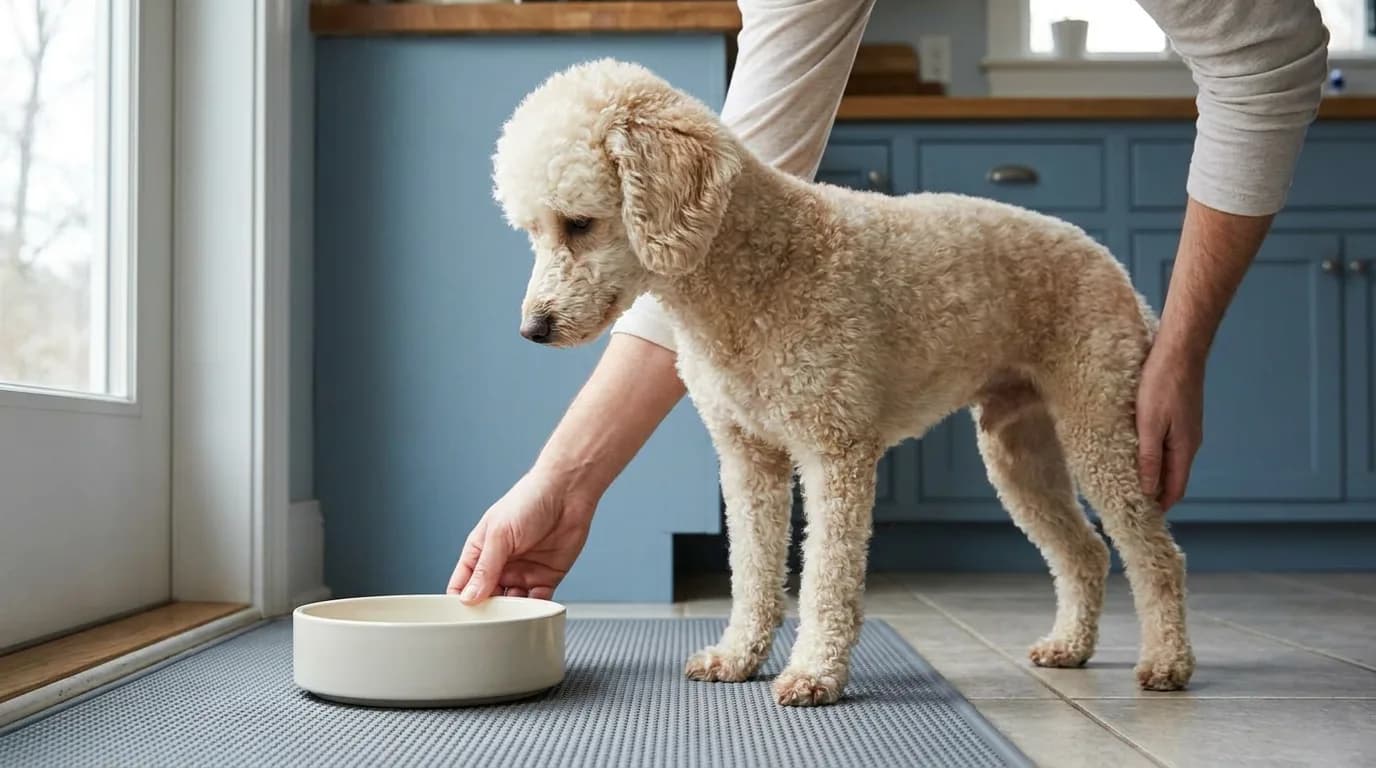
Fresh Frozen meals require frozen storage and refrigerator thawing. For a small Poodle, consider how long the measured serving makes a package last. For a larger dog, calculate the stock needed before discovering at delivery that there is too little space.
An adult household can compare JustFresh Home-Cooked Chicken for unopened pantry storage. Use its own calorie density and opened-use instructions. This is a concrete convenience difference, not a claim that storage format makes one complete food inherently healthier.
Distinguish preference from a feeding problem
A Poodle may prefer a particular texture, temperature within safe handling guidance, or feeding location. Keeping a calm, consistent routine gives you a clearer picture of what the dog accepts than changing several ingredients and treats at once. Record what is actually eaten instead of repeatedly refilling the bowl.
A sudden appetite change, discomfort, or persistent refusal deserves veterinary assessment. Those situations are different from an ordinary shopping preference. A fresh recipe can offer a useful format option, but a change of food should not be presented as the answer to an unexplained eating problem.
Share calories when combining two complete foods
If you combine an appropriate fresh meal with another suitable complete food, allocate the daily calories between them. For example, half of an assumed 500-calorie allowance would assign 250 calories to each food. Chicken & Rice's share would be about 5.8 ounces, while the other food's quantity would come from its own calorie information. The ratio is an example, not a required feeding split.
This is especially helpful when two Poodles share shopping but have different preferences. One dog might receive a full fresh-food routine and another a measured combination. Give each dog a separate written plan and bowl rather than estimating from the other dog's serving. A topper labeled for supplemental feeding has a different role from a complete main food, so check that distinction before deciding how much of the daily diet it will provide.
Separate home cooking from complete nutrition
Homemade food needs a properly formulated recipe if it supplies the whole diet. Plain meat, rice, or eggs do not automatically provide a balanced daily meal. Follow professional formulation advice rather than freely substituting ingredients or omitting required supplements.
Petful's guide to vet-approved homemade dog food provides more context. Commercially prepared complete fresh food is another route: owners select an eligible labeled formula and concentrate on portions and handling. That is the practical role of the JustFoodForDogs options here.
Check the whole raw-feeding choice
Raw food is separate from fresh cooked food. The FDA's raw pet-food guidance discusses microbial risks to pets and people. A preference for fresh meals does not require a raw diet.
When comparing a raw product with a cooked meal, first check whether the exact product is complete for the Poodle's life stage. Raw meat alone does not establish a balanced diet, and a growing toy Poodle still needs growth-appropriate nutrition. Then compare the handling routine your household can maintain. A labeled complete cooked recipe such as Chicken & Rice offers a different route with its own adequacy statement and measured serving.
Frequently asked questions
There is no single number one food that Poodles should never eat while all other foods are safe. Several human foods can be dangerous. Poodles should not receive toxic foods such as chocolate, grapes, raisins, or products containing xylitol. The ASPCA's toxic-food guidance is a useful reference. Treats and plain table foods also should not replace balanced daily nutrition. After a suspected toxic exposure, contact a veterinarian or animal poison service promptly instead of waiting for symptoms.
The best fit is a complete balanced food appropriate to the individual life stage and served in an appropriate amount. Chicken & Rice and Fish & Sweet Potato provide growth-eligible fresh choices; Beef & Russet Potato and JustFresh Home-Cooked Chicken offer adult alternatives. Texture, storage, calorie density, and feeding history help determine the choice without assuming every Poodle needs one identical diet.
Evaluate the exact recipe rather than treating the brand name as a nutritional adequacy statement. JustFoodForDogs offers several options with clear recipe-specific life-stage and calorie information, making it useful to consider for fresh feeding. Verified recipe suitability and individual needs still determine the fit. A puppy and an adult may need different selections within the same brand.
Plain cooked egg can be an occasional addition for a dog that tolerates it, but it is not a complete main meal. Keep additions within the allowance for extras, avoid unnecessary added fat or seasoning, and account for their calories. Complete food should supply the main nutrition. Ask your veterinarian about additions if your Poodle has individual dietary restrictions.
No single meat establishes the healthiest complete diet for every dog. Whole-recipe balance, individual tolerance, and life-stage adequacy matter more than ranking chicken, beef, or fish in isolation. The JustFoodForDogs options here use different proteins within complete formulations. Compare those full recipes and their intended feeding purpose rather than attempting to build a balanced diet from a meat choice alone.
Rice and eggs alone are a nutritionally incomplete combination for the full daily diet. They do not replace a formulated complete recipe. To cook regularly, obtain an appropriately formulated plan and follow it consistently, including required supplements. If rice and eggs are occasional additions to complete food, count their calories within the allowance for extras and respect individual dietary restrictions.
A food change cannot be promised to remove tear stains. Facial staining alone does not establish a food allergy or identify the right diet. Maintain suitable complete nutrition and discuss persistent staining, irritation, or other eye concerns with your veterinarian. Food selection should follow individual findings; a recipe comparison cannot offer a guaranteed cosmetic result or a diagnosis from coat condition.
Extra calcium is not a routine addition to an already complete growth diet. The balance of the whole recipe matters, and future size does not make indiscriminate supplementation appropriate. Choose a growth-eligible food, check relevant large-size growth wording, and ask your veterinarian before adding supplements. Follow the complete recipe rather than trying to strengthen it with an unneeded mineral addition.

Coreen Saito is a pet writer and longtime shelter volunteer with more than a decade in animal rescue. She covers cat behavior, breed care, and the small, ordinary science of sharing a life with companion animals, with a particular focus on honest takes about the products and decisions that actually matter. At home in Arizona, she's outranked by Mac (a dog with the loudest opinion in the house), Rebel (a cat who governs by quiet authority), and Meri (an orange tabby who runs the late shift and the laundry basket). She writes about all three, plus the rescues that keep coming through her life, at LifeWithMinty.com.
Sign up for expert-backed reviews and safety alerts all in one place.
A Final Word (Disclaimer)
At Petful, our review integrity is paramount; we never exchange special treatment in our reviews for monetary or material rewards.
Nonetheless, when our readers click through to online merchants (including Chewy or Amazon), we receive a referral commission. This supports the running of our free blog, and we appreciate your backing.