Best Dog Food for Great Danes: Puppy and Adult Options
Compare JustFoodForDogs meals for Great Dane puppies and adults, with growth-label checks, practical serving calculations, package-use examples, storage planning, and current feeding costs.
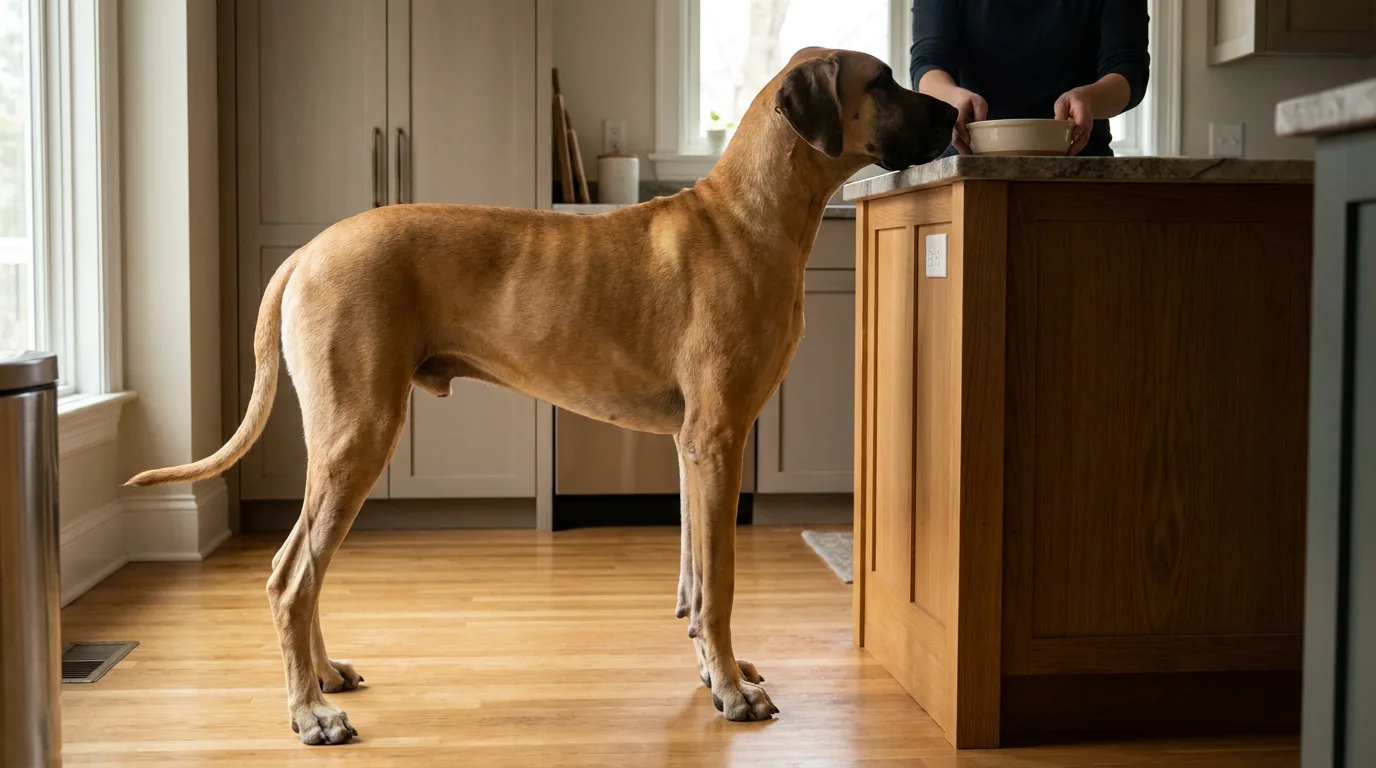
An adult fawn Great Dane stands beside a kitchen counter.
Petful is reader supported. As an affiliate of platforms like Amazon and Chewy, we may earn a commission when you buy through links on this page. There is no extra cost to you.
This article is sponsored by JustFoodForDogs. Petful maintains editorial control and may earn a commission from qualifying purchases, at no extra cost to you.
The best dog food for Great Danes needs to match two different realities: a puppy is still growing into a giant body, while an adult may need a substantial quantity of food every day. Start with the exact recipe's nutritional adequacy statement, then compare the amount, storage space, and ongoing cost of serving it.
JustFoodForDogs offers complete fresh meals that make those decisions straightforward. Chicken & Rice and Fish & Sweet Potato include large-size growth in their life-stage statements. Beef & Russet Potato and JustFresh Home-Cooked Chicken are adult-maintenance choices. All four publish calorie information, so you can plan by the dog's actual needs instead of guessing from a large bowl.
For a Great Dane puppy, verify that the food includes growth of large-size dogs. For an adult, compare complete recipes at the same individual calorie allowance. A lower-calorie-per-ounce food requires more ounces, which changes meal volume, package use, storage, and cost.

Sign up for expert-backed reviews and safety alerts all in one place.
Food options for Great Dane puppies and adults
Chicken & Rice is a practical starting choice for a grain-inclusive fresh food that covers growth and adulthood. Fish & Sweet Potato offers a fish-based, grain-free alternative with a different serving weight. For adults, Beef & Russet Potato adds another complete recipe, and JustFresh Chicken suits households that value unopened pantry storage.
Our comparison uses current manufacturer labels, ingredient information, and transparent serving calculations. We did not conduct a hands-on feeding trial. The recommendations identify useful recipe differences rather than claiming a universal veterinarian endorsement or one best food for every Great Dane.
| Food | Reason to consider it | Life-stage statement | Calories per ounce | Household planning point |
|---|---|---|---|---|
| Chicken & Rice Fresh Frozen | Grain-inclusive starting choice | All life stages, including large-size growth | 43 | Plan freezer space and refrigerated meals |
| Fish & Sweet Potato Fresh Frozen | Fish-based alternative | All life stages, including large-size growth | 26 | More ounces supply the same calories |
| Beef & Russet Potato Fresh Frozen | Complete beef-based adult meal | Adult maintenance | 44 | Close to Chicken in calories per ounce |
| JustFresh Home-Cooked Chicken | Unopened pantry convenience | Adult maintenance | 36 | Refrigerate after opening; use within three days |
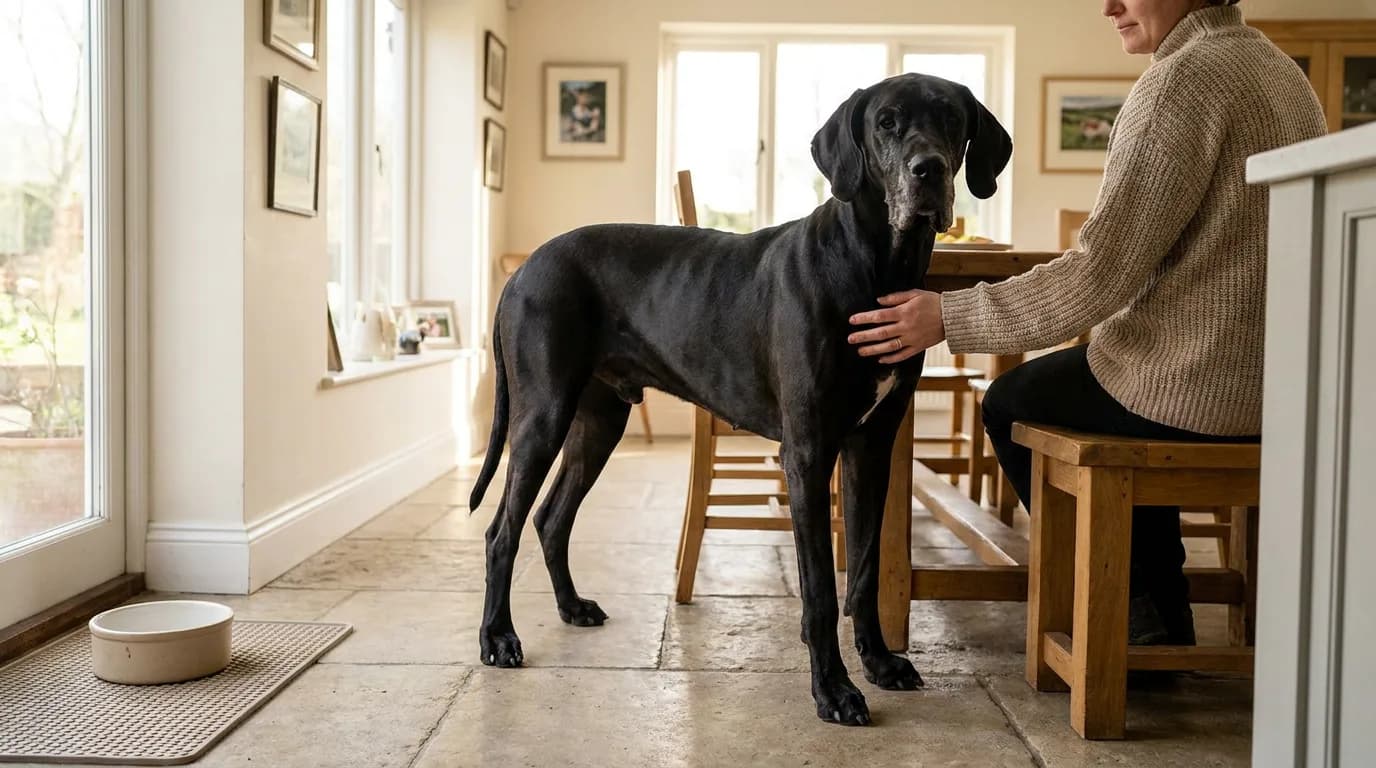
JustFoodForDogs Chicken & Rice: A grain-inclusive starting choice
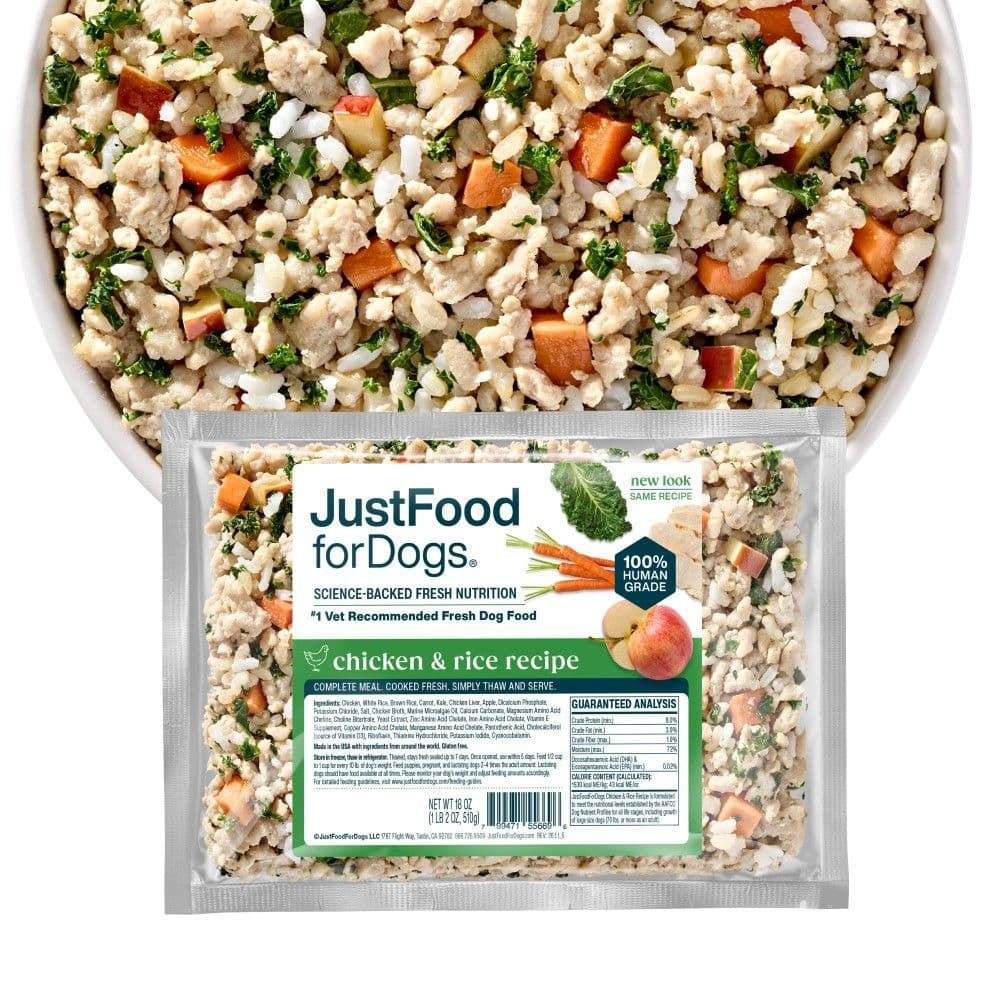
Chicken & Rice combines chicken thigh and liver with white and brown rice, plus ingredients such as carrots, kale, and apples. Its current nutritional statement covers all life stages, including growth of large-size dogs expected to weigh 70 pounds or more as adults. That makes it a relevant fresh-food option to discuss for a Great Dane puppy as well as a mature dog.
At 43 calories per ounce, Chicken gives you a useful starting point for meal planning. An illustrative adult allowance of 2,000 food calories would require about 46.5 ounces a day. The number shows the amount involved; it is not a recommendation that every Great Dane receive 2,000 calories.
- Consider it when you want a complete, grain-inclusive chicken meal.
- Use its calorie density to work out daily weight and freezer turnover.
- Keep the puppy's individual portion separate from any adult example.
The practical advantage is continuity of an eligible recipe across life stages when it continues to suit the dog. A growing puppy's amount can change without the family assuming that adulthood automatically requires a new flavor. The feeding plan still needs periodic review as growth and activity change.
Petful may earn a commission when you click through to JustFoodForDogs, at no extra cost to you.
JustFoodForDogs Fish & Sweet Potato: A fish-based choice with a larger serving weight
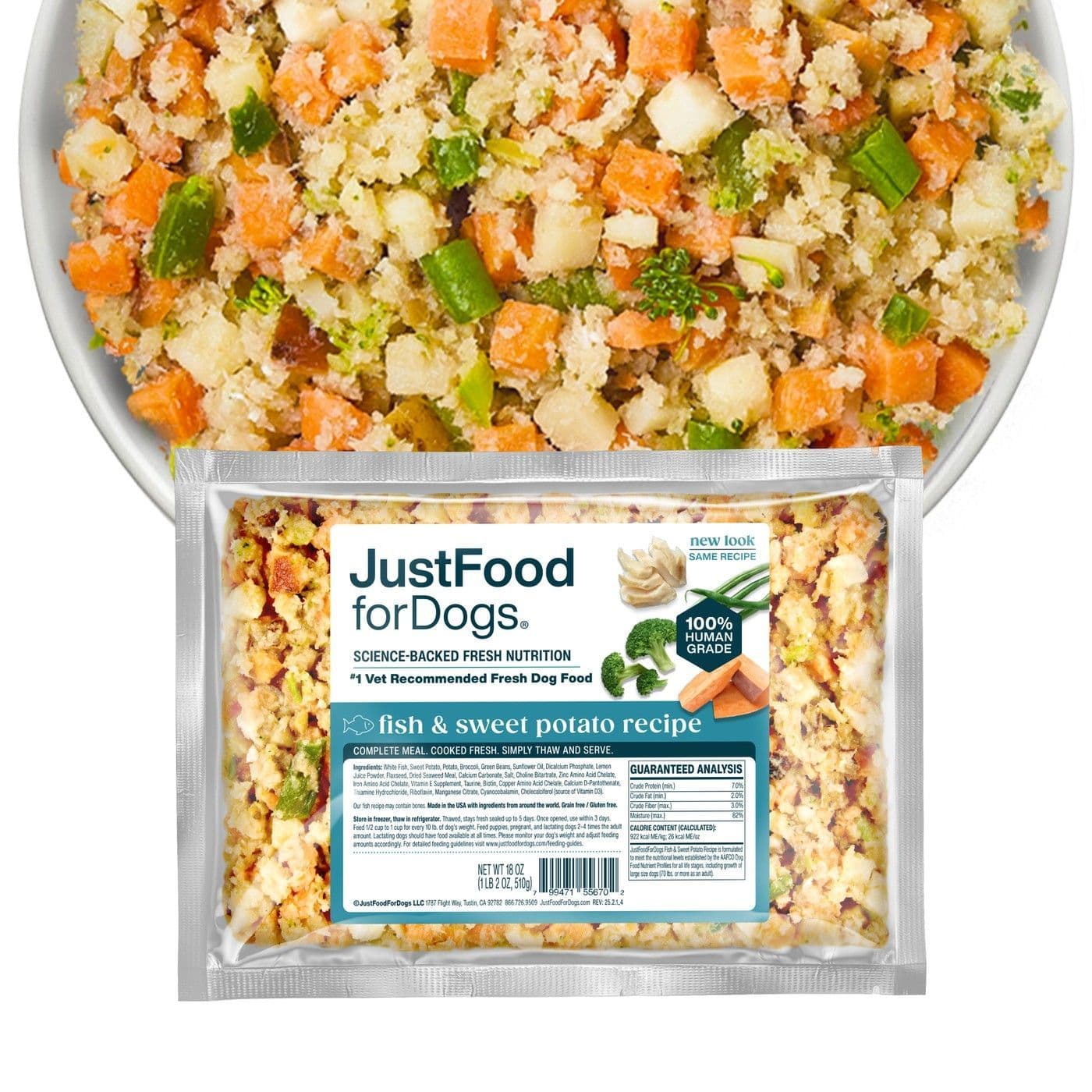
Fish & Sweet Potato uses whitefish with sweet potatoes, russet potatoes, green beans, and broccoli. Its current label also includes large-size growth, providing another complete fresh option for the puppy-to-adult comparison. It is grain-free, an ingredient-format choice rather than a claim that Great Danes need to avoid grains.
Its 26 calories per ounce make the practical difference clear. At the same illustrative 2,000-calorie food allowance, Fish requires about 76.9 ounces a day, compared with 46.5 ounces of Chicken. A family interested in a fish-based recipe should account for that larger serving weight when assessing containers, freezer space, and deliveries.
- Consider it when a fish-based complete recipe fits the dog's established preferences.
- Compare the same number of calories before judging the price of a package.
- Check whether the household can store and serve the resulting quantity consistently.
The larger portion is neither a nutritional disadvantage nor proof of greater satisfaction. It is a planning fact. Fish can be a good fit when the ingredients and complete-food label suit the dog and the family's storage routine supports the amount needed.
Petful may earn a commission when you click through to JustFoodForDogs, at no extra cost to you.
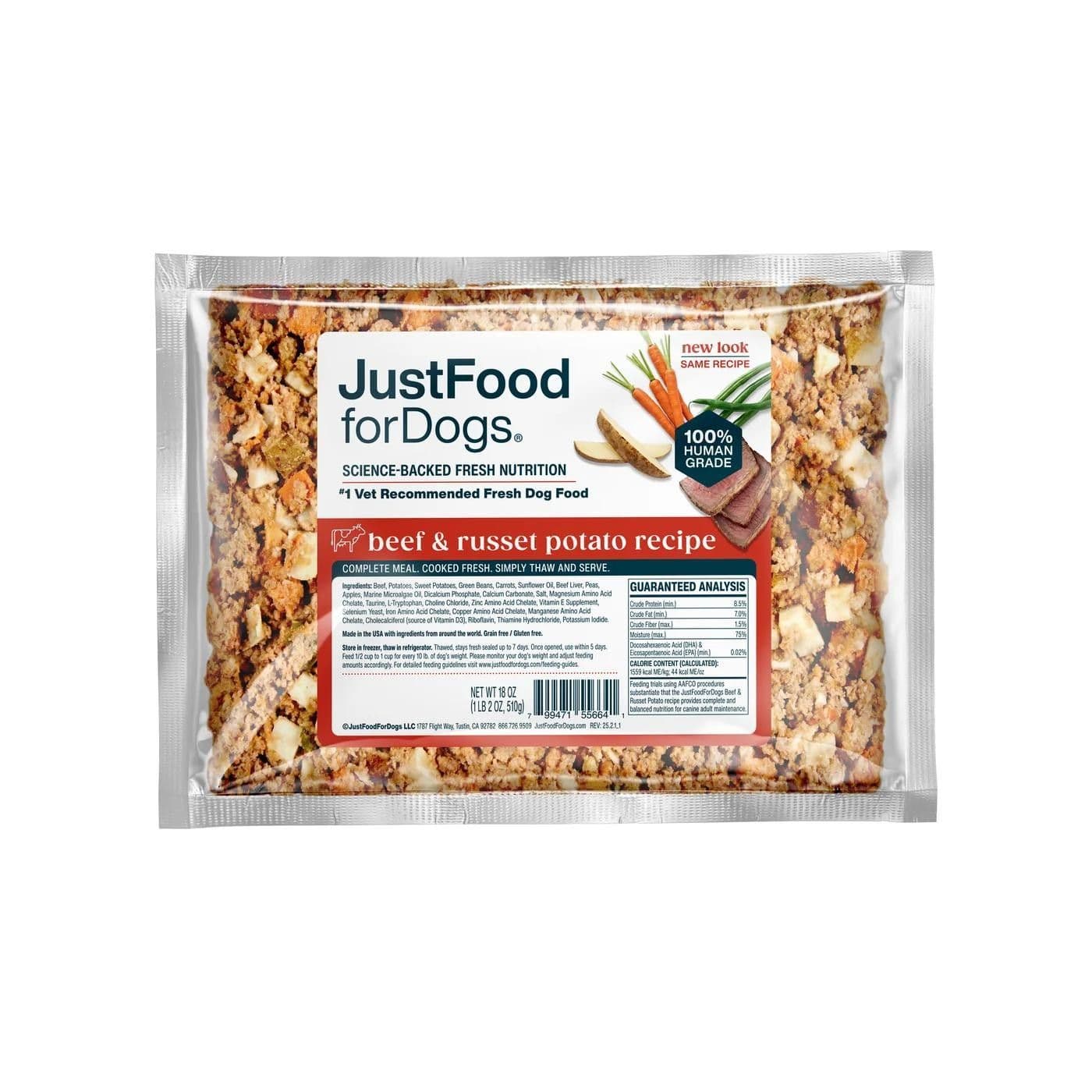
JustFoodForDogs Beef & Russet Potato: Another complete adult meal
Beef & Russet Potato provides a beef-based choice for adult Great Danes. Its current product information identifies adult maintenance, so this selection belongs in the mature dog's shortlist. It is not the puppy choice within this comparison.
At 44 calories per ounce, it is close to Chicken's calorie density. An assumed 2,000-calorie food allowance comes to approximately 45.5 ounces of Beef. That similarity can make adult meal planning easier to compare, although it does not mean the same measured scoop supplies identical calories.
- Consider it for an adult whose routine suits a complete beef-based fresh meal.
- Recalculate the daily weight when changing recipes, even when the densities are close.
- Compare the current package and price before extending Chicken's budget example to Beef.
For a household deciding between Chicken and Beef for an adult, ingredients and the dog's experience with the food may matter more than the small difference in ounces. The useful outcome is a complete meal you can portion reliably and keep in stock, not a rotation undertaken simply because the dog is large.
Petful may earn a commission when you click through to JustFoodForDogs, at no extra cost to you.
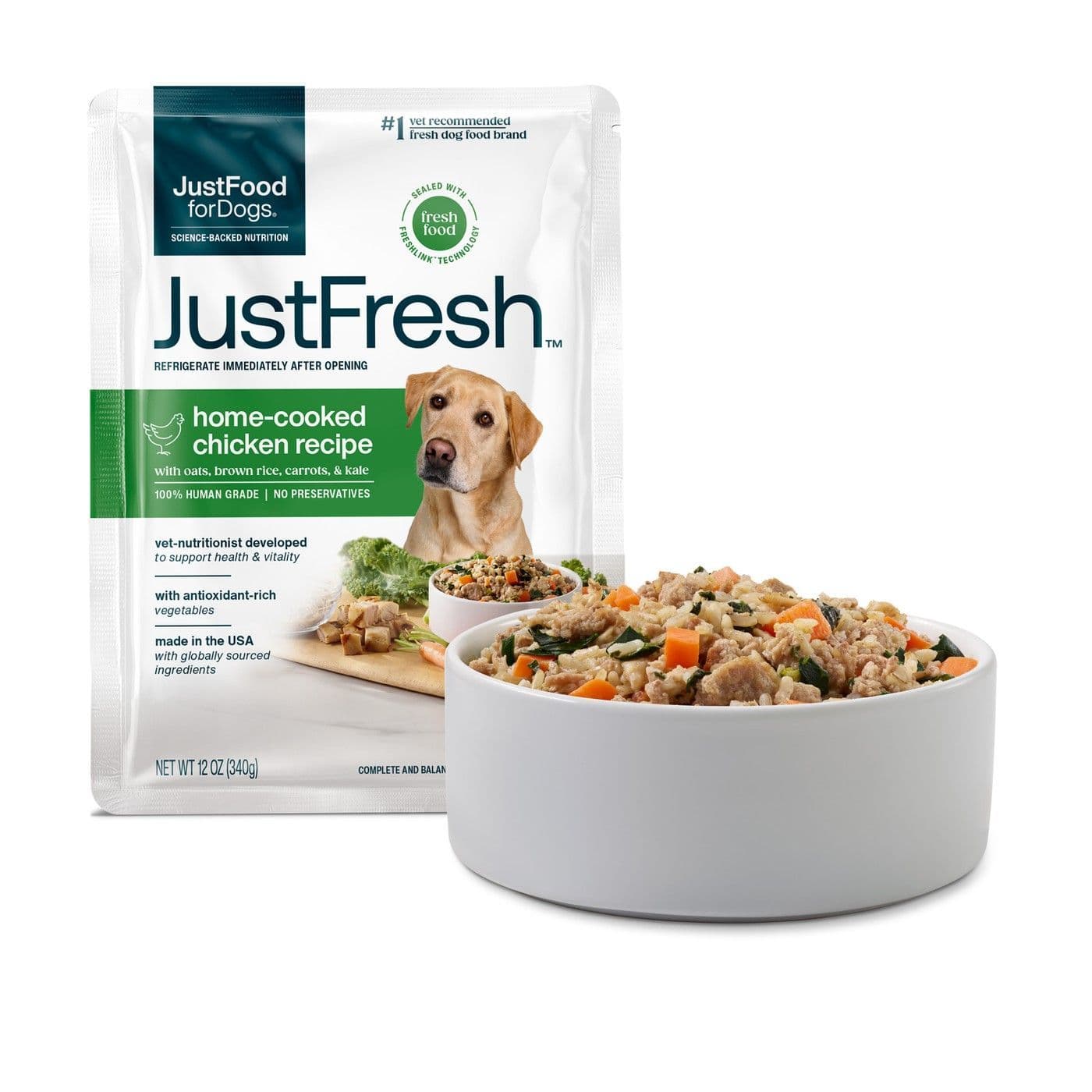
JustFresh Home-Cooked Chicken: An adult option for unopened pantry storage
JustFresh Home-Cooked Chicken offers a different storage format. Unopened packages can be kept without freezer space, making the food worth considering for an adult Great Dane when cold-storage capacity is the main obstacle to serving prepared meals. The current label and directions identify adult maintenance and 36 calories per ounce.
At an assumed 2,000 food calories, the daily amount is approximately 55.6 ounces. Work from the actual package size you purchase to determine how many packages that uses. A pantry-friendly format still needs enough shelf space for the dog's consumption and the delivery interval.
- Consider it for adult feeding when unopened pantry storage simplifies the routine.
- Refrigerate the food after opening and use it within three days.
- Plan the opened remainder separately from the unopened supply.
JustFresh Chicken can also simplify an adult dog's travel or sitter plan when unopened packages are convenient to transport. Confirm refrigeration at the destination before opening. Its storage advantage does not change its adult-only role in this puppy-and-adult guide.
Petful may earn a commission when you click through to JustFoodForDogs, at no extra cost to you.
Check the large-size growth label for Great Dane puppies
A Great Dane puppy needs food appropriate for growth into a large adult. Read the nutritional adequacy statement on the exact recipe, including any wording about large-size dogs. The FDA explains adequacy through AAFCO nutritional profiles or feeding trials. Its explanation of complete and balanced pet food distinguishes growth from adult maintenance; the front of a bag or a photograph of a big dog cannot replace that statement.
- Chicken & Rice and Fish & Sweet Potato include large-size growth in the current statements reviewed here. Beef & Russet Potato and JustFresh Chicken are adult maintenance. Feeding an adult-only food is not a way to manage how quickly a giant-breed puppy grows.
The decision at eight weeks, three months, and six months
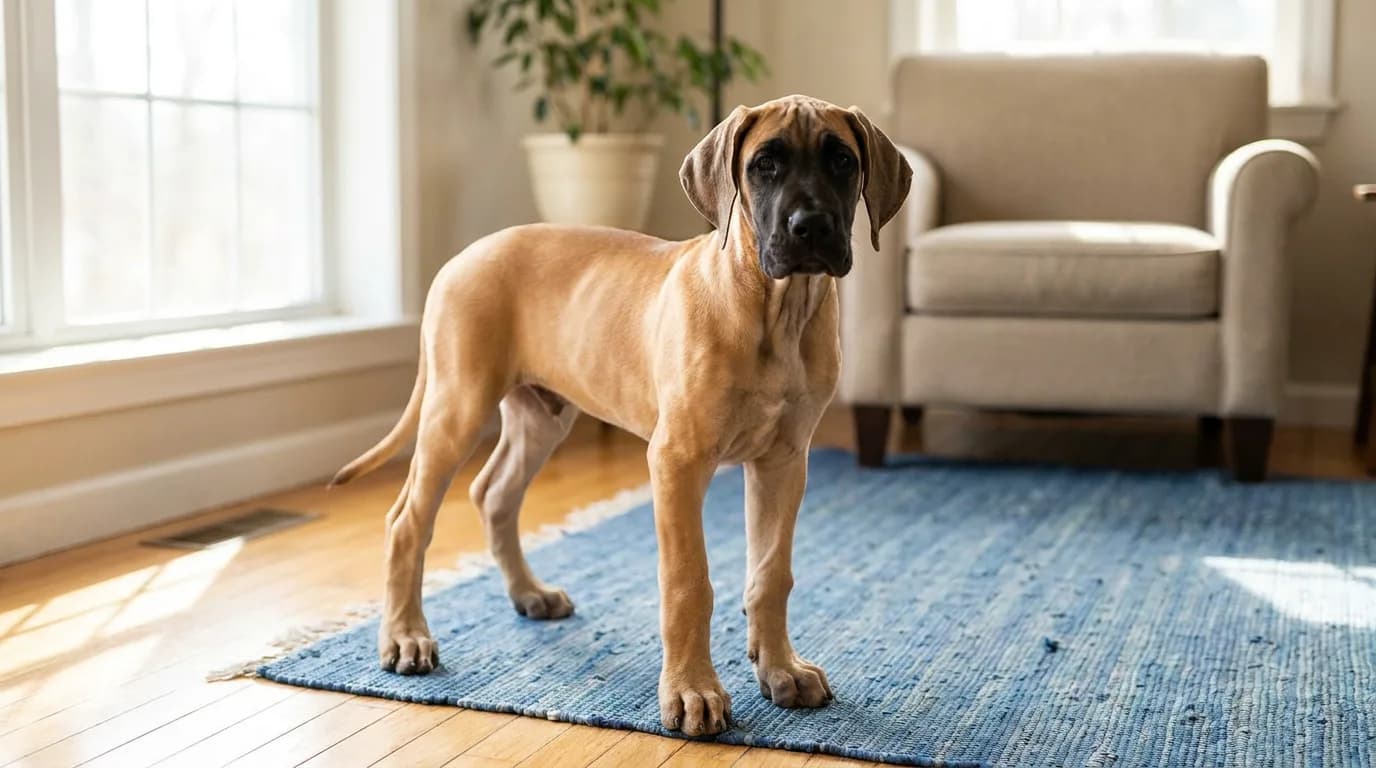
At each of these ages, the food-selection question remains growth suitability. What changes is the individual puppy's size, growth pattern, appetite, and appropriate daily quantity. An eight-week-old puppy and a six-month-old puppy should not receive the same amount simply because they eat the same recipe.
When bringing a puppy home, collect the exact food name, daily quantity, number of meals, and recent weight information from the previous caregiver. This provides a usable starting record for the first veterinary visit. If you decide to change food, a planned transition is easier to follow when the existing routine is documented.
- Record the complete recipe name, not just the brand.
- Ask whether the stated quantity is for one meal or the entire day.
- Check whether treats and training food were included in that amount.
- Keep the nutritional adequacy statement with the feeding information.
Petful's Great Dane growth chart provides breed-growth context. Use it to understand development alongside your veterinarian's assessment, rather than converting an average chart weight into a mandatory food amount. A puppy's growth record is more useful when it is paired with the food and portion actually being served.
Read the statement beyond the words “all life stages”
The important puppy check is whether the statement includes growth of large-size dogs, or excludes it. Those are materially different uses even if the rest of the packaging looks similar. The current Chicken and Fish statements reviewed for this article include that growth category; keep checking the current package when ordering because the exact recipe is the decision unit.
Also distinguish a complete food from a product intended for intermittent or supplemental feeding. A topper may add variety without being formulated to supply all of a growing puppy's nutrition. A complete meal offers a different role, even when both products are sold as fresh food or come from the same company.
If the package wording is unclear, ask the manufacturer for the nutritional adequacy statement for that exact product and share it with the puppy's veterinarian. Save the response with the feeding record. This is more useful than relying on a customer review that mentions another owner's Great Dane without giving its age, feeding amount, or exact food.
Calculate a puppy serving from an individual allowance
Start with an appropriate calorie allowance established for the individual puppy, using the food's directions and veterinary guidance. Then convert that allowance using the recipe's published energy density. A calculator can help with arithmetic, but it cannot independently decide whether the puppy's growth, body condition, or current feeding plan is appropriate.
For example, suppose a puppy's established allowance from its complete food is 900 calories a day. This is a calculation example only, not an age-based Great Dane recommendation. Chicken's published 1,530 calories per kilogram equal 1.53 calories per gram, so 900 divided by 1.53 is approximately 588 grams a day.
- If that puppy's plan uses three equal meals, each meal would be about 196 grams.
- If the individual plan changes to a different calorie allowance, redo the calculation.
- If you change recipes, replace 1.53 with the new food's calories per gram.
This method answers “how much” with a reproducible serving instruction instead of an unsupported universal number of cups. Record both daily grams and grams per meal. A note saying only “196 grams” leaves a sitter unable to tell whether that is the day's food or a single feeding.
Keep meals regular while growth changes
The AKC's puppy-feeding guidance describes four meals for young puppies, a move toward three during roughly three to six months, and two as dogs mature. Confirm the appropriate schedule for your Great Dane puppy rather than changing meal frequency solely because an online age chart reaches a new row.
Splitting a day's food into more meals does not mean adding another day's worth of food. If the daily allowance stays the same while the schedule changes from four meals to three, divide that same allowance by three. Keep training rewards inside the plan so the total is visible.
Review the portion as the puppy grows. The same serving that was appropriate several weeks earlier may no longer fit, but a bigger body is not a reason to make arbitrary increases. Bring the record of weights, daily intake, and any feeding difficulty to routine veterinary visits so adjustments have a clear basis.
Large portions do not mean faster growth
The goal is appropriate growth and good body condition, not reaching an adult size as quickly as possible. A giant puppy can look impressively tall while still needing a carefully managed growth diet. Choosing a food because it has a lower protein number, adding extra calcium, or using adult-maintenance food to “slow growth” bypasses the more useful question: is the complete recipe suitable for large-size growth?
Do not add calcium supplements to a complete growth food unless the puppy's veterinarian specifically directs it. The AKC's breed-based puppy nutrition guidance explains why large-breed growth needs particular attention. Petful's discussion of why large dogs need appropriate food provides additional context for choosing by life stage rather than simply buying more food.
Protein is one part of the whole recipe
Neither “high protein” nor “low protein” is a complete Great Dane feeding strategy. Check overall nutritional adequacy, calories, and the amount being served. A food's protein percentage does not tell you the correct daily portion or whether the recipe includes the appropriate balance for a growing giant dog.
Comparing percentages across formats also requires care. Fresh food contains more moisture than dry food, so a lower protein percentage on the label does not automatically mean less protein on a dry-matter basis. The FDA's pet-food labeling guidance explains how to account for moisture when comparing guaranteed analyses.
- For a hypothetical food with 8% protein and 75% moisture, dry matter is 25%, and 8 divided by 25, multiplied by 100, equals 32% protein on a dry-matter basis. This illustrates the comparison method, not a target protein level for a Great Dane. The growth statement still comes first for a puppy.
Measure the plan instead of chasing a bowl size
A serving that looks small in a giant bowl may still supply the intended calories. Conversely, a full bowl does not prove that the food supplies an appropriate amount. Use a kitchen scale and the food's calorie information to turn the daily plan into a repeatable weight.
Once the food has been measured, the bowl becomes a practical serving tool. Choose a dish with enough capacity for the meal and a setup the dog can use comfortably. A larger bowl is not permission to increase the portion until the empty space disappears.
Choosing an everyday food for an adult Great Dane
For a mature Great Dane, start with a complete food suited to adult maintenance and the dog's individual routine. All four recipes in the comparison can be considered for adult feeding. Chicken, Fish, and Beef offer fresh frozen choices; JustFresh Chicken provides the unopened pantry option.
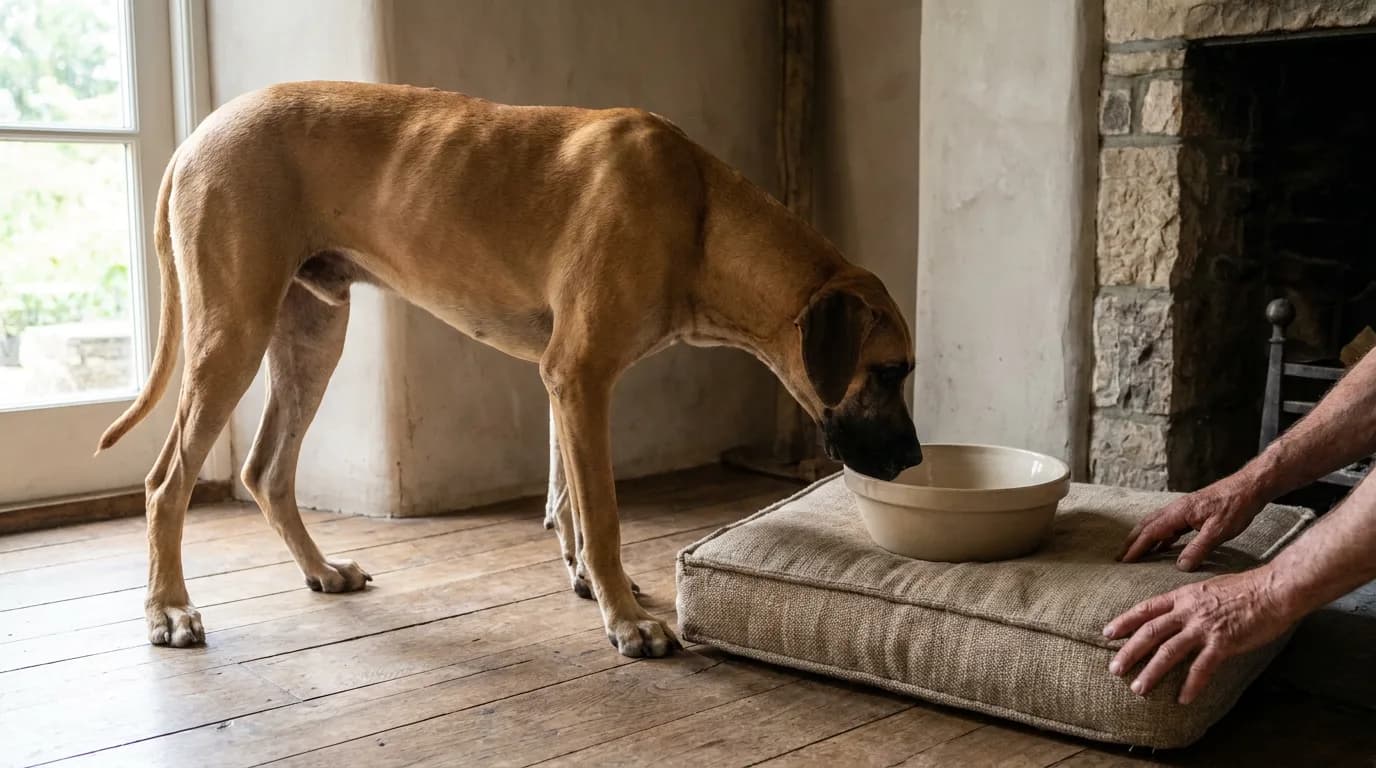
A useful adult decision begins with ordinary life: the dog's established daily intake, body condition, activity, preferences, and your ability to serve the food consistently. A calm companion and a more active adult may need different quantities. Sex or a broad breed label alone does not supply a precise calorie allowance.
Build the shortlist around the routine you can maintain
If the family wants a grain-inclusive chicken recipe and has adequate freezer space, Chicken & Rice is a practical starting point. If a fish-based recipe is preferred, compare Fish's greater daily serving weight before ordering. An adult who does well with a beef-based meal may suit Beef & Russet Potato.
For a household with limited freezer capacity, JustFresh's unopened storage format changes the logistics. The best practical choice is one that satisfies the nutritional purpose and fits the household's reliable routine. A plan that repeatedly runs out of thawed meals is harder to maintain than one matched to the actual kitchen.
- Choose the eligible recipe and an individual daily amount.
- Calculate how many days the order will provide.
- Check cold-storage or pantry capacity before buying a large supply.
- Assign responsibility for thawing, serving, and checking remaining stock.
These steps also make a preference trial more useful. Keep a record of whether the dog eats the measured meals and how the routine works. A sudden or persistent appetite change deserves veterinary attention rather than an assumption that the dog simply wants an increasingly elaborate menu.
Use measured meals rather than an open-ended supply
Measured meals make a giant dog's intake visible and let you compare it with the feeding plan. Record leftovers before assuming the planned portion was eaten. If the dog regularly leaves food or needs a different schedule, review the amount and routine rather than repeatedly topping up the bowl.
Change the food with a plan for both recipes
During a food transition, calculate the assigned calories from each recipe separately and follow the transition advice for the dog. An equal-weight mixture may have unequal calories. Keep the current step written down so every feeder serves the same planned combination.
Account for training food and household extras
Reserve the day's extras before calculating complete-food portions. If a reward comes from an already measured meal, count it once within that meal allowance. A Great Dane's size does not make training treats nutritionally invisible; several handlers should use one shared daily supply.
- If an adult's established total allowance were 2,000 calories and its agreed extras accounted for 150, the complete main meals would provide 1,850 calories. At 43 calories per ounce, that is about 43 ounces of Chicken for the main meals. The 150-calorie figure is an arithmetic assumption, not a recommended treat allowance.
Keep the older adult's needs individual
A senior Great Dane does not automatically need the smallest serving or the lowest-protein product available. Reassess body condition, activity, appetite, and the ease of eating the current food. Changes in those factors can justify reviewing the feeding plan with the veterinarian; age alone does not identify one universal senior recipe.
Complete fresh meals can remain useful when their nutritional purpose and serving routine fit the older dog. The practical questions become especially important: can the dog comfortably reach the feeding area, does the household measure consistently, and is the chosen format easy to keep available?
An older dog's established portion should not be copied from a younger Great Dane's record. Keep a separate written plan for each dog in a multi-dog home, even if they share the same recipe. This prevents an adult or senior adjustment from accidentally changing a puppy's carefully measured food.
Fresh, dry, wet, and homemade options for a giant dog
Food format affects convenience, serving weight, and storage. Nutritional adequacy determines whether the food can serve as the complete diet for the relevant life stage. A wet or fresh meal is not automatically complete, and a dry food is not automatically suitable for large-size growth.
Prepared fresh food is appealing when you want the meal formulated and made for you, with published serving information. JustFoodForDogs makes the comparison concrete through complete recipes with stated calories and life-stage suitability. Kibble can be convenient to store and measure; canned food has its own package and opened-storage routine. Compare the exact foods instead of assigning one nutritional status to an entire format.
Compare fresh and dry food on equal terms
Use the same daily calorie allowance for both products, then calculate their respective quantities. If a hypothetical dry food supplies 400 calories per cup, 2,000 calories would equal five cups. Chicken at 43 calories per ounce would require about 46.5 ounces for that same assumed allowance.
Those measurements describe different units and foods. Five cups is not directly comparable to five ounces, and neither number establishes a universal Great Dane portion. If a dry label also gives grams per cup or calories per kilogram, a scale can help make the serving more reproducible.
For a Great Dane puppy, the dry food must independently include appropriate large-size growth nutrition. The useful dry-versus-fresh decision is whether the eligible format fits the dog's plan, the family's storage, and the recurring budget.
Make a mixed-food plan a replacement calculation
Fresh food can supply part of a complete feeding routine rather than the entire day's calories. Decide the calorie share first. Then remove the corresponding amount of the other food instead of adding a fresh meal on top of the existing full ration.
- Suppose an adult's established food allowance is 2,000 calories, split evenly between Chicken and a hypothetical complete dry food containing 400 calories per cup. The fresh half is 1,000 divided by 43, or about 23.3 ounces. The dry half is 1,000 divided by 400, or 2.5 cups.
- The combined food supplies the assumed 2,000 calories.
- If divided into two equal meals, each contains about 11.6 ounces of Chicken and 1.25 cups of that hypothetical kibble.
- A different dry food requires its own calorie conversion.
- For a puppy, both foods must be appropriate for large-size growth.
This can make Chicken & Rice a practical part of an adult's routine while reducing the frozen quantity needed compared with an all-fresh plan. Evaluate the combined daily cost, including the dry food; the fresh portion alone is not the price of the complete mixed diet.
Grain-inclusive and grain-free are ingredient choices
Chicken & Rice provides a grain-inclusive choice, while Fish & Sweet Potato provides a grain-free choice. A Great Dane's size does not itself establish a need to avoid grains. Look at the whole complete recipe, the dog's individual history, and any guidance relevant to that dog.
For shoppers drawn to “natural” or “holistic” food, the useful next step is to read the actual ingredients and nutritional adequacy statement. If you want recognizable ingredients and prepared-meal convenience, the JFFD ingredient lists and life-stage information let you assess those preferences directly. Pair those details with the published calories to plan an appropriate serving.
Home cooking involves more than choosing meat and vegetables
A home-cooked diet for a Great Dane must be complete for the dog's life stage, with precise ingredients, quantities, and supplements. A puppy formulation also needs to account for large-size growth. A bowl of meat, rice, and vegetables does not become balanced merely because the ingredients seem wholesome.
Consider the ongoing workload before choosing this route: obtain an appropriately formulated recipe, weigh ingredients as specified, source the exact supplements, prepare the food safely, and avoid casual substitutions. A large dog's daily consumption magnifies the amount of shopping, cooking, cooling, and storage involved.
Prepared complete food offers a useful alternative when you want cooked meals without managing the formulation and supplement process yourself. Chicken & Rice, for example, combines a published complete-food statement with known calorie density. That supports a clear choice between professionally formulated prepared meals and the responsibilities of a properly designed homemade plan.
Raw food has separate formulation and handling considerations
A complete raw diet needs a formulation that meets the dog's life-stage needs, just as a complete cooked food does. For a puppy, that includes large-size growth suitability. Assess the full nutritional statement and formulation rather than assuming a combination of meat and bones supplies everything a growing Great Dane needs.
Handling also differs. The FDA explains that raw pet food can carry harmful bacteria, affecting the dog and people who handle the food. Compare that responsibility alongside storage, preparation, and the nutritional statement when weighing raw food against kibble or cooked meals.
For families seeking ready-made cooked food, complete JFFD recipes offer professional formulation, published calories, and prepared-meal convenience in one choice. This lets owners focus on measuring and storing an appropriate complete meal. Consider those advantages alongside the formulation and handling responsibilities of a raw plan when choosing the routine your household can sustain.
Daily ounces, package use, and feeding cost
A giant dog's food plan becomes much easier to assess when you turn calories into daily weight, then daily weight into actual packages. The following example uses an assumed 2,000 calories a day from the main food for an adult Great Dane. It is not a breed recommendation, a puppy chart, or a female-versus-male feeding rule.
The four foods differ meaningfully in calories per ounce. Compare them at the same allowance to see the effect on food weight. These are approximate serving calculations; use the current label and individual plan when preparing the dog's actual meals.
| Recipe | Large-size growth eligibility | Calories per ounce | Daily ounces at assumed adult 2,000 calories | Days per 252-ounce package bundle |
|---|---|---|---|---|
| Chicken & Rice | Included; puppy amount is individual | 43 | 46.5 | 5.4 |
| Fish & Sweet Potato | Included; puppy amount is individual | 26 | 76.9 | 3.3 |
| Beef & Russet Potato | Adult maintenance only | 44 | 45.5 | Not part of this package-size example |
| JustFresh Chicken | Adult maintenance only | 36 | 55.6 | Not part of this package-size example |
Separate serving weight from bowl volume
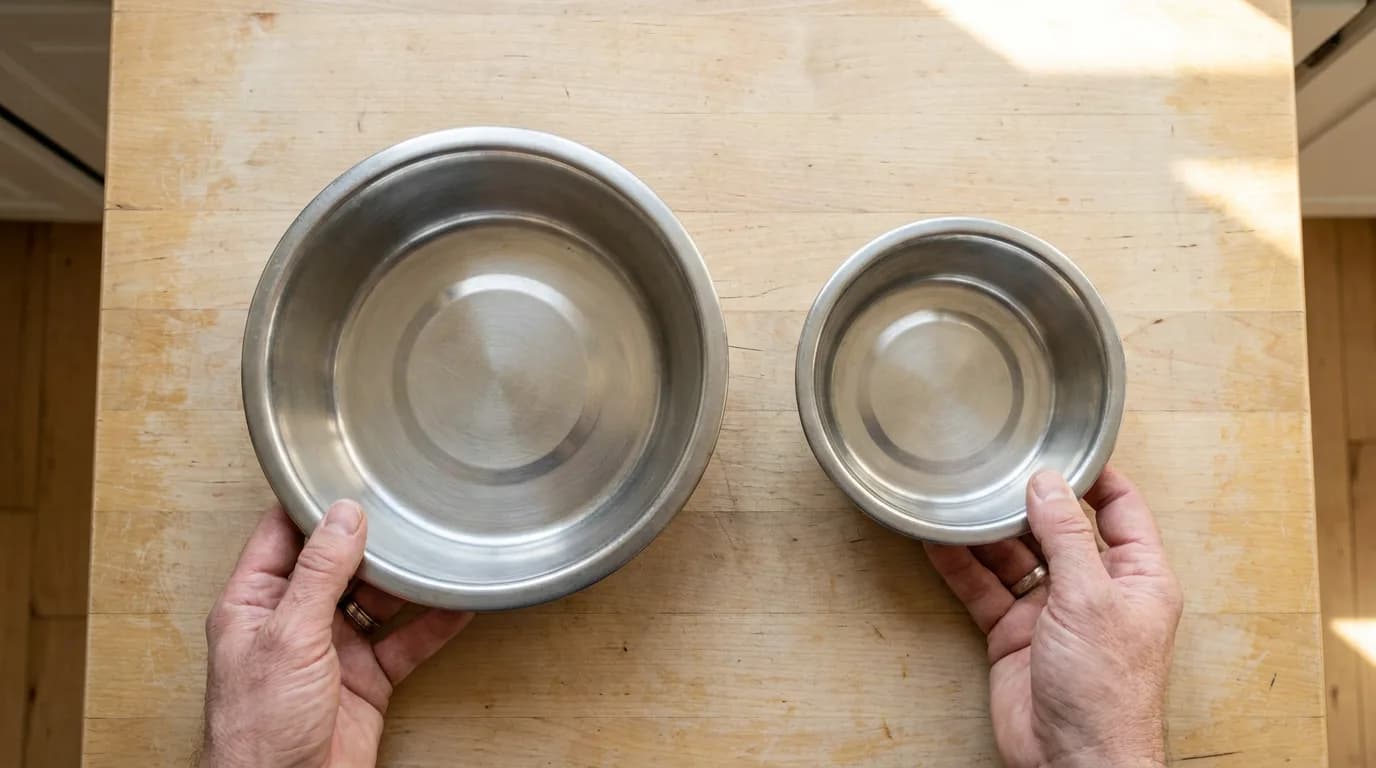
A Great Dane's serving may occupy a large bowl because of the food's moisture and calorie density. Choose the quantity from the calorie calculation, not the bowl's capacity. Weigh the food after zeroing the empty bowl; do not convert weight ounces into fluid ounces.
Work out how quickly an actual package is used
The current Chicken and Fish bundle examples below each contain fourteen 18-ounce packs: 252 ounces total. Use that stated pack count and weight rather than assuming every purchase format contains the same quantity. An 18-ounce pack is packaging, not necessarily one meal for a Great Dane.
At the assumed adult allowance, Chicken uses approximately 2.6 of those packs per day, and a 252-ounce bundle supplies about 5.4 days. Fish uses approximately 4.3 packs per day, with the same-weight bundle supplying about 3.3 days. Both results follow from the different calorie densities, not from an assumption that the fish recipe is less complete.
- Chicken: 252 ounces divided by about 46.5 ounces a day gives roughly 5.4 days.
- Fish: 252 ounces divided by about 76.9 ounces a day gives roughly 3.3 days.
- Different calorie needs change both results.
- A mixed-food plan changes the fresh portion and therefore the package-use rate.
Round purchase quantities up to whole packs or bundles when necessary, while keeping leftover food in the inventory. Do not round the dog's serving up to a whole pack simply to empty it. The remainder belongs in the next appropriately stored portion, following the current package directions.
Portion across package boundaries without changing the meal
When the measured serving exceeds one pack, finish the first pack and weigh the required remainder from the next. Keep the meal amount unchanged. Label the opened pack and refrigerate it as directed; rounding every meal to whole packs would change the daily calories.
Compare daily consumption cost before order size
On September 28, 2026, the listed regular prices observed on the official pages were $153.99 for fourteen 18-ounce Chicken packs and $167.99 for fourteen 18-ounce Fish packs. These are regular listed prices, excluding tax and shipping, not verified checkout totals. Prices and purchase options may change; promotional prices are not used in these calculations.
Using those Chicken and Fish listings, Chicken costs approximately $0.611 per ounce and Fish approximately $0.667 per ounce. Multiplying by the daily quantity gives about $28.42 a day for Chicken and $51.28 a day for Fish at the assumed 2,000-calorie food allowance.
| Current-price illustration | Chicken & Rice | Fish & Sweet Potato |
|---|---|---|
| Weight purchased in the example bundle | 252 oz | 252 oz |
| Listed regular bundle price observed September 28, 2026 | $153.99 | $167.99 |
| Approximate daily consumption cost at 2,000 calories | $28.42 | $51.28 |
| Approximate seven-day consumption cost | $198.95 | $358.95 |
| Approximate days supplied by one bundle | 5.4 | 3.3 |
These are food-consumption costs. The amount charged for an order depends on the number of whole bundles purchased, and some food may remain after the example period. This distinction helps when comparing a delivery invoice with a weekly budget: paying for food today does not mean all of it will be eaten this week.
Check what a price comparison actually includes
Compare the same ongoing purchase terms: exact recipe, package weight, regular price, and shipping. A large first order can last fewer days than expected when the daily serving spans several packs. Use the days-supplied calculation above to choose a delivery interval rather than equating one box with one month.
Plan storage around the next delivery
For an all-Chicken plan at the assumed allowance, seven days use about 326 ounces. Buying two 252-ounce bundles supplies 504 ounces, leaving about 178 ounces after that week. Check storage capacity for the 504 ounces arriving, not only the amount expected to be eaten in seven days.
For Fish, seven days use about 538 ounces. Three bundles supply 756 ounces, leaving about 218 ounces after that week. Once there is a carryover supply, include it in the next order calculation rather than repeatedly buying the same rounded-up amount and accumulating extra food.
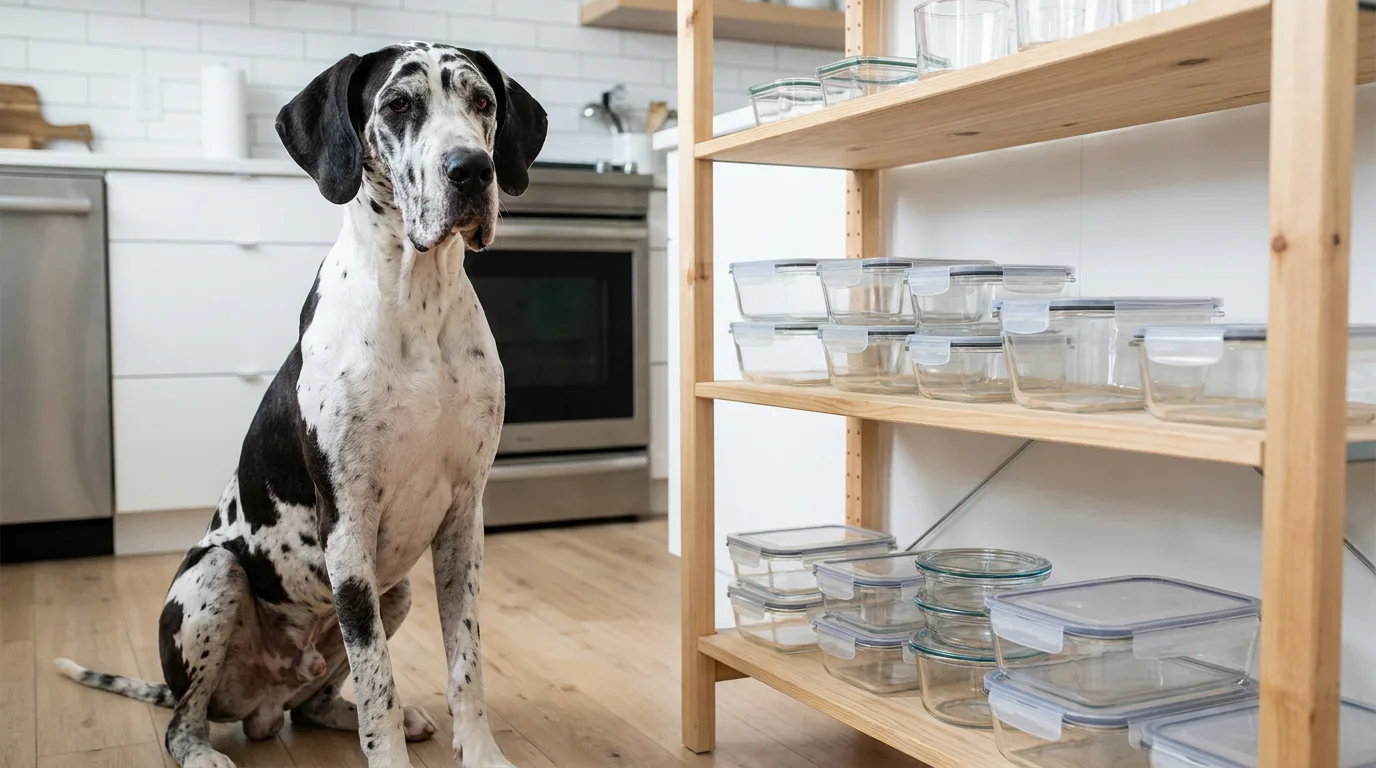
A simple inventory record can keep this manageable:
- Unopened food already available, listed by recipe and amount.
- Food currently thawing or opened, with the relevant dates.
- Expected consumption before the next delivery.
- Whole packs or bundles needed to cover the remaining interval.
Keep frozen food according to its package instructions and plan refrigerated thawing around the quantity you actually need. Handle opened food according to the current product directions. For JustFresh Chicken, the explicit instruction is refrigeration after opening and use within three days; unopened pantry storage does not extend the opened-food window.
Evaluate a smaller fresh share honestly
A mixed-food routine changes the fresh-food budget substantially because fewer calories come from fresh meals. In the earlier 1,000-calorie Chicken share, daily fresh consumption is about 23.3 ounces. At the observed regular price, that fresh component costs approximately $14.21 a day, before adding the cost of the other food.
It uses about 163 ounces a week, and one 252-ounce bundle supplies roughly 10.8 days of that fresh share. This may fit a household's freezer and delivery routine differently from the full-fresh example. It is a useful option to compare, not a claim that half-fresh is the correct ratio for every dog.
When comparing an “affordable” plan, include everything served: the fresh component, the remaining complete food, and regular extras. Then compare the total against the amount the household can sustain. Petful's Great Dane cost guide places food within the wider responsibilities of owning the breed.
Keep the serving instructions usable by another person
- A caregiver needs the exact daily amount, the number of meals, and clear handling directions. “One big bowl” or “one packet” is not enough when a day's food may span several packages. Write the amount in grams or weight ounces and identify the scale unit being used.
When several packs contribute to a Great Dane's meal, give the caregiver the exact weight of each recipe, meal times, and opened-food directions. Confirm enough refrigerator and freezer space for the visit. One current instruction prevents package size from becoming an accidental serving rule.
Frequently asked questions
Three foods to keep away from Great Danes are grapes or raisins, chocolate, and products containing xylitol. The ASPCA's food-safety list also covers other foods to keep away from dogs. If a dog eats a potentially toxic item, contact a veterinarian or poison-control service promptly. For puppies, an adult-maintenance food or unbalanced meat-and-rice mixture should not replace complete large-size growth nutrition.
Ask who formulates the food, what nutritional expertise supports it, how the company checks product quality, and where to find the exact nutritional adequacy and calorie statements. The WSAVA nutrition guidelines provide a useful framework. Review the answers for the specific product you are considering. Brand reputation and words such as “premium” cannot establish that every recipe serves every life stage.
Sex alone does not determine the best recipe or a precise feeding amount. Choose complete food for the dog's life stage, then base portions on individual needs, body condition, and activity. A generic female feeding chart cannot account for all of those factors. Pregnancy or nursing creates a different nutritional situation that should be planned with the veterinarian; the adult-maintenance examples in this guide do not address it.
Hold the daily calorie allowance constant, then divide it by each food's calories per ounce. At an assumed 2,000 food calories, Chicken's 43 calories per ounce require about 46.5 ounces, while Fish's 26 require about 76.9 ounces. Compare the cost and storage of those actual quantities. The same weight of each food would supply different calories, so a scoop-for-scoop replacement can change the day's intake.
Choose by the nutritional statement on the exact recipe: a Great Dane puppy needs large-size growth nutrition. Chicken & Rice and Fish & Sweet Potato provide that eligibility in this comparison, while Beef & Russet Potato and JustFresh Chicken offer complete choices for adult maintenance. Keep the puppy on an appropriate growth food and review the move to an adult feeding plan with the veterinarian as the individual dog matures. Adult-maintenance food is not a tool for slowing puppy growth.

Coreen Saito is a pet writer and longtime shelter volunteer with more than a decade in animal rescue. She covers cat behavior, breed care, and the small, ordinary science of sharing a life with companion animals, with a particular focus on honest takes about the products and decisions that actually matter. At home in Arizona, she's outranked by Mac (a dog with the loudest opinion in the house), Rebel (a cat who governs by quiet authority), and Meri (an orange tabby who runs the late shift and the laundry basket). She writes about all three, plus the rescues that keep coming through her life, at LifeWithMinty.com.
Sign up for expert-backed reviews and safety alerts all in one place.
A Final Word (Disclaimer)
At Petful, our review integrity is paramount; we never exchange special treatment in our reviews for monetary or material rewards.
Nonetheless, when our readers click through to online merchants (including Chewy or Amazon), we receive a referral commission. This supports the running of our free blog, and we appreciate your backing.