Best Dog Food for Corgis: Puppy and Adult Feeding Choices
Choose a complete food for your Corgi's life stage, then calculate daily meals and training rewards together using clear fresh-food portion examples.

An adult Pembroke Welsh Corgi stands on a garden path.
Petful is reader supported. As an affiliate of platforms like Amazon and Chewy, we may earn a commission when you buy through links on this page. There is no extra cost to you.
This article is sponsored by JustFoodForDogs. Petful maintains editorial control and may earn a commission from qualifying purchases, at no extra cost to you.
The best dog food for Corgis is a complete recipe appropriate for the dog's life stage, served in an amount that includes everything eaten during the day. Short legs do not make every Corgi a toy-sized eater, and training rewards still count when the main meals are carefully measured. The useful food choice combines suitability, portions, and a routine the whole household can follow.
JustFoodForDogs offers fresh options for both puppies and adults. Chicken & Rice and Fish & Sweet Potato include growth in their nutritional adequacy statements. Beef & Russet Potato and JustFresh Home-Cooked Chicken provide adult-maintenance choices. Compare those exact labels, then use the individual calorie allowance to plan meals and rewards together.
Choose complete daily nutrition with life stage suitability first. Set the training reward allowance before calculating measured meal portions. A Corgi's height does not determine its calories, and treats should not simply be added to an unchanged full-day ration.

Sign up for expert-backed reviews and safety alerts all in one place.
Food options for Corgi puppies and adults
Start with the dog's age and individual needs. A puppy requires growth-appropriate food; a healthy adult can be considered for an appropriate adult-maintenance or all-life-stages recipe. Calorie density and storage then help you decide how the food fits the routine.
The comparison below uses current manufacturer labels and practical feeding fit. It does not describe a hands-on taste test or a universal veterinary endorsement. Each recommendation has a specific life-stage and household context.
| Food | Useful fit | Label life stage | Calories per ounce | Practical consideration |
|---|---|---|---|---|
| JustFoodForDogs Chicken & Rice Fresh Frozen | Grain-inclusive fresh feeding through growth and adulthood | All life stages, including large-size growth | 43 | Frozen storage and refrigerator thawing |
| JustFoodForDogs Fish & Sweet Potato Fresh Frozen | A fish-based fresh choice | All life stages, including large-size growth | 26 | A larger food weight at the same calories |
| JustFoodForDogs Beef & Russet Potato Fresh Frozen | A complete fresh meal for mature Corgis | Adult maintenance | 44 | Keep separate from a puppy's growth diet |
| JustFoodForDogs JustFresh Home-Cooked Chicken | Adult meals with unopened pantry convenience | Adult maintenance | 36 | Refrigerate opened food and use within three days |
Chicken & Rice: a fresh choice for puppies and adults
Chicken & Rice offers a grain-inclusive complete recipe with an all-life-stages adequacy statement. Its current ingredients include chicken, white and brown rice, and vegetables such as kale. The growth eligibility and 43 calories per ounce are useful facts for making a feeding plan.
It can suit a household that wants an eligible fresh recipe during growth and an option to continue it in adulthood. The amount still needs review as the dog matures. A familiar food can remain appropriate while the daily serving changes.
Consider it for:
- Clear growth suitability.
- Grain-inclusive fresh feeding.
- A routine based on weighed portions.
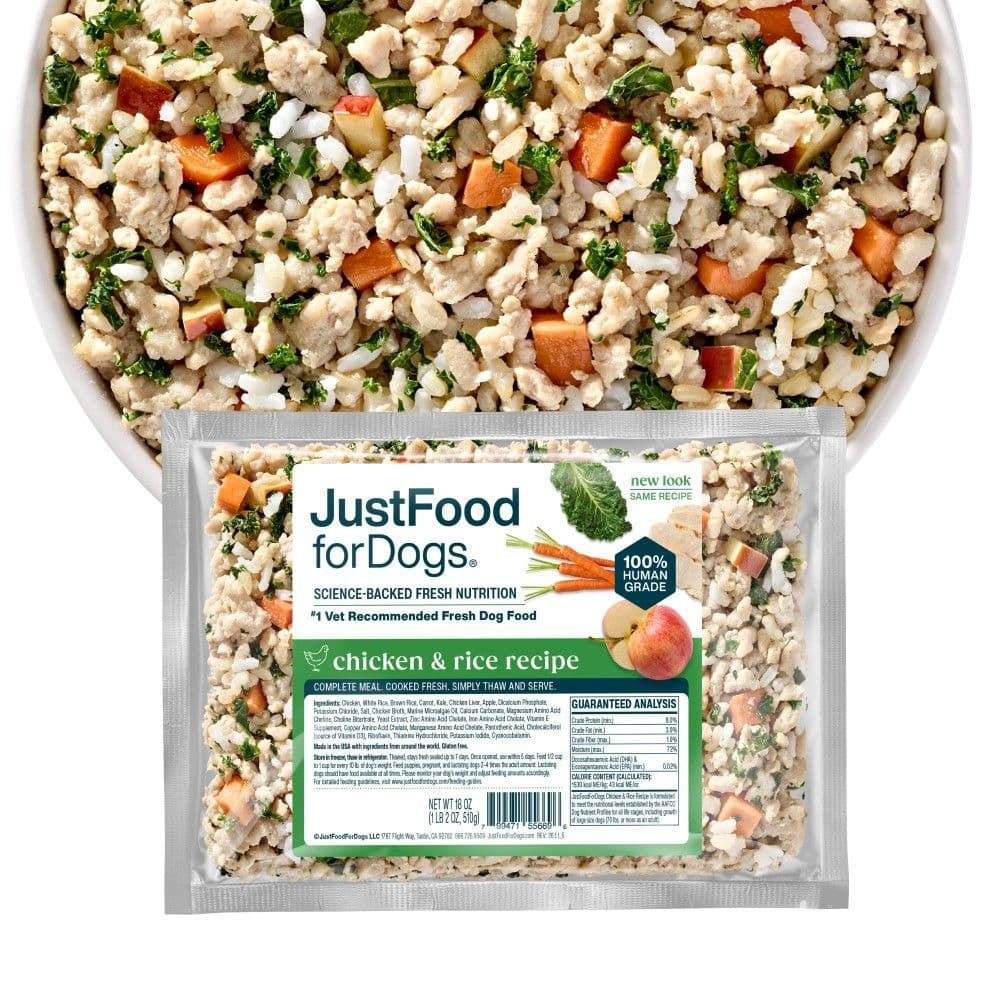
Petful may earn a commission when you click through to JustFoodForDogs, at no extra cost to you.
Fish & Sweet Potato: a distinct protein and portion comparison
Fish & Sweet Potato provides 26 calories per ounce and includes growth in its adequacy statement. It gives owners a fish-based alternative with a different meal volume. More ounces supply the same calories than with the other recipes here.
The grain-free description identifies the formula; it is not automatically an advantage for every Corgi. Compare the complete recipe, individual feeding history, and storage needs. A different protein source should not be treated as a diagnosis or universal allergy solution.
Check:
- Daily ounces at the individual calorie allowance.
- How quickly a package will be used.
- Available freezer and refrigerator space.
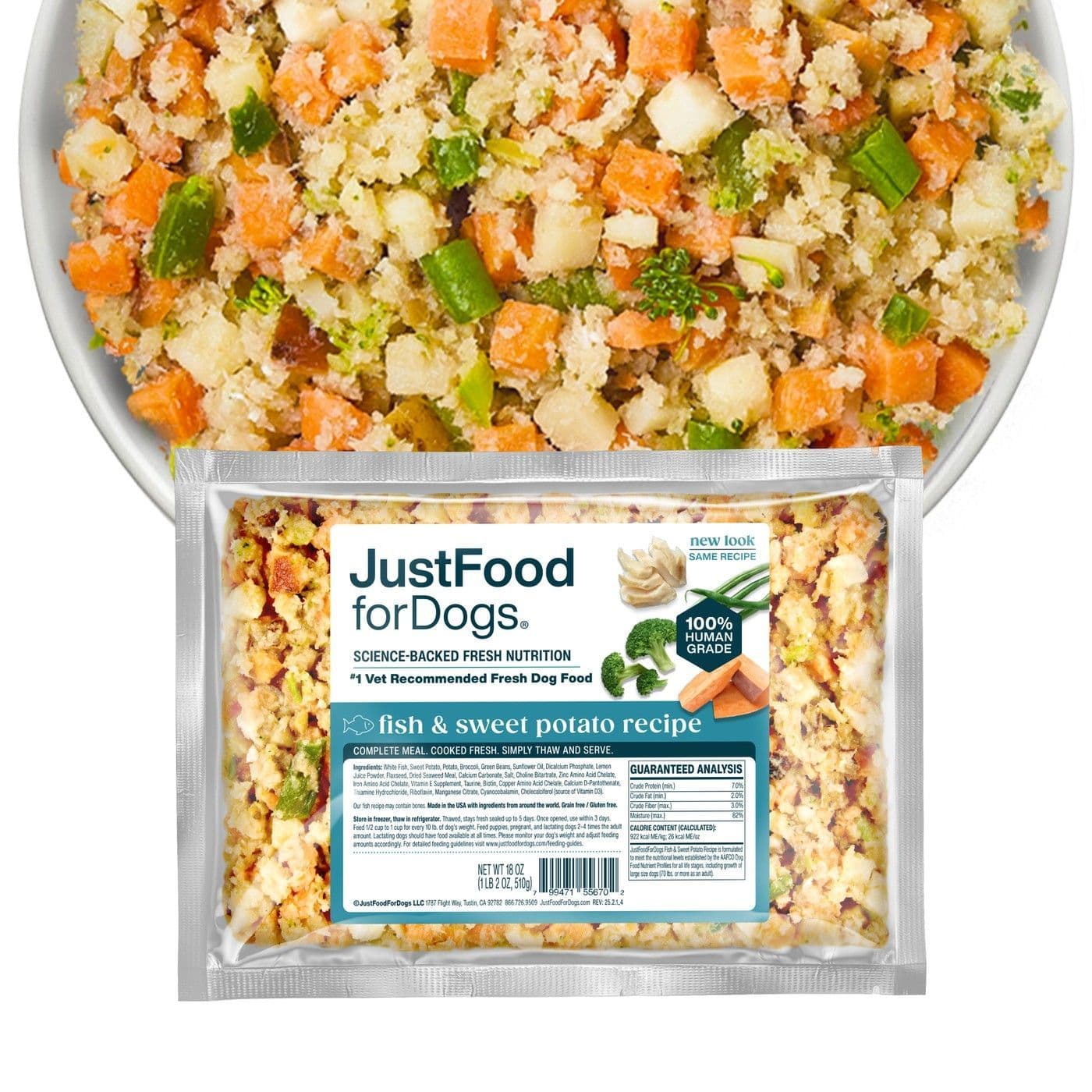
Petful may earn a commission when you click through to JustFoodForDogs, at no extra cost to you.
Beef & Russet Potato: a complete adult option
Beef & Russet Potato supplies 44 calories per ounce and is formulated for adult maintenance. It offers a fresh meal for a mature Corgi when the recipe fits the dog and household. Its calorie density is close to Chicken & Rice, while its life-stage statement differs.
An adult-maintenance recipe is not a puppy food simply because the serving is small. Keep the product and portion clearly identified if a puppy and adult share the home. Similar bowls do not mean identical nutritional requirements.
Useful considerations include:
- Mature adult eligibility.
- Individual acceptance and feeding history.
- Measured portions and regular feeding cost.
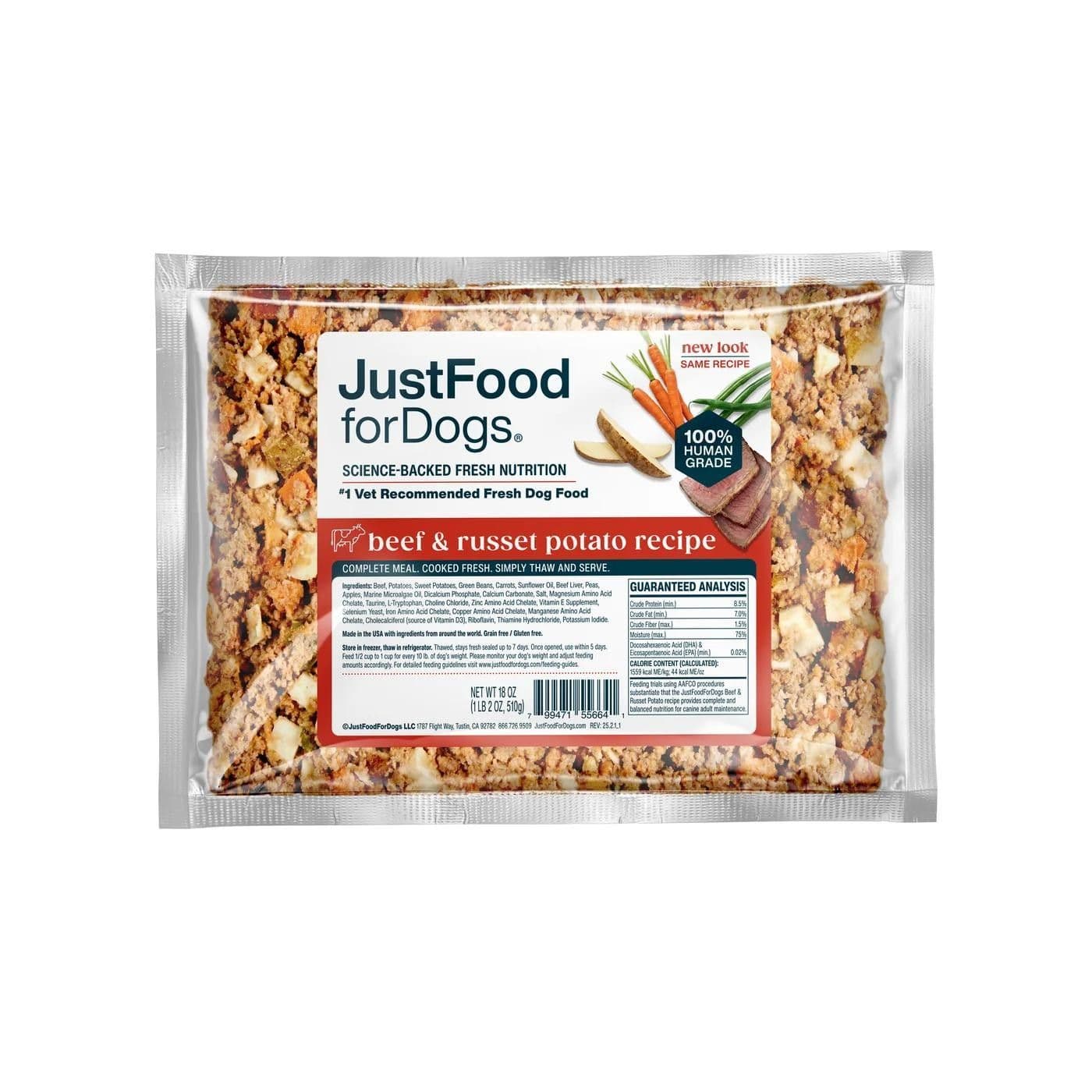
Petful may earn a commission when you click through to JustFoodForDogs, at no extra cost to you.
JustFresh Home-Cooked Chicken: adult pantry convenience
JustFresh Home-Cooked Chicken provides adult-maintenance nutrition at 36 calories per ounce. Its shelf-stable unopened format can simplify inventory when freezer space is limited. It offers a different practical routine from a Fresh Frozen recipe.
Refrigerate opened food and use it within the manufacturer's three-day period. Calculate the serving from this product's own label, rather than copying a Chicken & Rice portion. Both are chicken recipes, but their life-stage and calorie information differ.
Plan for:
- The individual adult's daily amount.
- Package use within the opened-food period.
- Refrigeration and clear caregiver instructions.
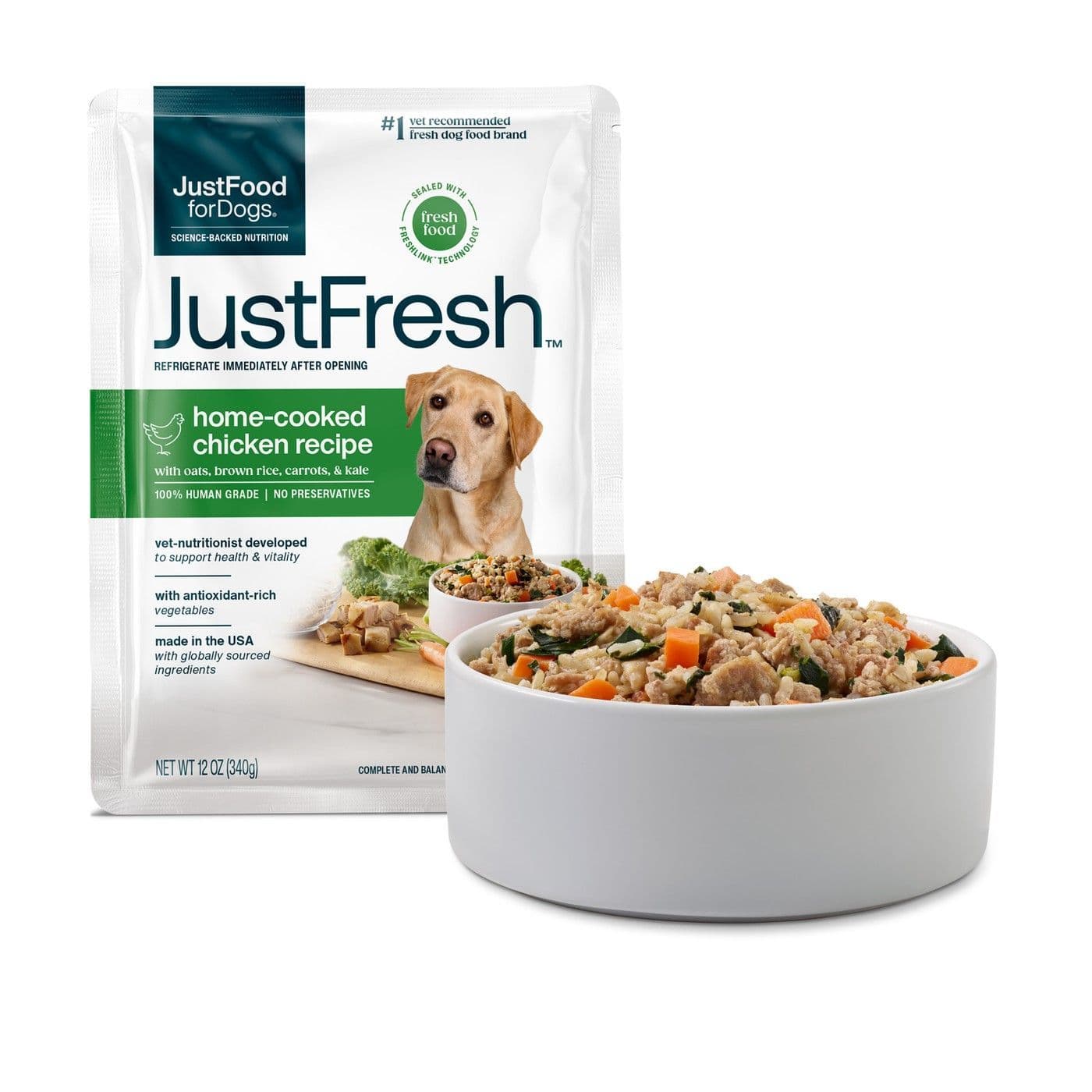
Petful may earn a commission when you click through to JustFoodForDogs, at no extra cost to you.
A Corgi's short legs do not determine the portion
A Corgi's low height can make body size easy to misjudge. Use actual adult weight, growth status, and body condition when considering the allowance. A toy-dog serving rule should not be borrowed simply because the dog stands close to the ground.
Pembroke and Cardigan Corgis also should not be assumed to need identical amounts. The recipe's life-stage suitability and the individual dog's needs are separate decisions. Two dogs can eat the same eligible food while receiving different measured portions.
Keep the starting record simple:
- Current age and weight.
- The dog's usual activity pattern.
- Exact recipe and calorie density.
- Main meals plus treats and other additions.
- Any recent change in condition or intake.
The WSAVA nutrition resources include tools for assessing body condition alongside weight and diet history. Ask your veterinary team to demonstrate an assessment. The goal is a repeatable evaluation of your individual dog rather than a judgment from height or a photograph.
Choosing a complete Corgi puppy food
A Corgi puppy needs an appropriate complete growth diet. Read the exact recipe's nutritional adequacy statement before deciding on flavor or texture. Adult-maintenance nutrition serves a different life stage, regardless of how small the puppy's bowl is.

The FDA explains complete and balanced food through AAFCO nutrient profiles or feeding-test procedures. Chicken & Rice and Fish & Sweet Potato provide growth-eligible choices here. Beef & Russet Potato and JustFresh Home-Cooked Chicken are adult-maintenance alternatives.
- Choose an appropriate complete puppy diet while your Corgi is growing. Adult maintenance is a different label purpose. Reassess the amount as the individual dog develops instead of using another dog's portion as the target.
Start with a clear puppy schedule
A Corgi puppy does not need a large-breed label solely because of its stocky build or short legs. The nutritional requirement is an appropriate complete growth food for the individual puppy. A recipe whose statement also includes large-size growth can still suit a Corgi; that broader eligibility does not prescribe a large-dog portion. Use the puppy's own feeding plan.
Establish the starting food and meal times
Collect the current food name, daily amount, meal times, and recent weight when the puppy comes home. This gives you a useful baseline for veterinary advice and a planned transition. Keep treats and other additions visible rather than changing several foods at once.
The AKC puppy feeding timeline describes several small meals for young puppies, commonly moving from four toward three during the three-to-six-month period and toward two as they mature. Confirm the individual schedule and divide the established daily allowance across those meals.
Write down:
- The whole-day food amount.
- The quantity intended for each meal.
- Food reserved for puppy training.
- The exact product's handling instructions.
Keep training calories inside the growth plan
The recipe's calories per kilogram can also give a clear gram-based puppy serving. Suppose, only for calculation practice, the puppy's established allowance assigns 450 daily calories to Chicken & Rice. At 1,530 calories per kilogram, divide 450 by 1.53 calories per gram: the result is about 294 grams daily. If the agreed schedule uses three equal meals, each would contain about 98 grams.
That example does not establish the puppy's calorie need, prescribe three meals for every age, or add a separate treat allowance. It translates an already established main-food target into a measurable amount. If training food is taken from those 294 grams, the bowl portions must be reduced accordingly. Keep the scale in grams throughout so a caregiver does not confuse the calculated number with ounces.
Plan rewards without changing the puppy's daily total
Puppy training can involve many small rewards. Account for those calories when reviewing the day's food, while keeping appropriate complete nutrition as the main diet. A treat used for a successful toilet break and another used for a short practice session still belong to the same allowance.
If using part of a suitable regular food for rewards, subtract it from the portion that would otherwise go in the bowl. For a fresh recipe, choose a practical, safely handled situation rather than assuming it can be carried without refrigeration for a long outing. The reward's feeding purpose and handling requirements both matter.
Revisit food and amount at maturity
Ask your veterinarian when the individual puppy is ready for adult feeding. Body condition and growth history are more useful than an arbitrary date copied from another dog's routine. Extra supplements are not a routine way to improve an already complete growth food.
A suitable all-life-stages recipe may remain an option after growth, with a reviewed allowance. If you move to an adult-maintenance food, compare calorie densities and follow transition guidance. A change of product should not accidentally change the whole-day calorie intake.
Adult and senior Corgi food choices
For a Pembroke Welsh Corgi or a Cardigan, the best diet combines complete adult nutrition with a measured individual allowance. The dog's usual activity, condition, and feeding history help determine that amount. A quiet companion and a dog with a more demanding routine may need different amounts. Enthusiasm for food is not itself a measurement of energy needs.

Adult-maintenance Beef & Russet Potato offers one complete fresh choice, while Chicken & Rice remains another eligible option. Consider the recipe's fit and then calculate its portion, including the effect of training food and other extras.
Review the normal week
Record ordinary walks, play, and quieter periods rather than assigning a vague active label. A sustained change in routine may justify reviewing the allowance, while one unusual afternoon is different. Check the result against weight and body condition over time.
Keep several questions together:
- Has the regular activity pattern changed?
- Has the amount of reward food changed?
- Is the dog maintaining the intended condition?
- Are several people independently adding food?
If appetite or weight changes unexpectedly, investigate rather than repeatedly switching products or increasing the serving. A clear feeding record gives your veterinary team more useful information than the description that the dog always seems hungry.
Make senior feeding an individual decision
An older Corgi may continue on an appropriate adult recipe when it fits current needs. Age alone does not establish the correct amount or a special food category. Review body condition, eating comfort, activity, and any individual veterinary recommendations.
Petful's Corgi lifespan guide provides life-stage context. If chewing or swallowing becomes difficult, have the cause assessed. A soft fresh format can be convenient, but a food comparison should not be treated as a diagnosis or a promise of treatment.
Use meals to make intake visible
A measured daily allowance split into regular meals makes a Corgi's eating habits easier to assess. Record what the dog eats, including its complete diet and extras. Free feeding can make that harder to track, especially if more than one dog shares access to the bowls. Follow the fresh food's handling instructions rather than treating an opened meal as an unlimited unattended supply.
Give caregivers a single plan with the exact recipe and daily amount. Distinguish that number from a per-meal serving. A simple note prevents a household from doubling the food merely because two people each believe they are providing the intended meal.
Fresh, wet, dry, and homemade Corgi food
Format affects texture, moisture, calorie density, and storage, but the nutritional adequacy statement remains the first check. A cup of dry food and an ounce of fresh food are different units. Compare the labeled calories rather than replacing equal volumes by appearance.
Petful's food-label guide can help you evaluate the whole product. A treat or topper has a different feeding role from a complete main food, even when the ingredients look similar.
Make a deliberate combination
If two appropriate complete foods share the diet, assign calories to each before measuring them. Adding a full fresh meal to an unchanged full ration of another food raises the total. A planned split lets you compare formats while preserving a clear daily allowance.
For example, half of an assumed 600-calorie allowance would assign 300 calories to each food before considering treats. Chicken & Rice's share would be about seven ounces at 43 calories per ounce. The other food's measured share must come from its own calorie information.
Compare raw and cooked options by feeding purpose
A raw product intended as a main diet still needs an appropriate complete nutritional statement for the dog's life stage. Plain meat does not establish that balance. Then consider the handling routine: the FDA's raw pet-food guidance discusses microbial risks to pets and people.
A complete cooked fresh recipe offers a different choice with its own adequacy and calorie information. Choose a suitable format the household can manage consistently, rather than assuming fresh means raw or that a single ingredient list supplies a balanced diet.
Keep home cooking complete
If home-prepared food will provide the whole diet, use an appropriately formulated recipe and follow it consistently, including specified amounts and required supplements. Plain meat, rice, and vegetables are not automatically complete nutrition. Ingredient substitutions can change the formulation.
Commercially prepared complete fresh food offers another route: choose an eligible product, calculate the portion, and follow storage instructions. The JustFoodForDogs recipes here allow that comparison through product-specific labels. Their usefulness comes from a suitable complete meal and practical routine rather than an unsupported promise about a breed's health.
Include training rewards in the daily food allowance

Training food belongs in the same daily budget as breakfast and dinner. A few small rewards can become a substantial addition when several people each run a practice session. Start with the dog's individual calorie allowance, reserve the planned reward calories, and calculate the main meal from what remains.
The AAHA nutrition guidelines generally limit treats and other extras to no more than 10% of daily calories. That is a ceiling for extras, not a requirement to use the whole amount. Most calories should still come from appropriate complete food.
Work through the main-food amount
Suppose a Corgi has an assumed 600-calorie daily allowance and the household reserves 60 calories for treats. That leaves 540 calories for the main food. These numbers demonstrate the method; they are not a recommended daily target for every Corgi or a puppy feeding prescription.
With Chicken & Rice at 43 calories per ounce, 540 divided by 43 equals about 12.6 ounces daily, before dividing that food among meals. Calculate with the precise figure and round only to a practical measurement at the end.
| Recipe | Labeled calories per ounce | Ounces for the assumed 540 main-food calories | Life-stage check |
|---|---|---|---|
| Chicken & Rice | 43 | 12.6 | Includes growth |
| Fish & Sweet Potato | 26 | 20.8 | Includes growth |
| Beef & Russet Potato | 44 | 12.3 | Adult maintenance |
| JustFresh Home-Cooked Chicken | 36 | 15.0 | Adult maintenance |
The difference between 12.6 and 20.8 ounces comes from calorie density. It does not show that one bowl is nutritionally superior or that the smaller portion is inadequate. Use the label to measure food; use the individual dog's growth, body condition, appetite, and veterinary guidance to judge whether the overall allowance fits.
If the 540 main-food calories are divided into two equal adult meals, each meal supplies 270 calories. That is about 6.3 ounces of Chicken & Rice per meal. A puppy may need a different meal schedule, but the same principle applies: dividing the daily amount changes meal size, not the daily total.
Check a portion when switching recipes
Equal ounces of two recipes can provide different calories. In the worked example, 12.6 ounces of Chicken & Rice roughly fills the 540-calorie main-food allowance. The same 12.6 ounces of Fish & Sweet Potato supplies only about 328 calories. Switching by equal weight would therefore change the plan substantially, even though the bowl and scale reading look familiar.
To make a full replacement at an equivalent calorie share, calculate the new recipe's amount from the same established allowance. Here, 540 divided by 26 gives approximately 20.8 ounces of Fish & Sweet Potato. Follow the manufacturer's transition instructions and individual veterinary advice about how to introduce the change; the arithmetic identifies the eventual equivalent portion, not a requirement to switch abruptly.
During a planned overlap, record each food separately. For a hypothetical equal calorie split of the 540-calorie main-food budget, Chicken & Rice supplies 270 calories in about 6.3 ounces, while Fish & Sweet Potato supplies 270 calories in about 10.4 ounces. “Half and half” means half the calories in this example, not equal spoonfuls or equal package weights.
Translate reward calories into pieces
Treat size is an unreliable unit without calorie information. In a hypothetical 60-calorie reward budget, pieces labeled two calories each would allow 30 pieces; pieces labeled five calories each would allow 12. Those are arithmetic examples, not calorie claims about any particular treat. Check the actual package before planning a session.
You do not need a large piece for every successful repetition. Where the treat can be divided safely and practically, smaller pieces can spread the same calorie allowance across more repetitions. Recalculate using the portion actually offered, and keep an eye on what the dog swallows rather than merely what goes into the pouch.
Use a short household plan:
- Record the daily calorie allowance and the amount reserved for extras.
- Count the total reward pieces that fit the actual product's calorie information.
- Allocate those pieces among planned walks, practice sessions, and caregivers.
- Return unused rewards to the tracked supply rather than adding a second unrecorded allowance.
Complete daily food can sometimes provide part of the rewards. If you use it that way, remove that portion from the measured daily ration instead of serving it again at dinner. Its calories remain part of the food budget even when the dog earns them outside the kitchen.
Fresh food also brings handling requirements. A thawed cooked meal is not a shelf-stable pocket snack. Follow its storage directions and select a practical training format for the situation, especially when food will be carried away from home. Convenience should support the feeding plan rather than erase temperature and opening instructions.
Keep one record when several people feed the dog
Two caregivers can each follow a reasonable routine and still double the intended extras. A shared daily record makes their contributions visible. Record food used in training, chews, table food, and any other calorie-containing extras alongside the meals, rather than tracking only the largest bowl.
For the 600-calorie example, one person might plan to use 30 reward calories during a morning session and another the remaining 30 later. Both allocations belong to the same 60-calorie pool. If an additional activity needs food rewards, redistribute the available allowance or review the plan rather than automatically increasing the total.
- Write “daily main food” beside the calculated ounces. Then list how that food is divided into meals and training portions. This helps another caregiver follow the same plan without accidentally repeating the entire ration.
Put a price on the main-food portion
Daily ounces make the ongoing budget more useful than a single package price. At the displayed regular prices observed September 28, 2026, Chicken & Rice cost $153.99 for fourteen 18-ounce packages, or 252 ounces. Fish & Sweet Potato cost $167.99 for the same total weight. These are observed regular list prices, not a verified checkout total; shipping and tax are excluded and prices can change.
At the assumed 540 main-food calories, Chicken & Rice would cost about $7.67 per day, or $53.72 for seven days of food consumed. Fish & Sweet Potato would cost about $13.85 per day, or $96.92 for seven days. The calculations use unrounded portions before rounding the cost. Neither estimate includes the separately planned treats.
The higher daily Fish & Sweet Potato figure reflects both its displayed price per ounce and the larger quantity needed for the same calories. Comparing equal package weights alone would miss that difference. Compare an equivalent calorie allowance when deciding whether the recipe fits the ongoing budget.
Price both parts of a mixed meal
For a mixed-food plan, price each share separately. If 270 of the 540 main-food calories come from Chicken & Rice, that share is about 6.3 ounces and $3.84 daily at the observed price. The other food must supply the remaining 270 calories; calculate its measured amount and price from its own label rather than assuming half a cup or half a pouch.
This is one part of the broader cost of caring for a Corgi. A useful food budget includes the complete meals, planned extras, and any shipping or tax shown at checkout. Keep the calculation separate from an introductory discount so you can assess the regular routine.
Calculate the treat expense separately
The main-food estimate leaves a deliberate place for the training budget. If a treat package states both total quantity and calories per piece, estimate how many days it lasts at the planned number of pieces. Divide its actual purchase price by those days, then add that daily figure to the main-food cost. Include other planned extras in the same way.
A food reward taken from the measured complete ration should not be charged twice in the calorie or food-consumption calculation. A separately purchased treat belongs in both records. Distinguishing the two makes a training-heavy week easier to compare with a quieter week without confusing food spent with extra calories served.
Match the order to actual use
An order contains whole packages, while a daily serving often uses part of a package. At approximately 12.6 ounces of Chicken & Rice daily, a 252-ounce bundle supplies about 20 days of main food in this example. At approximately 20.8 ounces of Fish & Sweet Potato, the same bundle weight supplies about 12 days. Those estimates assume all of that main-food share comes from the named recipe.
Use the unrounded calculations when planning a longer period, then consider the whole packages you will actually buy. The cash paid for an order may exceed the price of food consumed during the first week because food remains for later meals. Leftover inventory is not an extra meal and should not change the dog's portion.
Before reordering, check three practical details:
- How much usable food remains, including opened packages.
- How long that supply will last at the current measured daily amount.
- Whether the next delivery fits the available freezer or pantry space.
A change in appetite, activity, or body condition may justify reviewing the portion with the veterinarian. Update the cost estimate after the feeding plan changes. The order should follow the dog's needs; a convenient bundle size should not decide how much the dog eats.
Keep the feeding station easy to clean
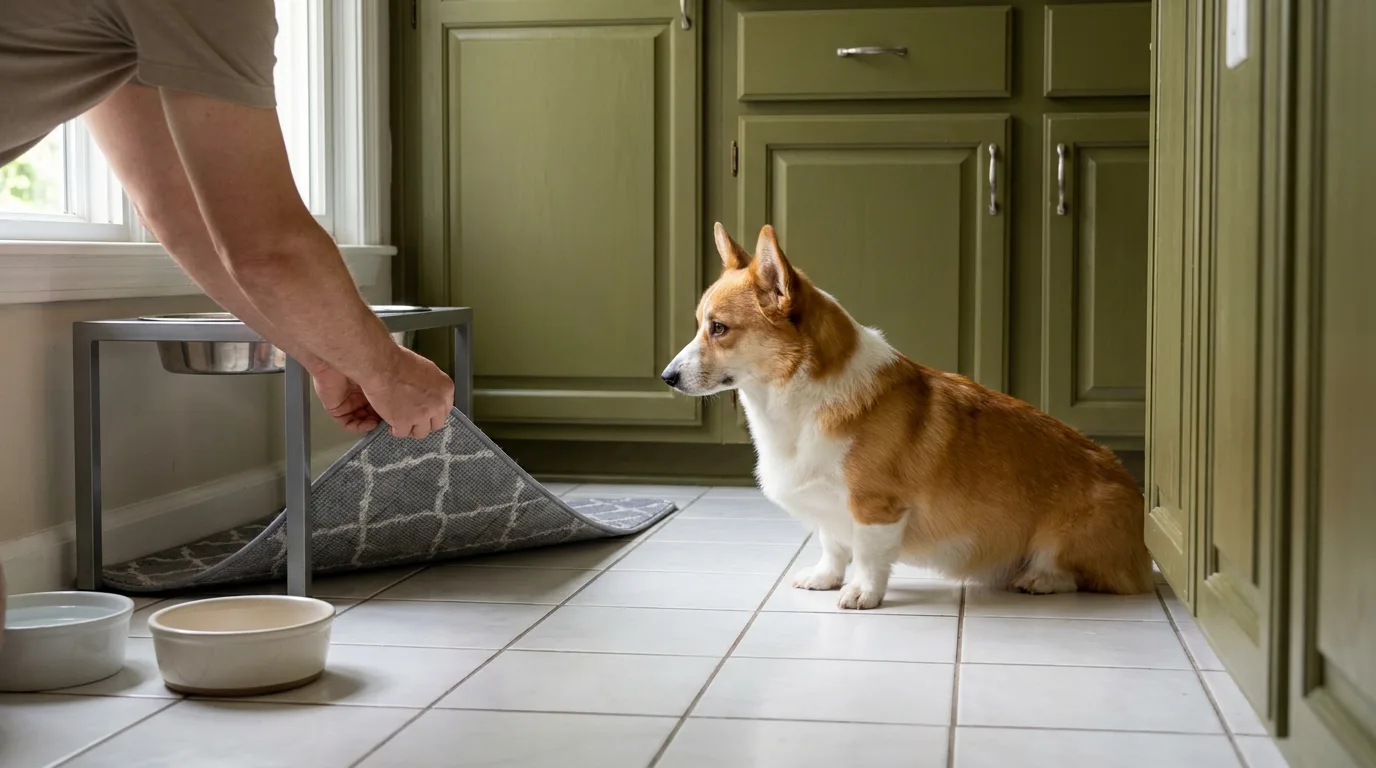
A practical station has enough room for the dog to eat comfortably and for you to remove the bowl without spilling food into corners. A washable mat can help contain ordinary drips, but it needs cleaning along with the dish. Choose an arrangement you can maintain after each meal rather than one that simply looks tidy when empty.
Keep meal preparation and cleanup connected. Measure the serving, return the remaining food to appropriate storage, and clean utensils and food-contact surfaces. Follow the product's thawing and opened-package directions. Keep old food residue out of the next meal instead of adding a fresh portion to an unwashed bowl.
For unopened pantry storage, JustFresh Home-Cooked Chicken offers an adult-maintenance alternative to Fresh Frozen food. Once opened, refrigerate it and use it within three days. Pantry convenience applies to the unopened package, not to leftovers in the feeding bowl.
Frequently asked questions
Reserve the planned treat calories before calculating the complete-food portion. Alternatively, use food already taken from the measured daily ration and count it only once. Put the allowance in one shared container so training, walks, and family rewards draw from the same supply.
Corgis should not receive toxic human foods such as chocolate, grapes or raisins, onions, or products containing xylitol. The ASPCA's food-safety guide explains several hazards. Also distinguish a safe occasional extra from a complete daily diet: plain meat or table leftovers do not establish balanced nutrition. Contact a veterinarian promptly if a harmful ingestion is suspected.
Many adult feeding routines divide the measured daily amount into two regular meals. Puppies generally need more frequent meals, with their schedule changing as they grow; follow the puppy's veterinary plan and the guidance discussed above. The key distinction is daily versus per-meal quantity. Dividing a ration into more meals does not mean serving the full daily allowance each time.
Corgis are often described as medium-sized dogs despite their short legs. For food selection, use the individual dog's actual weight, expected adult size, life stage, and body condition instead of treating short stature as a toy-dog portion rule. A measured calorie allowance gives a more useful serving calculation than a broad size category printed on a food package.
A breed-specific label is not required to identify a suitable complete food. Check the nutritional adequacy statement, life-stage eligibility, calorie density, and the individual dog's needs. In this comparison, Chicken & Rice and Fish & Sweet Potato include growth, while Beef & Russet Potato and JustFresh Home-Cooked Chicken are adult-maintenance choices. The exact recipe and measured portion matter more than a Corgi picture on the package.

Coreen Saito is a pet writer and longtime shelter volunteer with more than a decade in animal rescue. She covers cat behavior, breed care, and the small, ordinary science of sharing a life with companion animals, with a particular focus on honest takes about the products and decisions that actually matter. At home in Arizona, she's outranked by Mac (a dog with the loudest opinion in the house), Rebel (a cat who governs by quiet authority), and Meri (an orange tabby who runs the late shift and the laundry basket). She writes about all three, plus the rescues that keep coming through her life, at LifeWithMinty.com.
Sign up for expert-backed reviews and safety alerts all in one place.

A Final Word (Disclaimer)
At Petful, our review integrity is paramount; we never exchange special treatment in our reviews for monetary or material rewards.
Nonetheless, when our readers click through to online merchants (including Chewy or Amazon), we receive a referral commission. This supports the running of our free blog, and we appreciate your backing.