Service Dog Registration: What's Real and What's a Scam
There is no official US service dog registry, and no certificate or ID is legally required. Here is what actually makes a dog a service dog, the rights that status carries, and how the paid registration sites mislead owners.
Petful is reader supported. As an affiliate of platforms like Amazon and Chewy, we may earn a commission when you buy through links on this page. There is no extra cost to you.
If you have searched for service dog registration, you have already met a wall of websites promising an official certificate, a numbered ID card, and a spot in a "national database" for $79.99. Almost none of that means anything. Here is the honest version, straight up: under the Americans with Disabilities Act (ADA), there is no federal service dog registry, no required certificate, and no government ID that makes a dog a service animal. What actually makes a dog a service dog is training, not paperwork. This guide explains what service dog registration really is, what genuinely turns a dog into a service animal, the rights that status carries, and exactly how the paid registration sites mislead owners into buying props with no legal weight.
- 1Under the ADA there is no official service dog registry, certificate, or ID card, and none is legally required.
- 2What makes a dog a service animal is individual training to perform a task for a person's disability, not any registration you can buy.
- 3Paid "registration" sites sell certificates, cards, and vests that carry zero legal standing, and a business is never allowed to demand them anyway.

Sign up for expert-backed reviews and safety alerts all in one place.
What "Service Dog Registration" Actually Means (Legally)
Here is the part the marketplace works hardest to hide: legally, service dog registration means nothing. There is no federal registry maintained by any US agency. The Department of Justice, which enforces the ADA, has said plainly that covered businesses may not require documentation, and per guidance published at ada.gov, a service animal is simply a dog that is individually trained to do work or perform tasks for a person with a disability. Training is the entire definition. A registration number is not part of it.
That is why every site inviting you to "register your service dog" and pay for a listing is selling a product with no legal function. The certificate they mail you, the ID card, the "verified" database entry: none of it is issued by a government body, and none of it grants your dog a single right it did not already have from its training. A dog that meets the ADA's definition is a service dog whether or not it appears in any database. A dog that does not meet the definition is not a service dog no matter how many certificates you buy.
- The ADA does not require service dogs to be registered, certified, or issued an ID. Any website selling "official registration" is not a government service and is not issuing a legal credential. Save your money.
The one place the ADA mentions another animal is a separate, narrow provision for miniature horses that meet the same working standard. For the overwhelming majority of handlers, though, the rule is simple: a service animal is a trained dog, and the trained work is what counts.
What Actually Makes a Dog a Service Dog
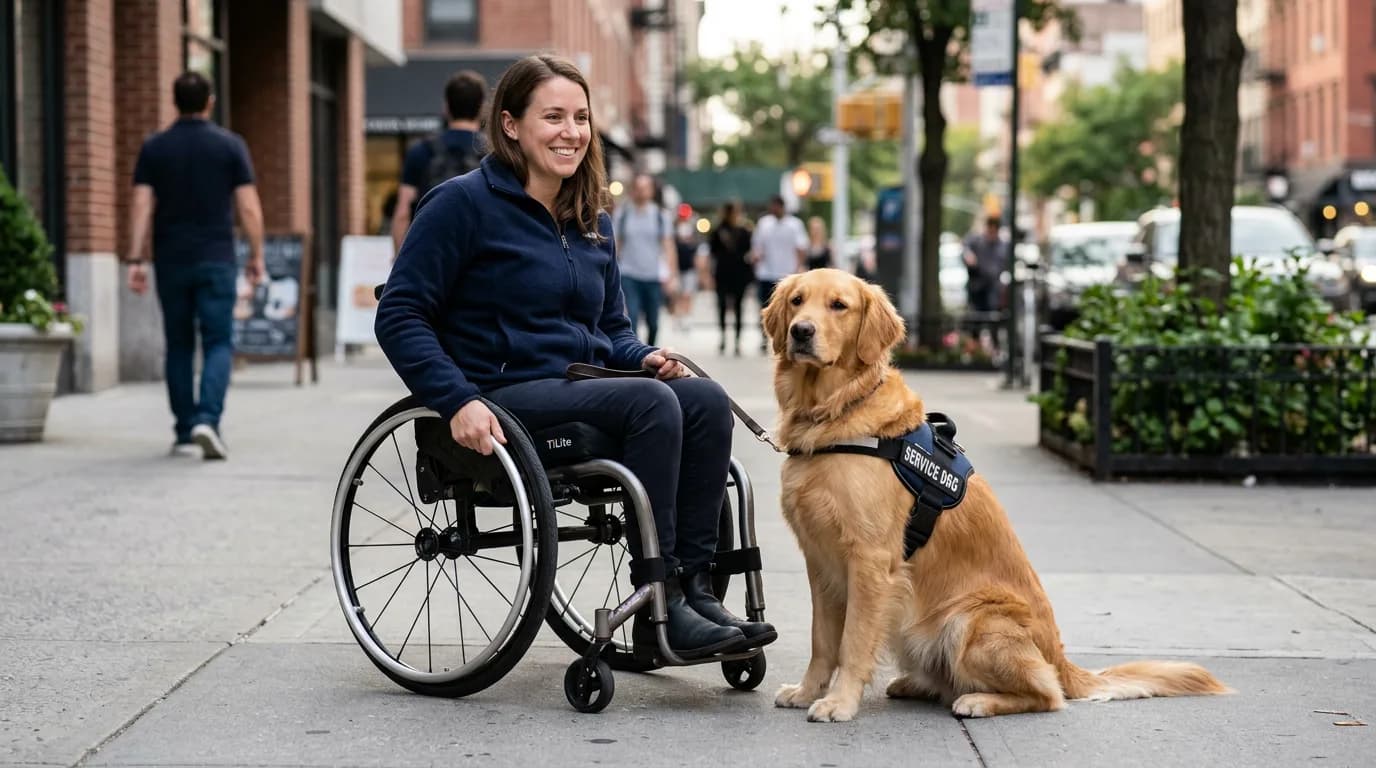
Strip away the merchandise and the real test has three parts. First, the handler must have a disability, meaning a physical, sensory, psychiatric, intellectual, or other condition that substantially limits a major life activity. Second, the dog must be individually trained to perform a specific task or do work that is directly related to that disability. Third, the dog must be under control and housebroken in public.
The task is the heart of it. A dog that guides a person who is blind, alerts a deaf handler to sounds, retrieves items for someone with limited mobility, interrupts a panic attack, reminds a handler to take medication, or braces a person who is unsteady is doing trained work. Comfort alone is not a task. A dog that simply makes its owner feel calmer by being present is an emotional support animal, which is a different category with different, narrower rights. If that is what you have, our guide to how to get an ESA letter walks through that honest process instead.

Petful may earn a commission when you click through to Chewy, at no extra cost to you.
How do I make my dog a real service dog?
You make a dog a real service dog by training it to perform a specific task tied to your disability, not by registering it anywhere. The steps are: confirm you have a qualifying disability, identify the concrete task the dog will do to help with it, and then train the dog to perform that task reliably while behaving calmly in public. The ADA does not require a professional trainer, so you may train the dog yourself, work with a private trainer, or go through a service dog organization. What matters is that the finished dog genuinely does the trained work and is well-mannered enough to be under control in public settings. No certificate, class completion card, or database listing is part of that legal picture. The training is the credential, and it is the only credential the law recognizes. To understand the different working roles a service dog can fill, our overview of the types of service dogs breaks down guide, hearing, mobility, medical-alert, and psychiatric service dogs.
Is It Easy to Register Your Dog as a Service Dog?
This question hides a trap, because "registering" and "qualifying" are two completely different things that the scam sites deliberately blur together.
Is it easy to get your dog registered as a service dog?
Yes, and that is exactly the problem: "registering" a dog is instant, effortless, and completely meaningless. A paid site will happily take any dog, of any breed, with no training and no assessment, and issue a certificate and ID card within minutes for a fee. There is no test, no verification, and no standard, because the registry itself has no legal authority. What is genuinely hard, and what actually matters, is the training that makes a dog able to perform a reliable task for a person's disability, which can take many months of consistent work. So the honest answer flips the question around. Getting your dog "registered" is trivial and worthless. Making your dog an actual service dog is real work, and once that work is done, no registration is needed to make it count. If a service is offering to register your dog in five minutes, that speed is proof you are buying nothing.
- Any site that will register a dog with no training and no assessment is selling paperwork, not status. The ease is the red flag. A real service dog is defined by trained work, which no online form can grant.
The Rights a Real Service Dog Carries
Once a dog genuinely meets the ADA definition, it carries meaningful rights, and these rights come from that status directly, never from a purchased card. A qualified service dog and its handler generally have:
- Public access to businesses and government facilities open to the public, including stores, restaurants, hotels, hospitals, and government offices, even where pets are banned
- Housing access under the federal Fair Housing Act, which requires most housing providers to make a reasonable accommodation and to waive pet fees and pet deposits for the animal
- Air travel access under the Air Carrier Access Act, under which airlines must accommodate a trained service dog, though the handler may need to submit a US Department of Transportation form in advance
- Freedom from pet surcharges, because a service dog is working equipment for a disability, not a pet
These are real, enforceable protections, which is exactly why the scam stings: people assume the rights come from the ID card, when in law they come entirely from the dog's training and the handler's disability. A business that improperly turns away a legitimate service dog can be violating federal law. A business that turns away a "registered" pet with no trained task is usually within its rights.

Petful may earn a commission when you click through to Chewy, at no extra cost to you.
- A qualified service dog has public-access, housing, and air-travel rights under federal law regardless of whether it is "registered." An ID card adds nothing to those rights, and a business cannot lawfully demand one to grant access.
The Two Questions a Business Can Ask (and How You Prove Access)
Because there is no registry to check, the ADA sets a deliberately simple standard for businesses. Staff who are not certain a dog is a service animal may ask only two questions: is the dog a service animal required because of a disability, and what work or task has the dog been trained to perform. That is the entire permitted inquiry.
Staff may not ask about your disability, may not require medical documentation, may not demand any certificate or ID, and may not require the dog to demonstrate its task on the spot. They can ask a dog to leave only if it is out of control and the handler does not regain control, or if it is not housebroken. Otherwise, your spoken answers to those two questions are what the law contemplates.
How do you prove that you have a service dog?
You prove it with your words, not with a document, because the ADA does not authorize anyone to demand proof beyond two questions. A business may ask whether the dog is required because of a disability and what task it is trained to perform, and your honest verbal answers are the legally sufficient response. You are not required to carry an ID card, show a certificate, produce registration papers, or reveal your diagnosis. This surprises people, because the whole registration industry exists to convince you that you need a card to "prove" your dog. You do not. A vest or an ID can be convenient shorthand that reduces awkward questions, and many handlers use one for that reason, but it is optional gear, never legal proof, and a business cannot lawfully condition access on it. The real thing that backs you up is that your dog actually performs its trained task and behaves in public, which no laminated card can fake.
What Service Dog Registration Really Costs (and What You Get)
Cost is where the deception does its damage, because the sites price a worthless certificate right next to the language of legitimacy so the two look interchangeable. They are not. Here is what the common "registration" products actually cost and what each one legally does.
| Where You "Register" | Typical Price | What It Legally Does |
|---|---|---|
| Paid "national service dog registry" listing | $50 to $200 | Nothing; it is not a government registry and grants no rights |
| Certificate plus photo ID card kit | $30 to $100 | Nothing; props a business can never require anyway |
| Vest or patch labeled "Service Dog" | $20 to $50 | Optional gear only; not proof and not required |
| Actual task training (self, trainer, or program) | $0 to $25,000 | The only thing that legally makes a dog a service dog |
The pattern is unmistakable. You are either paying for genuine training that creates a working dog, or you are paying for merchandise that creates nothing. A vest, a card, and a database number can feel official, but a business owner, a landlord's attorney, or a gate agent is never allowed to demand them, so they buy you no access you did not already have. Spend on the training, not the trinkets.
State Rules: Do the Requirements Change Where You Live?
Service dog access is governed by the federal ADA, so the baseline is the same in all fifty states, and no state operates an official registry that the ADA recognizes. Some states add their own protections on top, and many have passed laws that make it a violation to fraudulently pass a pet off as a service animal, which is a response to exactly the fake-credential problem this guide describes.
What are the requirements for a service dog in Arizona?
Arizona follows the federal ADA, so the core requirements are the same as everywhere else: you must have a disability, and your dog must be individually trained to perform a task directly related to it. Arizona does not run an official service dog registry, does not require certification, and does not require an ID card, so any site selling "Arizona service dog registration" is selling the same empty product as everywhere else. Arizona law does add one notable wrinkle in the other direction: it makes it a civil violation to fraudulently misrepresent a pet as a service animal, so buying a certificate to pass an untrained pet off as a service dog is not just useless in Arizona, it can expose you to a penalty. Businesses in Arizona are held to the same two-question limit as the rest of the country and may not demand documentation. The practical takeaway for Arizona handlers is identical to the national one: train the dog, skip the registry, and rely on the ADA.
How to Spot a Service Dog Registration Scam
The single most important fact to hold onto is that there is no official service dog registry in the United States, so every site built around registering, certifying, or issuing an ID for your service dog is selling a product the law does not recognize. The same racket runs in the emotional support world, which is why our how to get an ESA letter guide warns about the identical "register your animal" trap. Here are the red flags that a site is selling paperwork instead of legitimacy:

Petful may earn a commission when you click through to Chewy, at no extra cost to you.
- It offers to "register" or "certify" your dog with no training and no assessment
- It sells a certificate, ID card, database listing, or vest as if it were legally required for access
- It uses official-sounding names, government-style seals, or "national database" language to imply federal backing it does not have
- It claims the card will make businesses let your dog in, when businesses can never lawfully demand a card in the first place
- It promises instant approval or same-day service dog status for a fee
A legitimate path looks nothing like that. It centers on training the dog to perform a real task, it never claims a purchase grants rights, and it does not pretend a card is proof. If a service's core offer is a registration number rather than a trained dog, treat it as a scam and walk away.
- No US law requires you to register a service dog, and no registry has legal authority. If a site's main product is a certificate, ID, or database listing rather than actual training, it is selling you nothing.
Keep Your Service Dog's Own Paperwork in Order
Skipping the fake registry does not mean skipping real records. A service dog is still a dog, and honest guidance says its ordinary health paperwork genuinely matters, both for the animal's welfare and because housing and travel rules can require proof of vaccination even when they cannot require a service dog certificate. Keep a simple file with your dog's vaccination history, local licensing, and vet records.
If your service dog is a dog, that means staying current on core protection. Our overview of pet vaccination lays out the schedule, and the DHPP and DHLPP vaccine is the core combination most dogs need. That combination guards against serious diseases including distemper and, in the DHLPP version, leptospirosis. Rabies vaccination is legally required in most areas, so knowing the signs of rabies in dogs and staying current both protects your dog and satisfies the health requirements a landlord or airline can reasonably ask about.
If your future service dog is starting out as a brand-new puppy, you are building two things at once: the training that will one day make it a service dog, and the health foundation every dog needs. Our new puppy checklist walks through the early vet visits, records, and supplies so nothing slips in those first weeks.
It pays to start your dog’s paperwork trail on day one. A digital pet ID like MyPetID stores registration documents, vaccination records, the microchip number, and any ESA or service-dog paperwork in one place, so nothing is lost when you actually need to show it.
The Honest Bottom Line
Service dog registration is a marketing invention, not a legal requirement. Under the ADA there is no federal registry, no required certificate, and no government ID, and no business, landlord, or airline can lawfully demand one. What makes a dog a service dog is training to perform a real task for a person's disability, and that status carries genuine public-access, housing, and travel rights on its own. The certificates and cards sold online add nothing to those rights and cannot substitute for the training. Skip the registry, invest in the training, keep your dog's ordinary health records current, and you will have the only thing the law actually recognizes.
Do You Need a Service Dog Certificate or Certification?
No. A service dog certificate and service dog certification are not legal requirements, and no U.S. law recognizes either one. Under the ADA, a dog becomes a service dog the moment it is trained to do work or a task for a person's disability. Nothing has to be certified, stamped, or filed for that to be true.

Petful may earn a commission when you click through to Chewy, at no extra cost to you.
The "certificates" sold online, usually bundled with an ID card for a flat fee, are printed by private companies, not by any government body or accredited authority. They say nothing about the dog's training, and a business, landlord, or airline cannot require one.
What can carry real weight is documentation of actual training: a task log, a graduation record from a training program, or notes from a professional trainer. Those describe what the dog does. A store-bought certificate only shows that someone paid.
Because certification is optional, the popular search for how to certify a service dog "for free" has a simpler answer than people expect. You do not need to, and any site charging you for legitimacy is selling a document with no legal power.
Service Dog vs. Emotional Support Animal vs. Therapy Dog
These three roles get lumped together, but only one carries public-access rights, and the difference decides where your dog can legally go.
Service dog
Individually trained to perform a specific task tied to a disability, such as guiding, alerting to a medical event, or interrupting a panic episode. Protected under the ADA with full access to stores, restaurants, and other public places. A psychiatric service dog trained to do a real task belongs in this group too.
Emotional support animal (ESA)
Provides comfort simply by being present, with no task training. An ESA is not a service animal under the ADA and has no public-access rights. It may still qualify for a housing accommodation under the Fair Housing Act, but airlines are no longer required to treat ESAs as service animals, so most now board them as pets.
Therapy dog
Trained, and often evaluated by a volunteer group, to comfort other people in places like hospitals, schools, and nursing homes. A therapy dog works by invitation and has no automatic right to public spaces.
If a task-trained service dog is what you have, registration adds nothing to the rights the ADA already grants.
Is There a Federal or National Service Dog Registry?
No. There is no official federal, state, or national service dog registry, and the U.S. Department of Justice, which enforces the ADA, does not keep one. Any website that sounds governmental, puts "USA" or "national" in its name, or offers a "registry lookup," is a private business, not a public authority.
That distinction matters. A "registry lookup" only searches that one company's paid customer list. A genuine service dog that was never entered into it will not appear, and a fake dog whose owner paid the fee will. The database proves nothing in either direction.
Because no government registry exists, no business or landlord can require you to be listed in one. Staff confirm access by observing the dog and asking the questions the ADA allows, never by checking a number against an online directory.
What actually establishes a service dog
- The dog is trained to perform a task for a disability
- The dog is under control and behaves appropriately in public
- The handler can state the task the dog performs
None of those depend on being "registered" anywhere.
How to Tell a Real Service Dog From a Fake
Because vests, ID cards, and papers can be bought by anyone, the honest signal is behavior, not gear. A properly trained service dog looks almost boring in public, and that is exactly the point.
Signs of a genuine service dog
- Stays focused on its handler and ignores other people, dogs, and food
- Walks calmly on a leash or harness, or works under voice or signal control
- Is fully housebroken and settles quietly at the handler's side
- Responds to direction and performs a clear task on cue
Common tells of a fake
- Barking, lunging, growling, or pulling toward strangers
- Being carried in a bag or riding in a shopping cart
- Eliminating indoors or acting out of control
- A handler who cannot name a task the dog is trained to do
A vest, an ID card, or a printed certificate is not proof of anything. Under the ADA, a business can ask a disruptive or unhousebroken dog to leave even if it is a real service dog, because access depends on the dog's conduct, not its accessories. That is why buying registration to "look official" backfires: it never substitutes for training.
There is no waiting period, because registration is not required. A dog has full service dog status the moment it is trained to perform a task for a disability. Buying an online certificate takes only minutes, but it changes nothing about the dog's legal standing.
You can pay a private site to add your dog to its list and mail you a card, but the listing carries no legal weight and no business is required to accept it. Online registration is optional and proves nothing about training.
No. The VA does not run a service dog registry, though it helps cover veterinary costs for dogs paired with veterans through recognized programs for certain disabilities. Treat any site advertising "free registration for veterans" as a marketing hook, not an official step.
Train it to perform a specific task tied to your disability, not by registering it anywhere. Confirm you have a qualifying disability, identify the concrete task the dog will do, and train the dog to perform that task reliably while behaving under control in public. The ADA does not require a professional trainer or any certificate, so self-training is allowed. The trained work is the only credential the law recognizes.
Registering is instant and meaningless, which is the whole problem. Paid sites will register any untrained dog in minutes for a fee, but that listing has no legal authority. What actually matters, the task training that makes a dog able to help with a disability, takes months of work, and once done it needs no registration to count.
Arizona follows the federal ADA: you must have a disability and a dog individually trained to perform a task related to it. Arizona has no official registry, certification, or ID requirement, and it separately makes it a civil violation to fraudulently misrepresent a pet as a service animal. Businesses there are held to the same two-question limit as the rest of the country.
You prove it with your words, not a document. A business may ask only whether the dog is required because of a disability and what task it is trained to perform, and your honest verbal answers are legally sufficient. You are never required to carry an ID, show a certificate, produce registration, or disclose your diagnosis. A vest is optional convenience gear, not legal proof.

Coreen Saito is a pet writer and longtime shelter volunteer with more than a decade in animal rescue. She covers cat behavior, breed care, and the small, ordinary science of sharing a life with companion animals, with a particular focus on honest takes about the products and decisions that actually matter. At home in Arizona, she's outranked by Mac (a dog with the loudest opinion in the house), Rebel (a cat who governs by quiet authority), and Meri (an orange tabby who runs the late shift and the laundry basket). She writes about all three, plus the rescues that keep coming through her life, at LifeWithMinty.com.
Sign up for expert-backed reviews and safety alerts all in one place.