How to Get an ESA Letter: The Honest, Legal Guide
An emotional support animal letter is real and useful, but only a licensed mental-health professional can issue a valid one. Here is the honest, legal way to get an ESA letter and how to avoid the certificate scams.

Petful is reader supported. As an affiliate of platforms like Amazon and Chewy, we may earn a commission when you buy through links on this page. There is no extra cost to you.
If you have searched how to get an ESA letter, you have already run into a wall of websites promising instant approval, an official certificate, and a registration number for $49.99. Almost none of that is real. An emotional support animal (ESA) letter is a genuinely useful document, but only one kind of person can legally write a valid one, and no registry, database, ID card, or certificate can substitute for it. This honest guide walks through what an ESA letter actually is, who can issue a valid one, how the real process works, the housing rights it unlocks under federal law, and how to spot the scam sites that sell paperwork with no legal weight at all.
- 1A valid ESA letter can only be written by a licensed mental-health professional who is treating you, not by a website.
- 2The federal Fair Housing Act, not the ADA, is what gives an ESA letter its real power, and it applies to housing only.
- 3No registry, certificate, ID card, or vest is legally required or legally meaningful, and any site selling one is not issuing a credential.

Sign up for expert-backed reviews and safety alerts all in one place.
What an ESA Letter Actually Is (Legally)
An emotional support animal is a pet that provides comfort and relief from the symptoms of a diagnosed mental or emotional condition simply by being present. Unlike a service dog, an ESA is not trained to perform specific tasks. Its therapeutic value comes from companionship, routine, and the steadying effect an animal can have on anxiety, depression, and related conditions.
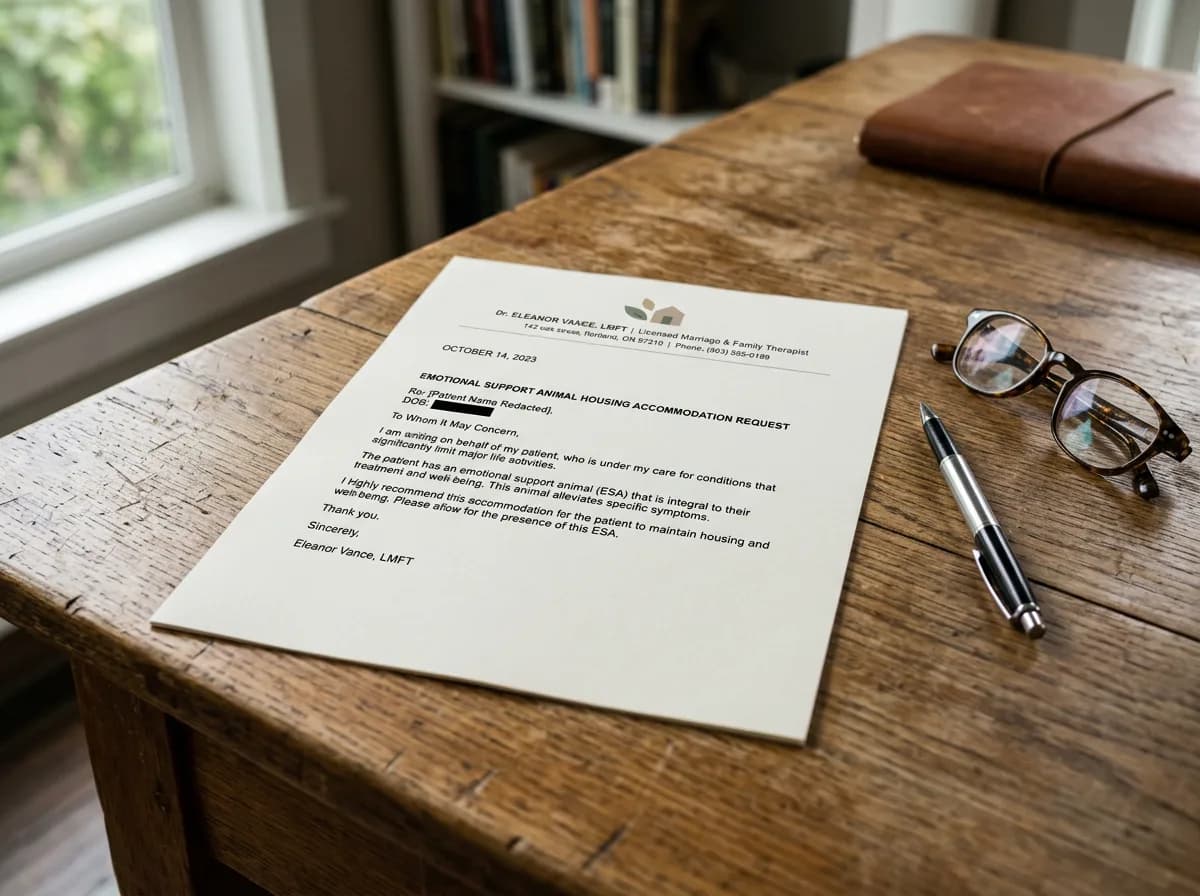
An ESA letter is the document that connects that animal to your treatment. It is a signed letter, on the professional's own letterhead, from a licensed mental-health provider stating that you have a condition recognized in the current diagnostic manual and that the animal is part of managing it. That is the entire product. There is no national ESA database, no government-issued ESA card, and no official seal that makes a letter more real. A plain letter from a licensed clinician outranks the fanciest laminated certificate every time.
- The valid document is a signed letter from a licensed mental-health professional on their letterhead. A certificate, ID card, or registry number is not the same thing and carries no legal standing on its own.
The letter typically confirms three things: that the provider is licensed and treating you, that you have a qualifying condition, and that the animal helps ease that condition. It usually includes the provider's license type, license number, and the date. It does not need to disclose your specific diagnosis to a landlord, and you are not required to hand over your full medical records to anyone.
It also helps to understand what an ESA letter is not, because that is where most people get taken advantage of. It is not a lifetime pass, it is not a public-access permit, and it is not a product you buy off a shelf. The letter is only as strong as the clinical judgment behind it. That is why two letters that look nearly identical on paper can behave completely differently when a landlord pushes back: one is backed by a licensed provider who actually knows you, and the other is backed by a website that has never met you. The paper is the same, but only one of them is real.
ESA vs. Service Dog vs. Therapy Animal: Know the Difference
People lose money and get denied housing because these three categories get blurred together. They are not the same, and the laws that cover them are different.
A service dog is individually trained to perform specific tasks for a person with a disability, such as guiding someone who is blind, alerting to a seizure, or interrupting a panic attack. Service dogs are covered by the Americans with Disabilities Act (ADA) and have broad public-access rights, meaning they can go into restaurants, stores, and airplanes. Per guidance published at ada.gov, staff may only ask two questions and may never demand paperwork or a demonstration. If you want to understand that category in depth, our guide to the types of service dogs breaks down the working roles.
An emotional support animal provides comfort through its presence and is not task-trained. ESAs do not have public-access rights under the ADA. You cannot bring an ESA into a grocery store or a restaurant the way a service dog can go. What an ESA letter does give you is protection in housing under a separate law, the Fair Housing Act.

A plush, long-fur donut bolster bed with a raised rim that gives a recovering pet a secure, cushioned place to curl up during the crucial 10 to 14 days after surgery.
Petful may earn a commission when you click through to Chewy, at no extra cost to you.
A therapy animal is a third thing entirely. Therapy animals are handled by their owners to provide comfort to other people, in settings like hospitals, nursing homes, and schools. A therapy dog visiting a hospital ward has no special rights in your own apartment, and that role has nothing to do with getting an ESA letter for yourself.
The reason these categories get deliberately blurred is money. When a website conflates an ESA with a service dog, it can imply that its certificate unlocks restaurants, stores, and airline cabins, which sounds worth paying for. It is not true, and acting on it can get you turned away in public or accused of misrepresenting an animal, which is a real offense in a growing number of states. Keep the three categories straight in your own mind and you will not fall for the pitch. An ESA is a housing accommodation. A service dog is a trained working animal with public access. A therapy animal serves other people. Only the first one is what an ESA letter is about.
- An ESA letter does not let you bring your animal into stores, restaurants, or the cabin of a plane. Only trained service dogs have public-access rights under the ADA. Anyone telling you otherwise is selling something.
Who Can Legally Write Your ESA Letter
This is the part the scam sites work hardest to blur. A valid ESA letter can only come from a licensed mental-health professional who is qualified to assess your condition. In practice that means one of the following:
- A licensed psychologist
- A licensed clinical social worker (LCSW)
- A licensed professional counselor (LPC) or licensed mental-health counselor (LMHC)
- A licensed marriage and family therapist (LMFT)
- A psychiatrist or psychiatric nurse practitioner
- Your primary-care physician, if they are comfortable assessing and documenting a mental-health condition
The one non-negotiable is that the person must hold an active license, ideally in the state where you live, and must have actually evaluated you. A letter from someone who has never spoken with you, or who "approves" you through a 60-second web form and no real assessment, is exactly the kind of letter a landlord can challenge. The value of the letter is the clinical relationship behind it, not the PDF itself.
Legitimate telehealth platforms exist, and using one is fine, as long as a real licensed clinician in your state actually assesses you and is willing to put their license behind the letter. The difference between a legitimate telehealth service and a scam is not whether it happens online. It is whether a licensed human being genuinely evaluates you and stands behind the document.
What Belongs in a Valid ESA Letter
Knowing what a real letter contains makes it easy to tell a genuine document from a printed prop. A letter that will actually hold up with a housing provider generally includes the provider's professional letterhead, their license type and license number, the state where they are licensed, and the date the letter was written. It confirms that you are under their care and that you have a condition that substantially limits one or more major life activities, without necessarily naming the specific diagnosis. It then states that an emotional support animal is part of your treatment or would ease the symptoms of that condition.
Just as important is what a valid letter does not need. It does not need to disclose your full diagnosis to a landlord. It does not need a registry number, a case number from any database, or a serial code. It does not need a photo of the animal, a certificate, or an ID card. And it does not expire on some arbitrary schedule invented by a website, although many housing providers reasonably ask for a letter dated within the past year, so a current letter is worth keeping on hand.
- When your provider writes the letter, ask them to phrase it so it confirms your need for the accommodation without disclosing your specific diagnosis. That protects your privacy while still giving a landlord the reliable documentation the Fair Housing Act allows them to request.
If a letter is missing the license information or the provider's signature, it is not a valid ESA letter no matter how official the rest of it looks. Conversely, a plain one-paragraph letter that has those elements is exactly what the law contemplates.
How to Get an ESA Letter, Step by Step
Here is the honest process, start to finish. None of it requires paying a registry.

Peanut butter soft chews with L-theanine, chamomile, and ashwagandha to ease hyperactivity and support calm, relaxed behavior.
Petful may earn a commission when you click through to Chewy, at no extra cost to you.
Step 1: Confirm You Have a Qualifying Condition
An ESA letter is grounded in a diagnosed mental or emotional condition. If you already see a therapist, counselor, or psychiatrist, you are most of the way there. If you do not, the first real step is talking to a professional, not buying a certificate.
Step 2: Talk to a Provider Who Already Treats You
The simplest and cheapest path is to ask a clinician you already work with. They know your history, so they can decide quickly whether an ESA fits your treatment. There is usually no extra charge beyond your normal visit copay.
Step 3: If You Have No Provider, Find a Licensed One
If you are not currently in treatment, you can start with a licensed therapist through your insurance, a community mental-health center, or a reputable telehealth platform that connects you with a licensed clinician in your state. Verify the license before you pay anything.
Step 4: Have the Assessment
The provider evaluates whether you have a qualifying condition and whether an emotional support animal is a reasonable part of managing it. This is a real conversation, not a checkbox.
Step 5: Get the Letter in Writing
If the clinician agrees, they write and sign the letter on their letterhead, including their license type and number and the date. Ask for a version you can share with a landlord that confirms the need without disclosing your specific diagnosis.
How do I ask my doctor for an ESA letter?
Be direct and honest. You do not need a script or special legal language. Tell your provider that your pet meaningfully helps your anxiety, depression, or other condition, and ask whether they would be comfortable writing an emotional support animal letter documenting that. Bring specifics: describe how the animal changes your daily symptoms, such as helping you get out of bed, easing panic, or giving you a reason to keep a routine. If your regular doctor is not comfortable writing it, that is normal, and they can often refer you to a mental-health provider who will assess you properly. Never pressure a clinician to sign something they have not evaluated. A letter they believe in is the one that holds up.
What is the fastest way to get an ESA letter?

The fastest legitimate way to get an ESA letter is to ask a licensed provider who already treats you, because they can often document your need in a single existing appointment with no new assessment required. If you have no provider, the next fastest honest route is a reputable telehealth service where a licensed clinician in your state evaluates you, sometimes within a few days. Be very skeptical of any site promising a letter in minutes or "instant same-day approval" with no real conversation. Speed that skips the clinical assessment is the single biggest red flag that you are buying a worthless document that a landlord can reject on sight.
Do You Actually Qualify for an ESA?
An ESA letter must be tied to a condition recognized in the current diagnostic manual (the DSM-5-TR). Common qualifying conditions include anxiety disorders, major depression, panic disorder, post-traumatic stress disorder, obsessive-compulsive disorder, phobias, and certain other diagnosed mental-health conditions. The decisive question is not the label alone. It is whether a licensed professional believes the animal genuinely helps you manage that condition.
This is worth sitting with, because it is the opposite of how the marketplace frames it. The scam sites treat qualification like a quiz you pass to unlock a purchase. Real qualification is a clinical judgment made by someone accountable for it. You do not qualify because you checked the right boxes on a form. You qualify because a licensed provider who has assessed you concludes that an emotional support animal is a reasonable part of your care. That is a higher bar than a web form, and it is also the reason the resulting letter actually protects you.
Can I get an ESA if I have PTSD?
Yes. Post-traumatic stress disorder is one of the most commonly documented conditions behind ESA letters, and a licensed mental-health professional can absolutely write one if they are treating you for PTSD and believe your animal eases your symptoms. Many people with PTSD find that an animal's presence reduces hypervigilance, interrupts flashbacks, and makes it easier to sleep and to leave the house. One note worth understanding: if your dog is individually trained to perform a specific task related to your PTSD, such as waking you from a nightmare or creating space around you in a crowd, that may make it a psychiatric service dog with broader public-access rights under the ADA, which is a stronger category than an ESA. Either way, the qualifying step is the same. A licensed provider assesses you and documents the need.

Petful may earn a commission when you click through to Chewy, at no extra cost to you.
Can an ESA help with OCD?
Yes. Obsessive-compulsive disorder is a recognized qualifying condition, and an emotional support animal can be part of managing it. For many people with OCD, an animal provides a grounding routine, a source of comfort during intrusive-thought spirals, and a reason to step away from compulsions. As with any condition, the letter still has to come from a licensed mental-health professional who is treating you and who believes the animal genuinely supports your care. An ESA is not a replacement for evidence-based OCD treatment such as therapy or medication. It is a complement to it, and a good clinician will frame it that way in the letter.
- There is no fixed list of "approved" diagnoses that guarantees a letter. What matters is that a licensed professional has evaluated you and genuinely believes an emotional support animal helps manage your condition. Honesty in that conversation is what makes the letter hold up.
What a Legitimate ESA Letter Costs
Cost is where the scams do their damage, because they price a worthless certificate right alongside a real clinical service so the two look interchangeable. They are not. Here is what the real options actually cost and what you get for the money.
| Where You Get It | Typical Price | What You Actually Receive |
|---|---|---|
| Your current therapist or doctor | $0 beyond your usual copay | A valid letter, if it fits your treatment |
| Licensed telehealth mental-health service | $95 to $200 | A real clinical assessment and a valid letter if you qualify |
| "Instant ESA certificate" registry | $50 to $150 | A certificate with no legal standing at all |
| Registration kit with vest and ID card | $20 to $80 | Props that carry zero legal weight |
The pattern is clear. You are paying for a licensed professional's assessment and signature, or you are paying for nothing. A vest, an ID card, and a registry number can feel official, but a landlord's attorney knows they mean nothing. Spend your money on the clinical relationship, not the merchandise.
Your Housing Rights Under the Fair Housing Act
This is the real reason an ESA letter is worth having. The Fair Housing Act (FHA) requires most housing providers to make a reasonable accommodation for a tenant with an emotional support animal, even in buildings that otherwise ban pets. This is federal guidance enforced by the Department of Housing and Urban Development (HUD), and it is a different, broader protection than the ADA's public-access rules.
Under the FHA, if you have a valid ESA letter, a landlord generally must:
- Allow your emotional support animal even under a no-pets policy
- Waive pet fees and pet deposits for the ESA, because it is an accommodation, not a pet
- Avoid breed or weight restrictions that would otherwise apply, within reason
There are real limits, and honest guidance says so. A housing provider can deny the accommodation if the specific animal poses a direct threat to the safety of others or would cause substantial physical damage, if the request would impose an undue financial or administrative burden, or if the building is one of the narrow categories the FHA exempts (such as some owner-occupied buildings with four or fewer units). A landlord may also ask for documentation of the need when the disability or the need is not obvious, and that documentation is your letter from a licensed professional.
- The Fair Housing Act protects ESAs in housing, not in stores, restaurants, or airplane cabins. Landlords can require reliable documentation from a licensed provider, which is exactly why a real letter matters and a purchased certificate does not.
What a landlord cannot do is demand your entire medical file, insist on a specific diagnosis, require the animal to be professionally trained, or charge you a pet deposit for a documented ESA. If you meet resistance, HUD's assistance-animal guidance is the standard both sides are measured against, and putting your request in writing creates a record.
How to Request the Accommodation
You do not need a lawyer to ask. Send your housing provider a short written request stating that you have a disability-related need for an assistance animal and that you are requesting a reasonable accommodation under the Fair Housing Act, and attach your letter from the licensed provider. Keep it factual and brief. You are not required to describe your condition in detail, only to establish the need through the documentation the law allows a landlord to request. Send it by email or another method that timestamps it so you have a record of when you asked and what you provided. If the landlord responds with questions, they are generally limited to confirming the disability-related need, not interrogating your diagnosis. A calm paper trail resolves most accommodation disputes before they escalate.
Common Myths About ESA Letters
A few stubborn myths cost people money and get their accommodations denied. Clearing them up is part of getting this right.
The first myth is that you must register your animal or buy a certificate. You do not. No US law requires registration, and no registry has legal authority. The second myth is that an ESA can go anywhere a service dog can. It cannot. ESA protection lives in housing under the Fair Housing Act, not in public spaces under the ADA. The third myth is that a vest or an ID card gives your animal rights. It does not. Those items are merchandise, and a housing provider's attorney knows it. The fourth myth is that any doctor can be talked into signing a form for a fee. A responsible clinician writes a letter only after genuinely assessing you, and a letter produced any other way is the kind that gets challenged.

A durable rubber dog toy that can be stuffed with treats and selected by the manufacturer's size guide; supervise use and retire it when damaged.
Petful may earn a commission when you click through to Chewy, at no extra cost to you.
The fifth and most damaging myth is that faster is better. The websites promising a letter in minutes are optimizing for your impatience, not your protection. A letter that skips the clinical assessment is precisely the letter a landlord can reject, which means you paid for a document that fails exactly when you need it. The slower, honest route produces the only version that works.
- A plain letter from a licensed clinician who actually assessed you beats every certificate, badge, and registry number on the market. Doing it the real way is not just more ethical, it is the version that protects your housing when it is tested.
How to Spot a Fake ESA Registry or Certificate Scam
The single most important thing to understand is this: there is no official ESA registry in the United States. None. Every website that invites you to "register your emotional support animal" and pay for a listing is selling a product that has no legal function. The same is true of the sister scam covered in our guide to service dog registration, where paid databases and ID cards are marketed as if they were credentials. They are not.
Here are the red flags that a site is selling paperwork instead of care:
- It promises "instant approval" or a letter in minutes with no real assessment
- It sells a certificate, an ID card, a registry listing, or a vest as if it were legally required
- It never connects you to a licensed clinician in your state, or hides the clinician's license entirely
- It uses official-sounding names, seals, or "national database" language to imply government backing
- It guarantees approval before anyone has evaluated you
A legitimate service does the opposite. It is transparent about the licensed provider, it involves a genuine assessment, it delivers a plain signed letter rather than a laminated badge, and it never claims your animal gains public-access rights. If a landlord or an attorney ever tests the document, the clinical relationship behind it is what holds. A registry number holds nothing.
- No US law requires you to register an emotional support animal, and no registry has any legal authority. If a site's core offer is a registration or a certificate rather than a licensed clinician's assessment, treat it as a scam.
Keep Your ESA's Own Paperwork in Order
An ESA letter covers your need for the animal. It does not exempt the animal from ordinary responsibilities, and honest guidance says so plainly. Under the Fair Housing Act, a landlord can still hold you to reasonable rules: the animal must not be a direct threat, must not cause damage, and must comply with local licensing and health requirements. That means your emotional support animal's own records still matter.
Keep a simple file with your animal's vaccination history, licensing, and vet records. If your ESA is a dog, that includes staying current on core protection. Our overview of pet vaccination explains the schedule, and the DHPP and DHLPP vaccine is the core combination most dogs need. That combination guards against serious diseases including distemper and, in the DHLPP version, leptospirosis. Rabies vaccination is legally required in most areas, so knowing the signs of rabies in dogs and staying current protects your animal and satisfies the health requirements a landlord can reasonably ask about.
If your emotional support animal is a brand-new puppy, you are starting two paperwork trails at once: the ESA letter for yourself and the health foundation for the dog. Our new puppy checklist walks through the early vet visits, records, and supplies so nothing slips through the cracks in those first weeks.
It pays to start your dog’s paperwork trail on day one. A digital pet ID like MyPetID stores registration documents, vaccination records, the microchip number, and any ESA or service-dog paperwork in one place, so nothing is lost when you actually need to show it.
The Honest Bottom Line
Getting an ESA letter is simpler, cheaper, and more legitimate than the marketplace wants you to believe. The valid version is a signed letter from a licensed mental-health professional who has actually assessed you, and it gives you real housing protection under the Fair Housing Act. The invalid version is a certificate, an ID card, or a registry listing sold by a website, and it gives you nothing. Skip the props, have an honest conversation with a licensed provider, keep your animal's own records current, and you will have documentation that stands up when it counts.
Can You Get an ESA Letter for a Cat, Dog, or Any Other Animal?
Yes. An ESA letter is not tied to a species. The Fair Housing Act protects emotional support animals in general, and HUD guidance treats commonly kept household animals (dogs, cats, rabbits, small birds, hamsters, and similar pets) as reasonable by default. Your letter names your specific animal, so the same process that works for a dog works for a cat, and the qualifying factor is your mental health need, not the breed or type of pet.
A few practical points:
- The letter should identify the animal (species, and often its name). One provider can document more than one ESA if you genuinely need each, though every additional animal invites more landlord questions.
- Unusual or exotic animals (reptiles, larger birds, anything not commonly kept in the home) are not automatically covered. Your provider has to explain why that particular animal is necessary, and a landlord can reasonably ask for that detail.
- Getting the letter is identical whether it is for a cat or a dog. What a clinician evaluates is your condition and how the animal helps you, never the species itself.
How Long Does It Take to Get an ESA Letter?
Realistically, anywhere from the same day to about a week. The timeline depends on which route you take:
- Through your own therapist or doctor: if you already see a licensed provider for a qualifying condition, they may write the letter within a few days, because the clinical relationship already exists.
- Through a legitimate online service: you complete an assessment that a state-licensed clinician actually reviews. A genuine evaluation can turn around the same day or within a few business days, but a real clinician still has to sign off.
- Starting from scratch with a new provider: expect longer, because some states require an established relationship before a letter can be issued (see the state section below).
Be wary of anything promising an instant letter in minutes with no evaluation. Speed itself is fine, but skipping the clinical assessment entirely is the pattern behind fake letters that landlords reject.
Also plan for renewals. An ESA letter does not legally expire under the Fair Housing Act, but most landlords want one dated within the past 12 months, so treat it as an annual refresh.
Does ESA Letter Law Change From State to State?
Your core housing protection does not, because the Fair Housing Act is federal and applies in all 50 states. What changes is how the letter must be issued and how misuse is penalized.
The clearest example is California. Under AB 468, before a provider can write an ESA letter they must hold a valid California license, have had a client relationship with you for at least 30 days, complete a clinical evaluation, and give you specific written disclosures. That 30-day rule alone means a same-day letter is not possible for a brand-new California patient.
More broadly:
- Several states require the clinician to be licensed in the state where you live, so an out-of-state signature can be rejected.
- A growing number of states (such as Montana, Iowa, and Arkansas) have passed laws penalizing fake or misrepresented ESA documentation.
- Texas, Florida, Ohio, Utah, and most other states currently follow the federal baseline with no extra 30-day-style requirement, though that can change.
Before you pay anyone, confirm the provider is licensed in your state and check whether your state adds requirements on top of the FHA.
Can You Get an ESA Letter for Free?
Sometimes, but only through a real provider, never through a free-letter website. There is no such thing as legitimate ESA documentation with zero clinical involvement, and free is the most common hook used by fake registries.
The genuinely low-cost or no-cost routes all run through a licensed professional you can already reach:
- Your current therapist, psychiatrist, or primary care doctor can write the letter as part of care you are already receiving, often at no charge beyond your normal visit.
- Community mental health centers frequently work on a sliding scale, so a qualifying evaluation may cost little or nothing.
- Students can ask their campus counseling center, and veterans can ask their VA mental health provider.
- Insurance does not pay for an ESA letter as a product, but if the underlying appointment is covered, your out-of-pocket cost may be only a copay.
If a site offers a free letter with no evaluation and no named, licensed clinician, treat it as a scam. The section above on spotting fake registries explains exactly what to look for.
The fastest legitimate route is asking a licensed provider who already treats you, since they can often document the need in an existing appointment. With no current provider, a reputable telehealth service with a licensed clinician in your state is next, sometimes within days. Avoid any site promising a letter in minutes with no real assessment.
Yes. PTSD is one of the most commonly documented conditions behind ESA letters, and a licensed provider treating you can write one if they believe your animal eases your symptoms. If your dog is trained to perform a specific PTSD-related task, it may qualify as a psychiatric service dog with broader rights.
Yes. Obsessive-compulsive disorder is a recognized qualifying condition. An emotional support animal can provide grounding routine and comfort, though the letter must still come from a licensed professional treating you, and an ESA complements rather than replaces evidence-based OCD treatment.
Be direct and specific. Tell your provider how your animal helps your diagnosed condition day to day, and ask whether they would be comfortable writing an emotional support animal letter. If they are not, they can often refer you to a mental-health provider who can properly assess you and write it.

Coreen Saito is a pet writer and longtime shelter volunteer with more than a decade in animal rescue. She covers cat behavior, breed care, and the small, ordinary science of sharing a life with companion animals, with a particular focus on honest takes about the products and decisions that actually matter. At home in Arizona, she's outranked by Mac (a dog with the loudest opinion in the house), Rebel (a cat who governs by quiet authority), and Meri (an orange tabby who runs the late shift and the laundry basket). She writes about all three, plus the rescues that keep coming through her life, at LifeWithMinty.com.
Sign up for expert-backed reviews and safety alerts all in one place.