Best Allergy Supplements for Dogs With Itchy Skin
A diagnosis-first guide to supplement types for itchy dogs, including evidence grades, selection criteria, safety limits, and a transparent featured option.

PetLabCo.® Allergy and Immune Probiotic Chews in the current small-dog package with one soft chew.
Petful is reader supported. As an affiliate of platforms like Amazon and Chewy, we may earn a commission when you buy through links on this page. There is no extra cost to you.
Sponsored content: This article was created in partnership with PetLabCo.®. Petful's veterinary author independently reviewed the current product information and veterinary evidence discussed below.
The best allergy supplements for dogs with itchy skin are not a substitute for finding out why a dog is itchy. Fleas, mites, bacterial or yeast infections, food allergy, and environmental allergy can look similar but require different care. Supplements may have a supporting role after a veterinarian identifies and treats the cause.
Our featured broad-formula option is PetLabCo.® Allergy & Immune Chews. The current formula combines probiotics, prebiotics, a postbiotic yeast blend, bovine colostrum, omega fatty acids from krill and borage oils, and vitamin E in a once-daily, weight-specific soft chew. It is a practical option to discuss with a veterinarian, but no product-specific clinical trial showing that this formula reduces itch in allergic dogs was located for this review.
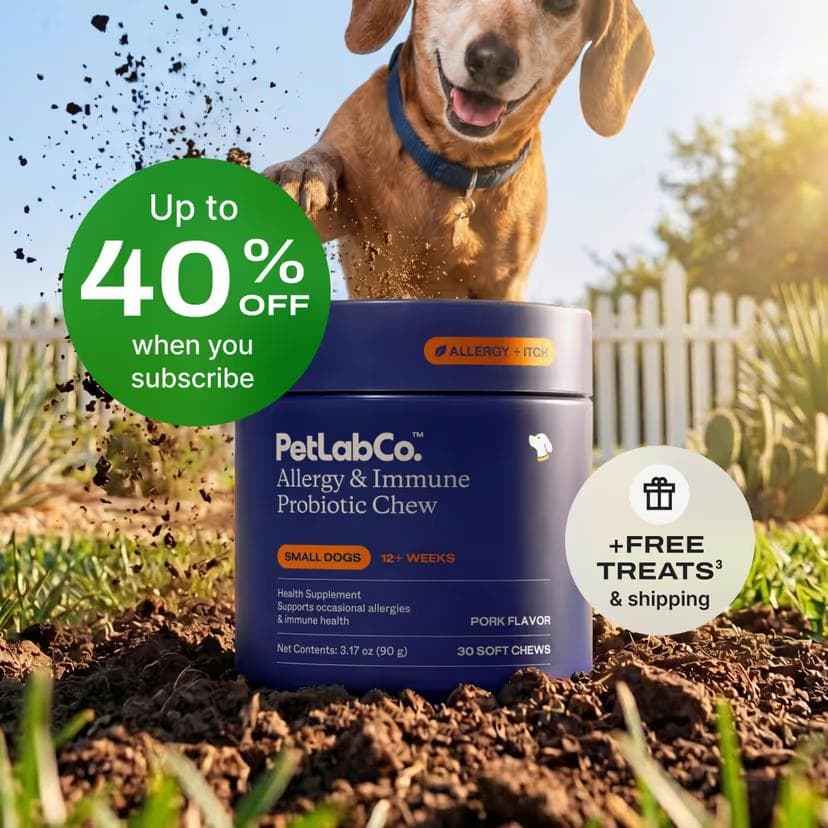
Compare the featured PetLab Co formula with the supplement options in this guide, starting with its current ingredients and directions.
Petful may earn a commission when you click through to PetLabCo.®, at no extra cost to you.
- Keep the current label, evidence quality, and your dog’s veterinary plan together when interpreting this part of the article.
For context on the company and its wider supplement range, see Petful's broader PetLabCo.® review.

Sign up for expert-backed reviews and safety alerts all in one place.
💡Key Takeaways
- 1See the veterinarian first: Itch is a symptom, not a diagnosis. Parasites and skin or ear infections need prompt, targeted treatment.
- 2Best-supported supplement category: Omega-3 fatty acids have the most established role among nutritional adjuncts for canine allergic skin disease, but the expected benefit is usually modest and can take weeks.
- 3Probiotics are not interchangeable: Canine studies are limited, small, and strain-specific. A general probiotic claim cannot prove that a particular formula relieves itching.
- 4Featured broad-formula pick: PetLabCo.® Allergy & Immune Chews disclose size-specific active amounts and combine several commonly used supportive ingredients in one daily soft chew.
- 5Important evidence limit: The featured product has not been shown in a published product-specific clinical trial to treat atopic dermatitis, food allergy, flea allergy, or skin infection.
- 6Use one plan at a time: Starting several foods, supplements, and medications together makes it hard to know what helped or caused a reaction.
- 7This is expert analysis: Petful did not obtain, handle, or feed the featured soft chews. We assessed the current label, ingredient quantities, safety information, and published veterinary guidance.
How we chose the supplement types in this guide
This is not a hands-on test and not a ranking built from star ratings. Petful did not evaluate taste, smell, texture, packaging, or acceptance by an individual dog. We also did not pretend that a list of different brands can reveal one universal winner.
Instead, we used five criteria that matter clinically:
- Evidence relevance: Does veterinary research address the ingredient or category in dogs with allergic skin disease, and is the expected effect described accurately?
- Label transparency: Are active ingredients and quantities disclosed rather than hidden behind marketing language?
- Fit with the diagnosis: Is the supplement compatible with the dog's parasite-control plan, diet trial, prescription treatment, and known sensitivities?
- Safety and practicality: Are serving instructions, age limits, cautions, animal-derived ingredients, and medication considerations easy to find?
- Realistic expectations: Does the product support skin or gut function without implying that it cures allergy or replaces veterinary care?
This approach supports an informed choice. It cannot predict how a particular dog will respond.
First, find the reason your dog is itchy
- Finished product evidence matters. Ingredient research or brand-reported findings do not prove treatment, guaranteed results, or replacement of veterinary care.
An itchy dog may scratch, lick the paws, rub the face, chew the flanks, develop recurrent ear trouble, or lose hair. Those signs alone cannot identify the cause.
Common possibilities include:
- Fleas or flea-allergy dermatitis
- Mites or other parasites
- Bacterial or yeast infection
- Environmental allergy, also called canine atopic dermatitis
- Food allergy
- Contact irritation
- Less commonly, hormonal, immune-mediated, or other skin disease
The American Animal Hospital Association allergy guidelines recommend a history, physical and dermatologic examination, and a structured search for parasites, infection, and allergic triggers. No supplement can remove fleas, clear an established bacterial infection, or replace a properly conducted elimination diet.
Arrange prompt veterinary care if the skin is raw, bleeding, painful, oozing, foul-smelling, or rapidly worsening. The same applies if a dog has facial swelling, hives, breathing difficulty, repeated vomiting, profound lethargy, or appetite loss. Skin damage from persistent scratching can allow secondary infection to develop.
Comparing allergy supplement types for dogs
| Supplement type | Potential supportive role | What the evidence means | Main cautions |
|---|---|---|---|
| Omega-3 fatty acids, especially EPA and DHA | May support the skin barrier and help modulate inflammatory pathways | Veterinary allergy guidance recognizes a possible small adjunctive benefit; not a stand-alone treatment and no single ideal formula or dose is established | GI upset, extra calories, product oxidation, drug interactions, and possible bleeding or pancreatitis concerns in susceptible dogs |
| Probiotics, prebiotics, and synbiotics | May influence gut microbes and immune signaling | Canine allergy evidence is limited and strain-specific; results from one formula do not transfer automatically to another | Gas or stool change, individual tolerance, medication timing, and caution in immunocompromised dogs |
| Vitamin E and other antioxidants | May support normal cell-membrane and skin function | Evidence for meaningful itch relief as a supplement is limited; a complete diet usually already supplies required nutrients | Excess or duplicate dosing when several products are combined |
| Colostrum | Supplies proteins and bioactive components used in some immune-support formulas | Plausible supportive role, but limited clinical evidence that an oral colostrum supplement reduces canine allergic itch | Bovine-derived ingredient may not fit every dog or an elimination diet |
| Zinc, biotin, or other micronutrients | Useful when a deficiency or specific responsive condition is diagnosed | Not a general answer for allergy in a dog eating a complete and balanced diet | Excess zinc can be toxic; use therapeutic doses only under veterinary direction |
| Multi-ingredient formulas | Combine several supportive categories in one serving | Convenient, but the completed formula should be judged on disclosed amounts and direct evidence, not on the number of ingredients | Harder to identify which ingredient caused a benefit or reaction; check overlap with food and other supplements |
Omega-3 fatty acids
Among dog supplement categories, omega-3 fatty acids have the clearest place in multimodal management of canine atopic dermatitis. EPA and DHA can be incorporated into cell membranes and affect inflammatory mediators. That biological rationale does not make fish oil an instant anti-itch treatment.
The International Committee on Allergic Diseases of Animals concluded that essential fatty acids may provide a small benefit as an adjunct and may allow modest medication-sparing in some dogs. They should not be used as monotherapy for active allergy signs, and improvement may take roughly two months. The committee also found insufficient evidence to name a superior fatty-acid formula, dose, ratio, or delivery system.
Read the label for actual EPA and DHA amounts rather than relying only on “fish oil” or “omega” on the front. Ask the veterinarian for a dose suited to the dog's diet, body size, health, and medications. More oil is not automatically better.
Probiotics, prebiotics, and synbiotics
The gut, skin, and immune system interact, which makes probiotics an active research area. Still, the leap from microbiome theory to reliable itch relief is too large to make without formula-specific evidence.
Check the product’s current probiotic ingredients alongside the evidence and limitations discussed in this section.
Petful may earn a commission when you click through to PetLabCo.®, at no extra cost to you.
A meta-analysis of probiotics for canine atopic dermatitis found only five small studies. The products, strains, ages, and outcomes varied, and the authors called for larger trials. A 2025 review of nutritional adjuncts likewise described the evidence for probiotics, fatty acids, vitamin E, and similar approaches as limited.
When comparing products, look for named organisms, a quantity such as colony-forming units, a use-by guarantee where applicable, and clear storage directions. Avoid assuming that more strains or a larger CFU number necessarily means better allergy control.
Vitamin E and antioxidants
Vitamin E supports normal antioxidant defenses and skin function. However, its presence does not turn a supplement into an allergy treatment. Dogs eating a complete and balanced diet already receive required nutrients, so check the entire diet and supplement list before adding more.
The same caution applies to broad antioxidant blends. An ingredient can be nutritionally useful without having evidence that it stops allergic itching at the amount included in a particular chew.
Colostrum
Bovine colostrum contains immunoglobulins and other bioactive proteins. It is included in some formulas marketed for immune and skin support. The relevant limitation is direct clinical proof: evidence that oral colostrum alone, or a specific colostrum-containing commercial product, meaningfully reduces itch in allergic dogs remains limited.
Because colostrum is bovine-derived, it may be inappropriate during a tightly controlled food-elimination trial. Ask the supervising veterinarian before adding any flavored or animal-derived supplement during diagnostic diet testing.
Zinc, biotin, and targeted nutrients
Zinc and biotin support normal skin and coat biology, but deficiencies are not the usual cause of itch in a dog eating a complete diet. Certain breeds and specific disorders may need veterinarian-directed zinc therapy. Giving extra zinc without a diagnosis can cause serious toxicity.
This is why a long nutrient list is not a shortcut to a better product. Targeted treatment of a documented need is different from routine supplementation.
Featured broad-formula option: PetLabCo.® Allergy & Immune Chews
PetLabCo.® Allergy & Immune Chews stand out as a convenient, once-daily dog allergy supplement option that publishes different active amounts for three dog-size ranges. The formula combines a three-species probiotic blend, prebiotics, a heat-treated yeast postbiotic, bovine colostrum, omega fatty acids, and vitamin E.
Review the full label with your veterinarian when deciding whether this broad formula fits your dog’s needs.
Petful may earn a commission when you click through to PetLabCo.®, at no extra cost to you.
The positive case for this product is label transparency and breadth. Owners can see how the amount changes with the dog's size, and the single-chew format avoids measuring multiple liquids or powders. It may suit an owner who wants a broad supportive formula and whose veterinarian agrees that all ingredients fit the dog's diet and treatment plan.
The evidence boundary is equally important. We did not locate a peer-reviewed product-specific trial showing that these Allergy & Immune chews reduce itch scores, skin lesions, ear infections, or medication use in dogs with diagnosed allergic dermatitis. PetLabCo.®'s published 31-day probiotic study examined a different probiotic, prebiotic, and yeast formula in healthy Beagles. Its gut-marker findings should not be presented as a clinical allergy trial of this product.
Current active ingredients and daily amounts
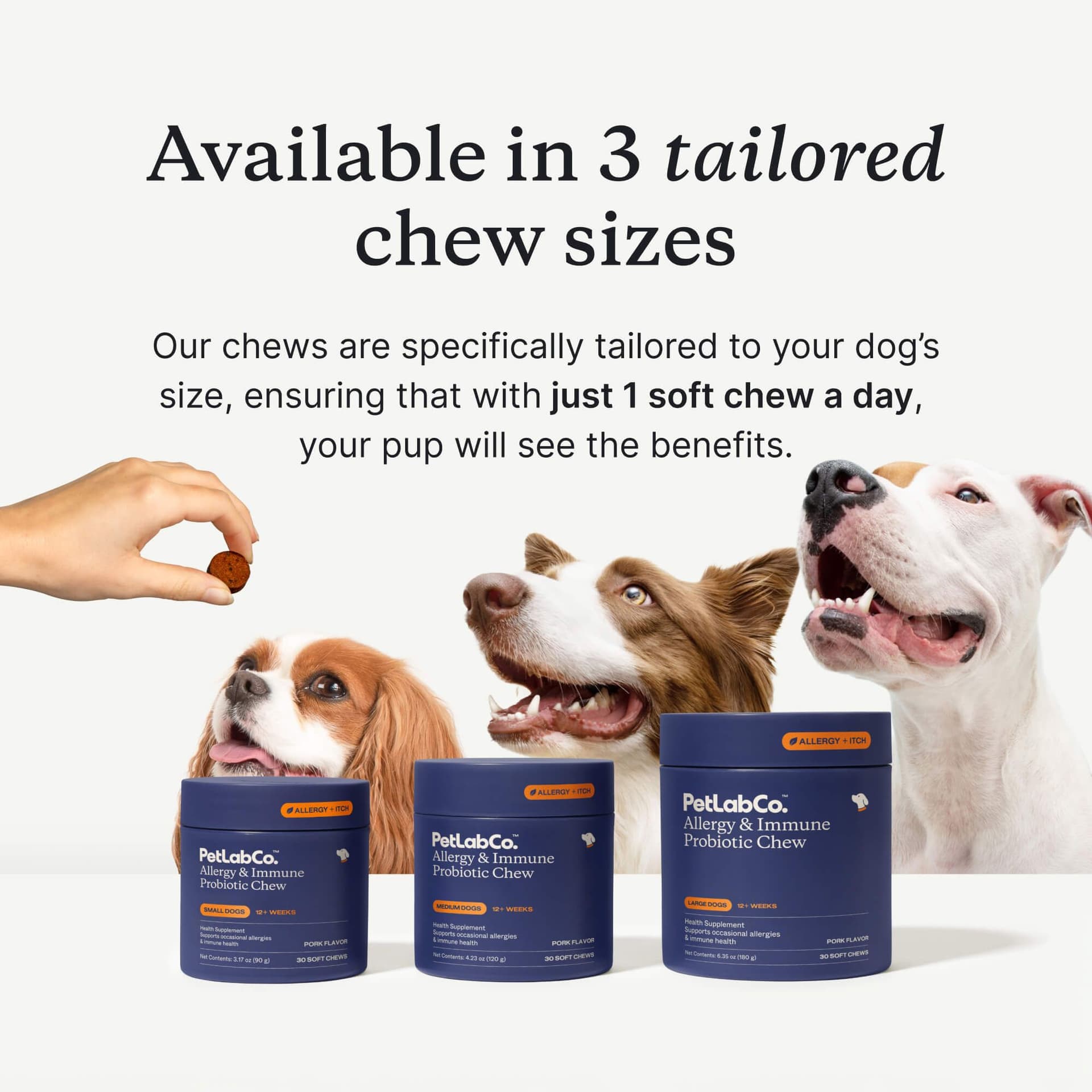
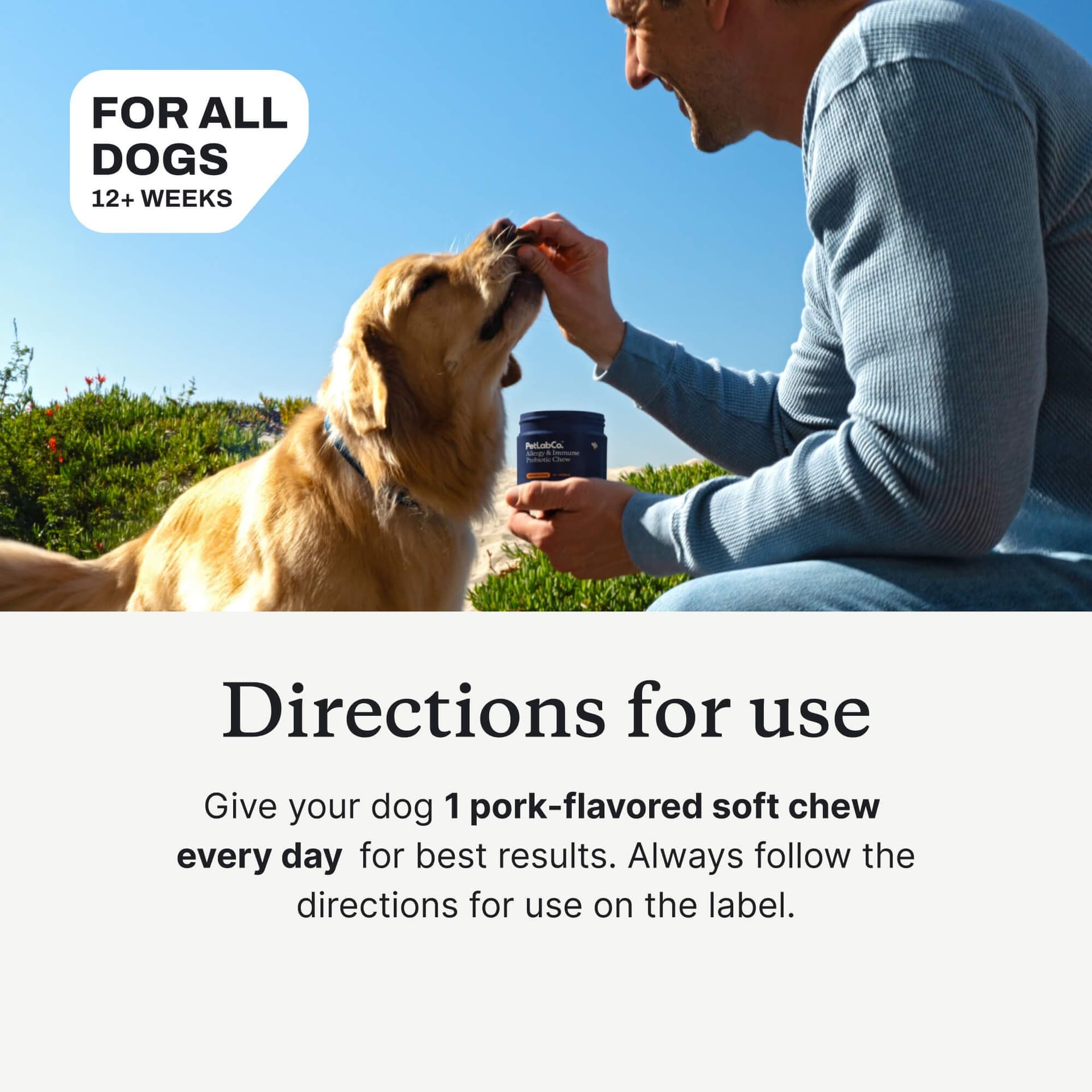
The current product page gives one size-specific soft chew daily. The amounts below are per daily chew for that weight group.
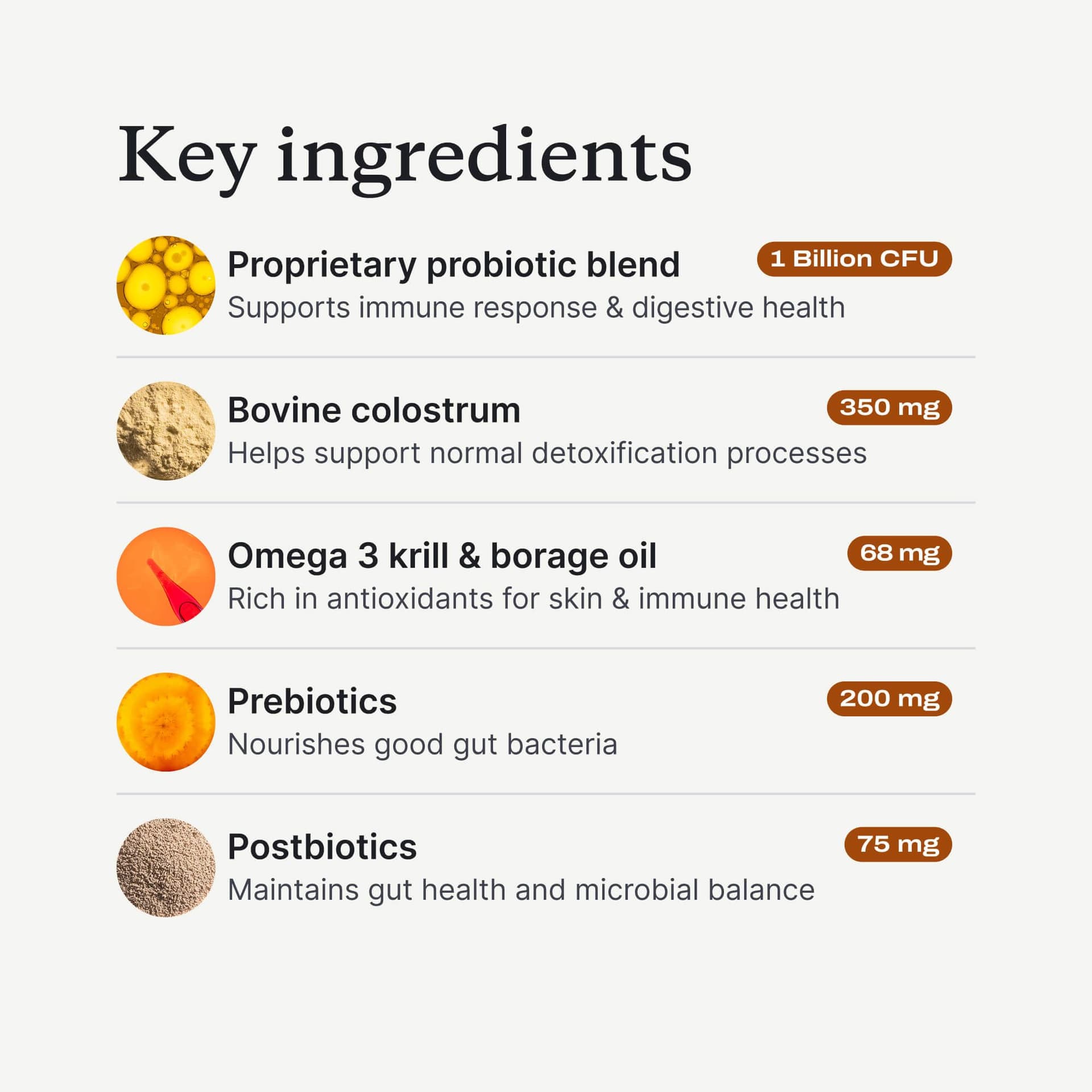
| Active ingredient | Small dog, under 25 lb | Medium dog, 25 to 75 lb | Large dog, over 75 lb |
|---|---|---|---|
| Probiotic blend: Bacillus coagulans, Bacillus clausii, and Bacillus subtilis | 1 billion total CFU | 2 billion total CFU | 3 billion total CFU |
| Bovine colostrum | 350 mg | 700 mg | 1,050 mg |
| Fructooligosaccharides (FOS) | 100 mg | 200 mg | 300 mg |
| Galactooligosaccharides (GOS) | 100 mg | 200 mg | 300 mg |
| Heat-treated Saccharomyces cerevisiae and Cyberlindnera jadinii | 75 mg | 150 mg | 225 mg |
| Total omega fatty acids | 68 mg | 137 mg | 206 mg |
| Gamma-linolenic acid (GLA) | 14 mg | 29 mg | 44 mg |
| EPA | 6 mg | 12 mg | 18 mg |
| DHA | 2 mg | 4 mg | 6 mg |
| Vitamin E | 3.3 mg | 6.7 mg | 10 mg |
Omega fats come from krill oil and borage oil. The online inactive-ingredient list includes pork liver and other flavoring ingredients. This product does not list quercetin on its current active label.
Check the physical package before use because formulas can change. A supplement's EPA, DHA, probiotic, or vitamin amounts should not be assumed from an older review or image.
Current serving and price
| Dog's weight | Current daily serving |
|---|---|
| Under 25 lb | 1 small-dog chew |
| 25 to 75 lb | 1 medium-dog chew |
| Over 75 lb | 1 large-dog chew |
Use the soft chew made for the dog's current weight range. Do not substitute several small-dog soft chews for a larger size unless PetLabCo.® or the veterinarian confirms that every active and inactive ingredient remains appropriate.
As checked August 25, 2026, the official product page displayed $37.44 for a tub and $29.95 with the shown 20% subscription discount. Prices and promotions can change. Confirm the tub count, correct size, refill frequency, and checkout total before subscribing.
Compare current prices, weight-specific options, and daily servings before choosing a tub.
Petful may earn a commission when you click through to PetLabCo.®, at no extra cost to you.
What the ingredients are formulated to support
The following are the manufacturer's supportive ingredient claims, not findings from a clinical trial of the finished product:
- Krill oil and borage oil, the formula’s omega-3 and omega-6 sources, help maintain normal skin conditions and support the skin's normal moisture content
- Borage oil supplies gamma-linolenic acid (GLA), an omega-6 fatty acid included for skin support.
- FOS, GOS, krill oil, and borage oil are the ingredients included for support with seasonal or occasional allergy discomfort, including occasional skin discomfort
- Colostrum, borage oil, and vitamin E are included to help maintain healthy skin
- Vitamin E provides antioxidant support linked to normal skin function
Who may find it suitable
The featured formula may be worth discussing with a veterinarian when:
- The dog is at least 12 weeks old.
- Parasites, infection, and other causes of itch have been assessed.
- The veterinarian has recommended nutritional support as one part of a broader plan.
- The owner prefers one daily soft chew to separate oils, powders, and capsules.
- Pork, bovine colostrum, krill, borage, and the other listed ingredients fit the dog's diet.
- The owner understands that the supplement supports normal function and is not expected to cure allergy.
Who should avoid it or ask a vet first
Do not start the soft chews without veterinary guidance if the dog:
- Is younger than 12 weeks
- Is pregnant, nursing, or intended for breeding
- Has an immune disorder or takes an immunosuppressant
- Takes medications whose timing or absorption is important
- Has a known sensitivity to pork, beef, fish, shellfish, or another listed ingredient
- Is on a strict veterinary elimination diet
- Has a history of pancreatitis, a bleeding disorder, or another condition affected by added oils
- Already receives other omega, vitamin E, probiotic, or multi-ingredient supplements
- Has severe, infected, painful, or rapidly worsening skin disease
The current label recommends a veterinary examination before use, warns that drug absorption taken at the same time may be delayed, and says safety has not been proven in pregnant or breeding animals. Stop use and consult a veterinarian if the condition worsens or does not improve.
Dog allergy supplements versus veterinary allergy treatment
Canine allergic skin disease is often lifelong and multimodal. Depending on the diagnosis, a veterinarian may recommend consistent flea control, treatment of bacterial or yeast infection, a prescription elimination diet, allergen-specific immunotherapy, topical therapy, or medicines that control itch and inflammation.
Allergy supplements for dogs occupy a different place. Their role is supportive. An omega or probiotic product may be used alongside treatment when the veterinarian considers it safe, but waiting for a supplement to work can prolong discomfort and allow skin damage or infection to worsen.
Do not stop prescribed Apoquel, Cytopoint, corticosteroids, antibiotics, antifungals, immunotherapy, or medicated bathing because a supplement has been added. Medication changes should be made with the prescribing veterinarian.
- Keep the current label, evidence quality, and your dog’s veterinary plan together when interpreting this part of the article.
A practical order of operations is:
- Identify and treat parasites, infection, pain, and other immediate causes of discomfort.
- Establish the veterinary plan for allergy diagnosis and control.
- Add one approved nutritional adjunct only when its goal, ingredients, and assessment period are clear.
Improvement should be judged against the dog's original problem, not against a vague hope for “better immunity.” Track scratching, licking, sleep disruption, ear signs, skin lesions, and medication use with the veterinarian. A supplement that fits the plan may remain useful even when prescription treatment is still necessary.
How to choose and assess a dog allergy supplement
1. Match the product to a defined goal
“Stop itching” is too broad. A clearer goal might be supporting the skin barrier while the veterinarian manages atopic dermatitis, or simplifying several approved nutritional ingredients into one daily chew. If the diagnosis and goal are unclear, buying another supplement is unlikely to solve the uncertainty.
2. Read quantities, not just ingredient names
Look for named probiotic species, CFU amounts, EPA and DHA quantities, serving size, age guidance, storage, and a complete inactive-ingredient list. A front label that says “omega blend” or “immune support” does not reveal the dose or clinical relevance.
3. Check diet compatibility
Soft chews commonly contain animal proteins and flavors. During a food trial, even a small flavored supplement can introduce an unapproved protein and undermine the result. Use only items approved by the veterinarian supervising the trial.
4. Avoid duplicate ingredients
Add up omega fats, vitamin E, probiotics, and other actives across food, treats, oils, and soft chews. Combining several “skin and coat” products can raise cost and risk without improving the chance of benefit.
5. Monitor one change at a time
Take baseline photographs and note scratching, licking, sleep disruption, ear signs, stool, appetite, and medication use. Start only one approved change at a time and keep the rest of the plan stable. Ask the veterinarian how long is reasonable to assess it. Fatty-acid support may take about two months, while worsening skin should never be left untreated for that long.
Stop and seek advice for persistent vomiting or diarrhea, unusual bruising or bleeding, marked lethargy, facial swelling, hives, breathing trouble, or a clear worsening of skin or ears.
Frequently Asked Questions
There is no universal best allergy supplement because itch has many causes. Omega-3 fatty acids have the most recognized supportive role in canine allergic skin management, but even they are an adjunct rather than a cure. The best choice is the one that fits a veterinarian's diagnosis, the complete diet, medications, and the dog's individual risks.
Some ingredients may offer modest support for some dogs. The evidence is not strong enough to promise that an over-the-counter supplement will stop allergic itch, and results are not interchangeable across products. Supplements work best as one carefully chosen part of a veterinary plan. For do allergy supplements really work for dogs?, the practical next step is to follow the current label and review the dog's individual health, diet, and medicines with a veterinarian. A supplement should not be treated as a diagnosis, treatment, or guaranteed result. Seek veterinary advice sooner if signs worsen or do not improve.
It depends on the ingredient, goal, and diagnosis. Fatty-acid benefits can take around two months. There is no established universal timeline for probiotics or combination soft chews to reduce itch. If the dog is uncomfortable, infected, or getting worse, contact the veterinarian rather than waiting. For How long should a dog allergy supplement take to help?, the practical next step is to follow the current label and review the dog's individual health, diet, and medicines with a veterinarian. A supplement should not be treated as a diagnosis, treatment, or guaranteed result. Seek veterinary advice sooner if signs worsen or do not improve.
Possibly, but ask the prescribing veterinarian first. The veterinarian should review the supplement's ingredients, medication timing, health history, and overlapping products. Never reduce or stop prescription therapy without veterinary direction. For can a dog take an allergy supplement with apoquel or cytopoint?, the practical next step is to follow the current label and review the dog's individual health, diet, and medicines with a veterinarian. A supplement should not be treated as a diagnosis, treatment, or guaranteed result. Seek veterinary advice sooner if signs worsen or do not improve.
Only if the supervising veterinarian approves the exact product. Flavored soft chews, pork liver, bovine colostrum, fish, krill, and other animal-derived ingredients can introduce proteins outside the trial diet and make the result difficult to interpret. For Can I give allergy supplements during a food-elimination trial?, the practical next step is to follow the current label and review the dog's individual health, diet, and medicines with a veterinarian. A supplement should not be treated as a diagnosis, treatment, or guaranteed result. Seek veterinary advice sooner if signs worsen or do not improve.
Use only a product labeled for the puppy's age and only after veterinary advice. The featured PetLabCo.® Allergy & Immune soft chews are labeled for dogs at least 12 weeks old. Itchy puppies especially need assessment for parasites, infection, and dietary issues.
No. Yeast overgrowth must be diagnosed and treated appropriately. Allergy may predispose a dog to repeated skin or ear infections, but an “immune” or probiotic supplement is not an antifungal treatment.
Sources
- American Animal Hospital Association. 2023 AAHA Management of Allergic Skin Diseases in Dogs and Cats Guidelines.
- American Kennel Club. Dog Allergies: Symptoms, Causes, and Treatment.
- Olivry T, DeBoer DJ, Favrot C, et al. Treatment of canine atopic dermatitis: 2015 updated guidelines from the International Committee on Allergic Diseases of Animals. BMC Veterinary Research. 2015;11:210.
- The Role of Diet, Nutrition, and Supplements in Canine Atopic Dermatitis. Veterinary Clinics of North America: Small Animal Practice. 2025.
- Probiotics as an adjunct in the treatment of canine atopic dermatitis: a systematic review and meta-analysis of in vivo studies in dogs. Journal of Veterinary Medical Science. 2025.
- American Kennel Club. Fish Oil for Dogs.
- PetLabCo.® Allergy & Immune Chews: current ingredients, serving, and cautions. Accessed August 25, 2026.
PetLabCo.® products are not intended to diagnose, treat, cure, or prevent any disease. Consult your veterinarian before starting supplements, especially if your dog has a health condition, takes medication, is pregnant or nursing, or has persistent or worsening symptoms.

DVM
Athena Gaffud, DVM, is a board-certified veterinarian and writer based in the Cagayan Valley of the northern Philippines. She runs the website countryvetmom.com Dr. Gaffud earned her Doctor of Veterinary Medicine degree from the University of the Philippines Los Baños in 2011, ranking in the top 10 and receiving the Best Undergraduate Thesis Award in Large Animals. With over a decade of experience, she has worked as a researcher, a practitioner for small and large animals, and in veterinary technical sales, marketing, and pet insurance. A published author, Dr. Gaffud promotes responsible pet ownership and combats misinformation on animal care through her platforms, including the DocAthena Facebook Page and DocAthena YouTube channel. She is a writer and editor for various pet-related websites such as Total Vet, Honest Paws, PangoVet, Dogster, Catster, My Best PH, Paw Origins, Bully Max, Not a Bully, Paws and Claws CBD, many others. She was also cited in different pet-related media articles such as The Dog People, USA Today, Newsweek, New York Post, Reader’s Digest, Smithsonian Magazine, Woman’s World, Dog Time, Patch, Kinship, Martha Stewart, and many others. Moreover, she is also a published fiction author on Kindle.
Sign up for expert-backed reviews and safety alerts all in one place.


A Final Word (Disclaimer)
At Petful, our review integrity is paramount; we never exchange special treatment in our reviews for monetary or material rewards.
Nonetheless, when our readers click through to online merchants (including Chewy or Amazon), we receive a referral commission. This supports the running of our free blog, and we appreciate your backing.