Khao Manee Cat: Identification, Personality, and Care
The Khao Manee cat is a social, intelligent Thai breed with a short white coat and vivid eyes. Learn how pedigree records support identification, what daily care involves, and whether this active companion fits your home.
Petful is reader supported. As an affiliate of platforms like Amazon and Chewy, we may earn a commission when you buy through links on this page. There is no extra cost to you.
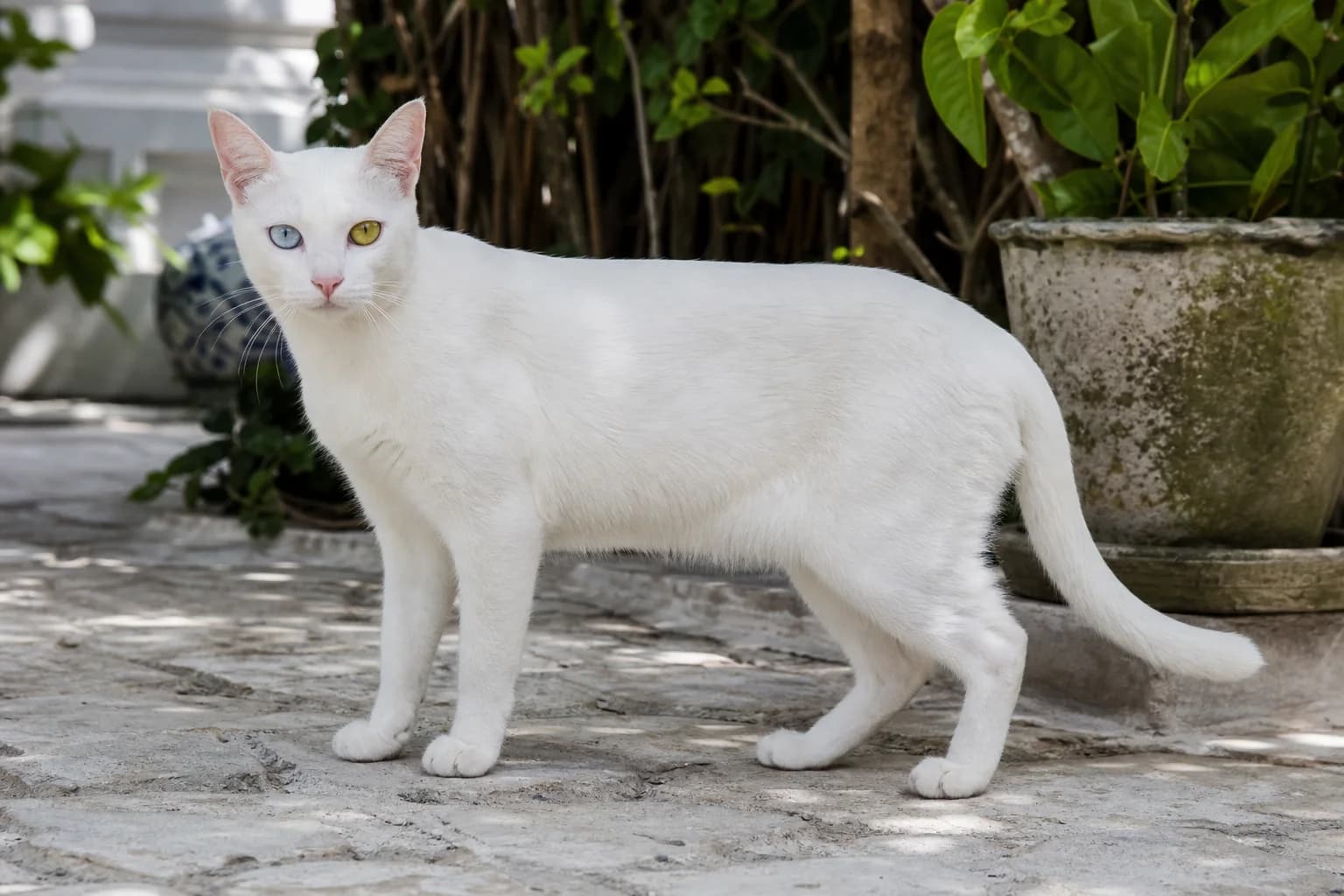
The Khao Manee cat is an old natural breed from Thailand with a short white coat, a flexible athletic build, and vivid eyes that may be blue, yellow, green, or odd-eyed. The name is commonly translated as "white gem." In the United States, the breed remains much less common than familiar white domestic shorthairs, so good information begins with an important distinction: a cat can resemble a Khao Manee without being one.
If you are trying to identify a cat, white fur and striking eyes are clues, not proof. Credible pedigree records from a recognized registry are the strongest evidence of Khao Manee ancestry. If you are deciding whether to live with one, expect a social, clever, active companion that wants daily interaction rather than a decorative cat who is content to be ignored.
- 1The Khao Manee is a registered natural breed from Thailand, not a label for every white shorthaired cat
- 2White fur, blue eyes, or odd eyes cannot prove ancestry without pedigree records
- 3Breed sources describe Khao Manees as active, intelligent, social, and communicative
- 4The short coat is straightforward to maintain, but the cat still needs daily play, companionship, routine veterinary care, and thoughtful hearing screening
This guide covers breed identity, history, personality, size, coat care, household fit, and the limits of visual identification. It also routes changing price questions, white-cat comparisons, and clinical health questions to dedicated Petful guides so those decisions get the depth they deserve.

Petful may earn a commission when you click through to Lemonade, at no extra cost to you.

Sign up for expert-backed reviews and safety alerts all in one place.
What is a Khao Manee cat?
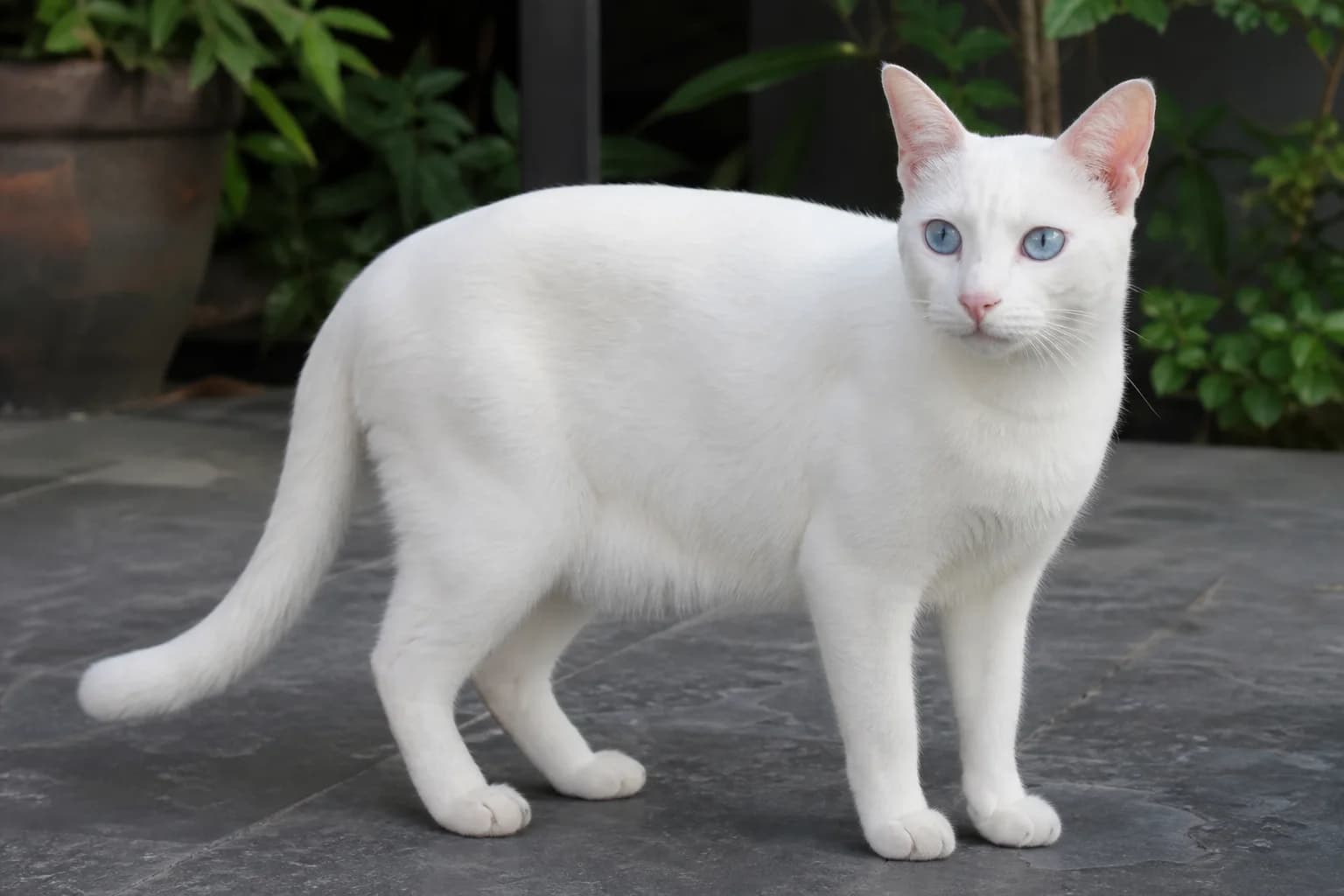
A Khao Manee is a pedigreed cat breed whose documented roots are in Thailand. The Cat Fanciers' Association breed profile describes a medium, muscular but flexible cat with a short, glistening white coat and clear, vivid eyes. The TICA Khaomanee profile likewise identifies the breed as an old Thai cat that is comparatively new to the Western cat fancy.
That definition matters because "white cat" describes pigmentation, not ancestry. Solid-white cats occur across the domestic cat population and within multiple breeds. A shelter cat with white fur, a short coat, and one blue eye may be wonderful, healthy, and visually similar to the standard, but those features do not turn an unknown family tree into a Khao Manee pedigree.
The spelling also varies. TICA uses "Khaomanee" as one word in its current breed materials, while CFA and many English-language sources use "Khao Manee." You may also see Khao Plort or "Diamond Eye." These names can help with research, but a seller using the right vocabulary still has to provide real documentation.
Khao Manee at a glance
| Trait | Practical meaning |
|---|---|
| Origin | Thailand; a natural breed with a history recorded in Thai cat tradition |
| Size | Medium; athletic and muscular without a heavy or bulky frame |
| Coat | Short, fine, smooth, and white; easy to brush but conspicuous on dark fabrics |
| Eyes | Clear and vivid; blue, green, yellow, or odd-eyed presentations may occur |
| Temperament | Social, curious, intelligent, playful, and communicative |
| Activity | Active; needs interactive play, climbing choices, and problem-solving opportunities |
| Grooming | Weekly brushing is usually enough, plus routine nail, dental, and ear care |
| Home fit | Best for people who want an involved companion and can provide daily attention |
| Identification | Pedigree and registry records carry more weight than physical clues |
| Health focus | Routine feline prevention plus a thoughtful discussion of hearing screening |
These are breed-level tendencies, not promises about an individual cat. A specific Khao Manee can be quieter, more independent, larger, or less playful than the typical description. Temperament is shaped by genetics, early socialization, health, learning, and the household as much as by the name on a pedigree.
Khao Manee history and breed recognition
Breed registries connect the Khao Manee with Thailand's long cat tradition. CFA notes references to auspicious cats in the Tamra Maeo, often called the Cat Book Poems, from the Ayutthaya period. It also describes the late-20th-century effort that brought documented cats to the United States and established a conservation breeding program.
That history is compelling, but it should not be inflated into certainty about every legend. Stories about exclusive royal ownership, hidden palace cats, good luck, and healing powers are part of the breed's cultural narrative. They are not evidence that any modern white cat descends from a royal line, and they should never justify a price premium without records.
In Western registries, recognition came much later than the breed's Thai history. TICA's materials document the breed's progress through its new-breed program to championship status. CFA accepted Khao Manees for registration in 2018 and currently presents the breed in its own breed resources. The useful buyer question is not whether a seller can repeat those dates. It is whether the seller can connect the individual kitten to a recognized registry with a verifiable pedigree.
Petful may earn a commission when you click through to Chewy, at no extra cost to you.
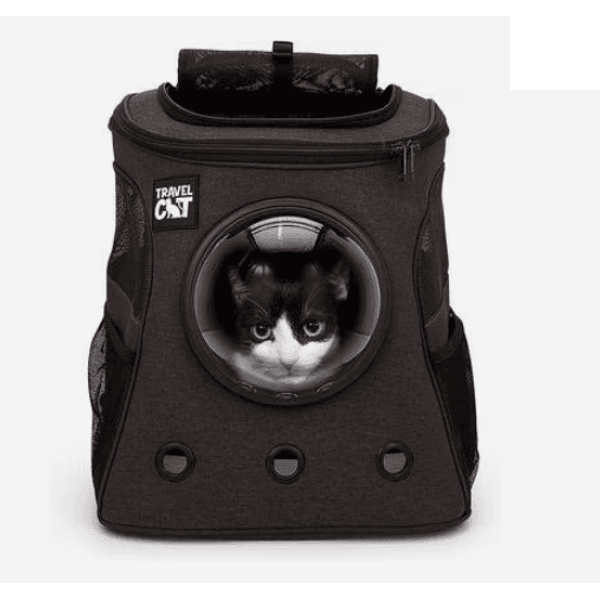
For budget planning, a current Lemonade pet insurance quote lets you compare the premium, deductible, reimbursement rate, waiting periods, and exclusions before a need arises. Check ventilation, load limit, and the cat's standing dimensions before considering the Travel Cat Fat Cat carrier backpack; a carrier label cannot substitute for a calm fit test. For a private retreat, the Best Friends by Sheri covered cat bed is one enclosed option to compare after checking entry size, washability, and where the cat already chooses to rest.
How to identify a Khao Manee without guessing
Start with documents, then use physical traits as a consistency check. A pedigree certificate should identify the cat, breeder, parents, and registered lineage. Ask which registry issued it and how the record can be verified. If a cat is already registered, the identifying details on the record should agree with the cat and the sale contract.
Next, compare the cat with the current CFA Khao Manee standard or TICA breed standard. The standard describes a medium, flexible, athletic cat rather than a round, heavy, or extremely slender one. The head, ears, eyes, body, tail, and coat form a complete type. Those traits are consistent with a breed from Thailand, but matching one memorable feature is not enough. Pedigree records are what connect an individual cat to documented ancestry.
- A white short coat, blue eyes, odd eyes, a kitten head spot, a friendly personality, or a high score from a breed-identification app can suggest a possible match. None establishes registered ancestry. For a purebred claim, ask for a verifiable pedigree and registry record. If those records do not exist, describe the cat by what you know, such as "white domestic shorthair," instead of assigning a breed with false certainty.
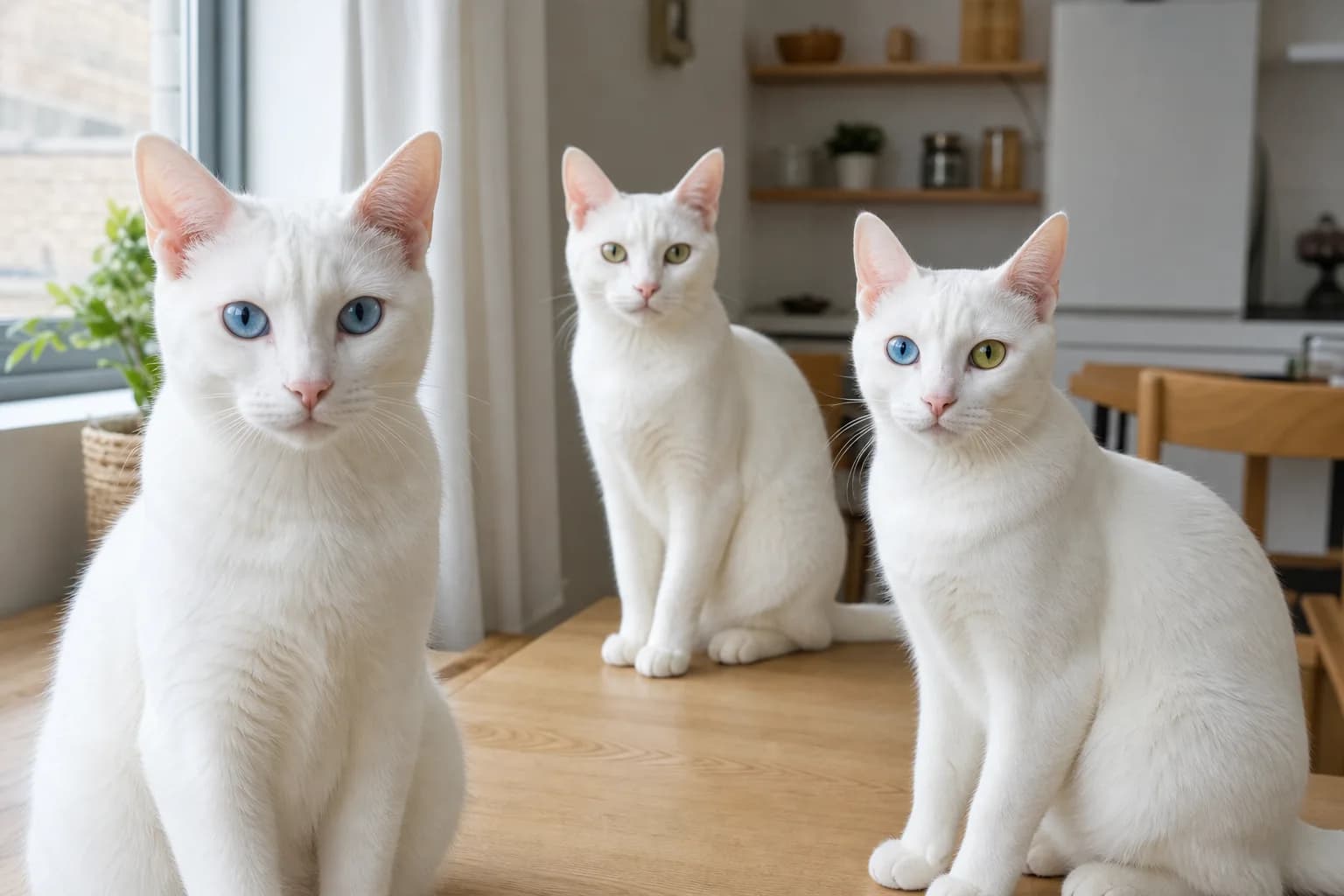
Eye presentation is the feature people notice first. CFA permits clear, vivid eyes in multiple shades, with odd eyes possible. However, blue or mismatched eyes are not unique to this breed. They also occur in white domestic cats and other pedigreed cats. The same caution applies to a colored patch on a white kitten's head. Registry standards note that a head cap reflecting underlying pigment can persist in a young kitten and later fade, but that temporary spot is not a breed certificate.
Body and tail clues
Body type provides another consistency check. The standard calls for a medium torso with firm musculature, agility, and flexibility. The head has a modified wedge, high cheekbones, and moderately large ears. The tail should be proportional to the body. Yet domestic cats vary enormously, and many can land near those broad traits by chance.
If there are no records because the cat came from a shelter, focus on the cat you have rather than solving an ancestry mystery at any cost. A veterinarian can record observable traits, check health, and scan for a microchip. Consumer DNA panels may estimate relationships among tested populations, but they do not replace a registry pedigree, and their breed confidence depends on the reference database.
For a more detailed evidence ladder, including what apps and documents can really tell you, see Petful's guide to Khao Manee vs. a white cat.
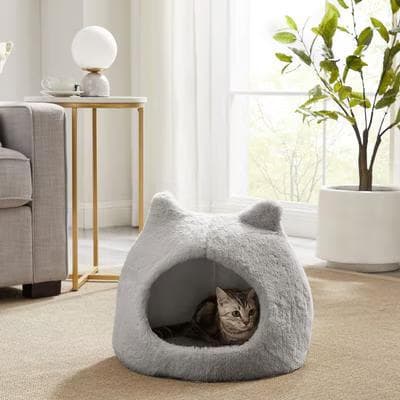
Covered, igloo-style cat bed in soft plush with a water-resistant bottom, giving cats a cozy enclosed spot to curl up. Grey.
Petful may earn a commission when you click through to Chewy, at no extra cost to you.
Khao Manee personality and home fit
CFA describes the Khao Manee as curious, clever, social, active, and affectionate. Breed accounts often mention cats who carry toys, play fetch, follow household activity, climb onto shoulders, and settle in laps after play. That combination can feel almost dog-like, but the better comparison is an engaged cat who wants access to the household's daily rhythm.
Khao Manee temperament and Khao Manee behavior are common search phrases, but no label predicts an individual perfectly. Typical Khao Manee traits and Khao Manee cat traits include curiosity, social confidence, and an interest in interactive play. A Khao Manee meow may be soft, insistent, or replaced by chirps and trills, depending on the cat and situation.
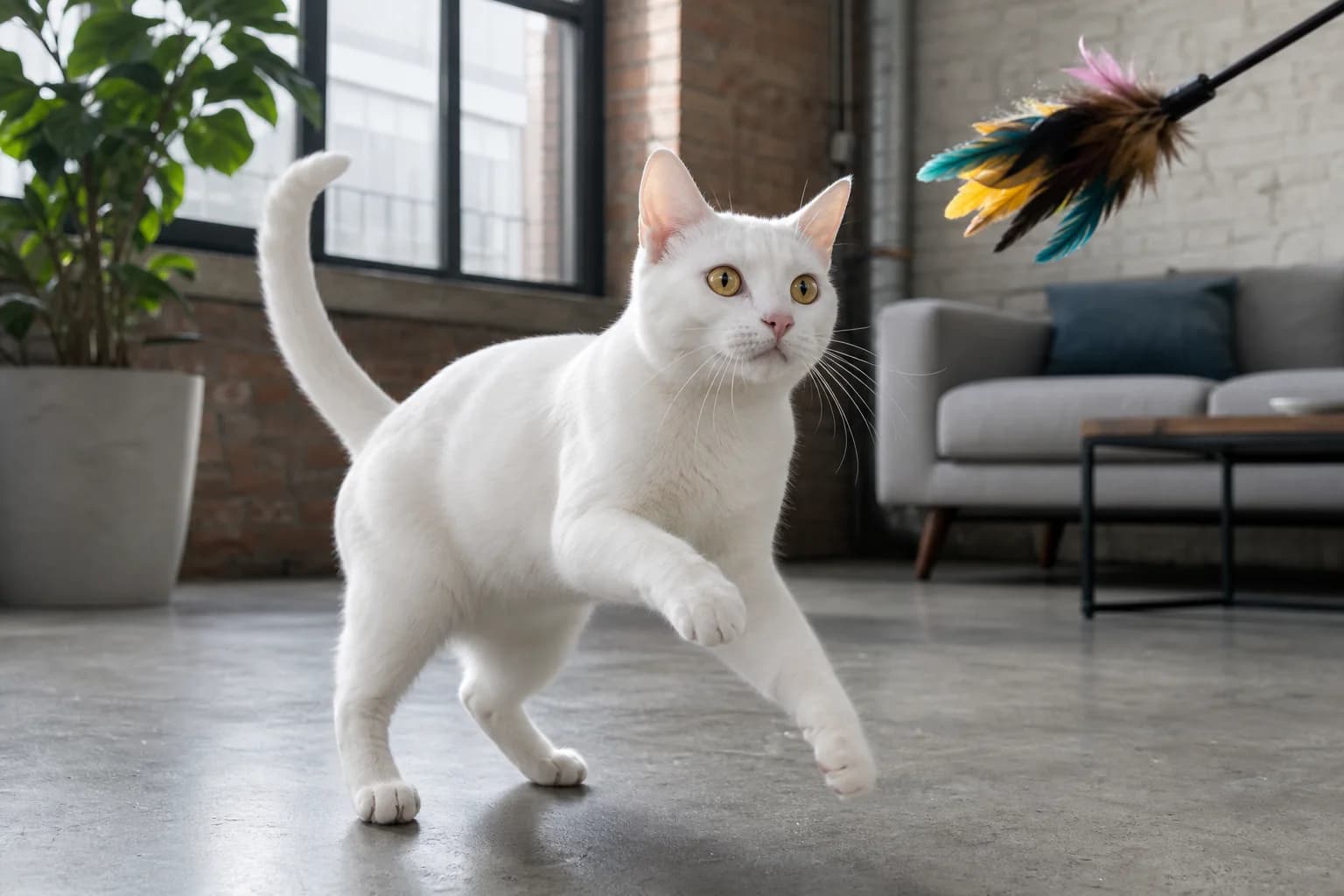
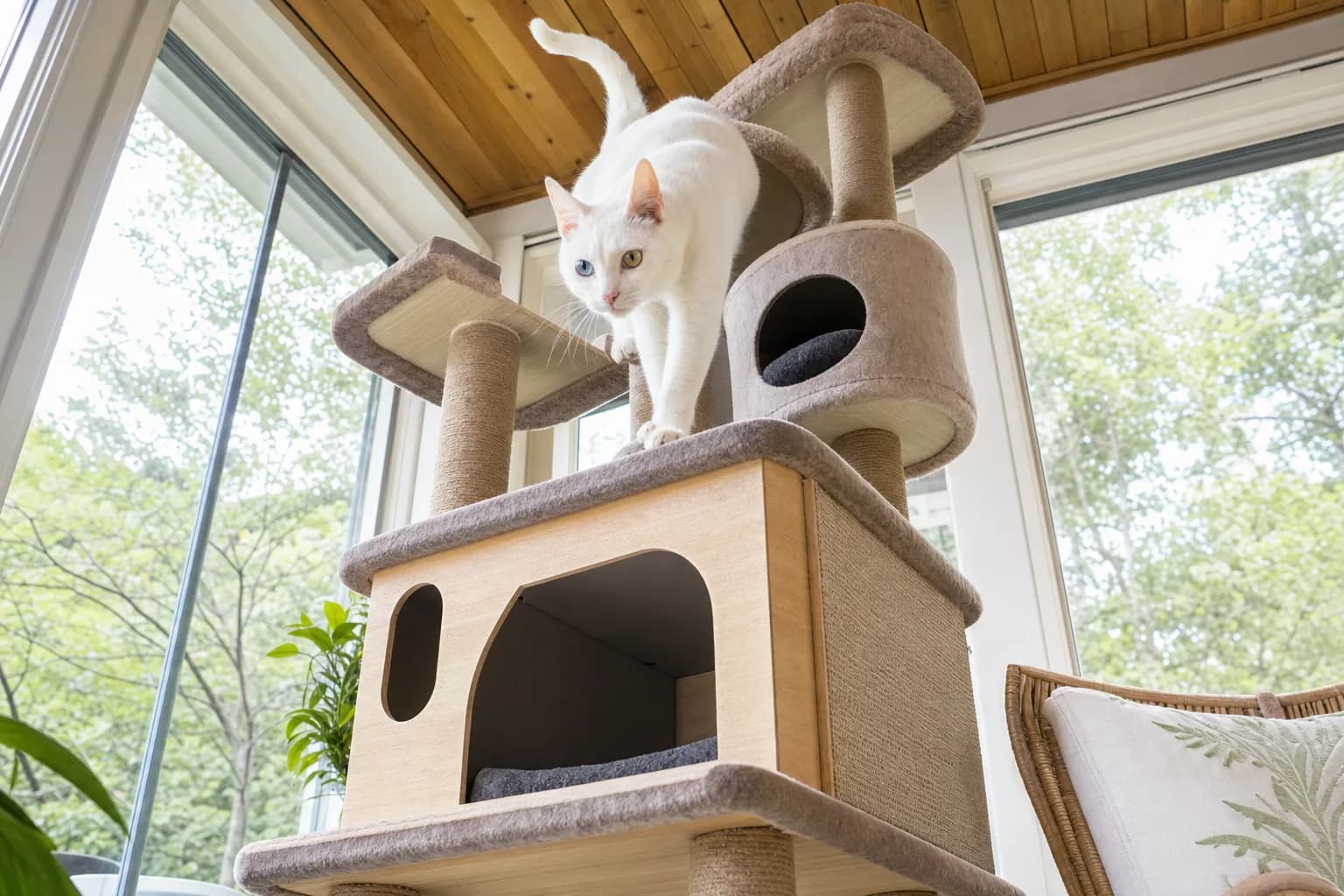
The breed's intelligence is rewarding when it has an outlet. Use short interactive sessions with wand toys, food puzzles, target training, and fetch-style games. Rotate a few toys instead of leaving everything out indefinitely. A tall, stable cat tree and window perch give the cat legal places to watch and climb. These are natural opportunities to choose durable enrichment products based on stability and fit, not novelty. The Frisco feather teaser wand is one supervised play option; let the cat catch the toy and store the string out of reach afterward.
Social does not mean every Khao Manee enjoys constant handling. Let the cat initiate contact, provide quiet retreat spaces, and teach children to stop when the cat turns away or flicks the tail. A confident cat may greet visitors, while another may need a slower introduction. Respecting individual signals matters more than trying to force a breed stereotype.
Vocal behavior also varies. Breed sources describe communicative cats that may chirp, trill, purr, or comment on household activity. That does not guarantee a loud cat, and "talkative" should not be confused with distress vocalization. A sudden change in voice, nighttime crying, or persistent calling can reflect pain, anxiety, sensory change, or another medical problem and deserves veterinary attention.
Children, cats, and dogs
An active, social Khao Manee can do well with respectful children and compatible pets. The key is controlled introduction, escape routes, and enough resources for everyone. Give each cat separate food and water stations, resting places, scratching choices, and litter boxes. Introduce dogs behind a barrier first and reward calm behavior.
Young children need active supervision. They should not pick up a cat that is trying to leave, chase it under furniture, or turn hands into toys. The cat should always have a high perch or separate room where nobody follows. This approach protects both child and cat and works regardless of breed.
Alone time
A Khao Manee that receives predictable attention can tolerate ordinary periods alone, but this is not the best match for a household that wants minimal interaction. Build a daily routine around play, meals, grooming, and calm contact. If workdays are long, consider timed enrichment, safe window access, and whether a compatible second cat would genuinely improve life for both animals.
A second cat is not an automatic fix. Introductions take time, and two bored cats can still be bored. Choose companionship based on individual temperament, available space, and your capacity to provide separate resources.
Khao Manee size, coat, and daily care
TICA describes the Khaomanee as medium-sized, and breed profiles commonly place adults within the general midrange for domestic cats. Khao Manee weight at full maturity varies by sex, family line, neuter status, body condition, and life stage, so a Khao Manee full grown may not match a single internet number. Your veterinarian's body-condition and muscle-condition assessment is more useful than forcing a healthy cat toward an average.
The short, fine coat is comparatively simple to maintain. Khao Manee long hair would not fit the current breed standard, though an unknown white domestic cat can have any coat length. Weekly brushing with a soft rubber brush or grooming glove removes loose fur and creates a routine for checking skin, claws, ears, and body condition. White hair can be conspicuous on dark fabric, so a washable throw and a practical lint tool may be more useful than frequent bathing. For routine tip trims after calm paw handling, the Resco Original cat nail clippers are one compact tool to compare.
Khao Manee eyes may be blue, yellow, green, or odd-eyed, but eye color does not alter routine coat care or prove ancestry. The Khao Manee tail should be proportional to the athletic body under the standard. Neither eye presentation nor tail shape is a health score, so daily decisions should follow the individual cat's condition and veterinary guidance.
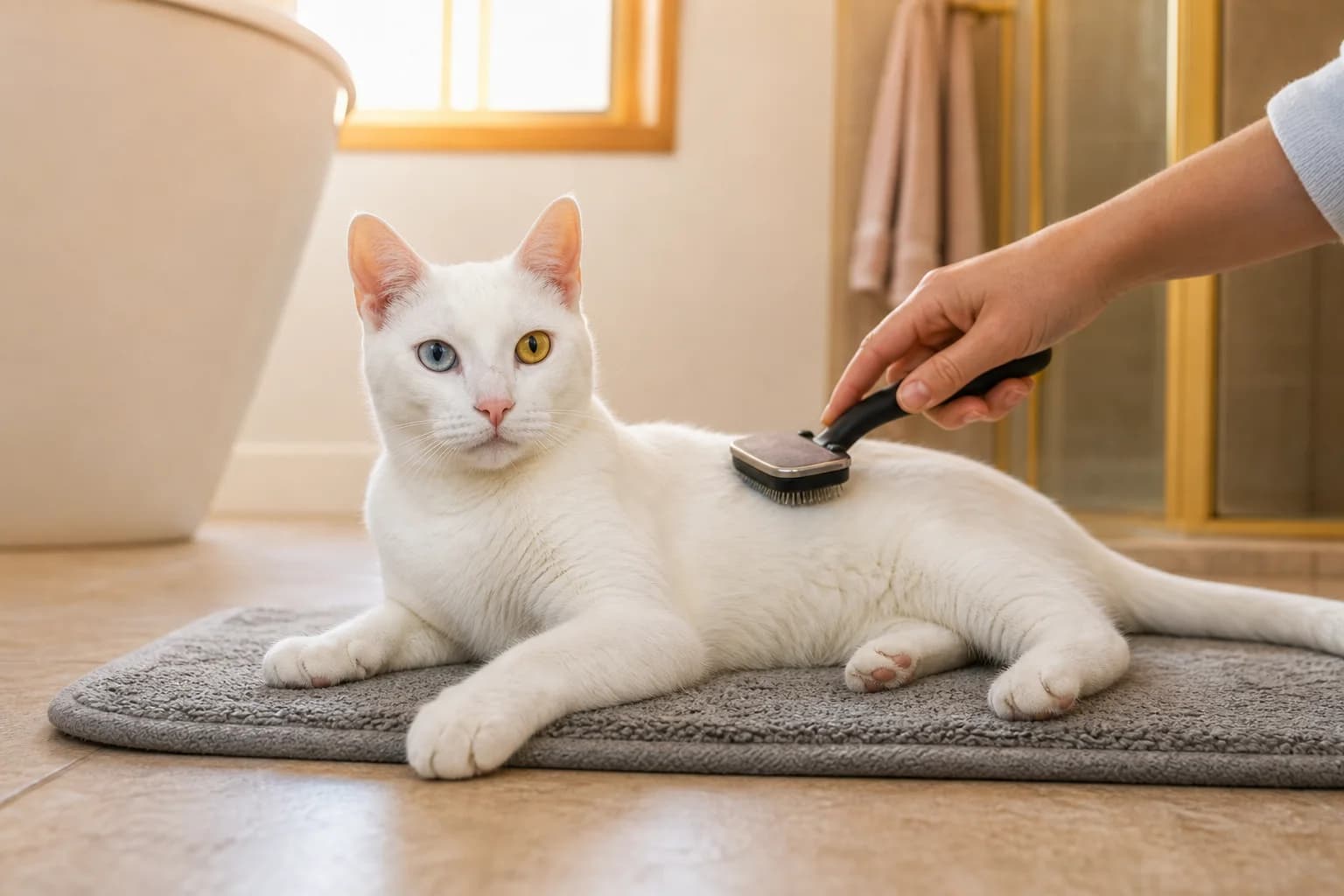
Most healthy cats rarely need a bath. If something sticky, oily, or unsafe gets on the coat, ask a veterinarian which cat-safe product to use. Human shampoo can irritate feline skin, and whitening products are unnecessary. Never use essential oils or dog flea products on a cat unless a veterinarian has confirmed the exact product is feline-safe.
Nail trims, dental care, litter-box monitoring, parasite prevention based on lifestyle, vaccination, and regular veterinary examinations make up the rest of routine care. A soft toothbrush and feline toothpaste can become a valuable long-term habit when introduced gradually. A sturdy carrier that opens from the top can make veterinary travel less stressful. For gradual feline dental care, use only pet-safe toothpaste such as Virbac C.E.T. enzymatic toothpaste after veterinary guidance; human toothpaste is not an appropriate substitute.
Feeding and weight
Feed a complete and balanced cat food appropriate for the cat's life stage, then adjust portions to maintain a healthy body and muscle condition. Package directions are starting points. Weighing food can make portions more consistent, while puzzle feeders can slow eating and add mental work for an active cat.

You should be able to feel the ribs under a light covering without pressing hard and see a waist behind the ribs from above. A growing kitten, muscular adult, and older cat have different needs. Ask your veterinarian to record body and muscle condition at each visit and to explain any meaningful trend.
Fresh water should always be available. Some cats drink more readily from a wide bowl or circulating fountain, but no device compensates for a sudden increase or decrease in thirst. Changes in drinking, urination, appetite, or weight are medical clues, not product problems.
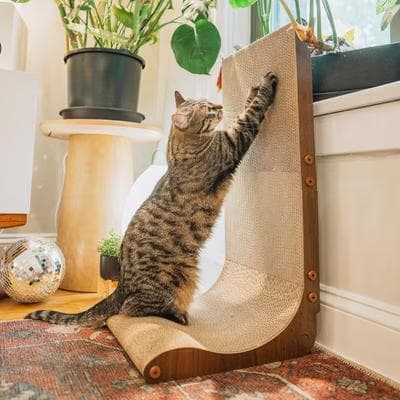
Curved cardboard wall scratcher with a wood frame that protects walls and gives cats a satisfying vertical scratch surface.
Petful may earn a commission when you click through to Chewy, at no extra cost to you.
Khao Manee health and lifespan
The breed's white pigmentation makes hearing the most discussed health topic, but the answer needs more care than "white cats are deaf." Not every white cat is deaf, not every blue-eyed white cat is deaf, and a cat can have normal hearing in one ear but not the other. Behavior at home may miss one-sided hearing loss.
Petful's veterinarian-authored guide to Khao Manee health, deafness risk, and lifespan explains the evidence, BAER testing, home safety, and why prevalence figures from studies of other white purebred cats should not be relabeled as a Khao Manee rate. It also separates registry lifespan estimates from population research.
For this general profile, the practical actions are straightforward: ask what hearing screening was performed, request the actual report rather than a verbal assurance, establish routine veterinary care, maintain healthy body condition, protect dental health, and keep the cat indoors or safely contained. If a cat does not respond to sound, startles easily, develops a head tilt, seems unsteady, or has ear pain or discharge, arrange a veterinary examination.

108-oz stainless steel pet fountain with quiet pump and water-level window. Bengals are notoriously water-obsessed; a flowing fountain encourages hydration and pulls them away from sinks and toilets.
Petful may earn a commission when you click through to Chewy, at no extra cost to you.
Khao Manee price and responsible sourcing
Online articles repeat very wide Khao Manee price ranges, often without showing where the numbers came from. A rare breed can have few current litters, long waits, travel costs, and large differences in what a quote includes. That makes a single universal price especially unreliable.
Use Petful's Khao Manee price and kitten sourcing guide to compare an itemized quote, pedigree records, vaccination and microchip documentation, hearing-test information, contract terms, travel, supplies, routine care, and an emergency reserve. Price by itself does not prove quality or ancestry.
Do not let urgency replace verification. The TICA Pet Buyer's Guide recommends checking breeder credibility, seeing how cats are raised, requesting parent and health records, understanding the contract, and avoiding high-risk payment demands. A responsible source should ask questions about your home as well as answer yours.
Khao Manee or another white cat?
Many all-white cats are domestic shorthairs with no Khao Manee ancestry. Others belong to different registered breeds. Eye color, a temporary kitten head spot, or an athletic build can overlap. Even a friendly, vocal temperament is far too broad to establish a breed.
That uncertainty is not a defect. A cat does not need a rare label to be valuable, trainable, affectionate, or beautiful. If the family history is unknown, use an accurate description and make decisions from the individual cat's health and behavior.
The dedicated Khao Manee vs. white cat comparison explains which traits are compatible with the standard, how domestic white cats overlap, why app results have limits, and what documentation can establish.
- Use pedigree and registry records for a purebred claim. Use the individual cat's observed health, behavior, and care needs for day-to-day decisions.
Place the Necoichi wall scratcher near an existing scratching or transition area and confirm that its mounted height lets the cat stretch fully. The PawsPik stainless-steel cat fountain is one water-station option to compare for capacity, cleaning access, filter cost, noise, and the cat's actual drinking preference. Before buying the Yaheetech multi-level cat tree, measure floor and ceiling clearance and confirm that the base, platforms, and wall placement are stable for the individual cat.
Prepare the home before the cat arrives
A calm first room helps a kitten or adult cat learn where safety, food, water, litter, scratching, and rest are located. Choose a quiet room with a closing door, remove cords and toxic plants, block unsafe gaps, and give the cat a covered hiding option as well as an open bed. The room is a landing zone, not permanent isolation. For the first litter setup, Dr. Elsey's Ultra unscented clumping litter is one option to compare while prioritizing the cat's texture preference and litter-box habits.
Set up the carrier as familiar furniture before travel. Leave it open with washable bedding and occasionally place treats or toys inside. A hard-sided or sturdy soft carrier with secure closures should let the cat turn around comfortably and should fit your travel method. If flying, verify the airline's current dimensions and rules before buying.
Core setup checklist
For one cat, provide at least two roomy litter boxes in different accessible places. Unscented litter is a practical starting point, especially when you can match what the breeder or rescue used. Scoop at least daily and watch output. Straining, repeated unproductive visits, crying in the box, or no urine can be urgent, particularly in male cats.
Build the vertical environment with stability in mind:
- Anchor tall furniture and choose a cat tree with a broad base.
- Put a sturdy scratching surface near sleep and activity areas.
- Offer a high retreat where children and dogs cannot follow.
- Screen windows securely and check that cords cannot form loops.
- Store string, ribbon, hair ties, needles, and small chewable objects after play.
Keep the first few days predictable. Sit quietly, offer play without crowding, and let the cat approach. Introduce household members one at a time. A cat who hides at first is not disproving the breed's social reputation; relocation is a major change, and confidence grows at an individual pace.
Introduce other animals gradually
Begin with separate spaces and scent exchange. Feed animals on opposite sides of a closed door, then use a secure barrier for brief visual sessions. Reward calm investigation and end before staring, stalking, barking, or chasing escalates. Moving slowly is faster than repairing a frightening first encounter.
Do not hold two animals nose-to-nose or assume they will "work it out." Give the resident animal its normal resources and attention while the newcomer gets separate food, water, litter, beds, and scratching choices. Progress can take days or weeks.
Establish the veterinary relationship
Choose a clinic before pickup and ask which records to bring. The first visit can confirm the microchip, review vaccination and parasite history, establish body and muscle condition, examine the mouth and ears, and plan any hearing discussion. If the sale or adoption contract sets a time window, schedule early enough to meet it.
Transport the cat in a secured carrier rather than loose in the car. Covering part of the carrier can reduce visual stimulation, but leave airflow open. A towel carrying familiar home scent may help. Never open the carrier in a parking lot or unsecured vehicle door.
Keep copies of the pedigree, transfer papers, contract, microchip record, veterinary notes, test reports, and insurance policy if used. A simple digital folder with clear filenames prevents frantic searching when a clinic, sitter, or registry needs information.
Is a Khao Manee right for you?
- Social and interactive companion
- clever and trainable
- athletic play without an elaborate grooming burden
- short coat is easy to maintain
- can fit families that enjoy daily engagement
- Rare in the United States and may require a long, carefully verified search
- needs daily play and companionship
- white-cat hearing questions require responsible screening
- physical traits make mislabeling and scam listings common
- not ideal for a household seeking a very independent, low-interaction cat
Match the individual, not the rarity
The best match is a person who enjoys an involved cat, will provide daily enrichment, can verify a source patiently, and is comfortable treating breed tendencies as a starting point rather than a guarantee. A Khao Manee can be affectionate and entertaining without being clingy every minute. It can be active without needing uncontrolled outdoor access.
The poor match is someone drawn mainly to rarity, odd eyes, or status. Those motives make it easier for a seller to create pressure and harder for the buyer to walk away from weak records. Choose welfare, temperament fit, transparent documentation, and long-term care over a dramatic label.
Before committing, meet the specific cat when possible. Ask how it responds to strangers, handling, noise, other pets, and short periods alone. Review veterinary and registry records. Price the first year and the routine years after it. Decide who will provide care during travel and how the home will support safe climbing, scratching, play, and rest.
Questions to answer honestly
Can the household provide two or three short play sessions most days, or will enrichment disappear after the novelty of a rare kitten fades? Is there enough vertical and floor space to let the cat move away from children, visitors, or another pet? Who notices litter-box changes, trims nails, brushes teeth, and takes the cat to the veterinarian?
Consider the next decade as well as the first year. Housing, work, relationships, travel, and finances can change. A responsible breeder contract may require the cat to return rather than be privately resold. Make sure every adult in the home understands that obligation.
Allergies and alternatives
Allergy concerns should be tested with the specific cat when possible. A short coat does not make a Khao Manee hypoallergenic, and white fur does not produce less of the major cat allergens. Spend meaningful time with cats, discuss significant allergy or asthma history with a medical professional, and do not rely on a seller's assurance.
Finally, separate the desire for this breed from the desire for companionship. If the right documented kitten is not available, waiting is better than compromising. If pedigree is not essential, a shelter may have a white or light-colored cat whose known temperament fits the home beautifully.
Khao Manee cat FAQs
Start with pedigree records and a verifiable registration from a recognized cat registry. A short white coat, vivid blue or yellow-green eyes, odd eyes, an athletic medium build, or a friendly personality can be consistent with the breed, but none proves registered ancestry. If your cat came from a shelter or has no family records, "white domestic shorthair" may be the most accurate description. A breed-identification app or consumer DNA result can suggest possibilities, but it does not replace documented lineage.
Breed sources generally describe Khao Manees as social, curious, active, intelligent, and affectionate. Those tendencies do not guarantee the same personality in every cat, because early experience, health, learning, and household conditions also shape behavior. Plan for daily interactive play, climbing choices, problem-solving activities, and regular contact with people. A good match is a household that enjoys an involved companion while respecting individual variation in handling, visitor confidence, and alone time.
Many Khao Manees are described as communicative, but talkative does not mean every cat is loud. An individual may use chirps and trills, purrs, short meows, or body language to participate in household routines. Learn that cat's normal pattern instead of expecting a specific Khao Manee meow. A sudden or persistent vocal change can reflect discomfort, stress, sensory change, or another problem, so it deserves attention rather than being dismissed as a breed trait.
A full-grown Khao Manee is generally a medium-sized cat with a flexible, athletic, muscular build rather than a bulky or extremely fine frame. There is no single correct adult weight because sex, family line, neuter status, life stage, and body condition all matter. Use published numbers only as rough context. Your veterinarian's body-condition and muscle-condition assessment is more useful than trying to push a healthy cat toward one internet average.
The Khao Manee is a natural breed from Thailand, with its history connected to Thailand's longstanding cat tradition and references to auspicious cats in the Tamra Maeo. Western registry recognition came much later, after documented cats entered conservation breeding programs outside Thailand. Stories about royal ownership and luck belong to the cultural narrative, but they do not prove any modern cat's lineage. Registry recognition and a verifiable pedigree remain the practical evidence for an individual cat.
Sources

Coreen Saito is a pet writer and longtime shelter volunteer with more than a decade in animal rescue. She covers cat behavior, breed care, and the small, ordinary science of sharing a life with companion animals, with a particular focus on honest takes about the products and decisions that actually matter. At home in Arizona, she's outranked by Mac (a dog with the loudest opinion in the house), Rebel (a cat who governs by quiet authority), and Meri (an orange tabby who runs the late shift and the laundry basket). She writes about all three, plus the rescues that keep coming through her life, at LifeWithMinty.com.
Sign up for expert-backed reviews and safety alerts all in one place.