Toyger Cat Breed: Price, Personality, Size & Colors
The Toyger is a domestic cat bred to look like a mini tiger. Get the full Toyger cat guide: price, coat colors, size, personality, lifespan, health, a Bengal comparison, and where to find a kitten.
Petful is reader supported. As an affiliate of platforms like Amazon and Chewy, we may earn a commission when you buy through links on this page. There is no extra cost to you.
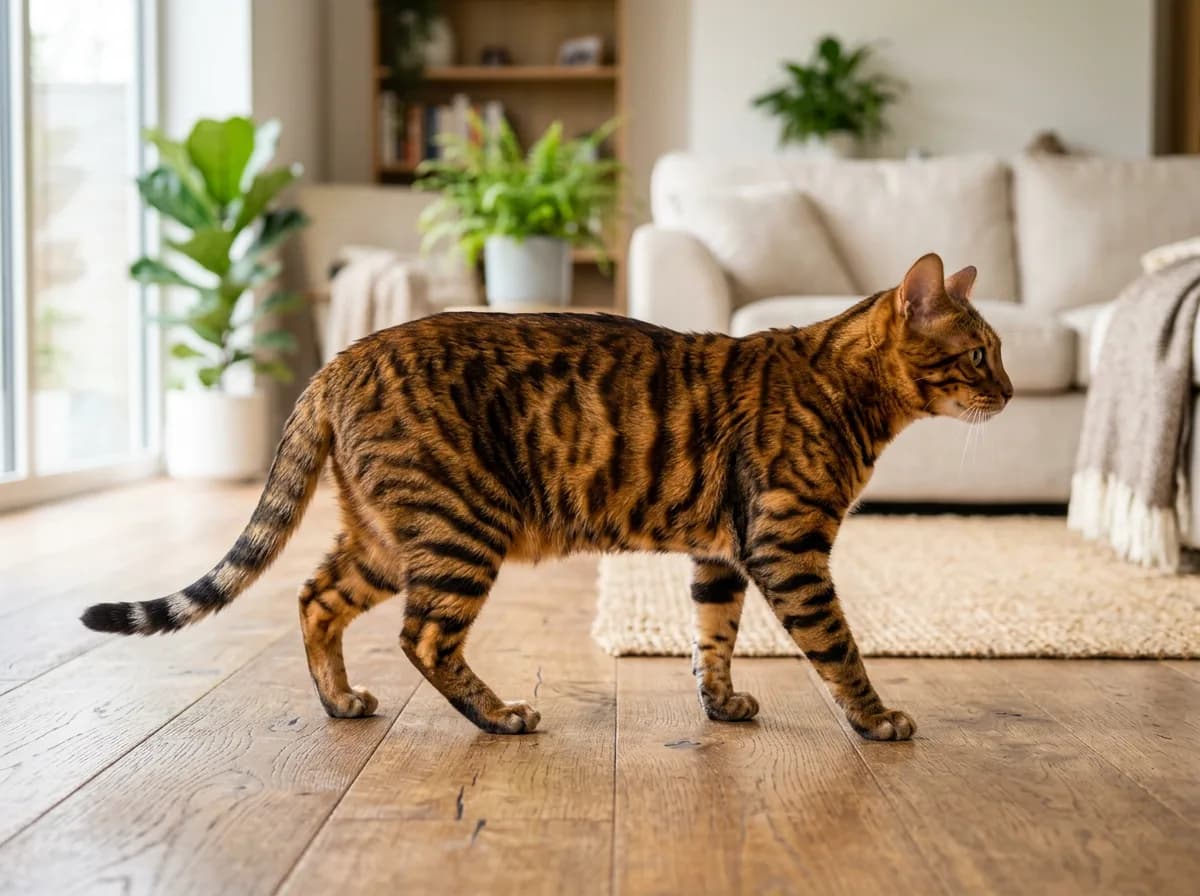
The Toyger cat is a domestic breed developed to look like a miniature tiger, with a warm orange-brown coat and bold dark vertical stripes instead of the spots and rosettes you see on a leopard-patterned cat. Despite the wild appearance, a Toyger cat has no recent wild ancestry and behaves like the friendly, people-oriented house cat it is. The breed is genuinely rare and still developing, so kittens are expensive and waiting lists are common. This guide covers everything buyers actually search for: how much a Toyger costs, its size, lifespan, colors, personality, health, how it compares to the Bengal, and where to find one.
- 1The Toyger is a domestic cat bred to resemble a toy tiger, with vertical mackerel stripes on a rich brown coat. It has no recent wild ancestry.
- 2Toygers are rare and in-demand: pet-quality kittens typically run $1,500 to $3,500, and show-quality cats from top lines can reach $5,000 or more.
- 3Expect a medium, muscular cat of about 7 to 15 pounds with a 10 to 15 year lifespan.
- 4Temperament is dog-like: outgoing, trainable, affectionate, and great with kids and other pets.
- 5The breed standard recognizes only the brown mackerel tabby. 'Blue,' 'white,' 'silver,' and 'black' Toygers are non-standard, in-development, or simply marketing labels, not separate recognized colors.

Sign up for expert-backed reviews and safety alerts all in one place.
Toyger Cat Characteristics at a Glance
If you want the quick version of the Toyger cat's key characteristics, the table below sums up size, weight, lifespan, price, colors, and origin before we dig into the details.
| Trait | Detail |
|---|---|
| Other names | Toy tiger, miniature tiger cat |
| Origin | United States (developed from the 1980s by Judy Sugden) |
| Size | Medium, long and muscular with a deep chest |
| Weight | 7 to 15 lb (males 10 to 15 lb, females 7 to 10 lb) |
| Lifespan | 10 to 15 years on average |
| Coat | Short, plush, and often glittered; low-shedding |
| Colors | Brown mackerel tabby only (the recognized standard) |
| Pattern | Dark vertical 'broken' tiger stripes, not spots or rosettes |
| Temperament | Outgoing, playful, trainable, affectionate, dog-like |
| Price | $1,500 to $3,500 pet quality; up to $5,000+ show quality |
| Recognition | Full championship status with TICA |
History and Origin of the Toyger
The Toyger was created by Judy Sugden, a California breeder (and daughter of Bengal pioneer Jean Mill), who set out to design a domestic cat that captured the look of a wild tiger. She started in the 1980s after noticing two distinctive markings on a tabby cat that hinted a true 'tiger in miniature' might be possible to breed.
To build the pattern, Sugden crossed a striped domestic shorthair with a Bengal, then added a street cat from Kashmir, India, that carried unusual spotted markings between the ears. The goal was never to add wild blood, but to assemble and refine the right combination of stripe, color, and conformation genes already present in domestic cats. The breed earned full championship status with The International Cat Association (TICA) in 2007.
So what is a Toyger cat mixed with? At its foundation it traces back to domestic shorthairs and the Bengal, but every modern Toyger is a fully domestic cat. The 'tiger' is the result of selective breeding for appearance, not recent wild ancestry.
Sugden's wider goal was always bigger than a pretty pet. She has spoken about hoping a charismatic, tiger-striped house cat could raise everyday awareness of real tigers and their conservation in the wild. That mission still shapes the breed's image today, and it is part of why breeders hold the pattern standard so strictly: the more a Toyger reads as a true 'tiger in miniature,' the better it does its job.
- The name is a portmanteau of 'toy' and 'tiger.' It captures the breed's whole reason for existing: a small, safe, lap-friendly cat that looks like a scaled-down tiger.
Toyger Appearance, Size, and Colors
A Toyger is a medium-sized, athletic cat. Most adults weigh between 7 and 15 pounds, with males on the heavier end at 10 to 15 pounds and females closer to 7 to 10 pounds. The body is long and muscular with a deep chest and a rolling, almost tiger-like walk thanks to high shoulders and a low-slung gait. Despite looking substantial, a Toyger is a true house cat, not a large or exotic-sized animal.
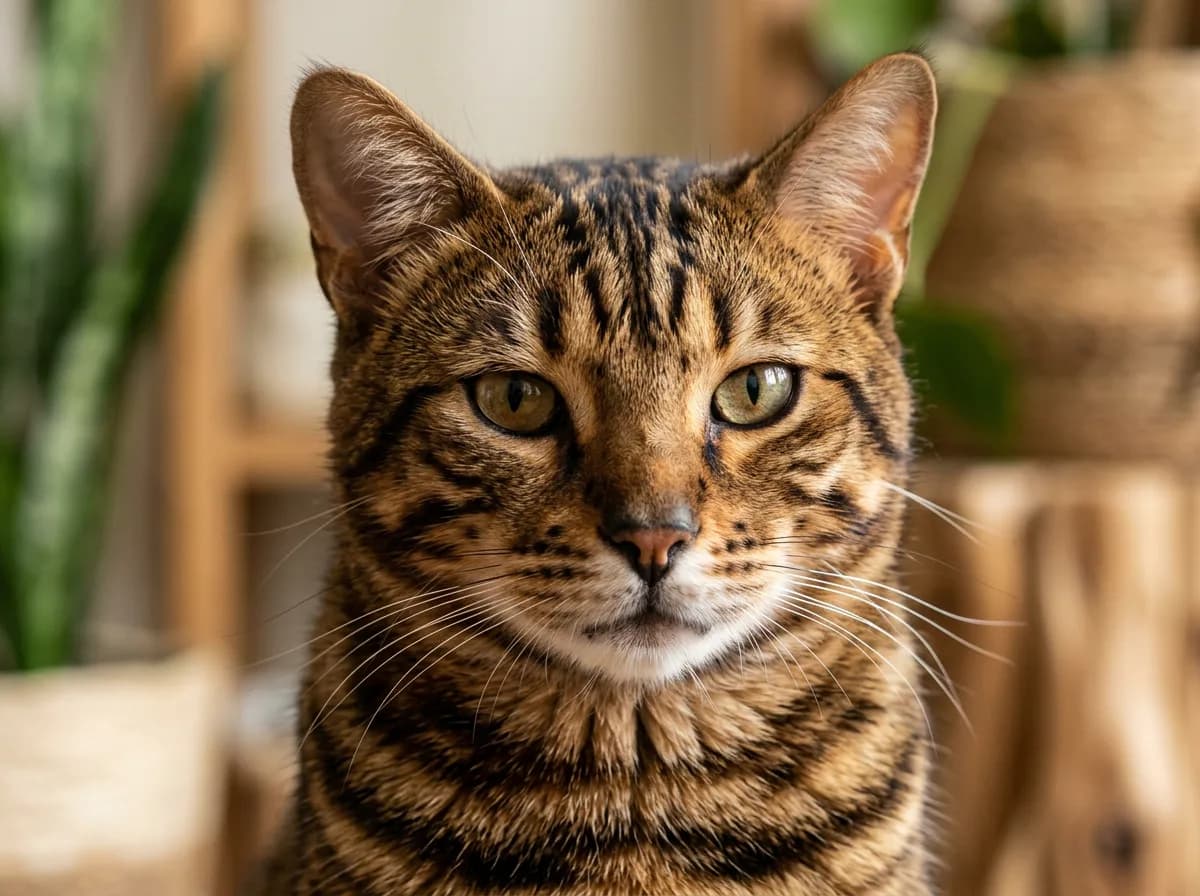
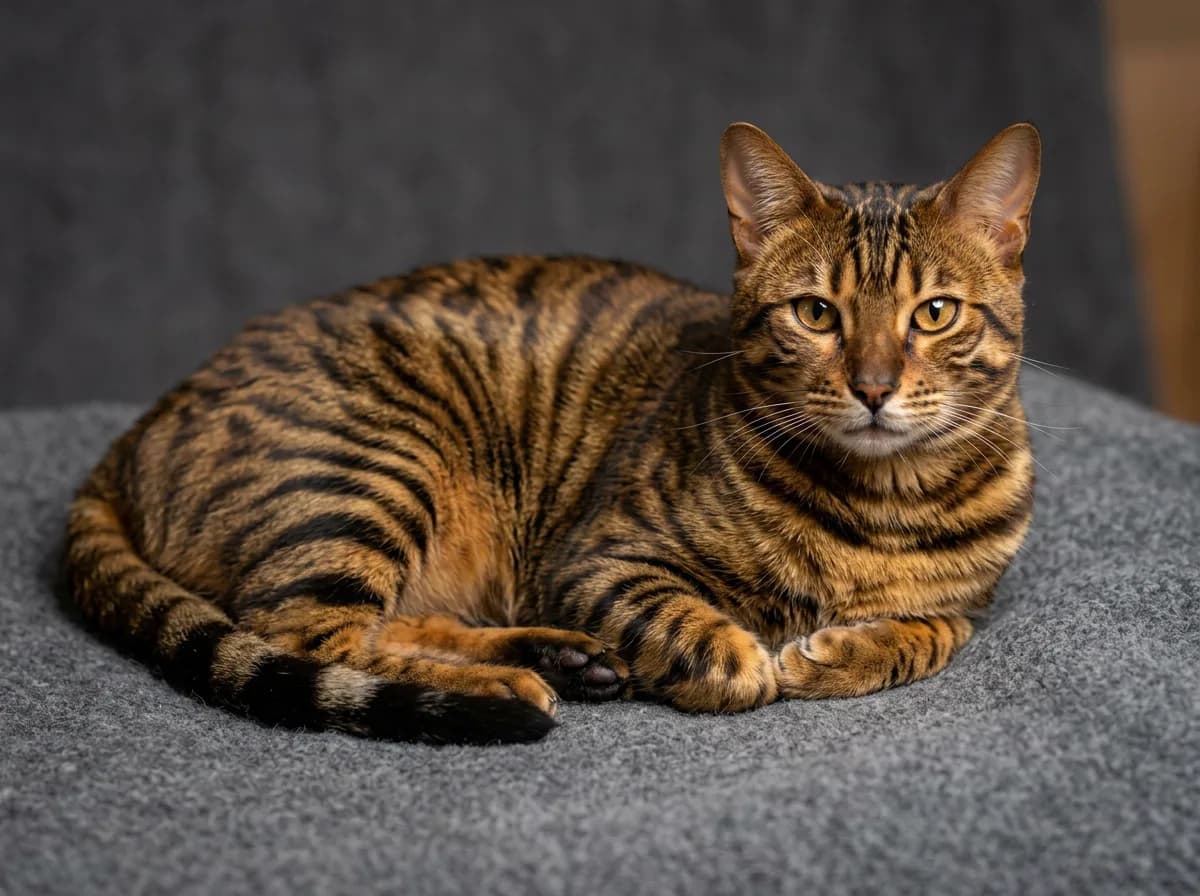
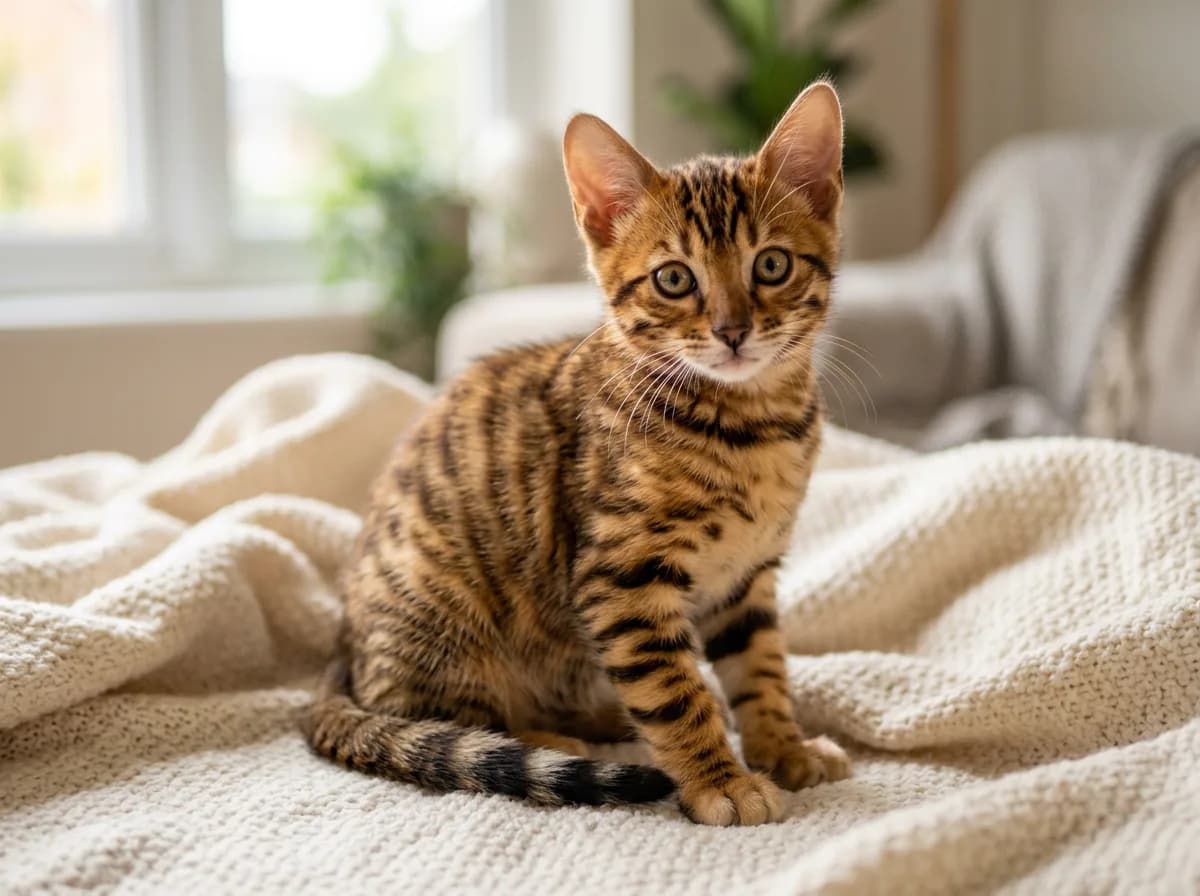
The signature look is in the markings. A show-quality Toyger has dark, vertical, branched stripes (called 'broken' or mackerel striping) on a rich orange-brown background, circular swirled patterns on the temples and cheeks, and a butterfly-shaped pattern on the forehead. The ideal coat is also 'glittered,' with a gold sheen that catches the light. The ears are small and rounded, the eyes are small and deep, and the whole face is engineered to read as 'tiger.'
Toyger Colors: Are Blue or White Toygers Real?
This is where buyers get confused, so here is the honest answer. The breed standard recognizes one color and pattern: the brown mackerel tabby. That warm orange-to-mahogany base with dark tiger stripes is what makes a Toyger a Toyger. Anything else is either non-standard, still in development, or a marketing label.
| Color searched | What it really means |
|---|---|
| Brown Toyger | The one true recognized color: orange-brown base with dark vertical tiger stripes. This is the breed standard. |
| Blue Toyger | Not a recognized Toyger color. 'Blue' (a soft gray) striping appears in some experimental lines but is non-standard and very rare; many listings labeled 'blue' are actually gray tabby cats, not pedigreed Toygers. |
| White Toyger | Not a standard Toyger. A genuinely white or very pale 'snow' tiger look is in-development and unrecognized; true white cats sold as Toygers are usually mislabeled. |
| Silver Toyger | A cooler, silvered version of the tabby pattern that some breeders are working toward. It is experimental and not the championship standard. |
| Black Toyger | Not a recognized color. A solid black or melanistic cat is not a Toyger; the stripes must be visible against a lighter ground. |
- If a seller is charging a premium for a 'blue,' 'white,' or 'black' Toyger, treat it as a red flag. The only color a reputable TICA breeder will register is the brown mackerel tabby. Exotic color claims are often used to upsell a mixed-breed or plain tabby cat.

Color-changing crystal litter that flags pH shifts in your cat's urine, an early warning sign of UTIs, kidney issues, and more.
Petful may earn a commission when you click through to Chewy, at no extra cost to you.
Toyger Personality and Temperament
If the Toyger looks wild, its personality is the opposite. The Toyger cat's personality is famously friendly, outgoing, and people-oriented. These cats bond closely with their families, follow their humans from room to room, and tend to greet visitors rather than hide from them. Many owners describe them as dog-like.
Toygers are intelligent and highly trainable. They readily learn to walk on a harness, play fetch, and pick up simple tricks and cues, which makes them a rewarding cat for owners who want an interactive pet. They are active and playful but not hyperactive, so they settle into a calm lap cat in the evenings.
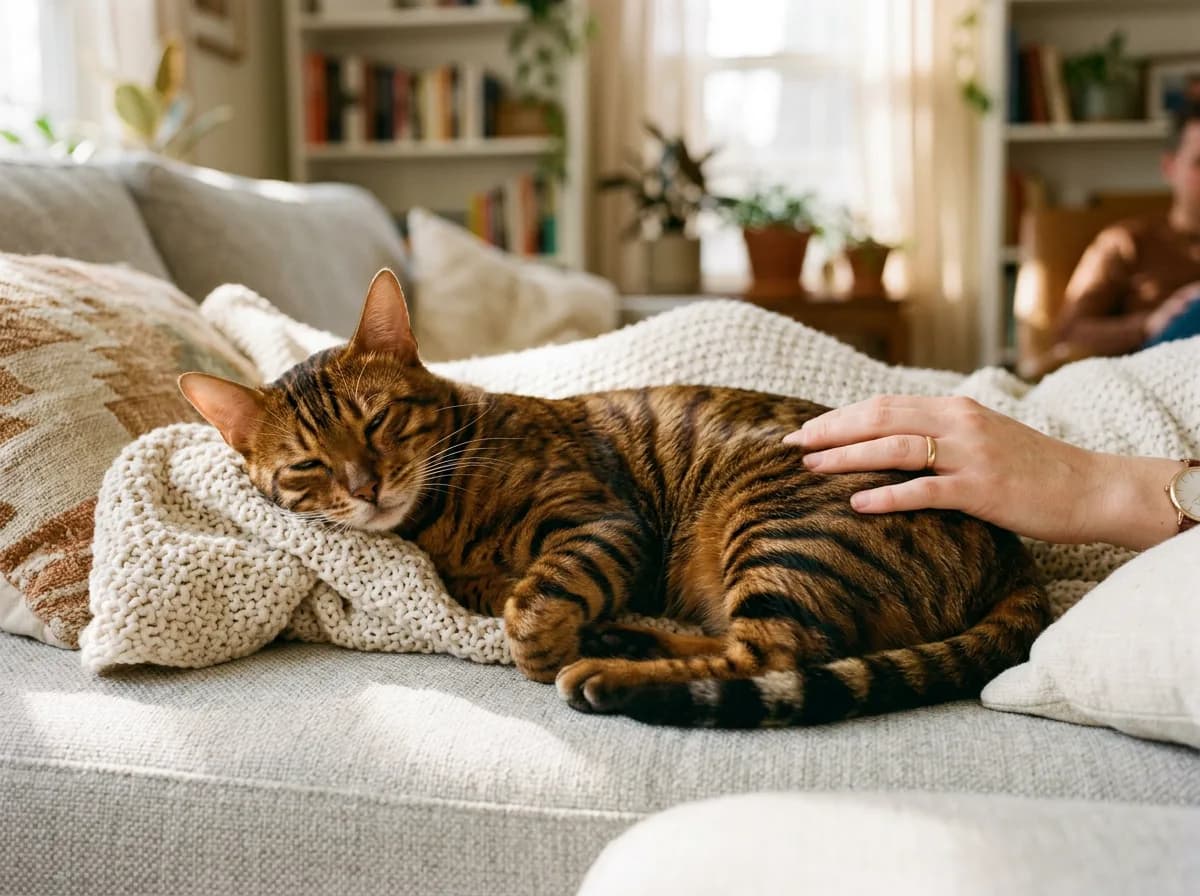
Are Toyger cats good family pets? For most households, yes. They are patient and gentle with respectful children, sociable with other cats and cat-friendly dogs, and they crave company rather than solitude. The flip side is that they do not like being left alone all day. A Toyger does best with a busy, interactive home or a second pet for company.
That sociable, trainable nature also makes the Toyger one of the easier exotic-looking cats to live with day to day. They tend to use a scratching post and litter box reliably, take to clicker training, and enjoy the kind of structured play (fetch, puzzle toys, harness walks) that keeps a clever cat out of trouble. Owners who travel a lot or are out of the house for long stretches should think twice, though, because a bored, lonely Toyger can become vocal and destructive. A companion pet or an enriched environment goes a long way.

Petful may earn a commission when you click through to Chewy, at no extra cost to you.
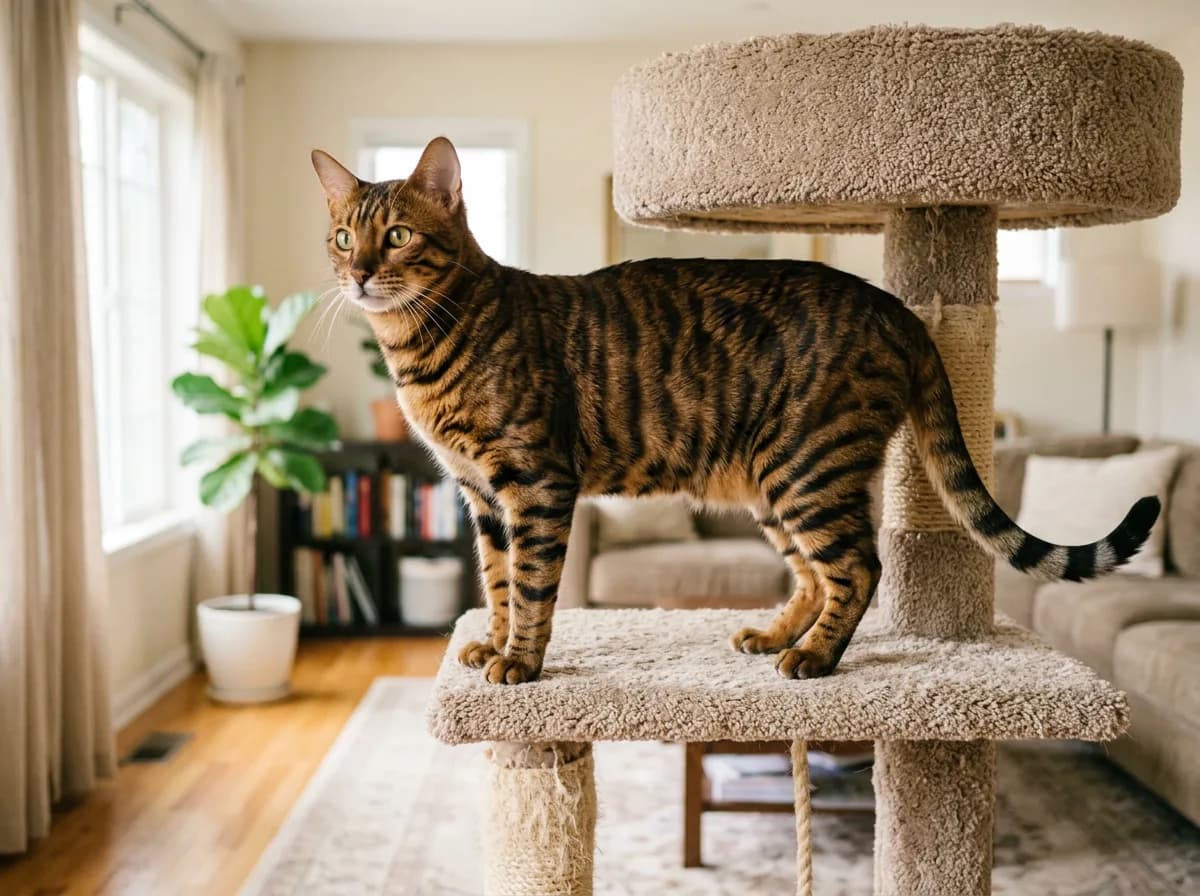
- Because Toygers are smart and social, boredom is the main behavior risk. Puzzle feeders, daily play, a tall cat tree, and harness walks all help channel that intelligence into good behavior.
How Much Does a Toyger Cat Cost?
A Toyger cat costs roughly $1,500 to $3,500 for a pet-quality kitten from a reputable breeder, while show- or breeding-quality cats from top lines can reach $5,000 or more. The Toyger is one of the more expensive domestic breeds because it is still rare, the breeding pool is small, and ethical breeders invest heavily in health testing and the careful selection needed to hit the demanding pattern standard.
| Quality / source | Typical price |
|---|---|
| Adoption or rescue (uncommon) | $100 to $400 when available |
| Pet-quality kitten (breeder) | $1,500 to $3,500 |
| High pattern / breeding quality | $3,500 to $5,000 |
| Top show lines | $5,000 and up |
Beyond the purchase price, budget for the same lifetime costs as any cat: quality food, litter, routine veterinary care, vaccinations, spay or neuter, and pet insurance. A premium price tag does not lower ongoing costs, so factor in several hundred dollars a year for upkeep on top of the kitten price.
- Searchers often land here after asking about the world's most expensive cats. The famous $100,000-plus price tags belong to Ashera and high-percentage Savannah cats, not Toygers. A Toyger is a luxury domestic breed, but its real-world price sits in the low thousands, not six figures.

108-oz stainless steel pet fountain with quiet pump and water-level window. Bengals are notoriously water-obsessed; a flowing fountain encourages hydration and pulls them away from sinks and toilets.
Petful may earn a commission when you click through to Chewy, at no extra cost to you.
Toyger vs Bengal (and vs Tabby)
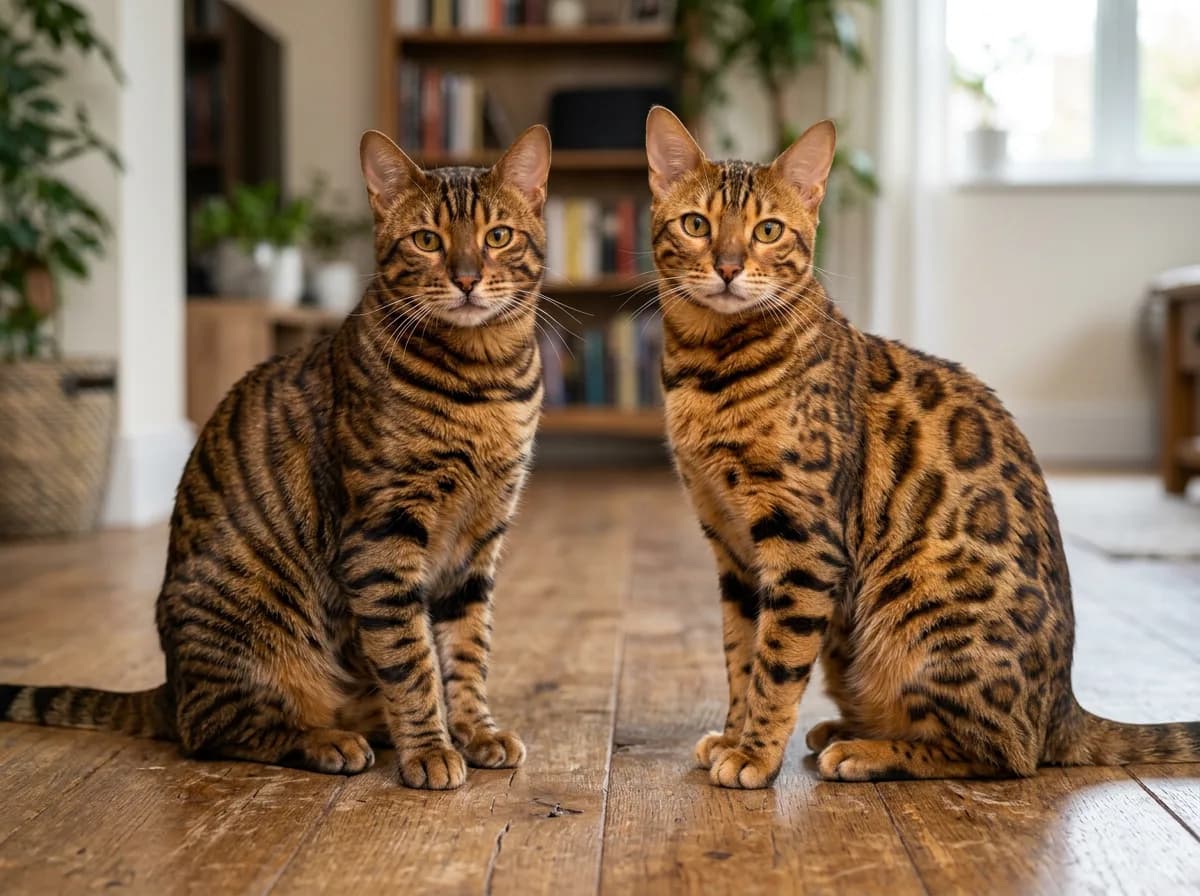
Is a Toyger a Bengal cat? No. The Bengal was used in the Toyger's early development, but they are two distinct breeds with one obvious difference: pattern. A Bengal is spotted or rosetted like a leopard, while a Toyger is striped like a tiger. Once you know to look at the markings, the two are easy to tell apart.
| Feature | Toyger | Bengal | Domestic Tabby |
|---|---|---|---|
| Pattern | Vertical tiger stripes | Spots and rosettes | Stripes, swirls, or spots (varies) |
| Inspiration | Tiger | Leopard / Asian leopard cat | None (natural pattern) |
| Wild ancestry | None (fully domestic) | Recent (Asian leopard cat) | None |
| Build | Medium, muscular, deep chest | Athletic, very active | Varies widely |
| Typical price | $1,500 to $5,000+ | $1,500 to $3,000 | Free to low cost |
| Energy | Active but balanced | High energy | Varies |
Both breeds are striking, but they suit different owners. If you want a high-energy, leopard-spotted cat with recent wild lineage, read our Bengal cat breed profile before deciding. The Toyger, by contrast, gives you the wild look with a calmer, more house-cat temperament.
And if it is simply the striped, warm-toned look you love rather than a pedigree, a friendly orange tabby cat delivers a similar vibe for a fraction of the price, as does a classic gray tabby.
Care, Grooming, and Shedding
Toygers are low-maintenance to groom. The short, plush coat needs only a weekly brushing or comb-through to keep it glossy and to cut down on loose hair. They are average shedders, no heavier than a typical shorthair, so a quick weekly groom plus the usual seasonal pickup is enough.
Do Toygers Shed or Cause Allergies?
Do Toygers shed? Yes, like all cats. Are Toygers hypoallergenic? No. The Toyger is not a hypoallergenic breed. Cat allergies are driven mainly by the Fel d 1 protein in saliva and skin oils, not by hair length, and Toygers produce it like any other cat. If allergies are a concern, spend time with an adult Toyger before committing, and manage exposure with regular grooming, air filtration, and clean litter habits.
Diet and Nutrition
Feed a Toyger a high-quality, protein-rich diet appropriate for its life stage, and measure portions to prevent weight gain. Like any muscular, active cat, a Toyger does best on food where named meat leads the ingredient list. Fresh water should always be available; many of these clever cats prefer a running fountain to a still bowl. Watch portion sizes closely, since obesity is the single biggest preventable health problem in house cats.
Never Scoop Again® with the Whisker Litter-Robot, the smart self-cleaning automatic litter box. Monitor visits and track weights for better overall care in the Whisker® app. Multi-cat friendly.
Petful may earn a commission when you click through to Whisker, at no extra cost to you.
Toyger Health Issues
Toygers are generally healthy and typically live 10 to 15 years, but because the breeding pool is small, responsible breeders screen carefully for inherited conditions. The most important one to ask about is heart disease.
Hypertrophic cardiomyopathy (HCM) is the most common heart condition in cats and can appear in Toygers. It thickens the heart muscle and may first show up as a heart murmur on a routine exam. Reputable breeders have their breeding cats screened by a veterinary cardiologist, and owners should keep up with annual checkups so any murmur is caught early. Other issues reported in the breed include heart murmurs unrelated to HCM and occasional eye problems such as cataracts.
- Before buying a Toyger kitten, ask to see proof of cardiac screening on the parents and a written health guarantee. A breeder who cannot or will not provide health records is one to avoid. This is the clearest sign of an ethical Toyger breeder.
Routine preventive care is the same as for any cat: keep vaccinations and parasite control up to date, brush the teeth or provide dental care to head off periodontal disease, and schedule yearly wellness exams (twice yearly for seniors). Spaying or neutering is standard for pet-quality cats and removes the risk of reproductive cancers. Because the Toyger gene pool is small, buying from a breeder who openly shares health-testing results is the single best thing you can do to stack the odds in your kitten's favor.
With good preventive care, a sensible diet, dental care, and routine veterinary visits, most Toygers stay healthy well into their teens. As with any cat, keeping your Toyger at a lean body weight does more for its lifespan than almost anything else.
Where to Find a Toyger Cat or Kitten
Because Toygers are rare, finding one takes patience. There are only a limited number of registered Toyger breeders worldwide, and reputable ones often have waiting lists. Start with the TICA breeder directory to find registered catteries, and expect to wait months and to pay a deposit to reserve a kitten.
When you contact a breeder, look for one who raises kittens underfoot in the home, health-screens the parents (especially for HCM), provides a written contract and health guarantee, and lets kittens go no earlier than 12 weeks. Be wary of any 'breeder' offering Toygers cheaply, shipping sight-unseen, or pushing rare 'colors,' as these are common red flags for kitten mills or mislabeled mixed cats.
Adoption is uncommon for such a rare breed, but it is worth a try. Breed-specific rescues and surrender networks occasionally have Toygers or Toyger mixes, and you can browse the wider cat breeds hub to compare the Toyger with other striped and exotic-looking cats that may be easier (and cheaper) to find.
Toyger Cat FAQ
A pet-quality Toyger kitten from a reputable breeder typically costs $1,500 to $3,500, while show- or breeding-quality cats from top lines can run $5,000 or more. The breed is expensive because it is rare, the breeding pool is small, and ethical breeders invest in health testing and careful pattern selection.
Yes. The Toyger is one of the rarer pedigreed cat breeds. There are only a limited number of registered breeders worldwide, the breed is still being refined, and most catteries keep waiting lists. That scarcity is a major reason the kittens are expensive.
No. The Bengal was used in the Toyger's early development, but they are separate breeds. The simplest way to tell them apart is the pattern: a Toyger is striped like a tiger, while a Bengal is spotted or rosetted like a leopard. A Toyger is also fully domestic with no recent wild ancestry.
Toygers typically live 10 to 15 years. With a good diet, a lean body weight, dental care, and routine veterinary checkups, many reach the upper end of that range or beyond.
Toygers are medium-sized cats. Most weigh 7 to 15 pounds, with males at 10 to 15 pounds and females at 7 to 10 pounds. They have a long, muscular body and a deep chest, so they can look more substantial than they weigh.
Toygers shed like all cats, though their short coat is low-maintenance and an average shedder. They are not hypoallergenic. Cat allergies come mainly from the Fel d 1 protein in saliva and skin, which Toygers produce just like any other cat.
The breed standard recognizes only the brown mackerel tabby: an orange-brown coat with dark vertical tiger stripes. 'Blue,' 'white,' 'silver,' and 'black' Toygers are non-standard, experimental, or marketing labels. Many cats sold under those names are gray tabbies or mixed cats rather than registered Toygers.
The Toyger was developed in the United States by Judy Sugden starting in the 1980s, using a striped domestic shorthair, a Bengal, and a spotted street cat from Kashmir, India. Every modern Toyger is a fully domestic cat; the tiger look comes from selective breeding, not recent wild ancestry.
Yes. Toygers are friendly, outgoing, and dog-like. They bond closely with their families, are gentle with respectful children, and get along with other cats and cat-friendly dogs. They are highly trainable and crave company, so they do best in an interactive home rather than being left alone all day.
Start with the TICA registered-breeder directory and expect a waiting list and a deposit. Choose a breeder who health-screens the parents for HCM, provides a written guarantee, and releases kittens at 12 weeks or later. Adoption is uncommon for such a rare breed but worth checking through breed-specific rescues.

Kristine Lacoste has been researching dog and cat breeds for nearly a decade and has observed the animals up close at dog shows in both the United States and the United Kingdom. She is the author of the book One Unforgettable Journey, which was named as a finalist for a Maxwell Award from the Dog Writers Association of America, and was host of a weekly pet news segment on the National K-9 Academy Radio Show. In addition, she was the New Orleans coordinator for Dogs on Deployment, a nonprofit that helps military members and their pets, for 3 years. Kristine has researched and written about pet behaviors and care for many years. She holds a bachelor’s degree in psychology, another bachelor’s degree in English and a Master of Business Administration degree.
Sign up for expert-backed reviews and safety alerts all in one place.