Mastiff: Temperament, Size, Types, Cost and Breed Guide
Understand the English Mastiff's size, temperament and care needs, compare related mastiff-type breeds, and plan realistically for life with a giant dog.

The broad body and black facial mask are visible in this full-body view.
Petful is reader supported. As an affiliate of platforms like Amazon and Chewy, we may earn a commission when you buy through links on this page. There is no extra cost to you.
The Mastiff is a giant, usually gentle companion whose size changes almost every part of dog ownership. Often called the English Mastiff, this broad-headed dog can outweigh an adult person. A calm temperament helps, but it does not make training, socialization, space, or veterinary costs optional.
There is also a naming trap: “mastiff” can describe a wider group of powerful dogs, while Mastiff is the name of a specific breed. A Tibetan Mastiff, Bullmastiff, and Cane Corso are different dogs with different needs. Start by identifying the breed you mean, then consider the daily life you can offer it.

Sign up for expert-backed reviews and safety alerts all in one place.
What is a Mastiff? The English Mastiff explained
The English Mastiff is the British giant recognized by the American Kennel Club as the Mastiff, in the Working Group. It is among the heaviest breeds. “Old English Mastiff” is another familiar name for this same breed. Its broad chest, substantial bone, short coat, black mask, and heavy head distinguish it from a long-coated Tibetan Mastiff or a more athletic Cane Corso.
- 1The Mastiff is one breed; mastiff-type dogs are a broader grouping.
- 2Expect a very large adult, early training, daily companionship and substantial lifetime costs.
- 3A gentle dog still needs supervision around children and visitors.
- 4Choose healthy body condition, never maximum body weight.
The word molosser is often used for the wider mastiff-type grouping. Treat “molosser family” as a useful descriptive label, not proof that every modern breed shares one simple ancestry or temperament. The Mastiff Club of America’s breed FAQ makes the practical distinction: these dogs should be identified by their actual breed names.
Historically, Mastiffs were bred for guarding roles. Today's household needs a dog that can settle, walk under control, accept appropriate handling, and recover comfortably from everyday surprises. A powerful appearance is not a substitute for those skills. If you are choosing a companion, prioritize stable behavior and good breeding practices over claims about toughness, size records, or protection.
Types of Mastiffs: the mastiff-type breeds compared
There is no single official count of “mastiff breeds,” because people apply that label differently. Some include only dogs with Mastiff in the breed name; others include a wider set of muscular working and guardian breeds. The comparison below identifies the English Mastiff and seven related breed labels you are likely to encounter. Mastiff-type breeds differ in coat, build, working background, and household needs; the links below lead to each separate Petful profile for the fuller care decision.
| Breed | Origin | Build and adult weight context | Guarding style or household distinction |
|---|---|---|---|
| Mastiff | Britain | Giant, broad and heavy; adults commonly 120 to 230 pounds | Usually calm with family; substantial space and handling needs |
| Bullmastiff | Britain | More compact; commonly 100 to 130 pounds | Watchful companion with a different working history |
| Tibetan Mastiff | Tibet | Heavy double coat; size varies considerably | Independent guardian; adult behavior deserves breed-specific research |
| Neapolitan Mastiff | Italy | Heavy frame, abundant loose skin and folds | Watchful dog with demanding skin-fold care |
| Cane Corso | Italy | Muscular and more athletic in outline | Needs consistent training and purposeful daily activity |
| Dogue de Bordeaux | France | Broad head, muscular body and short coat | Powerful family companion with its own health considerations |
| Boerboel | South Africa | Large, muscular working guardian | Physical management and experienced guidance matter |
| Dogo Argentino | Argentina | Athletic, muscular white dog | Hunting background; assess prey drive and household fit |
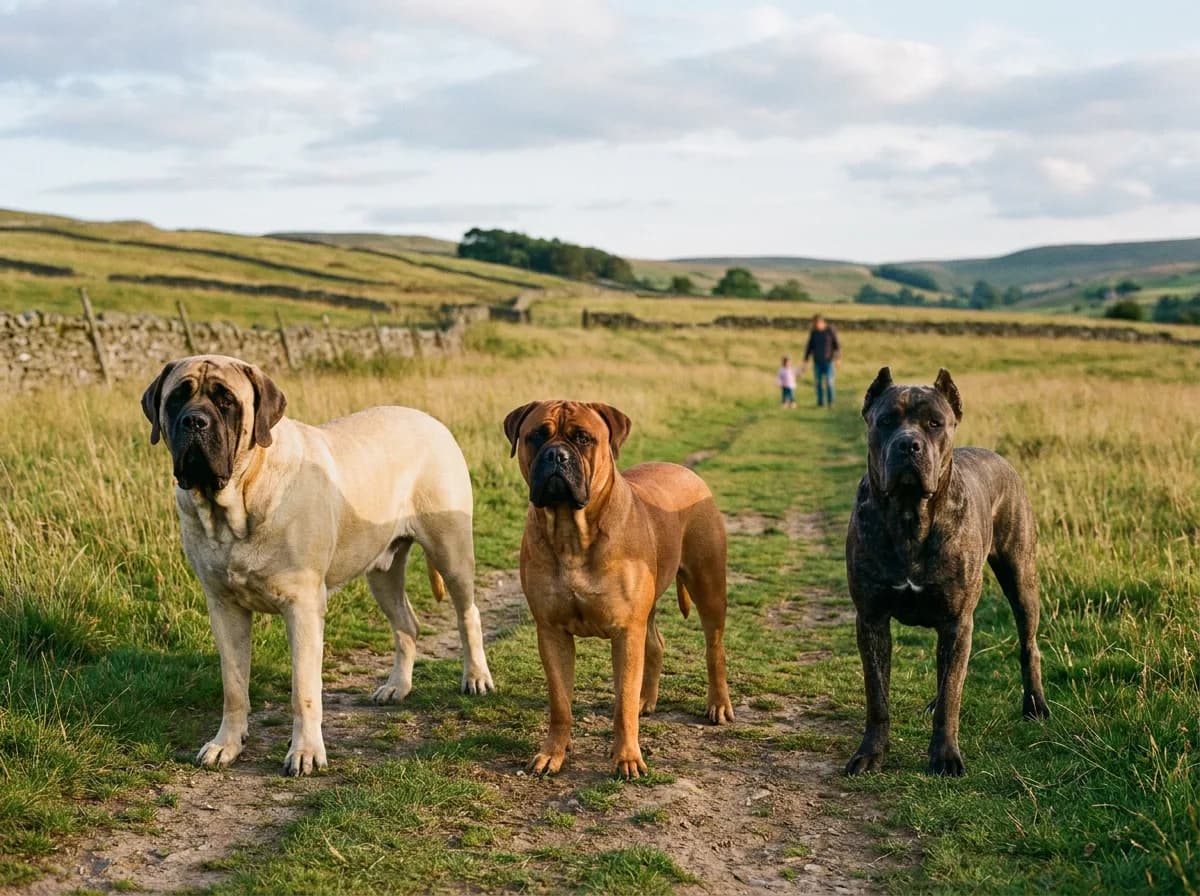
Use build and guarding style to decide which full profile to read, rather than sorting the dogs into a universal “best” or “calmest” ranking. An individual dog's temperament, health, social experience, and training can matter more than a broad breed label. These are all substantial dogs; choosing a lighter member of the group does not automatically make ownership easy.
Petful may earn a commission when you click through to Chewy, at no extra cost to you.
Tibetan Mastiff
A Tibetan Mastiff is not a long-haired English Mastiff. Its dense coat and independent guardian background create a different ownership question, especially around visitors, boundaries, and handling. Someone attracted to the English Mastiff's close household companionship should not assume those expectations transfer unchanged.
Read the Tibetan Mastiff breed profile for that breed's temperament, care, and family fit. That guide also connects to the Tibetan Mastiff's dedicated size and ownership coverage. Comparing the two begins with behavior and environment, not which puppy looks more impressive in a photograph.
Bullmastiff
The Bullmastiff was developed in Britain using Bulldogs and Mastiffs. It is a distinct breed, generally lighter and more compact than the English Mastiff, with a watchful nature of its own. Its name can confuse puppy buyers, but a Bullmastiff is not simply a small Mastiff or a label for any bulldog-and-mastiff mix.
Our Bullmastiff breed profile covers Bullmastiff temperament and care. Its breed-specific guidance helps you assess the Bullmastiff after the size and background comparison here. Smaller adult size does not erase the need for responsible breeding, training, and an adequate budget.
Neapolitan Mastiff
The Neapolitan Mastiff, sometimes shortened to “Neo,” has a notably wrinkled appearance and substantial loose skin. Those features are part of the breed's identity, but they also make skin-fold care and sensible physical management relevant questions for an owner. It is not an exaggerated version of the English Mastiff.
The Neapolitan Mastiff guide explains its distinctive care needs. If an advertisement says only “mastiff puppies,” confirm which breed the seller means before discussing temperament, adult size, health screening, or the home the puppy will need.
Cane Corso (Italian Mastiff)
The Cane Corso is often called an Italian Mastiff. Compared with the English Mastiff, it usually has a more athletic outline and a different expectation for purposeful activity. A spelling such as “King Corso” in an advertisement does not identify a separate recognized breed.
Read the Cane Corso breed profile before choosing between these dogs. The important comparison is the daily training, exercise, visitor management, and handling you can sustain. Choosing a dog for a dramatic appearance while overlooking that daily work is a poor match for either breed.
Dogue de Bordeaux (French Mastiff)
The Dogue de Bordeaux is the French Mastiff: a separate breed with a broad head, muscular body, and its own care considerations. “Bordeaux Mastiff” and “French Mastiff dog” usually refer to this breed, not to an English Mastiff born in France.
Our Dogue de Bordeaux profile is the place to compare its temperament and health needs. Meet adult dogs when possible. A short-coated puppy can make the breeds look more similar than their adult build, behavior, and medical histories actually are.
Boerboel (South African Mastiff)
The Boerboel is a South African working guardian, often described as a South African Mastiff. It is a powerful dog whose strength and protective behavior call for thoughtful placement and consistent management. A generic “African Mastiff” label should prompt a conversation about the dog's actual identity and background.
The Boerboel breed profile explains the specific ownership commitment. Evaluate access to secure space, professional training support, and handlers who can manage the dog safely. Those practical questions are more useful than comparing a Boerboel's weight with an unusually large English Mastiff.
Dogo Argentino (Argentine Mastiff)
The Dogo Argentino is an athletic white breed developed in Argentina with a hunting background. “Argentine Mastiff” or “Argentinian Mastiff” may appear as alternative labels, but its purpose and behavior should not be inferred from the English Mastiff's reputation as a laid-back companion.
Read the Dogo Argentino breed profile for the fuller decision, including activity and household considerations. When comparing any of these dogs, ask about the individual animal's behavior around other pets rather than assuming that a shared mastiff-type label predicts compatibility.
Petful may earn a commission when you click through to Chewy, at no extra cost to you.
How big does a Mastiff get?
An adult English Mastiff is very large, even among giant breeds. AKC’s Mastiff facts give typical weights of 160 to 230 pounds for males and 120 to 170 pounds for females. The breed standard gives minimum shoulder heights of 30 inches for males and 27.5 inches for females; it does not set an ideal maximum weight.
| Feature | What to expect |
|---|---|
| Adult weight | Commonly 160 to 230 pounds for males; 120 to 170 pounds for females |
| Minimum height in the breed standard | 30 inches for males; 27.5 inches for females, measured at the shoulder |
| Life expectancy | Commonly 6 to 10 years |
| Coat | Short, with fawn, apricot or brindle coloring and a dark mask |
| Daily activity | Regular moderate activity adapted to age, health and weather |
| Household planning | Space to turn and stretch, secure transport, training and a giant-dog budget |
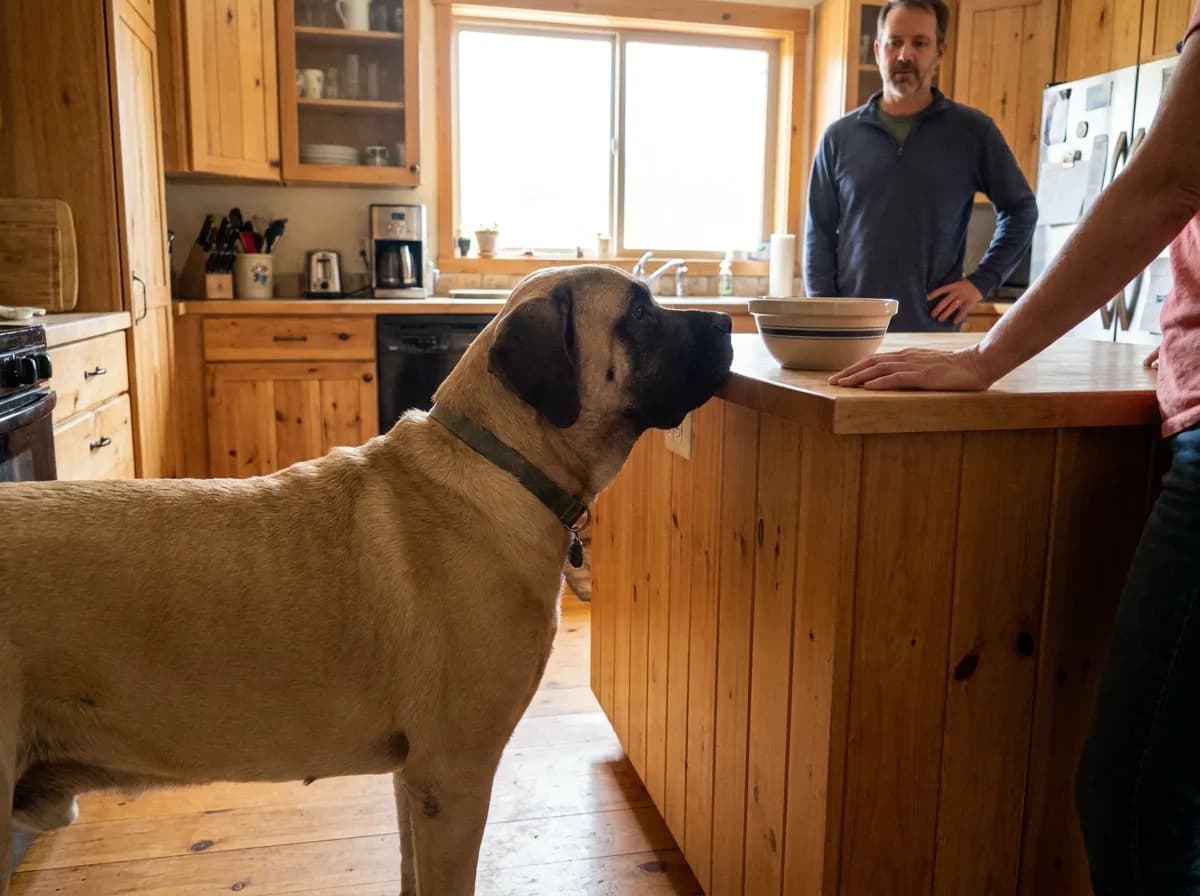
Before bringing one home, measure the spaces the adult dog must actually use. Can it turn comfortably between furniture? Can it rest without blocking a narrow doorway? Will your vehicle carry it safely, and could you transport it if it could not walk? The answers matter more than whether the home is described as a house or apartment.
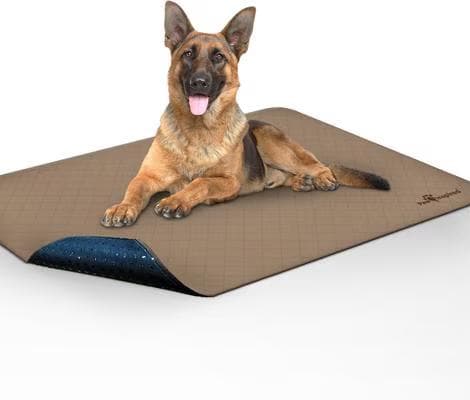
A washable floor protector such as the Paw Inspired 48-by-60-inch pad can help in a designated resting or cleanup area. Keep it flat and check whether your dog chews it or slips on it. It is floor protection, not a substitute for a properly sized bed, regular toilet outings, or treating new incontinence.
A record weight is not a health goal
AKC describes Zorba, a Mastiff reported at 343 pounds, as a historical size record. That example says nothing about the healthy weight of your dog. Do not increase food to match a famous animal or compare your puppy with the heaviest dog in its litter. Have your veterinarian assess body condition and growth, especially if weight is changing quickly.
Is a Mastiff bigger than a Cane Corso?
An English Mastiff is generally heavier than a Cane Corso. The Mastiff's typical adult weight range reaches well above 200 pounds in males, while Cane Corsos are commonly around 90 to 120 pounds, depending on sex and the individual dog. Both are powerful, but their proportions and daily activity needs differ.
A size comparison should include more than a weight range. The English Mastiff tends toward a heavy, broad build; the Cane Corso has a more athletic outline. Neither dog should be selected as a status symbol or judged by imaginary fights. Think about your handling ability, training interests, home, and access to appropriate veterinary care.
Mastiff temperament and family fit
Mastiff temperament is usually described as calm, affectionate, and dignified with familiar people. A well-socialized Mastiff can be a good family dog when the household respects its size and provides consistent training. “Gentle giant” describes a tendency, not a safety guarantee for every interaction.

Children should leave a sleeping or eating dog alone, avoid climbing on it, and have an adult manage greetings and play. Even a friendly dog can knock someone over without intending harm. Give the dog a quiet retreat and teach children that this space is off limits while it rests.
Mastiff temperament with other dogs varies. Ask about a rescue dog's observed history and arrange careful introductions rather than expecting two large dogs to “sort it out.” In a home with small animals, assess the individual's behavior and use secure separation whenever supervision is unavailable.
Teach the manners that make size manageable
Practice waiting at doors, four paws on the floor during greetings, a comfortable settle on a mat, and walking with a loose leash. Reward small successes before asking for the same behavior in a distracting place. Rehearsing calm routines at home gives both dog and handler a useful starting point outdoors.
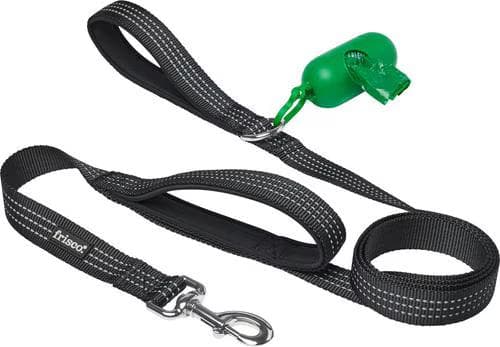
A Frisco traffic leash with dual padded handles offers a standard walking handle and a closer handhold when you need to guide your dog through a narrow space. Attach it to properly fitted walking equipment and practice before a crowded outing. A second handle does not replace training or make a handler physically capable of controlling any dog.
Some Mastiffs learn quickly but lose interest in repetitive exercises. Short, varied sessions can work better than drilling the same response. Our guide to independent dog breeds discusses why conventional trainability rankings do not measure everything a dog can learn. Avoid treating hesitation, confusion, pain, or fatigue as proof of stubbornness.
Is a Mastiff aggressive?
Aggression is not the desired Mastiff temperament, but any Mastiff can behave aggressively. Guarding instinct, fear, pain, prior learning, and the immediate situation can influence behavior. Early socialization and reward-based training support safer responses; they do not justify promising that a dog will never bite.

Petful may earn a commission when you click through to Chewy, at no extra cost to you.
Do not encourage your companion to threaten visitors or practice protection behavior. Teach a predictable greeting routine, use a barrier when needed, and give the dog distance from situations it cannot handle comfortably. WebVet’s dog body-language guide can help you notice tension before an interaction escalates.
If the dog stiffens, guards resources, snaps, or suddenly becomes uncomfortable with handling, contact your veterinarian and a qualified behavior professional. Do not punish warning signals or force someone to approach to prove the dog is friendly. With a giant dog, early help is far easier than waiting until safe management becomes difficult.
Can a Mastiff be left alone all day?
No breed reliably identifies dogs that can be left alone all day without care. A Mastiff should not be chosen on the assumption that it can routinely spend an entire workday alone without support. Some adults learn to settle during appropriate absences, but alone-time tolerance depends on the individual, its health, its routine, and gradual preparation.
The limit for an adult differs from a puppy's: a young puppy needs more frequent meals, toilet outings, supervision, and company. Plan those tasks around actual caregivers rather than a breed-based hourly allowance. Crate and space needs also change dramatically as a Mastiff grows. A crate is a resting and management tool, not a solution for leaving a 150-pound dog confined for an unsuitable stretch.
- Arrange midday help before a demanding work schedule begins.
- Practice short comfortable separations while someone is available to respond.
- Check how the dog behaves when alone rather than judging only the quiet return home.
- Have a backup caregiver for overtime, travel, or illness.
For the wider breed-selection question, see dog breeds for someone who works. If your Mastiff panics, damages exits, or cannot settle during absences, read our separation-anxiety guidance and seek individual help. Anxiety needs more than a longer walk or a firmer command.
Is a Mastiff a one-person dog?
A Mastiff can form a close bond with the whole family rather than only one handler. Some have a favorite person, but this is not a breed that should be expected to accept care from only that individual. Close companionship can look like following you from room to room or choosing a resting place nearby.
Sometimes called “velcro” guardian behavior, that preference for proximity is different from distress whenever someone leaves. Let several responsible household members participate in pleasant feeding, walking, and training routines. A whole-family bond makes ordinary care and temporary absences more manageable without asking the dog to tolerate unwanted hugging or constant attention.
Mastiff health, lifespan, and drool
English Mastiffs commonly live 6 to 10 years. That relatively short giant-breed lifespan is a real part of the commitment, although an individual dog's health and longevity cannot be predicted from a breed average. Ask about the health and ages of close relatives when discussing a puppy. A report about the longest-living Mastiff is not a forecast for another dog, and this English Mastiff range should not be applied to every mastiff-type breed.
Hip and elbow dysplasia, certain eye disorders, and heart concerns are among the reasons to check breeding-health records. The MCOA health-testing guidance lists recommended evaluations and explains why “vet checked” is not equivalent to screening the parents for inherited problems. Our giant-breed health guide gives additional context for a veterinary conversation.
- Repeated attempts to vomit without producing much, a swollen abdomen, marked restlessness, weakness or collapse can signal gastric dilatation-volvulus. Seek emergency veterinary care immediately. Do not wait for every sign or try a home remedy; stabilization and emergency surgery may be needed.
The American College of Veterinary Surgeons explains gastric dilatation-volvulus, or GDV, and its treatment. Discuss your dog's individual risk and whether preventive gastropexy is appropriate with your veterinarian. Our dog-bloat timeline explains why waiting for a suspected case to improve can be dangerous.
Plan for both drool and shedding in a Mastiff home. Mastiffs shed despite their short coat, and how much they shed can change with the season and the individual dog. Purina's breed information describes seasonal shedding. Expect regular cleanup rather than a hair-free sofa; unusual hair loss or irritated skin needs individual attention.
Drool is especially noticeable around drinking and meals. Keep clean towels available and gently dry damp skin. A new change in drooling, mouth discomfort, difficulty eating, or foul odor deserves an examination instead of being dismissed as “just a Mastiff thing.”
Mastiff coat: fawn, apricot, and brindle
The Mastiff breed standard recognizes fawn, apricot, and brindle coats with a dark muzzle, ears, and surrounding facial coloration. A brindle English Mastiff has darker striping over its base color. An apricot coat is warmer than a pale fawn coat, although lighting can change how either looks in a photo.

A dual-ended toothbrush with a large and a small head to fit different mouth sizes and reach the back molars where plaque hides. Soft bristles angled for the gumline.
Petful may earn a commission when you click through to Chewy, at no extra cost to you.

A very dark brindle Mastiff can appear almost black at a glance; sellers sometimes call this “reverse brindle.” The same recognized colors apply to English Mastiff puppies and adults. Do not assume a “black Mastiff dog” listing proves either a recognized solid-black English Mastiff or the identity of its parents. Ask for clear natural-light photographs, parentage records, and an explanation of the advertised coat. Color should not replace health, temperament, and breeder transparency in your decision.
Blue, solid white, and a “blue nose” label are not additional English Mastiff color varieties in the standard. A seller should clarify the actual breed and parentage behind such a description. Likewise, a fluffy or long-haired coat differs from the standard's short coat; a photograph alone cannot establish why. Neither unusual hair length nor an uncommon advertised color is a reason to skip the usual health and sourcing checks.
Groom the coat your dog has
Use regular gentle brushing, washable bedding, and routine cleanup to manage loose hair. For muddy paws or ordinary coat cleanup, Earth Rated unscented grooming wipes are one convenient option. Follow the label, avoid eyes and sensitive openings, and stop if the skin becomes irritated.
Feeding a Mastiff
Choose food for your Mastiff's life stage, health, and body condition. An adult and a growing puppy have different nutritional needs. A huge bag or an impressive protein percentage does not tell you whether a food is appropriate; read its nutritional-adequacy statement and review the feeding plan with your veterinarian.
Scheduled meals make it easier to see what the dog actually eats. Measure portions consistently, count treats within the daily intake, and adjust when activity or body condition changes. There is no universal cups-per-day rule for an English Mastiff because calorie density differs between foods and individual needs vary.
Keep growth steady and mouth care comfortable
Feeding a giant breed during growth requires portion control and attention to body condition, rather than trying to produce the fastest growth rate. For a puppy, select a complete growth diet suitable for large-size dogs. AAFCO’s food-selection guidance explains life-stage statements; the label matters more than a generic claim that one type of food is “best.” Do not add calcium or attempt to accelerate growth unless your veterinarian specifically prescribes a supplement. Our English Mastiff puppy guide covers the first-year routine in detail.
Regular mouth care belongs in that routine too. A Virbac C.E.T. dual-ended toothbrush gives you two brush-head sizes to consider for your dog's mouth. Introduce gentle handling gradually, use toothpaste intended for dogs, and ask your vet to demonstrate a comfortable technique. Pain, bleeding, or difficulty opening the mouth calls for an examination rather than more vigorous brushing.
How much does a Mastiff cost?
The Mastiff Club of America describes puppy prices as starting around $1,500 and up, with variation by location, pedigree, and breeder costs. That is the club's general starting guidance, not a current nationwide average or a guarantee that a particular puppy will cost that amount. A higher price does not prove better health or better care.
For a practical lifetime-cost decision, separate acquisition from continuing care. For a 200-pound dog, food costs, weight-based medication dosing, and insurance deserve individual estimates before you commit. Larger equipment, professional handling, and boarding arrangements also affect the budget. Ask how your clinic prices care for the expected adult weight, and compare insurance coverage as well as the premium. None of these costs can be predicted from the puppy's purchase price alone.
Calculate annual food cost from your own numbers
An illustrative example makes the calculation concrete: if a suitable food costs $80 per bag and your dog's prescribed feeding amount uses two bags per month, annual food cost would be $1,920. Those are hypothetical assumptions, not a feeding recommendation or a measured Mastiff average. Replace both numbers with your food price and actual consumption.
- Obtain a routine-care estimate and discuss likely age-related needs with your clinic.
- Price beds, barriers, walking equipment, and safe vehicle transport by dimensions and ratings.
- Compare insurance terms or decide how you will fund unexpected bills.
- Include training support, pet care during absences, and replacement equipment.
- Keep an emergency transport plan as well as an emergency-care budget.
Insurance premiums and coverage depend on the dog and policy; do not assume every inherited condition, existing symptom, or routine visit will be covered. The useful result of budgeting is knowing which costs you can carry throughout the dog's life, not arriving at one reassuring total that overlooks emergencies or regional differences.
Mastiff puppies
English Mastiff puppies need time, supervision, gentle handling, and a growth-appropriate diet. Their large paws and rapid early growth can make them look older than they are. A puppy that is already difficult to lift still needs age-appropriate toilet breaks, rest, gradual socialization, and help learning ordinary manners.

Our English Mastiff puppies guide covers home setup, feeding, training, and a weekly growth check. It also explains why a growth chart is not a target to force through extra food. If you are asking how many puppies Mastiffs have, remember that litter size varies and cannot tell you whether a particular litter was responsibly bred.
Mastiff mixes
A Mastiff mix dog can inherit a wide range of physical and behavioral traits. A Mastiff–Great Dane mix may be very tall and heavy; a Mastiff–Labrador mix or Boxer–Mastiff mix may have a different activity level. Names such as “Mastweiler” for a Rottweiler mix are labels, not standardized breeds with predictable adult outcomes.
A dog advertised as a Pitbull–Mastiff mix, or a Mastiff–Bulldog mix, also needs an individual assessment; these labels do not establish a standardized temperament or adult size. Learn what is known about both parents, review the dog's behavior, and plan for uncertainty in care. A DNA test or a shelter's best breed estimate can add information, but neither replaces observing the dog in the kinds of situations it will meet in your home.
Finding a Mastiff: breeders and rescue
Responsible sourcing means assessing Mastiff breeders and rescue organizations before choosing an available dog. Start with the Mastiff Club of America and established breed-rescue networks. Ask which health evaluations were completed, how to verify the results, how the puppies are raised, and what support or return arrangements exist after placement. Availability alone is not enough information to judge a source.
For rescue, ask about the dog's foster observations, handling needs, comfort with other pets, and any known medical care. Be honest about your physical limitations and household. An adult Mastiff with a well-described routine may be a better fit than a puppy, but it still needs an introduction and care plan tailored to that individual.
Questions worth answering before you commit
- Who will handle walks and unexpected situations safely?
- What happens if the dog cannot climb stairs or get into the vehicle?
- Can the dog rest separately from children and other pets?
- Who provides care when your normal routine breaks down?
- Can you afford the likely adult size as well as the puppy's purchase price?
Be cautious if a seller pressures you to pay before answering those questions or promises exceptional size as the main selling point. A responsible match is built around the animal's welfare and your ability to care for it, not urgency or a dramatic photograph.
Is a Mastiff right for you?
A Mastiff can suit someone who wants a close companion, enjoys calm training, and has the space, budget, and physical support for a giant dog. It is a demanding choice for a home where a dog must routinely manage long absences alone, where safe separation is impossible, or where adult size would make routine care difficult.
- Often affectionate and calm with familiar people
- Short coat with straightforward routine grooming
- Can enjoy varied reward-based learning and daily companionship
- Giant size changes handling, transport and equipment needs
- Drool, shedding and lifetime cost require preparation
- A short lifespan and possible major veterinary expenses are part of the commitment
Meet adult Mastiffs, speak honestly with breeders or rescue staff, and picture an ordinary busy week in your home. The right decision is the one in which you can meet this dog's needs consistently. A giant companion is most enjoyable when the practical arrangements are already in place.
Mastiff FAQs
Many Mastiffs have heavy drooling, particularly around drinking and eating. Keep a clean drool towel handy and dry damp skin gently. Sudden drooling or mouth pain deserves veterinary attention.
Litter size varies with the individual pregnancy. A breed-average number cannot predict a particular litter or show whether a breeder used appropriate health screening and care. Ask about the parents and the puppies' records instead.
The Bullmastiff is a separate breed developed from a Bulldog cross with Mastiffs. It is generally lighter and shorter than an English Mastiff, but both need thoughtful training and management.
The commonly reported range is six to ten years. Giant-breed lifespan is relatively short, and an individual dog's health and longevity can differ from that range.
Mastiffs are among the heaviest breeds, while the tallest dogs are not necessarily the heaviest. AKC cites Zorba's historical reported weight of 343 pounds. A record weight is never a healthy target for your own dog.

Kristine Lacoste has been researching dog and cat breeds for nearly a decade and has observed the animals up close at dog shows in both the United States and the United Kingdom. She is the author of the book One Unforgettable Journey, which was named as a finalist for a Maxwell Award from the Dog Writers Association of America, and was host of a weekly pet news segment on the National K-9 Academy Radio Show. In addition, she was the New Orleans coordinator for Dogs on Deployment, a nonprofit that helps military members and their pets, for 3 years. Kristine has researched and written about pet behaviors and care for many years. She holds a bachelor’s degree in psychology, another bachelor’s degree in English and a Master of Business Administration degree.
Sign up for expert-backed reviews and safety alerts all in one place.