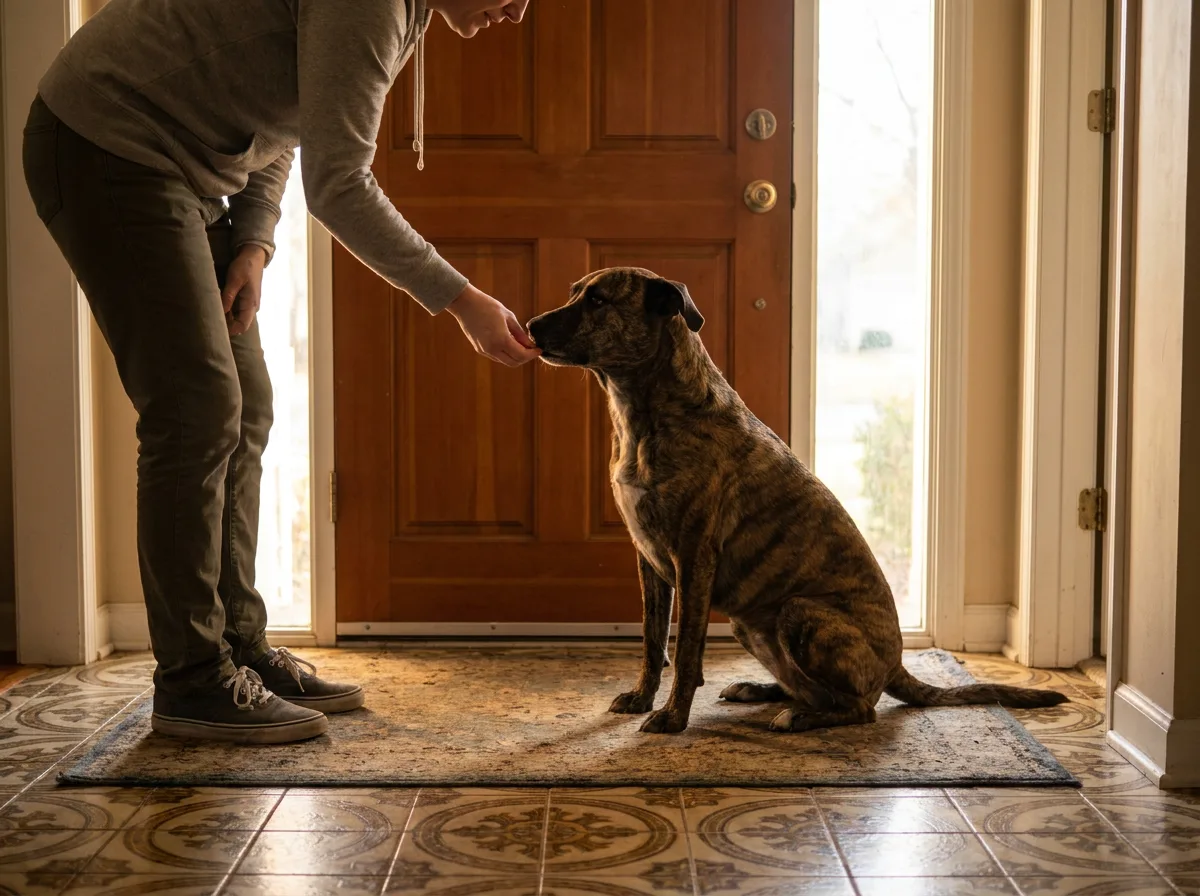
Noise Phobia in Dogs: Signs, Triggers, and Evidence-Based Treatment
Noise phobia in dogs is an exaggerated fear of sounds that goes far beyond a normal startle. Affecting up to half of all dogs, it causes panic and escape attempts. Treatment ranges from management and counterconditioning to FDA-approved medications.

BVMS, MRCVS
Petful is reader supported. As an affiliate of platforms like Amazon and Chewy, we may earn a commission when you buy through links on this page. There is no extra cost to you.
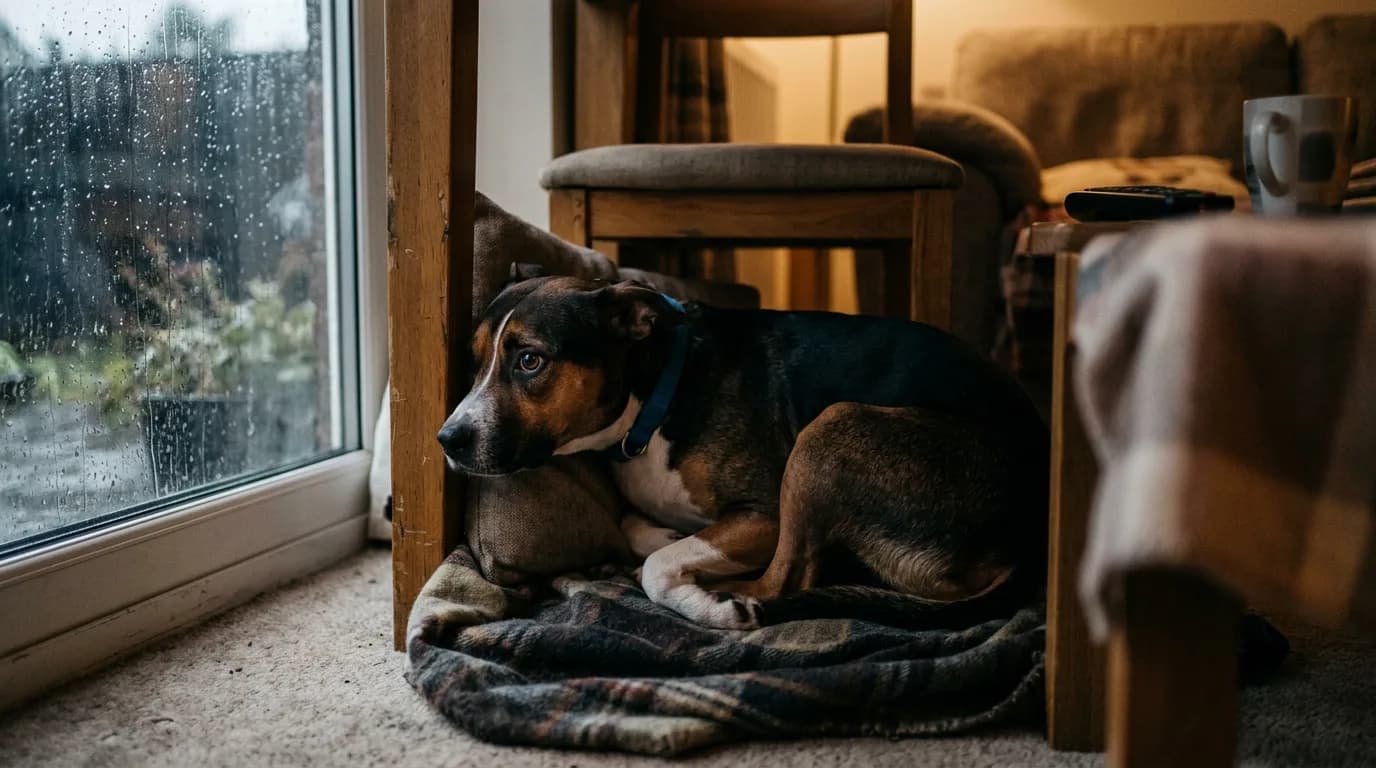
Noise phobia in dogs is an exaggerated, persistent fear of specific sounds that goes far beyond a normal startle and can spiral into full-blown panic. A 2023 review of the evidence on canine noise fears, published in the journal Animals by veterinary behavior researcher Stefanie Riemer, reports that fearful responses to loud noises affect roughly a quarter to half of the dog population, making it one of the most common behavioral problems veterinarians see. If your dog trembles, hides, drools, or tries to escape during thunderstorms or fireworks, you are not dealing with a quirk or a stubborn streak. You are watching a treatable medical and behavioral condition, and the earlier you act, the better the outcome.
This guide walks through what noise phobia in dogs actually is, how to tell it apart from a normal reaction, the common triggers, the warning signs at every severity level, why some dogs develop it, and the full evidence-based treatment ladder, from rearranging a room to FDA-approved medications and referral to a board-certified veterinary behaviorist.
- 1Noise phobia in dogs is an exaggerated, out-of-proportion fear of sounds, distinct from a brief normal startle.
- 2It affects an estimated 25 to 50 percent of dogs, with thunderstorms and fireworks the most common triggers.
- 3Treatment follows a ladder: environmental management, behavior modification (desensitization and counterconditioning), calming aids, and prescription medication.
- 4Two FDA-approved drugs exist for canine noise fear: Sileo (dexmedetomidine oromucosal gel) and Pexion (imepitoin).
- 5The condition rarely resolves on its own and tends to worsen with each exposure, so early, multimodal treatment gives the best prognosis.

Sign up for expert-backed reviews and safety alerts all in one place.
What Is Noise Phobia in Dogs?
Noise phobia in dogs is a profound, persistent, and out-of-proportion fear response triggered by specific sounds, in which the dog reacts with panic that is disproportionate to any real danger. According to VCA Animal Hospitals, a phobia is "a persistent and excessive fear of a specific stimulus," and once it is established, the dog reacts at near-maximum intensity to even a brief or distant version of the trigger. This separates phobia from simple anxiety or a one-time scare.
Veterinary behavior specialists distinguish three related terms that often get used interchangeably. Noise sensitivity or aversion is a mild dislike, fear is a normal protective emotion in proportion to a threat, and phobia is the extreme, irrational end of that spectrum. The American Veterinary Medical Association classifies noise aversion as a recognized welfare problem that warrants veterinary attention rather than something owners should simply wait out.
How Noise Phobia Differs from Normal Startle Response
A normal startle is brief and self-resolving, while noise phobia produces a prolonged panic that lingers long after the sound has stopped. A dog with a healthy startle response may flinch at a dropped pan, look toward the sound, and return to normal within seconds. The Today's Veterinary Practice diagnostic framework notes that a phobic dog, by contrast, may pant, pace, hide, and refuse food for minutes to hours after the trigger ends, and may begin to react to early warning cues such as falling barometric pressure before a storm even arrives.
The key clinical difference is recovery time and proportionality. Startle is adaptive and momentary. Phobia is maladaptive: the fear is out of proportion to the actual threat, it does not extinguish on its own, and it generalizes, meaning a dog frightened by thunder may eventually fear rain, wind, or a darkening sky. If your dog has trouble settling, you may also find our broader guidance on anxiety in dogs useful for recognizing overlapping signs.
Prevalence and Risk Factors
Noise phobia is strikingly common: an estimated 25 to 50 percent of dogs show fearful responses to noise, according to Riemer's 2023 review aggregating multiple owner-survey studies. Many cases go unreported because owners assume the behavior is normal or untreatable, so the true figure may be higher still.
Several factors raise the risk. Older dogs are over-represented, partly because the condition worsens cumulatively over a lifetime and partly because pain or cognitive decline can lower a dog's tolerance for stress. Certain herding and working breeds, including Border Collies and Australian Shepherds, appear predisposed, and research has linked noise fear to a co-occurring relationship with separation-related problems and generalized anxiety. Dogs that were under-socialized to everyday sounds as puppies are also at elevated risk.
- Veterinary behaviorists have documented that undiagnosed musculoskeletal pain can trigger or worsen noise phobia, because a startle that causes a sudden tense movement creates a painful association with the sound. If an older dog develops noise phobia suddenly, ask your veterinarian to screen for pain before assuming the problem is purely behavioral.
 Sponsored
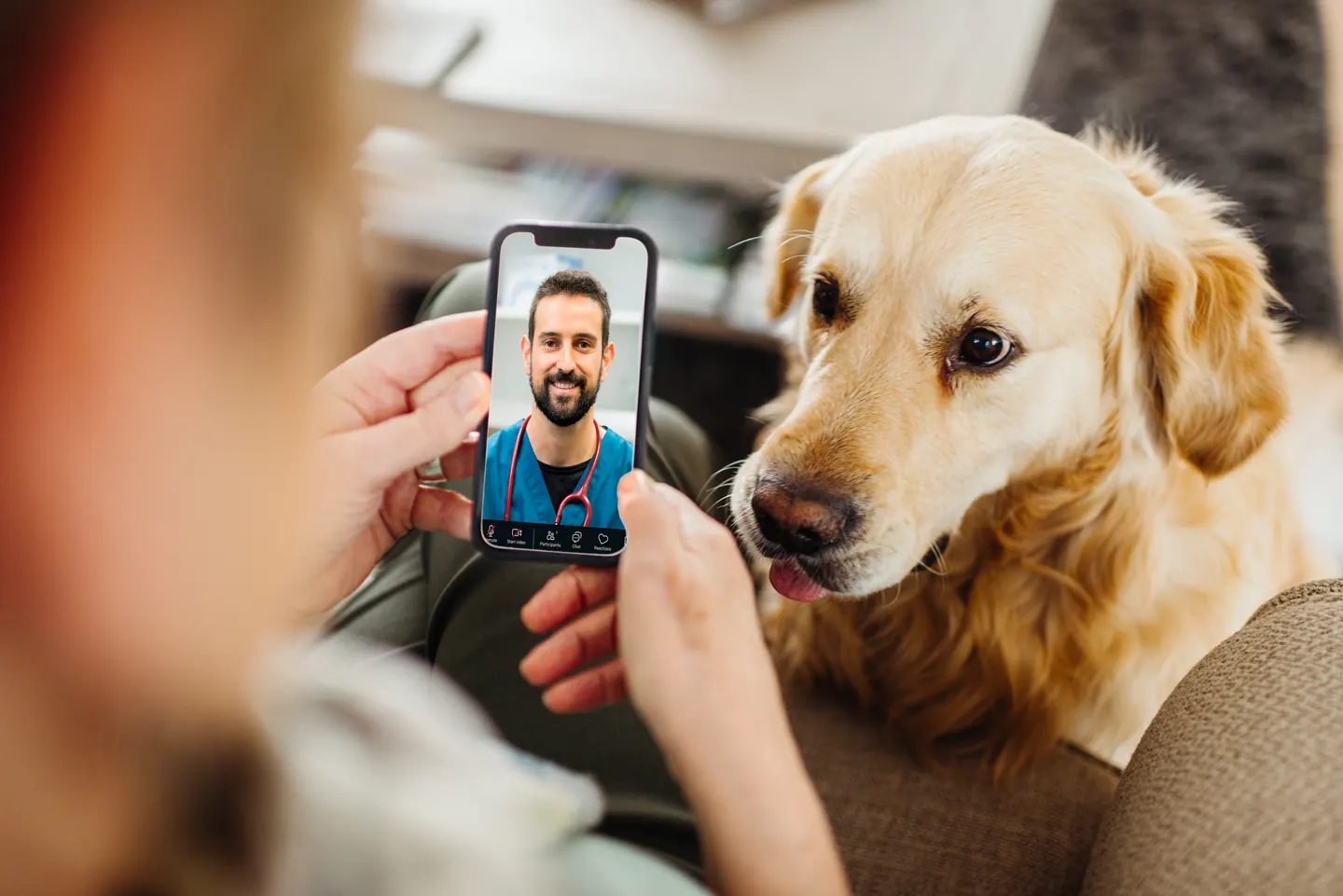
Want a vet's help with your dog's anxiety or behavior?
Talk to a licensed vet at Dutch over video, often the same day. They can recommend treatment and prescribe it when it's appropriate.
Use code Pets60
Plans start at $12/month · covers up to 5 pets
- Licensed vets in most states
- Rx for 150+ conditions
- 4.7 on Trustpilot
Common Triggers for Noise Phobia
The most common triggers for noise phobia in dogs are thunderstorms and fireworks, followed by gunshots and a range of sudden or high-frequency household and urban sounds. Veterinary Partner (VIN) notes that storm and firework phobias dominate behavior caseloads in summer months, with emergency clinics reporting spikes in lost and injured dogs around the Fourth of July and New Year's Eve specifically because of panic-driven escape attempts.
What unites these triggers is unpredictability, loudness, and often a sensory package that goes beyond sound alone. Understanding the specific trigger helps you tailor both management and treatment.

Thunderstorms and Weather Sounds
Thunderstorm phobia is uniquely difficult because the dog reacts to a whole sensory cascade, not just thunder. Veterinary behavior literature describes storm-phobic dogs responding to changes in barometric pressure, wind, rain on the roof, lightning flashes, darkening skies, and even the static electricity that builds in their coat. This is why many storm-phobic dogs become anxious well before any thunder is audible to humans.

Peanut butter soft chews with L-theanine, chamomile, and ashwagandha to ease hyperactivity and support calm, relaxed behavior.
Petful may earn a commission when you click through to Chewy, at no extra cost to you.
Because the trigger has so many components, storm phobia tends to be one of the hardest forms to fully desensitize and often requires medication during the active storm season. Our companion advice on how to support a frightened dog during severe weather pairs well with the management steps below.
Fireworks and Gunshots
Fireworks and gunshots are explosive, intermittent, and impossible to predict, which makes them especially potent phobia triggers. The 2023 Animals review highlights that fireworks rank among the single most-reported fear triggers in owner surveys, and because they cluster around predictable holidays, they offer a rare opportunity for owners to medicate and manage proactively rather than reactively.
Gunshots share the same acoustic profile: a sudden, high-intensity report with no warning. Hunting dogs and rural dogs are frequently exposed, and a single traumatic experience can establish a lifelong phobia, which is why gradual, positive sound introduction matters so much in working breeds.
Household and Urban Noises
Beyond weather and explosions, many dogs develop phobias to everyday sounds: smoke alarms, vacuum cleaners, blenders, construction, garbage trucks, and beeping electronics. The AKC notes that high-pitched or sudden mechanical sounds are common culprits, and that a dog can generalize from one device to a whole category, fearing every beep in the house after one alarming smoke-detector chirp.
These triggers matter because they occur year-round and inside the home, leaving the dog with no safe refuge. They are also frequently overlooked, because owners may not connect a dog's hiding under the bed with the dishwasher that just finished its cycle.
| Trigger Category | Examples | Why It Triggers Phobia |
|---|---|---|
| Weather | Thunder, wind, rain, barometric shifts | Multi-sensory cascade with early warning cues that build dread |
| Explosive | Fireworks, gunshots | Sudden, loud, unpredictable, often a single trauma is enough |
| Household | Smoke alarms, vacuums, blenders, beeps | Year-round, inside the home, easily generalized to whole categories |
| Urban | Construction, traffic, garbage trucks, sirens | Frequent, uncontrollable, and impossible for the dog to escape |
Signs and Symptoms of Noise Phobia
The signs of noise phobia in dogs range from subtle stress signals such as lip-licking and panting to severe panic that includes destructive escape attempts and self-injury. PetMD's veterinary-reviewed overview emphasizes that owners often miss the early, low-grade signals and only recognize a problem once the dog reaches full panic, which is exactly the point at which the condition is hardest to treat.
Learning to read the full spectrum lets you intervene early. Below, the signs are grouped by severity, but remember that an individual dog can escalate from mild to severe within a single event.
Mild to Moderate Signs
Mild to moderate noise phobia shows up as body-language stress signals long before a dog reaches outright panic. According to Today's Veterinary Practice, early indicators include panting, pacing, trembling, lip-licking, yawning, drooling, clinginess, hiding, and seeking the owner. A dog may also lower its ears, tuck its tail, widen its eyes so the whites show, and refuse treats it would normally take eagerly.
These signals are easy to dismiss but clinically important, because they mark the window in which behavior modification and management are most effective. A dog that is still able to take food and respond to cues is a dog that can still learn a new, calmer association with the sound.
Severe Phobic Responses
Severe noise phobia produces frantic, sometimes dangerous behavior, including destructive escape attempts, self-injury, and complete shutdown. Veterinary Partner documents dogs that chew through doors, break windows, jump fences, and dig until their paws bleed, all driven by an overwhelming instinct to flee the sound. Some dogs become inappetent for hours, lose bladder or bowel control, or freeze in a non-responsive crouch.
These are not behavior choices the dog can override, and punishment makes them worse. A dog in this state is in genuine distress and is at real risk of injury or of bolting and becoming lost, which is why severe cases warrant prompt veterinary involvement and almost always a medication component.
- Noise-phobic dogs are a leading cause of lost-pet reports around fireworks holidays. A panicking dog can scale a fence or break a leash it has never challenged before. Make sure your dog is microchipped and wearing ID tags, secure all exits before a known trigger, and never leave a severely phobic dog alone outdoors or in a yard during storms or fireworks.
Why Dogs Develop Noise Phobia
Dogs develop noise phobia through a combination of genetic predisposition, traumatic or repeated exposure, and inadequate early socialization, often with no single identifiable cause. Riemer's 2023 review concludes that noise fear is multifactorial: heritability plays a measurable role, but life experience determines whether a predisposed dog ever develops a clinical problem. Understanding the contributing factors helps explain why prevention is so much more effective than treatment.
Genetic Predisposition
Genetics load the dice. Studies cited in the peer-reviewed literature show that certain breeds, particularly herding breeds such as Border Collies, Australian Shepherds, and German Shepherd Dogs, report higher rates of noise fear, and that a dog's parents' temperament influences risk. Cornell College of Veterinary Medicine notes that fearfulness has a heritable component, meaning a naturally cautious dog enters the world more vulnerable to developing a phobia after a frightening sound.
Genetic predisposition does not guarantee a phobia, but it lowers the threshold. A genetically anxious puppy needs more careful, positive sound exposure during the socialization window than a naturally bold one.
Environmental Factors and Trauma
A single terrifying experience can create a lifelong phobia through one-trial learning. Veterinary behaviorists describe dogs that develop storm phobia after one close lightning strike or firework phobia after being caught outside during a display. Because the fear is paired so strongly with the sound, the brain treats every future occurrence as the same threat.
Repeated uncontrolled exposure works the same way more gradually. Each time a dog experiences the sound without relief, the association strengthens, which is why a dog left alone through storm after storm tends to deteriorate rather than habituate.
Lack of Early Socialization
Puppies that are not gently exposed to a variety of everyday sounds during their sensitive period are far more likely to fear those sounds as adults. The American Veterinary Society of Animal Behavior identifies roughly 3 to 14 weeks of age as the critical socialization window, during which positive experiences build lifelong resilience. A puppy that never hears thunder, fireworks recordings, vacuums, or traffic in a calm, positive context has no template for treating those sounds as safe.
This is the single most preventable cause. Structured early exposure, including enrollment in well-run puppy training classes, dramatically lowers the odds of adult noise phobia.
How Noise Phobia Worsens Over Time
Untreated noise phobia almost always gets worse, not better, because each frightening exposure reinforces and broadens the fear. Veterinary Partner describes a process of sensitization, in which the dog reacts more strongly to each successive event, and generalization, in which the fear spreads to related sounds and contexts. A dog that started out fearing only thunder may end up fearing rain, wind, the room where a storm once happened, and eventually being left alone.
This progressive nature is the central argument for early intervention. Waiting to "see if the dog grows out of it" allows the phobia to entrench and generalize, making it harder and more expensive to treat later.
The Evidence-Based Treatment Ladder
Treating noise phobia in dogs follows a stepwise ladder: environmental management first, then behavior modification, then calming aids, then prescription medication, with referral to a veterinary behaviorist for severe or refractory cases. PetMD and Veterinary Partner both frame treatment this way, and the peer-reviewed evidence supports a multimodal approach in which combining methods outperforms any single tactic. Crucially, mild and severe cases enter the ladder at different rungs: a severely phobic dog usually needs medication from day one alongside behavior work, not after months of failed management.

A vet-recommended probiotic supplement that helps dogs manage anxious behaviors and stay calm during stressful events like fireworks.
Petful may earn a commission when you click through to Chewy, at no extra cost to you.
The goal is not to eliminate the dog's awareness of the sound but to change its emotional response from panic to calm or indifference. That takes time, consistency, and often professional guidance.
Step 1: Environmental Management
Environmental management means controlling the dog's exposure and giving it a safe, sound-dampened refuge, and it is the foundation every other step builds on. Veterinary Partner recommends a comfortable hideaway such as an interior closet, a covered crate, or a basement room, combined with white noise, calming music, or a running fan to mask the trigger, and closed curtains to block lightning flashes.
Management alone rarely cures a true phobia, but it prevents the panic-driven harm and reduces the intensity of exposure so that behavior modification can work. Identify your dog's preferred hiding spot and make it more comfortable rather than blocking access to it; forcing a frightened dog out of its refuge increases distress.
- Set up the hideaway weeks ahead of storm or firework season and feed meals or offer favorite chews there on calm days, so the spot already carries positive, relaxed associations. A dog that has chosen and enjoyed its refuge in good weather will retreat there calmly instead of frantically when a trigger hits.
Step 2: Behavioral Modification Techniques
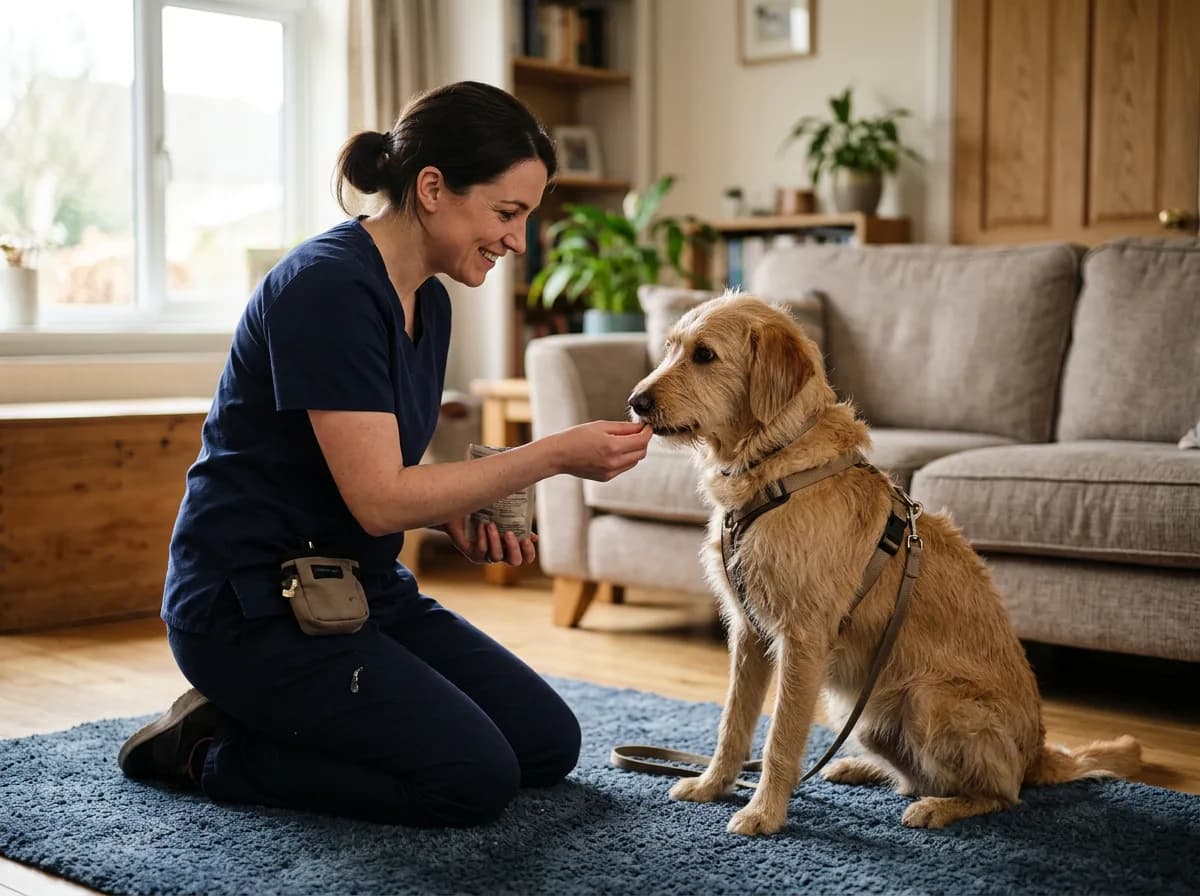
Behavior modification rewires the dog's emotional response to sound through two core techniques: desensitization and counterconditioning, ideally used together. The peer-reviewed evidence reports meaningful success rates for these methods, with one analysis citing desensitization protocols helping roughly half of dogs and counterconditioning approaches helping around 70 percent when applied consistently. These are the only interventions that address the underlying fear rather than just blunting the response.
Behavior modification requires patience and correct technique. Done too fast or at too high a volume, it can backfire and sensitize the dog further, which is why working with a qualified trainer or behaviorist improves results.
Desensitization with Recordings
Desensitization gradually exposes the dog to the feared sound at a volume so low it produces no fear, then raises the intensity in tiny increments over weeks. High-quality recordings of thunder, fireworks, or other triggers are played at a barely audible level while the dog stays relaxed, and the volume creeps up only when the dog remains calm at the current level. The critical rule, emphasized across veterinary behavior sources, is to stay below the threshold that produces any fear; if the dog reacts, you have moved too fast.
Recorded desensitization works best for sounds that reproduce faithfully through speakers, which is why it is more reliable for fireworks and gunshots than for thunderstorms, whose pressure and visual components a recording cannot replicate.
 Sponsored
Vet care that's always there
Unlimited video calls and messaging with licensed vets for less than a typical vet visit. One membership covers up to five pets.
Use code Pets60
Plans start at $12/month · covers up to 5 pets
- Licensed vets in most states
- Rx for 150+ conditions
- 4.7 on Trustpilot
Counterconditioning and Positive Associations
Counterconditioning pairs the feared sound with something wonderful, teaching the dog that the noise predicts good things. While a low-level recording plays, the dog receives high-value food, play, or affection, so over time the sound itself begins to trigger a happy anticipation rather than dread. The peer-reviewed literature reports counterconditioning success rates near 70 percent, and it is most powerful when layered on top of desensitization rather than used alone.
The technique depends on staying under the fear threshold, because a dog in panic cannot eat or learn. This positive, reward-based approach also aligns with the broader case against fear-based dog training: punishment increases fear, while positive association reduces it.
Step 3: Calming Aids and Supplements
Calming aids such as pressure wraps, pheromone diffusers, and nutritional supplements offer modest, lower-risk support that can be layered onto management and behavior work. The evidence base here is weaker than for medication: PetMD notes that products like snug-fitting anxiety wraps, dog-appeasing pheromone (DAP) diffusers and collars, and supplements containing L-theanine or alpha-casozepine help some dogs but are not reliable as sole treatments for moderate to severe phobia.
Think of calming aids as helpful adjuncts rather than cures. They are reasonable to try for mild cases or to add to a comprehensive plan, but they should not replace veterinary care or delay appropriate medication for a severely affected dog.
Step 4: Prescription Medications
For moderate to severe noise phobia, prescription medication is often essential and works best alongside behavior modification rather than as a standalone fix. The peer-reviewed review reports strong response rates for several drugs, and veterinary behaviorists stress that medicating a panicking dog is not a failure of training but a humane and often necessary step. All dosing must be set by your veterinarian, because the right drug and dose depend on the individual dog, its health, and the trigger pattern.
Medication does two things: it relieves acute suffering during a trigger event, and by keeping the dog under threshold, it actually makes behavior modification possible. Never give a dog human anti-anxiety medication or another pet's prescription without veterinary direction.
| Category | Examples | Typical Use |
|---|---|---|
| FDA-approved for noise aversion | Sileo (dexmedetomidine gel), Pexion (imepitoin) | Labeled specifically for canine noise fear, given around a known event |
| Situational anti-anxiety | Trazodone, alprazolam (benzodiazepine) | Given before a predictable trigger such as a storm or fireworks |
| Daily background medication | Fluoxetine, clomipramine (SSRIs and TCAs) | For dogs with frequent or generalized anxiety, taken long-term |
FDA-Approved Options: Sileo and Pexion
Two medications are FDA-approved in the United States for canine noise fear: Sileo, an oromucosal dexmedetomidine gel, and Pexion (imepitoin) for noise aversion. According to VCA Animal Hospitals, Sileo is applied to the gums and dosed around a known noise event, providing calming without heavy sedation, and the peer-reviewed efficacy data reports owner-rated success in roughly 70 to 75 percent of treated dogs. Pexion is given as a course leading up to an expected event such as New Year's fireworks.

Chicken flavored soft chews that support calm, positive behavior during times of occasional stress like fireworks and storms.
Petful may earn a commission when you click through to Chewy, at no extra cost to you.
Because these drugs are purpose-built and label-approved for noise fear, they are frequently first-line pharmacological choices. Both require a veterinary prescription and correct timing relative to the trigger, which your veterinarian will map out for your dog.
Other Pharmacological Interventions
Beyond the FDA-approved options, veterinarians commonly reach for situational drugs like trazodone and alprazolam and, for chronic cases, daily medications such as fluoxetine or clomipramine. The peer-reviewed literature reports high situational success rates for some of these agents, with trazodone and the benzodiazepine alprazolam each helping the large majority of treated dogs when dosed correctly before a trigger. For dogs whose anxiety is frequent, generalized, or year-round, a daily SSRI or tricyclic provides a calmer baseline on which situational drugs and behavior work can act.
Drug selection is individualized and sometimes layered, for example a daily SSRI plus a situational benzodiazepine on storm days. This is precisely the kind of plan that benefits from veterinary or veterinary-behaviorist oversight, both for efficacy and to avoid interactions.
When to Refer to a Veterinary Behaviorist
A board-certified veterinary behaviorist (Diplomate of the American College of Veterinary Behavior, or DACVB) is the right referral for severe, refractory, or complex cases. These specialists have advanced training in both the behavioral and pharmacological management of phobia, and the AVMA recognizes them as the highest level of expertise for cases that have not responded to first-line care or that involve overlapping problems such as separation anxiety or aggression.
Ask for a referral if your dog is injuring itself, if a comprehensive plan has not helped after a fair trial, or if multiple anxieties coexist. Early specialist involvement can shorten the road to relief and prevent the entrenchment that makes phobia so hard to treat.
Prevention: Training Puppies to Handle Noise
The most effective way to prevent noise phobia in dogs is structured, positive sound exposure during a puppy's critical socialization window, which the peer-reviewed evidence rates as far more successful than treating an established phobia later. Riemer's review concludes that prevention in puppies produces better outcomes than any adult treatment, because it builds resilience before fear can take hold. If you have a young puppy, this is the single highest-value thing you can do for its lifelong emotional health.

Critical Socialization Window
The critical socialization window runs from roughly 3 to 14 weeks of age, and experiences during this period shape a dog's lifelong response to the world. The American Veterinary Society of Animal Behavior identifies this stage as the time when a puppy most readily accepts new sights, sounds, people, and surfaces as normal and safe. Sounds a puppy encounters calmly during this window are far less likely to frighten it as an adult.
Because the window closes early, often before a puppy has completed its full vaccine series, organized puppy classes are designed to balance socialization benefits against minimal disease risk. The AVSAB's position is that the behavioral risk of under-socialization outweighs the controlled disease risk of well-run classes.
Gradual Sound Exposure Protocol
A gradual sound exposure protocol introduces recordings of thunder, fireworks, traffic, and household noises at low volume while the puppy plays, eats, or relaxes. The principle mirrors adult desensitization but is easier and faster in a young puppy: keep the volume low enough that the puppy stays happy, pair the sound with food and play, and slowly increase intensity over days and weeks. Several commercially available puppy sound-training programs package these recordings for exactly this purpose.
The goal is for the puppy to learn that these sounds are an unremarkable, even pleasant, part of normal life. A puppy that has eaten dinner to the sound of recorded thunder dozens of times rarely panics at a real storm.
Building Confidence in Young Dogs
Beyond specific sounds, a confident, well-socialized puppy is more resilient to all kinds of fear, including noise. The AKC recommends broad, positive exposure to varied environments, surfaces, people, and animals, combined with reward-based training that teaches the puppy it can cope with novelty. A dog that has learned the world is generally safe and that its owner is a reliable source of good things has a stronger foundation for handling a startling noise.

Clinically tested vet-formulated chews with a colostrum calming complex, L-theanine, and thiamine to quickly ease everyday stress, thunderstorms, and anxiety.
Petful may earn a commission when you click through to Chewy, at no extra cost to you.
Confidence-building and sound exposure work together. A dog that knows how to settle on cue and that trusts its environment has more emotional reserve when a genuinely loud, unexpected noise occurs.
Prognosis: What to Expect
The prognosis for noise phobia in dogs is good with early, consistent, multimodal treatment, though it is usually a condition to be managed rather than permanently cured. Veterinary behavior sources agree that while many dogs improve dramatically and live comfortably, the underlying sensitivity often remains, so the realistic goal is reliable control rather than total elimination. Owners who understand this from the start tend to stay consistent and get better long-term results.
Timeline for Improvement
Improvement typically unfolds over weeks to months rather than days, because behavior modification and daily medications need time to take effect. Veterinary Partner notes that desensitization and counterconditioning protocols are measured in weeks of consistent short sessions, and that daily anti-anxiety medications such as SSRIs can take several weeks to reach full effect. Situational medications, by contrast, work within a single event.
Set expectations accordingly. A dog will not be cured before this weekend's fireworks, but a thoughtful plan started now can transform next year's storm season. Patience and consistency are the strongest predictors of success.
Multimodal Treatment Success Rates
Combining methods produces the best outcomes, which is the central finding of the peer-reviewed evidence on canine noise fear. The 2023 Animals review reports that no single intervention works for every dog, but that layering management, behavior modification, and medication yields substantially higher success than any one approach alone, with several individual components (counterconditioning around 70 percent, FDA-approved Sileo around 70 to 75 percent, situational anti-anxiety drugs higher still) contributing to a strong combined result.
The practical takeaway is to build a plan with multiple rungs rather than searching for one magic fix. A dog on a daily medication, with a prepared safe space, an established positive association with the sound, and a situational drug for the worst nights, has the best chance of a calm life.
Long-Term Outlook with Early Intervention
Dogs treated early, before the phobia generalizes and entrenches, have a markedly better long-term outlook than those whose phobia was left to worsen for years. Because noise phobia sensitizes and spreads with each uncontrolled exposure, intervening at the first signs prevents the cascade that turns a thunder fear into a generalized anxiety. Cornell and other veterinary sources stress that the trajectory of the condition is far more favorable when owners act on early, mild signs rather than waiting for a crisis.
The message is simple and hopeful: this is a treatable condition, and the dogs that do best are the ones whose owners recognized the early stress signals and started a comprehensive plan promptly. Even an energetic or anxious dog can learn to settle through a storm with the right, consistent support.
When to Contact Your Veterinarian
Contact your veterinarian as soon as you recognize that your dog's reaction to noise is more than a brief startle, and treat severe panic or self-injury as urgent. PetMD and the AVMA both advise that noise aversion is a medical condition deserving professional evaluation, not a behavior to wait out, and that the earlier a dog is assessed, the more treatment options remain effective. Your veterinarian can rule out underlying pain or illness, recommend behavior modification, and prescribe appropriate medication.
Seek prompt or urgent veterinary care if your dog injures itself trying to escape, becomes inappetent or non-responsive for hours, has anxiety that is spreading to new sounds or situations, or is at risk of bolting and becoming lost. Your veterinarian may also refer you to a board-certified veterinary behaviorist for severe or complex cases. Whether the trigger is storms, fireworks, or the home environment, you do not have to manage this alone, and your dog should not have to suffer through it.
- Some older sedatives, including acepromazine, can immobilize a dog while leaving it fully aware and still terrified, which may worsen the phobia. Do not give any sedative, human anti-anxiety drug, or another pet's medication on your own. Always let your veterinarian choose a drug that addresses fear, not just movement.
FAQ
Noise phobia in dogs is a persistent, exaggerated fear of specific sounds, such as thunder or fireworks, in which the dog panics out of all proportion to any real danger. Unlike a brief startle, the fear does not resolve quickly, tends to worsen with repeated exposure, and is recognized by the AVMA as a treatable medical and behavioral condition.
A brief startle at a loud sound is normal, but noise phobia is not. A normal dog flinches and recovers within seconds, while a phobic dog panics, hides, trembles, or tries to escape and stays distressed long after the sound stops. Roughly 25 to 50 percent of dogs experience some degree of noise fear, so it is common, but it is a clinical problem worth treating rather than a behavior to ignore.
Early signs include panting, pacing, trembling, drooling, lip-licking, yawning, hiding, clinginess, and refusing food. Severe signs include frantic escape attempts, destroying doors or windows, self-injury, loss of bladder or bowel control, and freezing in a non-responsive crouch. Recognizing the early, milder signals is important because that is when treatment works best.
Noise phobia results from a mix of genetic predisposition, traumatic or repeated exposure to frightening sounds, and inadequate sound socialization as a puppy. Often there is no single cause. Herding and working breeds appear more prone, undiagnosed pain can trigger it in older dogs, and each uncontrolled exposure tends to make an existing phobia worse.
Treatment follows a ladder: start with environmental management (a safe, sound-dampened hideaway), add behavior modification (desensitization and counterconditioning), consider calming aids, and use prescription medication for moderate to severe cases. Combining methods works far better than any single approach, and severe cases usually need medication from the start alongside behavior work.
Two medications are FDA-approved for canine noise fear in the United States: Sileo (dexmedetomidine oromucosal gel) and Pexion (imepitoin). Veterinarians also use situational drugs such as trazodone and alprazolam before a known trigger, and daily medications such as fluoxetine or clomipramine for frequent or generalized anxiety. All dosing must be determined by your veterinarian.
Noise phobia can usually be managed very successfully, but it is more often controlled than permanently cured. Many dogs improve dramatically with early, consistent, multimodal treatment, yet the underlying sensitivity often remains, so the realistic goal is a calm, comfortable dog rather than one with zero awareness of the sound.
Prevention works far better than treatment. During the critical socialization window of roughly 3 to 14 weeks, expose your puppy to recordings of thunder, fireworks, traffic, and household sounds at low volume while it eats and plays, and build overall confidence through positive, varied experiences and well-run puppy classes. A puppy that learns these sounds are normal rarely develops a phobia as an adult.
Noise anxiety or aversion is a milder, proportionate dislike or unease around sounds, while noise phobia is the extreme end of the spectrum, an irrational, intense panic that is out of proportion to any threat and does not resolve on its own. Phobia generally requires more structured treatment, often including medication, whereas mild anxiety may respond to management and behavior work alone.
See your veterinarian as soon as you recognize the reaction is more than a brief startle. Seek prompt or urgent care if your dog injures itself, refuses food or becomes non-responsive for hours, is at risk of bolting and getting lost, or if the fear is spreading to new sounds. Early evaluation preserves more treatment options and can prevent the phobia from worsening.
💡Summary and Key Takeaways
Noise phobia in dogs is a common, treatable, and frequently underestimated condition that affects an estimated quarter to half of all dogs. It is distinct from a normal startle: the fear is exaggerated, persistent, and tends to worsen with each exposure. Thunderstorms and fireworks are the leading triggers, followed by gunshots and a wide range of household and urban sounds, and the warning signs run from subtle stress signals like panting and lip-licking to dangerous escape attempts and self-injury.
The good news is that an evidence-based treatment ladder works. Environmental management gives the dog a safe refuge, behavior modification through desensitization and counterconditioning rewires the emotional response, calming aids offer modest support, and prescription medications, including the FDA-approved options Sileo and Pexion, relieve acute suffering and make behavior work possible. Prevention through early puppy sound socialization is more effective than any adult treatment, and the dogs that do best are those whose owners recognize the early signs and start a comprehensive plan promptly. If your dog struggles with noise, talk to your veterinarian, because relief is genuinely within reach.
BVMS, MRCVS
Dr. Pippa Elliott, BVMS, MRCVS, is a veterinarian with nearly 30 years of experience in companion animal practice. Dr. Elliott earned her Bachelor of Veterinary Medicine and Surgery from the University of Glasgow. She was also designated a Member of the Royal College of Veterinary Surgeons. Married with 2 grown-up kids, Dr. Elliott has a naughty Puggle named Poggle, 3 cats and a bearded dragon.
Sign up for expert-backed reviews and safety alerts all in one place.