Do Cats Protect Their Owners? What Behavior Can Tell You
Cats sometimes help people in remarkable ways, but alertness and closeness do not prove a guarding motive. Learn what to observe and how to keep your cat and visitors safe.
Petful is reader supported. As an affiliate of platforms like Amazon and Chewy, we may earn a commission when you buy through links on this page. There is no extra cost to you.
Do cats protect their owners? Individual cats have acted in ways that helped people escape harm. But cats are not reliable protection against intruders, illness or other dangers, and following you or sleeping nearby does not prove a protective motive. The useful distinction is between what a cat did and why we think it happened.
A cat can be deeply attached to a person without acting as a guard. Appreciating the bond does not require interpreting every alert glance, hiss or nighttime visit as an attempt to keep us safe.
- 1Closeness and alertness can be normal behavior without demonstrating a guarding role.
- 2Describe the situation and the cat’s actions before deciding what they mean.
- 3Give the cat safe choices; a sudden change or aggression warrants veterinary advice.

Sign up for expert-backed reviews and safety alerts all in one place.
Can Cats Protect People?
Cats can behave in ways people call protective, but we cannot tell from a rescue story whether they feel protective toward their owners in the human sense. Tara, the Bakersfield cat, is a documented example of a helpful act. In May 2014 she interrupted a dog attacking a young boy and chased the dog away. The animal-welfare organization spcaLA honored Tara in 2015 with its National Hero Dog Award, making an exception for a cat.
Give a cat somewhere comfortable to observe ordinary household activity without being cornered. A securely assembled Yaheetech 63-inch cat tree may suit an agile cat with space to use it safely. Follow its installation instructions and provide easier alternatives for a cat with limited mobility. A perch is a choice, not a guard post.

63-inch multi-level cat tree with scratch posts, hammock, plush perches, and dangling toys. Vertical territory is non-negotiable for high-energy climbing breeds like the Bengal.
Petful may earn a commission when you click through to Chewy, at no extra cost to you.
That account establishes a helpful act, not a guarantee that another cat would defend its owner. A cat might flee, freeze or hide during an attack. Those responses do not measure how much the animal loves its family. Do not test a cat by pretending to attack someone or bringing a threatening animal close.
Do cats see humans as protectors? Attachment research supports relationships with caregivers, but it cannot tell us whether a cat understands a person’s action as protection. Nor should a cat be expected to protect a human baby. Adults remain responsible for supervision and safe separation when a child and animal are together.
- A rescue story describes an event; it does not establish how often cats behave that way.
- Attachment concerns a relationship; it does not make a pet a trained security animal.
- Ordinary household safety still depends on people, secure access and appropriate emergency plans.
A Meow Hut covered bed can give a cat another place to withdraw. Set it in a quiet, accessible location and leave the entrance unobstructed. Do not pull the cat out so a visitor can prove they are friendly. The option to decline contact matters more than the type of bed.
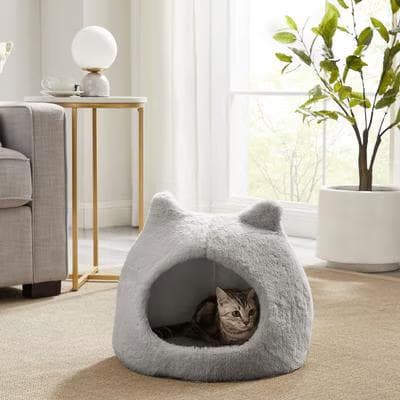
Covered, igloo-style cat bed in soft plush with a water-resistant bottom, giving cats a cozy enclosed spot to curl up. Grey.
Petful may earn a commission when you click through to Chewy, at no extra cost to you.
What Protective-Looking Behavior Can Mean
You cannot know that a cat is protecting you just from a pose, and there is no dependable checklist of protective signs. A cat between you and a visitor could be investigating, seeking attention or reacting to the visitor’s approach. Hissing may reflect fear or discomfort. Ask what happened just before the behavior and whether the cat can move away, rather than treating every response as defense of you.
Cornell’s feline aggression guidance distinguishes fear, territorial responses, redirected aggression and pain-related behavior. Those alternatives matter because the helpful response is to address the cat’s needs and reduce risk, not reward an apparent willingness to confront people.
| What you notice | Possible explanation | What to do |
|---|---|---|
| Cat stands between you and a guest | Interest, a preferred route or discomfort may be involved | Give the cat space and let it leave; do not stage another confrontation. |
| Cat stares at a door or window | Attention to a sound, movement or another animal | Check the situation safely without relying on the cat as an alarm. |
| Cat hisses or swats as someone approaches | Fear, unwanted contact or other causes of aggression | Stop the approach and prevent further contact. |
| Cat rests beside you or follows you | Social contact, comfort or a learned routine | Enjoy the company without assuming a protective motive. |
For more detail on reading the whole animal, WebVet’s cat body-language guide considers posture and context together. One movement is not a translation of a complete thought. Take a short note of the trigger, the response and how long the cat needed to settle; that is useful information if you seek professional help.
Do Cats Guard You While You Sleep?
A cat near your bed may enjoy the location, familiar company or a household routine. Its position at your feet, by the door or beside your head does not establish that it is guarding you while you sleep. Likewise, waking when there is a noise shows that something drew its attention, not that it assessed a threat to you.
If your cat guards the bedroom doorway in the sense of blocking, swatting or chasing someone away, describe those actions specifically. That is a household safety and behavior concern, not evidence to celebrate. Give people a way to avoid confrontation and discuss repeated incidents with your veterinarian.
- Offer a separate comfortable sleeping place and keep walking routes clear.
- Notice whether nighttime behavior is familiar or a new, persistent change.
- Keep normal security and smoke or carbon-monoxide alarms working independently of your pet.
Following You to the Bathroom
Following you into the bathroom does not prove that a cat is protecting you while you use it. The trip changes where you are, what is accessible and whether a door is open. A cat may want company or investigate the routine. If it waits calmly and then moves on, there may be no problem to solve.
For a young cat, see Petful’s explanation of a kitten following you around. Age and everyday needs matter more than a story about guarding you during a vulnerable moment. If following becomes frantic, vocal or newly persistent, record the change and ask your veterinarian for advice.
A resting or play option outside the room can make waiting more comfortable. The Frisco foldable play tunnel is one optional indoor hide or play space for a cat that enjoys it. Position it out of the walkway and let the cat choose it; it is not a barrier or a treatment for distress.
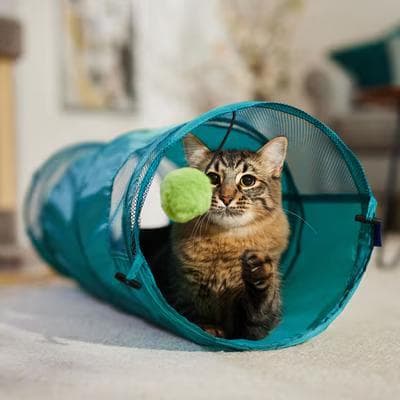
Petful may earn a commission when you click through to Chewy, at no extra cost to you.
Attacks, Intruders and Other Animals
A cat might intervene when a person is attacked, as Tara did, but you should never rely on a pet to confront an intruder or dog. Keep the cat away from danger while people use an appropriate safety plan. Do not train, encourage or reward attacks on visitors in the hope of creating a guard cat.
Cats can also defend themselves or territory when threatened. That is different from knowing they are defending a human. If your cat confronts another cat near you, competition for space, fear or arousal may explain the incident. A person can be injured when attention shifts toward them, even if the cat is normally affectionate.
- Prevent access between animals that are threatening or pursuing one another.
- Do not put your hands between fighting cats or pick up a highly aroused cat.
- Seek veterinary advice for repeated aggression or an abrupt behavioral change.
The same boundary applies to wildlife. Do not send a cat toward a snake or expect it to protect a child from an animal. Move people and pets away and seek appropriate local help. A cat that chases a hazard can become injured itself, regardless of whether a previous encounter ended safely.
Fear, Not a Guarding Test
There is no single worst fear shared by every cat. Unfamiliar people, animals, noises or unwanted handling may frighten a particular individual. Observe what triggers avoidance or agitation and reduce that exposure. Never manufacture a frightening situation to see whether your cat protects you. Choosing safety and distance is an appropriate response for the animal, not a failure of loyalty.
When the cat is calm and interested, familiar play can be part of an ordinary routine. A Frisco feather teaser wand keeps the activity away from hands; store it after supervised play. Do not wave a toy at a hissing or highly aroused cat, or use a game to lure it closer to someone it is avoiding.

Feathered teaser wand with catnip-stuffed bird. Pairs perfectly with the no-bite training policy: redirect Bengal play drive into a 10-minute interactive session with the wand.
Petful may earn a commission when you click through to Chewy, at no extra cost to you.
Helping a Cat Feel Safe Around Visitors
Prepare for visitors before the doorbell rings. Give your cat access to a familiar, quiet room with resting space, water and the resources needed during the visit. Tell guests to leave the cat alone if it withdraws. A successful visit can happen without anyone touching or even seeing the cat.
- Let the cat decide whether to approach; ask guests to avoid looming over or pursuing it.
- Keep children from entering the retreat or reaching into a hiding place.
- End contact at the first signs that the cat wants distance.
For a recently adopted cat, our guide to helping a new cat settle explains the patience behind the 3-3-3 rule of thumb. It is not a fixed calendar or a deadline for accepting guests. Physical punishment can increase fear and aggression, so work with your veterinarian on persistent problems rather than trying to establish dominance.
Weather, Illness and Spiritual Protection
- Investigate a possible household hazard safely and follow normal emergency guidance. If the cat shows a sudden change in behavior, contact your veterinarian about the cat’s health rather than assuming the change predicts someone else’s illness.
Stories about cats alerting people to danger are compelling, but they need to be assessed one claim at a time. Hearing something, behaving differently and reliably warning a person about a specific hazard are different achievements. A useful safety decision cannot depend on interpreting an unexplained change as a message.
Can Cats Warn You About Weather or Illness?
A cat can react to noise or other changes in its surroundings, and that reaction may draw your attention. It does not provide a dependable forecast. The U.S. Geological Survey reports that consistent, reliable animal behavior predicting earthquakes has not been established. Detecting an initial vibration is also different from forecasting a future event.
Use official weather alerts and ordinary household monitoring. If a cat persistently paws at you or behaves differently while you feel unwell, seek appropriate medical advice because of your symptoms. The cat’s action cannot diagnose a condition or rule one out. Likewise, a pet’s quiet behavior cannot tell you that a storm, intruder or medical problem is absent.
Can Cats Protect You Spiritually?
Claims that cats spiritually protect their owners are beliefs, not a demonstrated behavior-based protection system. Some people attach spiritual meaning to a cat’s presence or regard cats as protectors against harmful forces. But there are no verified signs that a cat is protecting you spiritually: looking into an empty corner, following you or sleeping nearby cannot establish the presence of spirits or black magic.
You can value the comfort your cat brings without treating ordinary actions as proof of an unseen threat. Keep decisions about security, health and animal care grounded in things that can be checked. If your cat’s behavior changes, consider its environment and wellbeing first. Avoid frightening, restraining or exposing the cat to danger as part of a protective ritual.
Questions About Protective Cats
There is no useful universal ranking that predicts whether your particular cat or dog would protect you. Dogs vary widely too, and a pet’s attachment is not a guarantee of a safe response in a crisis. Appreciate the individual relationship while keeping security and emergency decisions in human hands. Do not test either animal with a staged threat.
A cat may approach, watch, leave or behave differently when you cry. Those observations do not tell us exactly how the cat understands your emotion. If it chooses comfortable contact, you can accept the company; if it withdraws, let it. Neither reaction is a reliable test of caring, and the cat should not be expected to provide crisis support.
Avoid prolonged, close staring when a cat is uncomfortable, especially if you are also leaning over it or blocking its exit. Give the animal space and let it decide whether to approach. Looking at your cat normally is not forbidden; the important distinction is between relaxed observation and an intense interaction the cat cannot easily leave.
Being male does not establish that a cat will defend a person. Temperament, experience and the immediate situation matter, and aggression should not be mistaken for loyalty. Neither sex nor a breed label gives you a reliable guard cat. Choose a companion for an appropriate household fit and give that individual safe, predictable care.

T.J. Banks is the author of several books, including Catsong, which received a Merial Human–Animal Bond Award. A contributing editor to laJoie, T.J. also has received writing awards from the Cat Writers’ Association (most recently a Certificate of Excellence in 2019), as well as from ByLine and The Writing Self. Her work has appeared in numerous anthologies, including Chicken Soup for the Single Parent’s Soul and A Cup of Comfort for Women in Love, and T.J. has worked as a stringer for the Associated Press, as an instructor for the Writer’s Digest School and as a columnist.
Sign up for expert-backed reviews and safety alerts all in one place.