Best Dog Food for Labradoodles: Feeding Mini, Medium, and Standard Dogs
Compare four JustFoodForDogs recipes for mini, medium, and standard Labradoodles, with growth-label checks, calorie-based portions, and refrigerator and freezer planning.

Three Labradoodles of different sizes stand together outdoors.
Petful is reader supported. As an affiliate of platforms like Amazon and Chewy, we may earn a commission when you buy through links on this page. There is no extra cost to you.
This article is sponsored by JustFoodForDogs. Petful maintains editorial control and may earn a commission from qualifying purchases, at no extra cost to you.
The best dog food for labradoodles starts with the individual dog's life stage, expected adult size, and measured calorie needs. “Mini,” “medium,” and “standard” can help describe the dog in front of you, but those labels do not tell you how many grams belong in the bowl.
This guide compares four JustFoodForDogs recipes and shows how size affects growth-label checks, portion calculations, and food storage. Two options support growth; two are adult-maintenance choices. The useful comparison is which recipe fits your dog and household, followed by how to serve it consistently.

Sign up for expert-backed reviews and safety alerts all in one place.
What kind of food should I feed my Labradoodle?
Feed a complete and balanced food intended for your Labradoodle's appropriate life stage. A growing puppy needs growth-appropriate nutrition. A healthy adult may qualify for an adult-maintenance food or an appropriate all-life-stages food, with portions based on the dog's actual calorie allowance.
The best Labradoodle food is therefore not one universal product for every size. Australian Labradoodle food choices follow the same starting checks: nutritional adequacy, individual size, growth status, tolerance, and a routine the household can maintain.
The FDA's complete and balanced pet-food guidance explains the role of the nutritional adequacy statement. Petful's guide to AAFCO statements and dog-food labels adds practical help for reading it. These statements are more useful than assuming that a large picture of a puppy or a breed name on a package settles eligibility.
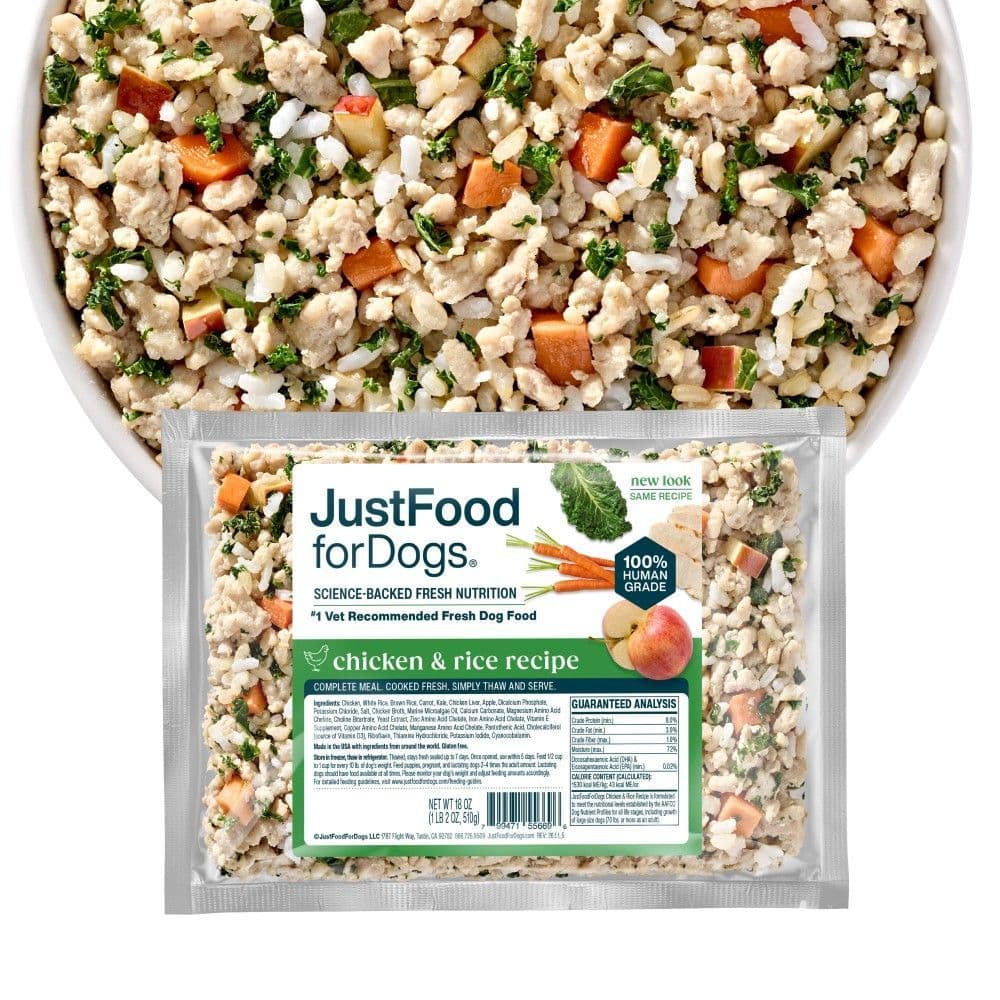
Petful may earn a commission when you click through to JustFoodForDogs, at no extra cost to you.
- 1Check life stage and expected adult size before choosing a recipe.
- 2A mini, medium, or standard label does not supply a daily feeding amount.
- 3Convert your dog's calorie allowance into grams, then plan storage around that actual ration.
Once a food qualifies, compare details that affect daily use:
- Whether your dog can comfortably eat its texture.
- Its calories per gram.
- The amount needed each day.
- The package size and opened-use window.
- The refrigerator, freezer, or shelf space available.
- Whether every caregiver can follow the same measured plan.
The Labradoodle breed guide provides broader background. For feeding, use a current weight and an individual plan rather than assuming every dog described by the same size term will need the same ration.
Mini, medium, and standard Labradoodles need individual portions
A size label is not a feeding amount. Two adult Labradoodles described as “medium” may differ in weight, activity, and body condition. A puppy currently similar in size to a mini adult may eventually become much larger.
Separate the questions. Current weight helps assess the dog now. Expected adult size controls the growth check. An established calorie allowance determines the amount of the selected food. Package size and daily grams determine how quickly the household uses its supply.
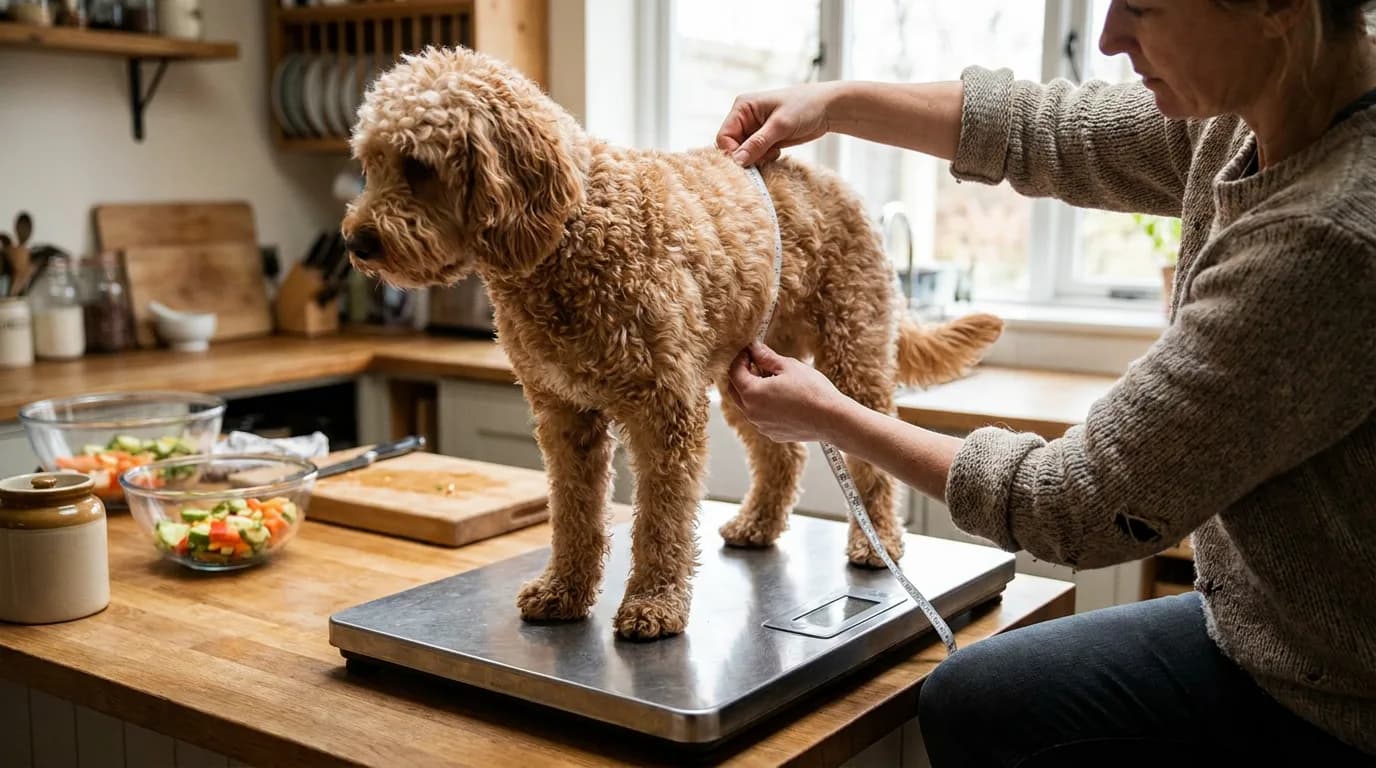
The three households below are hypothetical illustrations. Their calorie allocations are chosen to demonstrate arithmetic, not to recommend standard rations for mini, medium, or standard dogs.
| Illustrative household | Life-stage decision | Example allocation from Chicken & Rice | Approximate food needed |
|---|---|---|---|
| Mini adult with an established feeding plan | Adult-maintenance or appropriate all-life-stages food may qualify | 400 recipe calories daily | 261 g/day; 1.83 kg/week |
| Medium puppy whose mature size is still being assessed | Growth statement required; confirm expected adult size | 700 recipe calories daily | 458 g/day; 3.20 kg/week |
| Standard puppy expected to reach at least 70 lb | Growth statement must include large dogs | 1,000 recipe calories daily | 654 g/day; 4.58 kg/week |
These mini, medium, and standard examples have different practical consequences. The mini-adult household should check whether its smaller daily ration finishes an opened package within the allowed window. The medium-puppy household needs to reassess the amount as the puppy grows, so an old purchase schedule may become insufficient.
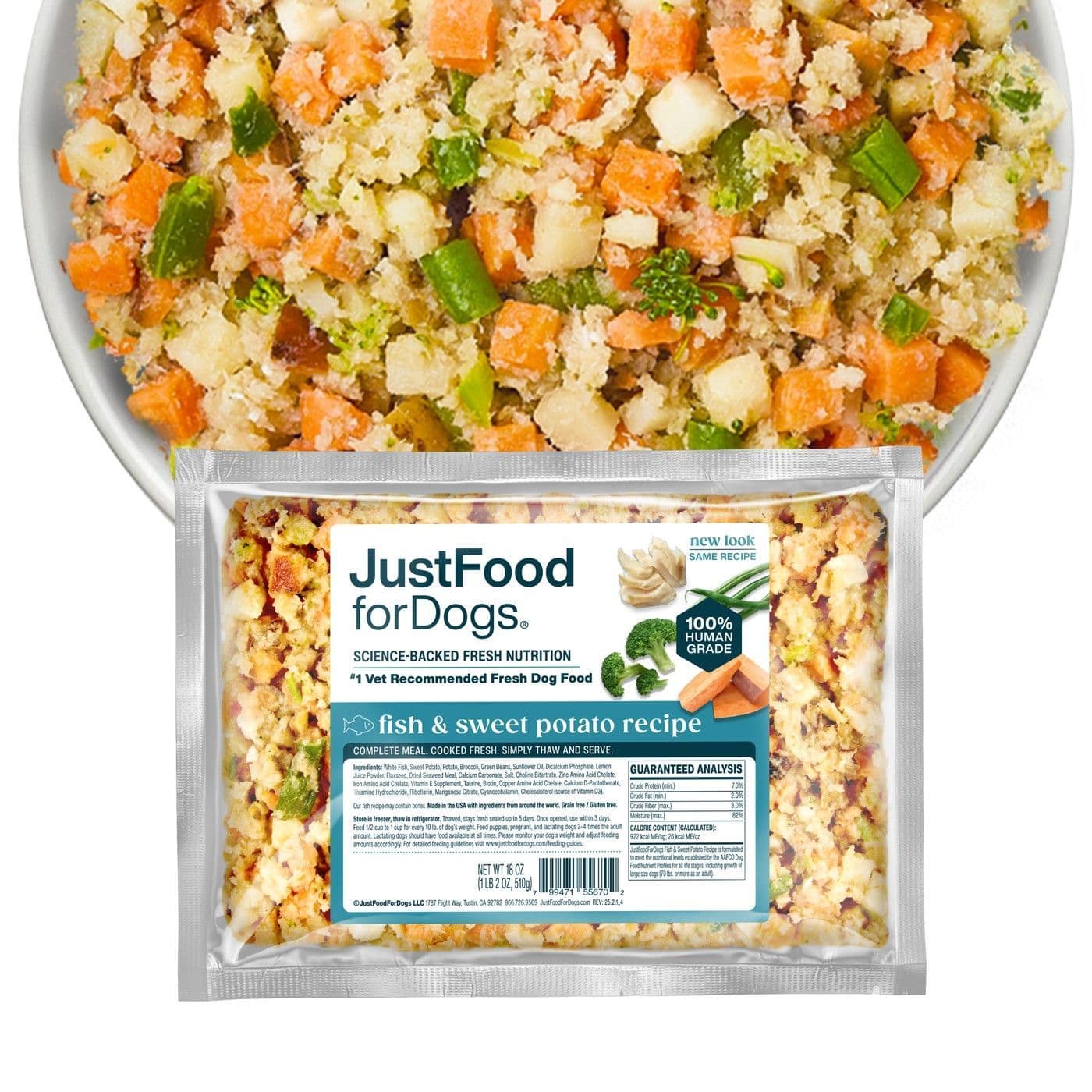
Petful may earn a commission when you click through to JustFoodForDogs, at no extra cost to you.
The standard-puppy household in this example uses about 4.58 kilograms a week. It needs enough freezer capacity for that supply and a thawing schedule that keeps pace. Those concrete feeding and storage requirements follow from the calculated ration, not a promise about allergies or coat quality.
Revisit the record as the puppy grows or the adult's activity changes. A size description may stay the same while the measured feeding requirement changes.
Four JFFD options and the Labradoodle routines they fit
These four options differ in both life-stage eligibility and calorie density. Choose among qualifying recipes first, then compare the practical serving and storage consequences.
| Recipe | Current eligibility | Calories per gram | Main planning consideration |
|---|---|---|---|
| JustFoodForDogs Chicken & Rice | All life stages, including large-dog growth | 1.530 | Growth-appropriate fresh option with rice |
| JustFoodForDogs Fish & Sweet Potato | All life stages, including large-dog growth | 0.922 | More grams per calorie and shorter opened storage |
| JustFoodForDogs Beef & Russet Potato | Adult maintenance | 1.559 | Adult-only fresh recipe |
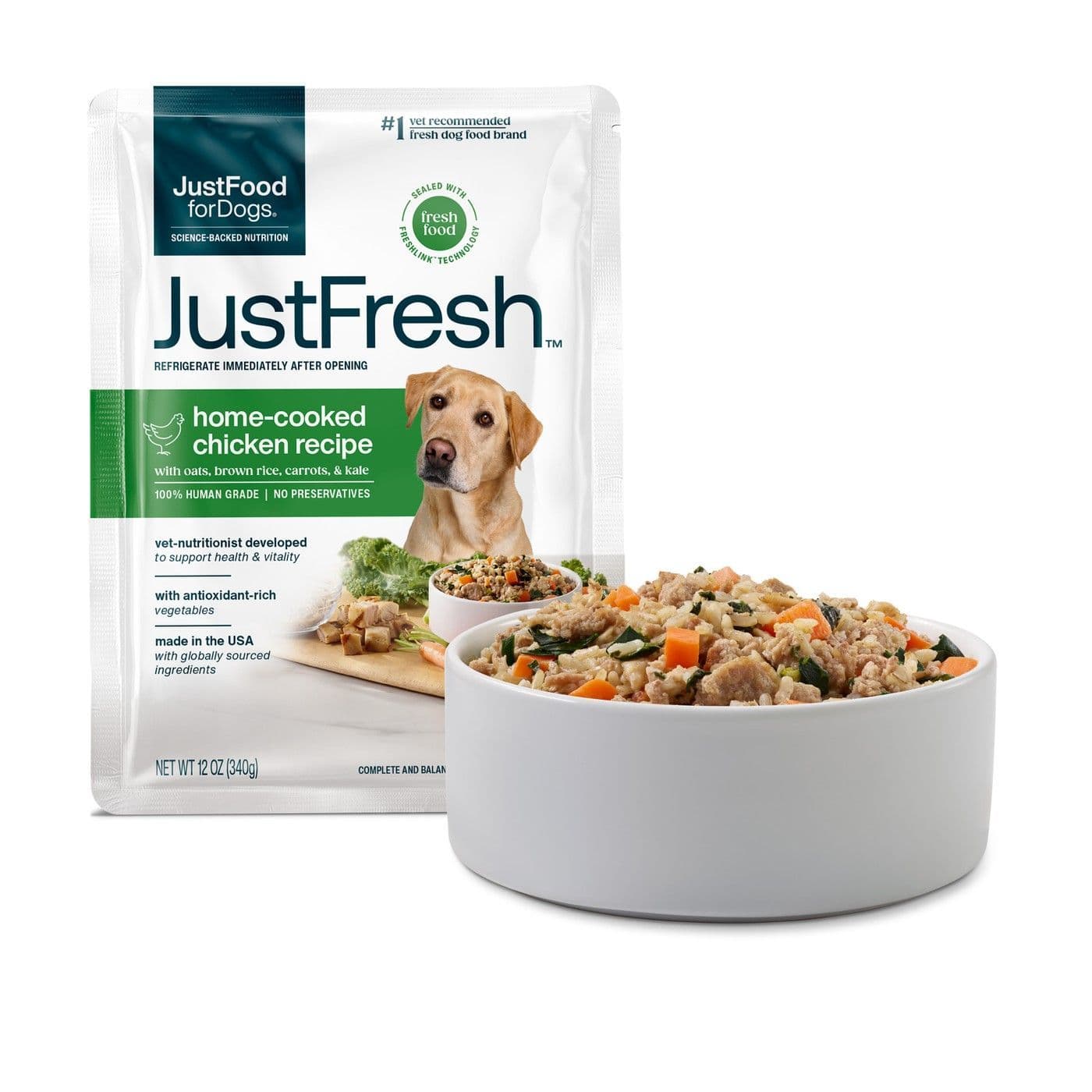
| JustFoodForDogs JustFresh Home-Cooked Chicken | Adult maintenance | 1.254 | Unopened shelf storage; refrigerate after opening |
JustFoodForDogs Chicken & Rice
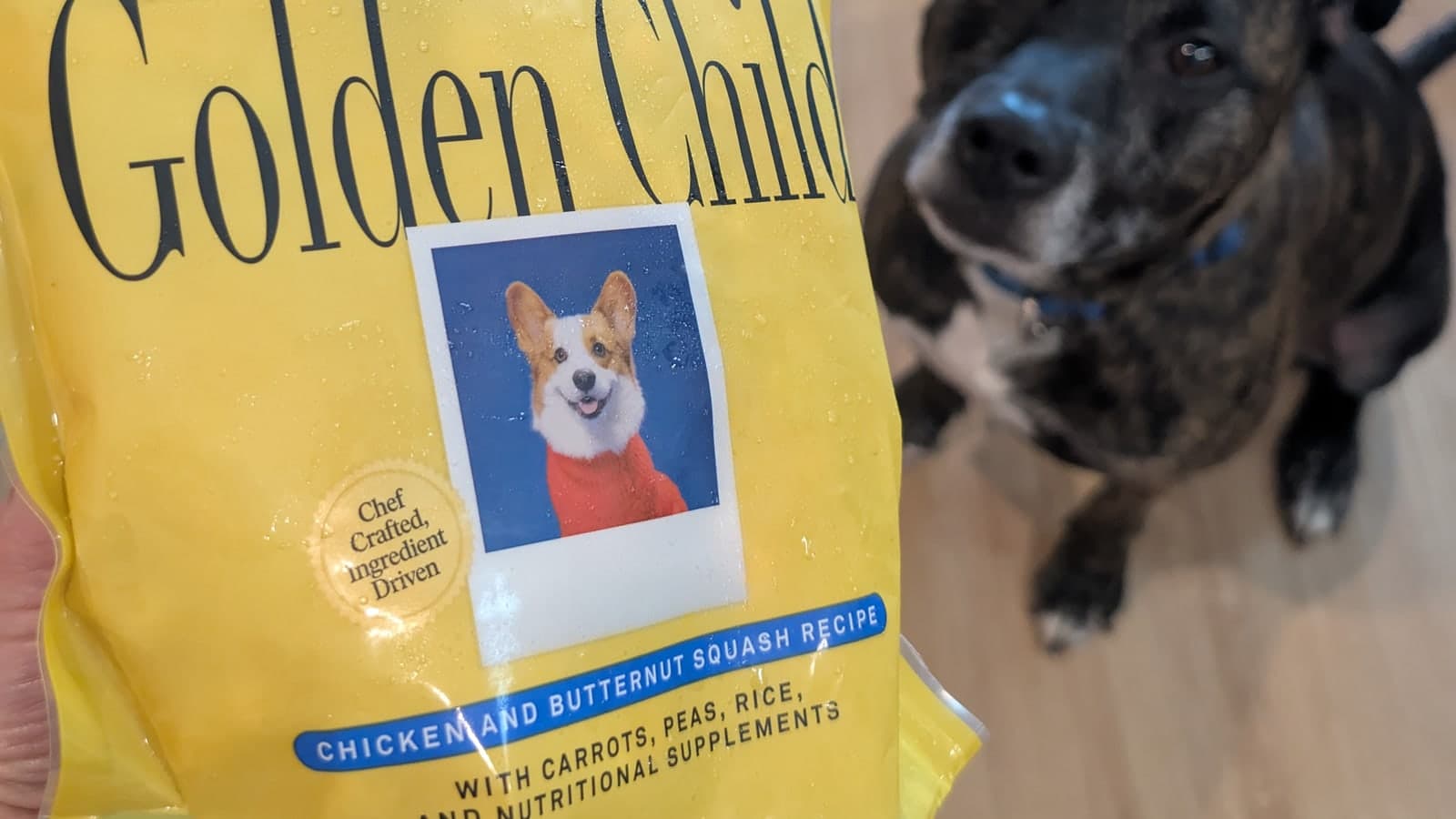
JustFoodForDogs Chicken & Rice is a grain-inclusive fresh option for a growing Labradoodle or an adult whose ingredients fit. The current formula includes chicken, white and brown rice, chicken liver, vegetables, and a nutrient blend.
Its adequacy statement includes all life stages and growth of dogs expected to weigh 70 pounds or more as adults. That makes the statement relevant when choosing for a potentially large standard Labradoodle puppy.
The recipe supplies 1,530 kcal/kg, or 1.530 kcal/g. A hypothetical allocation of 600 calories from this food equals about 392 grams. That figure is a calculation example, not a ration for all medium dogs.
- Practical fit: A household seeking a growth-appropriate fresh recipe.
- Planning point: Measure the portion and arrange dependable freezer and refrigerator space.
- Important distinction: The complete formulated recipe differs nutritionally from homemade plain chicken and rice.
JustFoodForDogs Fish & Sweet Potato
JustFoodForDogs Fish & Sweet Potato is also formulated for all life stages, including growth of large dogs. The current fish blend contains cod, pollock, and haddock.
At 922 kcal/kg, or 0.922 kcal/g, it requires a larger gram portion than Chicken & Rice for the same calories. A 600-calorie allocation is approximately 651 grams. A household feeding a large daily ration should consider that difference when estimating refrigerator turnover and freezer capacity.
- Practical fit: A puppy or adult whose feeding plan suits a fish-based recipe.
- Planning point: More food by weight per calorie, plus the shorter fish-specific storage window.
- Important distinction: Fish is an ingredient choice, not evidence that the recipe treats food allergies or itchy skin.
The manufacturer's FAQ gives fish guidance of five refrigerated days sealed after thawing and three days after opening. Plan purchases and thawing around the shorter fish-specific instructions.
JustFoodForDogs Beef & Russet Potato
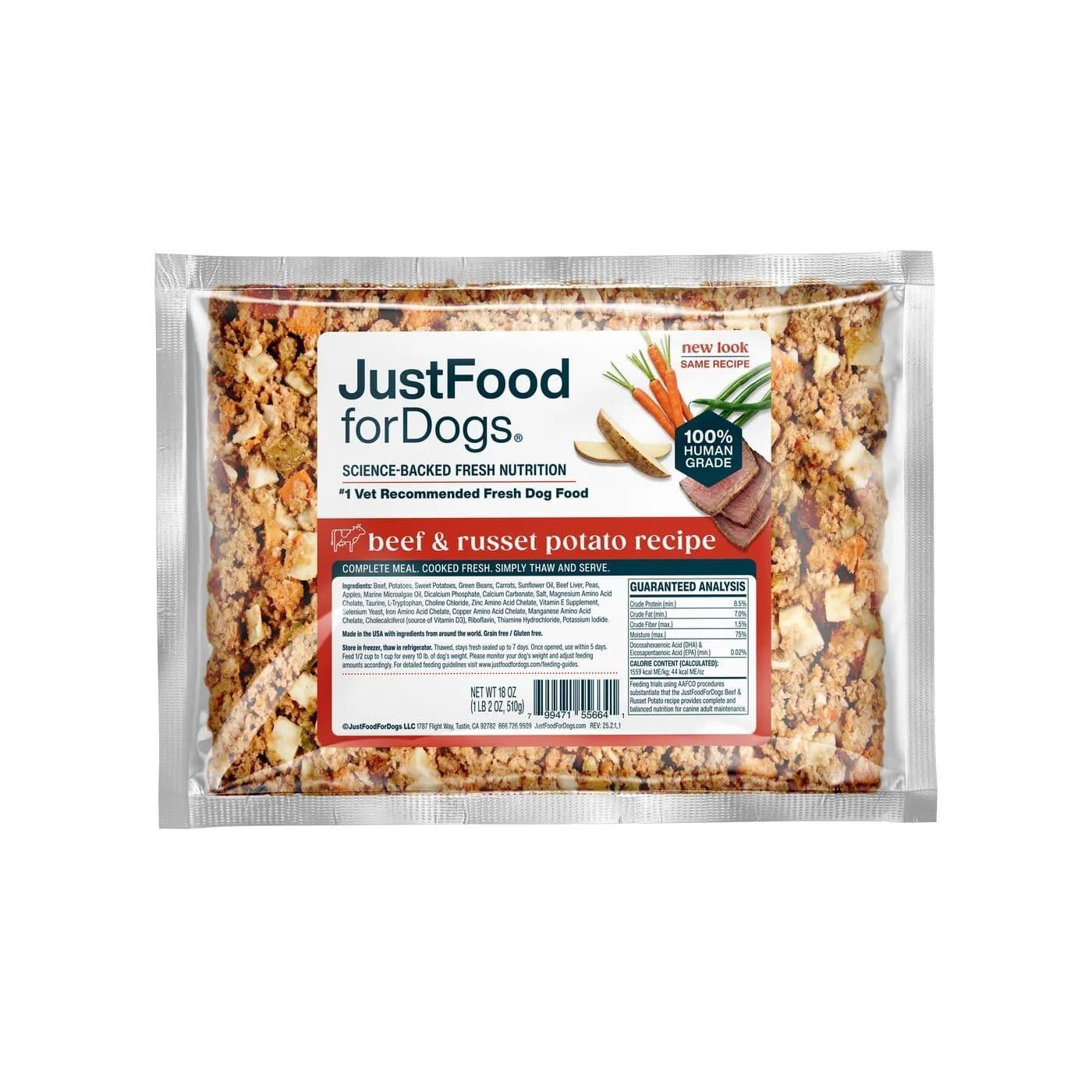
JustFoodForDogs Beef & Russet Potato is an adult-maintenance choice, with nutritional adequacy supported by feeding trials using AAFCO procedures. It is not intended as a complete diet for growing puppies.
Its energy density is 1,559 kcal/kg, or 1.559 kcal/g. A hypothetical 600-calorie allocation is about 385 grams. That portion is close to the Chicken & Rice example, but the similar numbers do not make the recipes interchangeable for a puppy.
- Practical fit: An adult Labradoodle with a settled feeding routine that tolerates the recipe.
- Planning point: Use its own calorie density and fresh-food handling instructions.
- Important distinction: A puppy sharing a home with an adult cannot automatically share this adult's recipe.
For a household with multiple dogs, label individual portions and keep the life-stage distinction visible. A shared brand name is not enough to establish that every dog qualifies for every recipe.
JustFoodForDogs JustFresh Home-Cooked Chicken
JustFoodForDogs JustFresh Home-Cooked Chicken suits an adult feeding routine when unopened shelf storage is useful. Its formula includes chicken thighs, chicken liver, oats, and brown rice.
Petful may earn a commission when you click through to JustFoodForDogs, at no extra cost to you.
It is formulated for adult maintenance and supplies 1,254 kcal/kg, or 1.254 kcal/g. A 600-calorie allocation works out to about 478 grams. Do not copy the gram amount from fresh-frozen Chicken & Rice simply because both recipes contain chicken.
- Practical fit: An adult household balancing meal volume against freezer capacity.
- Planning point: Refrigerate after opening and use within three days.
- Important distinction: It is an adult recipe, and unopened shelf stability does not continue after opening.
For travel or a caregiver handoff, send the exact recipe name, daily grams, and opened-storage instructions together. That makes it easier to preserve the established routine.
Check the large-dog growth statement before choosing puppy food
A Labradoodle puppy can eat the same food as an adult only when the recipe is appropriate for both dogs' life stages and individual needs. Each dog still needs its own portion. An adult-maintenance statement alone does not qualify a recipe for the puppy.
For puppies expected to reach 70 pounds or more as adults, inspect the language covering growth of large dogs. Do not rely only on the words “all life stages” without reading the complete statement. If expected adult size is uncertain, discuss the estimate before selecting a growth formula.
Among these four choices, Chicken & Rice and Fish & Sweet Potato include large-dog growth in their current statements. Beef & Russet Potato and JustFresh Home-Cooked Chicken are adult-only options.
Which puppy food do vets recommend?
There is no single food that all veterinarians recommend for every Labradoodle puppy. A useful recommendation considers the actual growth statement, expected adult size, complete formulation, feeding information, and the puppy's individual condition.
Bring concrete information to the conversation:
- The puppy's current weight and age.
- The best available estimate of mature size.
- The exact recipe and nutritional adequacy statement.
- The current daily amount and treats.
- Weight, growth, or digestive concerns.
These criteria do not imply a veterinarian has endorsed every product in this comparison. They explain how to choose an eligible food and identify the information needed for a tailored feeding plan.
Build a Labradoodle food chart from calories and grams
A useful Labradoodle food chart starts with the dog's daily calorie allowance. It then converts that allowance into the amount of the chosen recipe. A chart that assigns one cup amount to every mini, medium, or standard dog skips the information that makes the amount meaningful.
The formula is straightforward: calories assigned to the recipe ÷ calories per gram = grams to feed. If the label gives kcal/kg, divide by 1,000 first.
Petful may earn a commission when you click through to JustFoodForDogs, at no extra cost to you.
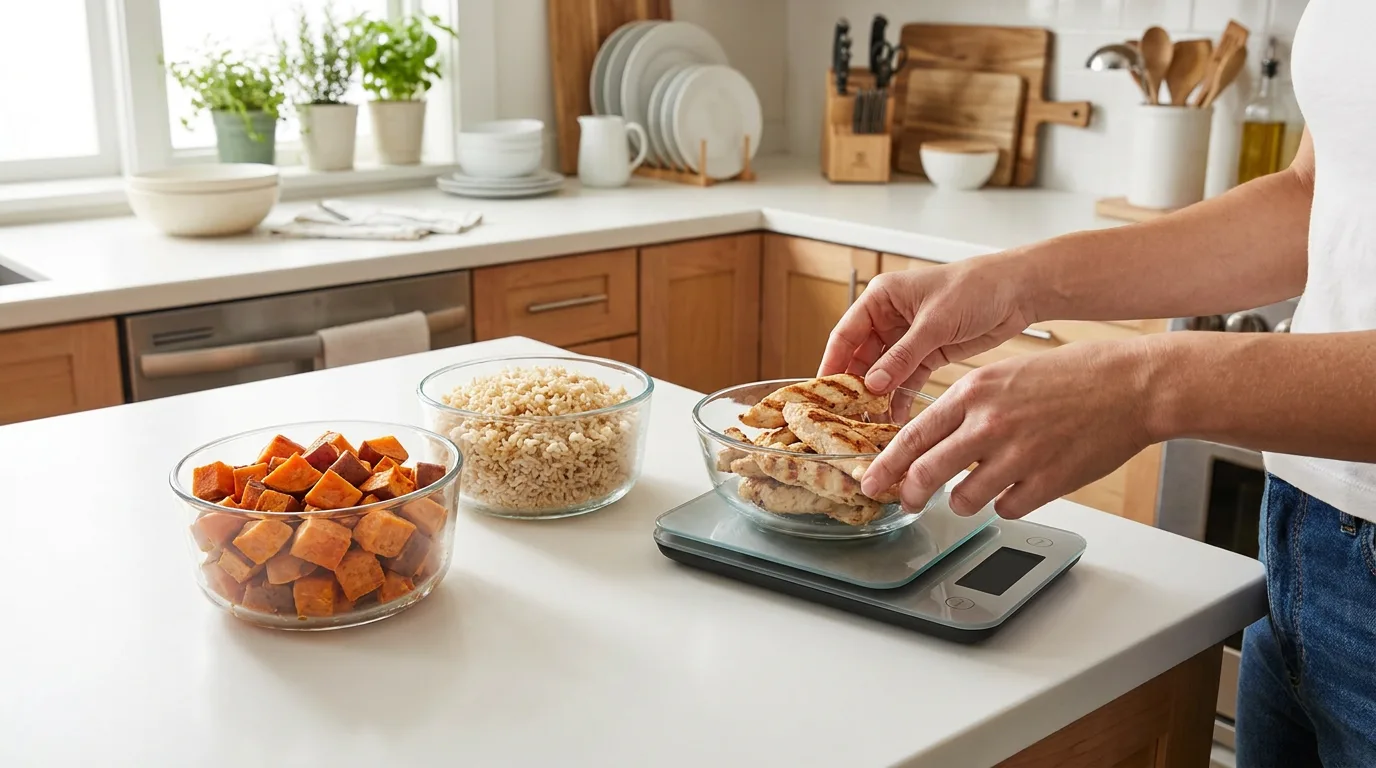
For example, suppose an adult has a hypothetical daily allowance of 800 calories, with 50 calories reserved for noncomplete extras. That leaves 750 recipe calories. Chicken & Rice would supply them in about 490 grams; Fish & Sweet Potato would require about 813 grams.
The example does not claim that 800 calories is right for a particular size category. It shows how an established allowance becomes an actionable feeding instruction.
Include treats before dividing meals
The AAHA nutritional-risk guidance flags more than 10% of calories from treats or table food as a nutritional risk factor. Count extras together, including training rewards, chews, toppers, and food used with medication.
Then build the daily record:
- Write the total calorie allowance and recipe name.
- Subtract the planned noncomplete extras.
- Calculate daily grams from the recipe's energy density.
- Divide those grams across meals.
- Record food left uneaten and meaningful changes in activity or weight.
If using two complete foods, calculate each one's contribution separately. Equal cups do not mean equal calories, and equal grams do not either.
Adjust from evidence
The WSAVA healthy-adult calorie guide provides estimates, not a permanent ration for every dog. Pair the initial amount with weight trend and a hands-on body-condition assessment.
A Labradoodle's coat can make visual estimates difficult. The WSAVA body-condition chart uses features such as readily felt ribs, waist, and abdominal tuck. Ask your veterinarian to demonstrate on your dog.
Before changing the ration, confirm that everyone is using the same measurement and counting extras. For growing puppies, assess progress within the growth plan rather than trying to hold adult-style weight stability.
Plan the refrigerator and freezer space for your dog's portion
A larger ration changes purchasing and thawing logistics. A smaller ration changes the risk of an opened package lasting beyond its intended use window. Both issues can be estimated from daily grams.
Multiply the daily portion by the number of days you are buying for. In the earlier Chicken & Rice examples, the hypothetical mini-adult household uses about 1.83 kilograms a week, while the standard-puppy household uses about 4.58 kilograms. Those quantities come from the illustrative calorie allocations, not the size labels.
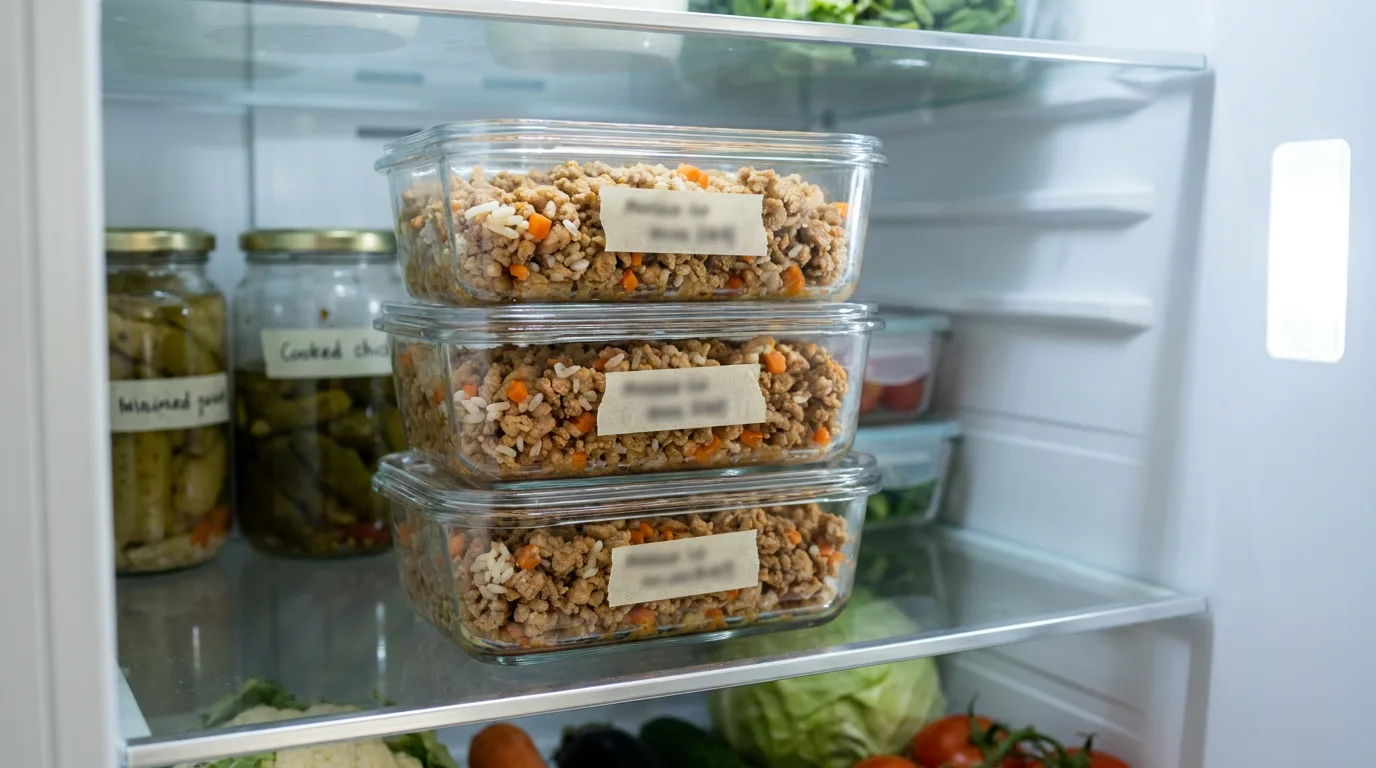
The JustFoodForDogs FAQ gives product-specific storage instructions:
- Non-fish fresh-frozen meals: Up to seven refrigerated days sealed in the thawed original package and five days after opening.
- Fish & Sweet Potato: Five refrigerated days sealed after thawing and three days after opening.
- JustFresh: Refrigerate after opening and use within three days.
For thawing, the FAQ allows up to 24 hours in the refrigerator for an 18-ounce package and up to 48 hours for a 72-ounce package. A household using large packages should build that lead time into the routine.
Do not solve a portioning mismatch by assuming you can freely refreeze fully thawed meals. The brand's FAQ specifically permits immediately refreezing arriving bags that remain partially frozen; it does not provide a general allowance for every thawed situation.
Keep storage instructions with the ration
Keep storage instructions with the feeding record, mark opening dates, and choose package sizes that match actual consumption. The FDA's pet-food storage guidance recommends prompt refrigeration or disposal of unused canned or pouched food, a refrigerator at 40°F or below, and clean feeding equipment.
After narrowing the recipe and package size, use Petful's guide to where to buy JustFoodForDogs to compare purchasing routes.
Separate food questions from skin-allergy claims
Food selection and an allergy investigation are different decisions. Choose everyday food using adequacy, portioning, tolerance, and practical fit. If recurring symptoms are driving the change, establish what needs investigation before treating an ingredient swap as the answer.
What foods are Labradoodles allergic to?
There is no Labradoodle-specific ingredient blacklist that diagnoses an individual dog. Australian Labradoodle food allergies likewise cannot be identified from the name or coat type. An itching dog is not automatically allergic to chicken, grains, or the food currently in the bowl.
Veterinary assessment can distinguish possible food reactions from other causes and determine whether a supervised diet trial is appropriate. Cornell's allergy guidance describes food elimination plans as part of evaluating suspected food allergy.
Bring the complete feeding history, not just the main recipe:
- Treats and chews.
- Toppers and table food.
- Food used for medication.
- Dates of changes and observed symptoms.
The fish-based choice here provides a different ingredient profile. That is not a claim that it treats allergies, and it should not be presented as a replacement for a diagnostic diet.
Labradoodle feeding questions
Follow standard dog-toxic-food boundaries: avoid chocolate, grapes and raisins, onions and garlic, and xylitol-containing products. Size does not make these safe. Keep noncomplete snacks within the feeding plan, because extras do not replace complete meals. If you suspect an unsafe-food exposure, contact a veterinarian promptly rather than waiting for symptoms.
They may, but both life stages must qualify and the ingredients must fit each dog's needs. Expect different gram portions based on their individual calorie allowances. Feed and record their meals separately so that sharing a recipe does not turn into sharing an unmeasured bowl.
Start with individual size and life stage, nutritional adequacy, measured intake, and tolerance. The name alone does not require a special formulation. Use the exact growth statement for a puppy and an individual feeding plan for an adult.
First check measured intake and body condition, including treats and food provided by other people. Appetite alone is not a calorie measurement. A new or persistent change in hunger, especially with weight or other changes, deserves assessment before repeated portion increases.
Base the decision on current activity and body condition, weight trend, and individual health needs. There is no automatic age-based percentage reduction that fits every dog. If needs change, update the calorie allowance and calculate the resulting portion rather than shrinking meals by guesswork.
For the household-food hazards named above, see Texas A&M's guide to foods pets should avoid.

Coreen Saito is a pet writer and longtime shelter volunteer with more than a decade in animal rescue. She covers cat behavior, breed care, and the small, ordinary science of sharing a life with companion animals, with a particular focus on honest takes about the products and decisions that actually matter. At home in Arizona, she's outranked by Mac (a dog with the loudest opinion in the house), Rebel (a cat who governs by quiet authority), and Meri (an orange tabby who runs the late shift and the laundry basket). She writes about all three, plus the rescues that keep coming through her life, at LifeWithMinty.com.
Sign up for expert-backed reviews and safety alerts all in one place.
A Final Word (Disclaimer)
At Petful, our review integrity is paramount; we never exchange special treatment in our reviews for monetary or material rewards.
Nonetheless, when our readers click through to online merchants (including Chewy or Amazon), we receive a referral commission. This supports the running of our free blog, and we appreciate your backing.