Best Dog Food for Cane Corsos: Puppy and Adult Feeding Choices
Compare growth-appropriate and adult JustFoodForDogs meals for Cane Corsos, then calculate daily ounces, storage needs, and feeding cost from the individual dog's allowance.

A black adult Cane Corso stands in profile on a garden lawn.
Petful is reader supported. As an affiliate of platforms like Amazon and Chewy, we may earn a commission when you buy through links on this page. There is no extra cost to you.
This article is sponsored by JustFoodForDogs. Petful maintains editorial control and may earn a commission from qualifying purchases, at no extra cost to you.
The best dog food for Cane Corso dogs starts with an important distinction: a growing puppy needs a food suitable for large-size growth, while an adult needs complete nutrition and a portion that matches the individual dog's activity and body condition. A large bowl, a high protein number, or a picture of a muscular dog cannot make that decision for you.
JustFoodForDogs offers practical fresh-food choices for both stages. Chicken & Rice and Fish & Sweet Potato carry all-life-stages statements that include the growth of large-size dogs. Beef & Russet Potato and JustFresh Home-Cooked Chicken provide adult-maintenance options. Choosing the right recipe first makes the later questions about daily ounces, storage, and cost much easier to answer.
Choose complete daily nutrition with life stage suitability first. A Cane Corso puppy needs an explicit large-size growth statement; an adult needs an appropriate recipe and measured daily meal weight. Calculate the portion using the individual calorie allowance and the chosen food's calories per ounce.

Sign up for expert-backed reviews and safety alerts all in one place.
Food choices for Cane Corso puppies and adults
A useful Cane Corso food comparison should answer three questions immediately: Can this recipe meet the dog's life-stage needs? How much food provides the intended calories? Can your household store and serve that amount consistently? These questions give you a more practical shortlist than ranking ingredients in isolation.
The four JustFoodForDogs foods below offer different combinations of life-stage suitability, calorie density, and storage convenience. Recommendations here reflect current manufacturer labels and feeding fit. They do not imply a hands-on feeding trial, a preference test with Cane Corsos, or a universal veterinary endorsement.
| Food | Practical reason to consider it | Label life stage | Calories per ounce | Storage consideration |
|---|---|---|---|---|
| JustFoodForDogs Chicken & Rice Fresh Frozen | A grain-inclusive fresh option for growth and adulthood | All life stages, including large-size growth | 43 | Requires freezer storage and refrigerator thawing |
| JustFoodForDogs Fish & Sweet Potato Fresh Frozen | A fish-based alternative with a lower calorie density | All life stages, including large-size growth | 26 | More ounces provide the same calories |
| JustFoodForDogs Beef & Russet Potato Fresh Frozen | An adult fresh meal with a relatively compact calorie serving | Adult maintenance | 44 | Plan freezer space and opened-food use |
| JustFoodForDogs JustFresh Home-Cooked Chicken | Adult feeding with convenient unopened pantry storage | Adult maintenance | 36 | Refrigerate after opening and use within three days |

Chicken & Rice: a practical fresh choice during growth
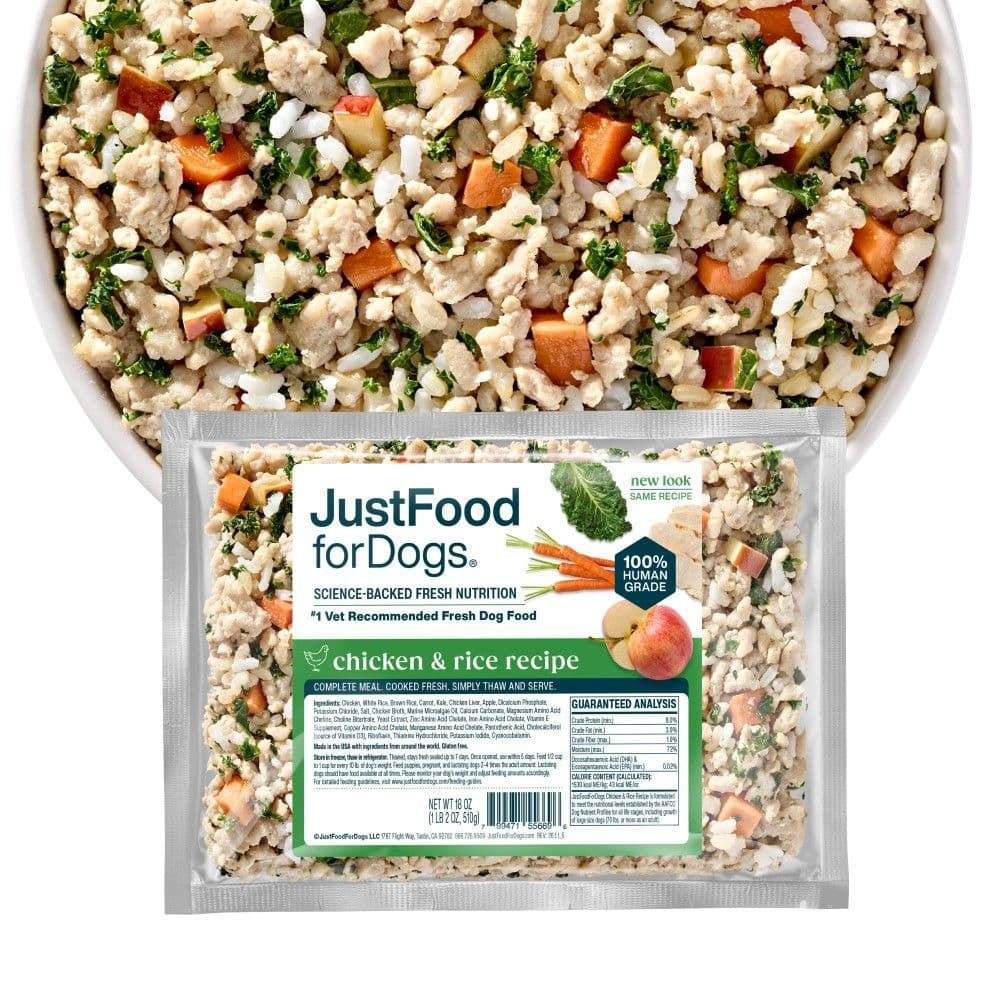
Chicken & Rice is a useful starting point when you want one fresh recipe that can fit a healthy growing Cane Corso and remain an option in adulthood. Its current recipe includes chicken, white and brown rice, and vegetables such as kale. More consequential than any one ingredient is the complete formulation and its large-size growth eligibility.
At 43 calories per ounce, the recipe also provides a straightforward basis for measuring a substantial daily amount. The same food can be suitable for two dogs without producing the same serving: a puppy's allowance changes through growth, while an adult's depends on maintenance needs and activity. Keep those calculations separate even if both dogs share a shopping order.
This recipe is particularly useful to compare when:
- You want a grain-inclusive fresh meal with an explicit growth statement.
- You can manage frozen storage and refrigerator thawing.
- You prefer to measure food by weight instead of assuming a cup amount.
- You want a recipe that can remain eligible after growth, with an adjusted portion.
A puppy finishing a familiar recipe does not necessarily need a different product on the day they become an adult. If the food remains suitable, the more important change may be reassessing the amount. That decision should follow the individual dog's maturity and condition, rather than the date on an arbitrary feeding chart.
Petful may earn a commission when you click through to JustFoodForDogs, at no extra cost to you.
Fish & Sweet Potato: a distinct protein and meal-volume option
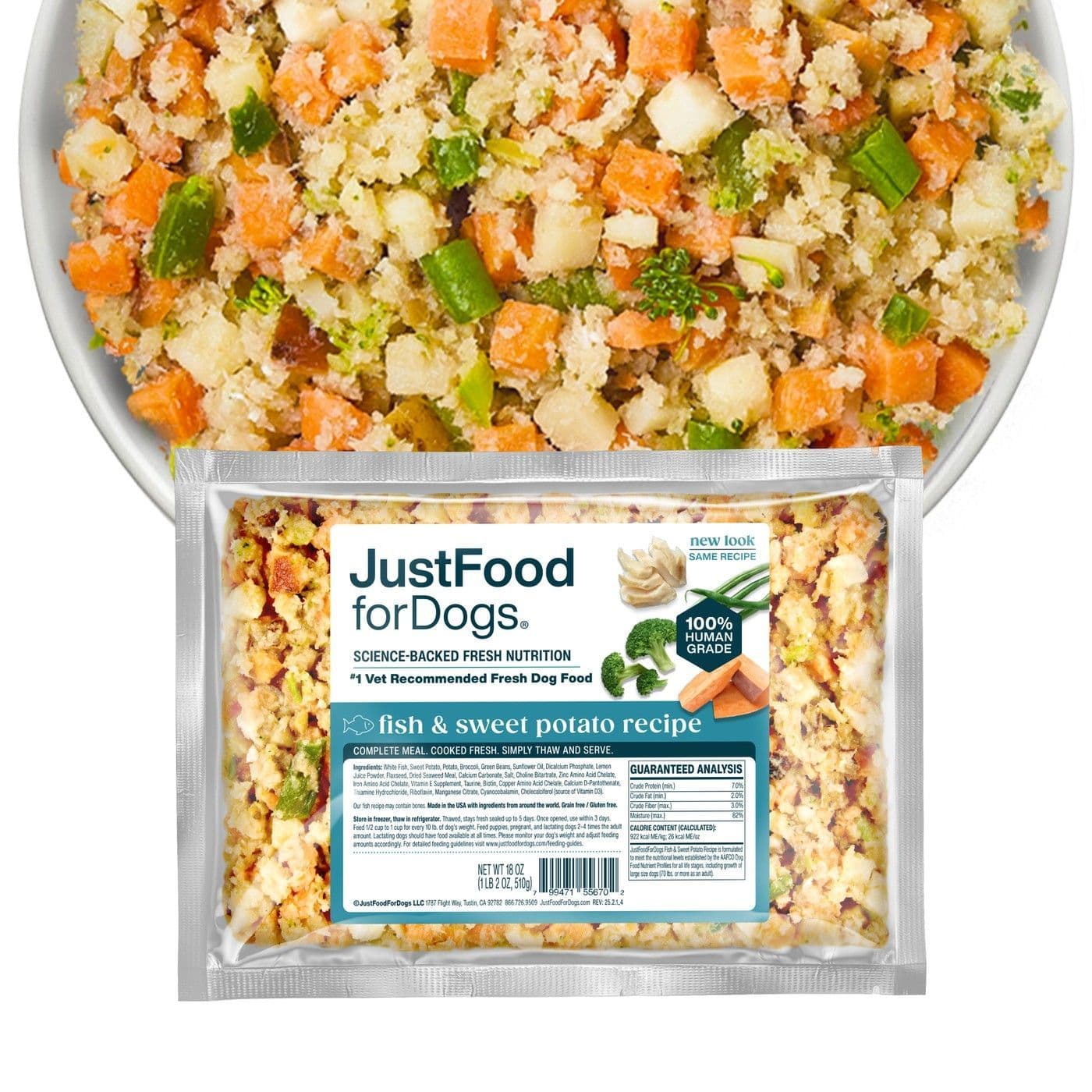
Fish & Sweet Potato provides another growth-eligible fresh choice, with a fish-based formula and 26 calories per ounce. That lower calorie density is a practical difference for a large dog: the same energy allowance occupies more ounces of food than it would with Chicken & Rice or Beef & Russet Potato. Owners should consider both the meal volume and the amount that must fit in storage.
A different protein source can offer variety when it suits the individual dog, but this recipe is not presented as a diagnosis or treatment for a food allergy. Choose it because the complete recipe, growth statement, texture, and feeding routine meet your requirements. An ingredient preference alone does not establish that one food is nutritionally better for every Cane Corso.
Use the actual calorie information to compare:
- Daily meal weight at the same individual calorie allowance.
- How many days each package will last after opening or thawing.
- Whether the bowl and storage arrangement accommodate the planned amount.
- The regular cost of feeding the full daily amount.
The grain-free description identifies a formulation choice, not a universal reason to rank the food above a grain-inclusive meal. Both can be considered through their complete nutritional adequacy statements. If your veterinarian has advised a particular dietary approach, bring the exact recipe information into that discussion.
Petful may earn a commission when you click through to JustFoodForDogs, at no extra cost to you.
Beef & Russet Potato: a fresh adult-maintenance choice
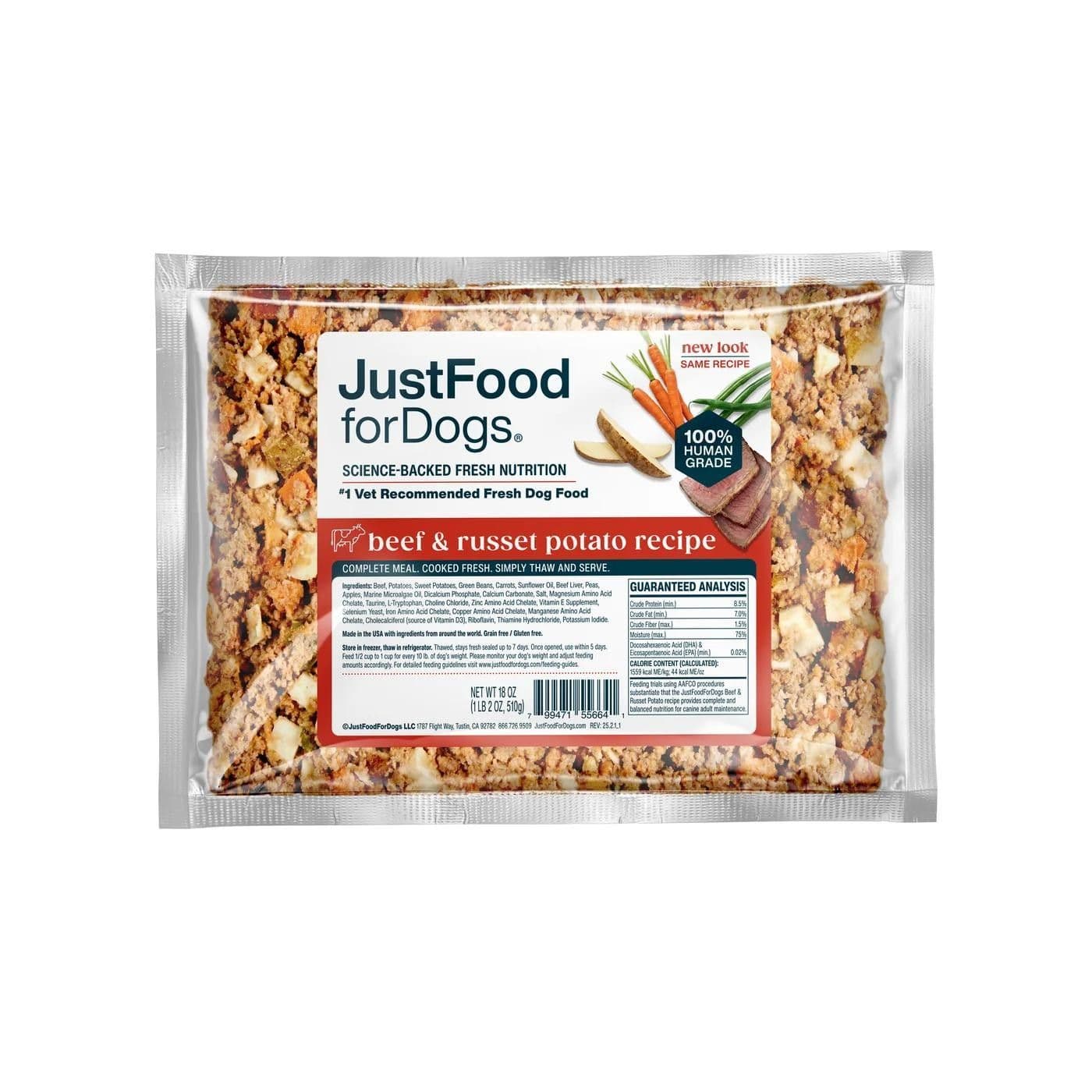
Beef & Russet Potato supplies 44 calories per ounce and is formulated for adult maintenance. It offers a useful fresh option after your Cane Corso has finished growing. Its energy density is close to Chicken & Rice, so the daily ounce amounts may also be similar when calculated against the same allowance, although the recipes remain distinct products.
The adult-maintenance statement is the key boundary. A larger puppy is still a puppy, and a substantial body weight does not make an adult-only recipe growth-appropriate. For a household feeding a growing Corso and a mature dog, label the separate containers clearly if this is the adult's food.
Consider it when:
- Your Cane Corso is mature and needs a complete adult meal.
- A beef-based recipe fits the dog's established feeding history.
- Your home has a reliable frozen-food routine.
- You want to compare calorie density alongside portion size and cost.
Keeping the full recipe name on a shopping list is a simple safeguard for a multi-person household. It also makes it easier to check whether a substituted product has the same life-stage statement and calorie information. Familiar brand packaging should not replace that quick label check.
Petful may earn a commission when you click through to JustFoodForDogs, at no extra cost to you.
JustFresh Home-Cooked Chicken: convenient adult pantry storage
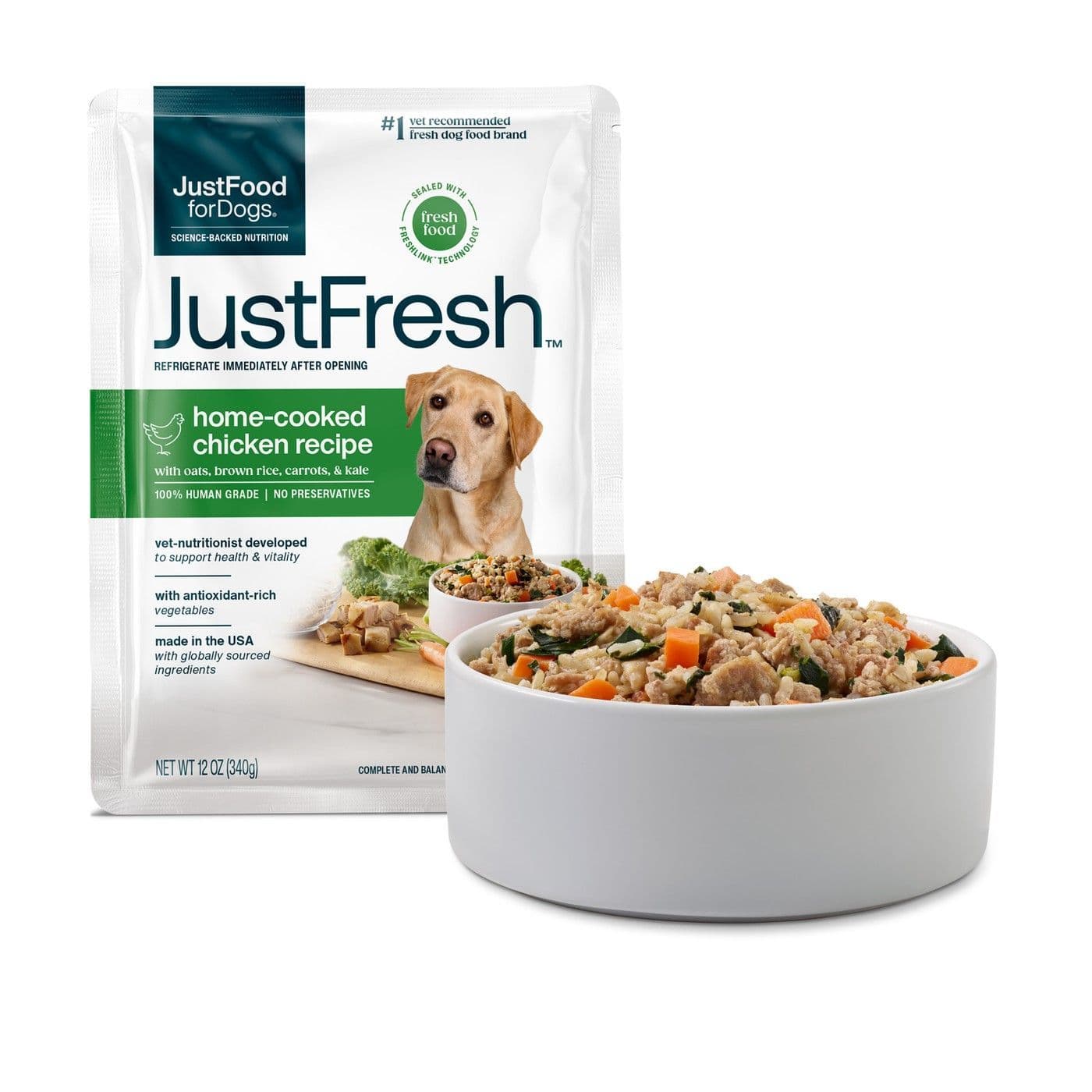
JustFresh Home-Cooked Chicken offers an adult-maintenance meal that is shelf-stable while unopened. That can be useful for owners who would rather use pantry space for some of a large dog's food. At 36 calories per ounce, its daily serving should be calculated from its own label rather than copied from a Fresh Frozen chicken recipe.
After opening, refrigerate the food and use it within the manufacturer's three-day period. The unopened storage advantage is real, but it does not remove the need to plan opened portions. An adult Cane Corso may use a package quickly; another dog may not. Base the routine on the amount you actually serve.
This format can be useful for:
- Adult dogs whose households have limited freezer capacity.
- A consistent pantry inventory for the regular feeding routine.
- Caregivers who find unopened shelf-stable packs easier to manage.
- Trips where you can still provide appropriate refrigeration after opening.
Chicken & Rice Fresh Frozen and JustFresh Home-Cooked Chicken have different calorie densities, formulas, and life-stage statements. That gives owners useful choices. Recording the exact product name and calculated daily ounces allows those choices to stay deliberate when a family member or sitter takes over feeding.
Petful may earn a commission when you click through to JustFoodForDogs, at no extra cost to you.
Why Cane Corso puppies need a large-size growth statement
Cane Corso puppies need food that supports growth into a large adult dog. This requires a more precise label check than looking for the word puppy in a product name. Read the nutritional adequacy statement and confirm that the recipe includes growth of large-size dogs, commonly described on labels as dogs expected to weigh 70 pounds or more as adults.
The FDA's explanation of complete and balanced pet food describes adequacy through an AAFCO nutrient profile or feeding-test procedures. A statement can include or exclude large-size growth. That qualifying language matters even when the front of the package says all life stages.

- Chicken & Rice and Fish & Sweet Potato include large-size growth in their current nutritional adequacy statements. Beef & Russet Potato and JustFresh Home-Cooked Chicken are adult maintenance. Keep the full life-stage wording in view when selecting a Cane Corso puppy's main food.
Growth suitability is different from faster growth
Feeding a large puppy is not a project to achieve the maximum size as quickly as possible. The useful objective is appropriate, monitored growth on a complete recipe. Choosing an adult-only food to try to slow growth can create a different problem: it removes the assurance that the diet is formulated for the puppy's life stage.
Likewise, extra calcium is not a routine addition to an already complete growth food. The AKC's breed-size puppy nutrition guidance explains why large-breed puppy feeding requires attention to the balance of nutrients and energy. Discuss a genuine supplementation question with your veterinarian rather than adding products because the puppy will become a large dog.
Before buying a puppy's regular meal, confirm:
- The recipe is complete and balanced for growth or all life stages.
- The statement includes the growth of large-size dogs.
- The feeding instructions apply to the exact product you are buying.
- The daily amount can be adjusted as the individual puppy develops.
This is where a current label comparison makes JustFoodForDogs particularly practical: the growth-eligible recipes and adult-maintenance recipes can be identified separately. Owners can choose a fresh format without giving up a clear life-stage check.
Read the whole statement before checking the serving guide
The front of a food package may emphasize a protein source, a fresh format, or a particular benefit. Turn to the nutritional adequacy statement for the life-stage decision, then look at the calorie declaration for portion planning. Those are different pieces of information: eligibility tells you whether the recipe can fit the puppy's needs, while calorie density tells you how to translate an established allowance into food weight.
A useful label-checking sequence is:
- Find the nutritional adequacy statement on the exact recipe.
- Identify whether it says growth, all life stages, or adult maintenance.
- For growth, read the qualifying language about large-size dogs.
- Write down the calorie unit before using the feeding guide.
- Save the current instructions with your feeding record.
This sequence also helps when you shop online. A brand may sell several recipes with different adequacy statements, and a general category page may not contain the detail needed for the puppy's decision. Open the exact product information and match it to the pack delivered. If a statement is unclear or unavailable, ask the manufacturer before making the product the puppy's main diet.
Establish a puppy meal schedule
Collect the existing food name, daily amount, meal frequency, and recent weight when your puppy comes home. A familiar routine provides useful continuity and a record for the first veterinary visit. It also makes it easier to plan a gradual food change without changing several other things at once.
The AKC's puppy feeding timeline describes several small meals for young puppies, commonly moving from four toward three meals during the three-to-six-month period and toward two as dogs mature. Use this as a discussion framework, with the actual schedule matched to the individual puppy. Divide the established daily food allowance across the planned meals.
For a growing Cane Corso, revisit:
- How much of the total daily food is served at each meal.
- Whether training rewards are being counted separately.
- Whether the current recipe remains appropriate and well tolerated.
- Whether the amount still supports the intended growth pattern.
Decide when to change to adult feeding
There is no advantage in switching to adult-maintenance food simply because a Cane Corso puppy looks large. Ask your veterinarian when the individual dog has reached an appropriate stage of maturity for that change. Expected adult size, growth history, and body condition provide better context than another owner's calendar date.
If you are using a suitable all-life-stages recipe, reaching adulthood does not necessarily require a different food. It may instead require a new maintenance allowance. If you choose an adult-only recipe, plan the change using the old and new foods' calorie information and their current feeding instructions.
Matching the recipe to a large individual dog
- A Cane Corso's size makes accurate portion planning especially useful, but the breed name is not a calorie prescription. A quiet adult companion, an adolescent still growing, and a dog with a more demanding activity routine can need different amounts. Even two dogs with similar body weights may not maintain condition on the same serving.
Use Petful's Cane Corso size, weight, and growth guide for breed context, then make feeding decisions from the dog in front of you. Expected adult size helps with the life-stage label check. Current weight, body condition, growth status, and activity help determine the amount.
Build a useful feeding record
Record the Cane Corso's life stage, weight, body-condition assessment, exact food, measured amount, and typical activity. Include training rewards. This distinguishes an individual puppy or adult plan from a generic breed chart and gives the veterinary team useful information when the amount needs review.
- Current age, weight, and whether the dog is still growing.
- The complete product name and the label's calories per ounce or kilogram.
- The total amount served across the whole day.
- Training rewards, chews, and food used for medication.
- The usual activity routine and any sustained change in it.
Read body condition alongside the scale
Body weight is a measurement, not the whole assessment. The WSAVA nutrition resources include body-condition tools that veterinary teams use alongside diet history and weight. Ask your veterinarian to show you how to apply an appropriate body-condition assessment to your Cane Corso.
That is particularly useful for a breed whose substantial frame can encourage owners to treat bigger as automatically better. The goal is an appropriate condition for the individual dog. Neither a broad chest nor an athletic breed description justifies increasing food without checking the result.
A repeatable review can be as simple as:
- Weighing the dog at suitable intervals agreed with your veterinary team.
- Noting whether the current routine maintains the intended condition.
- Checking whether treats or household extras have changed.
- Adjusting the measured allowance when there is a clear reason.
If weight or appetite changes unexpectedly, investigate the cause rather than continually switching food or adding more. A buying guide can explain how to compare recipes; it cannot determine why a particular dog is losing weight, refusing meals, or becoming unusually hungry.
Choosing food for an active adult Cane Corso
An active adult Cane Corso needs enough energy for the actual routine, along with complete nutrition. That does not mean every dog of this breed needs a working-dog ration or the highest protein percentage available. Separate the decision about which recipe fits from the decision about how much of it to serve.

For an adult whose routine is stable, Beef & Russet Potato offers one complete fresh-food option. Chicken & Rice remains another eligible choice. The decision can include protein preference, calorie density, storage, and cost without claiming that one recipe creates a more muscular dog.
Compare the week, not one unusually busy afternoon
Describe a typical week of exercise or work before changing the food allowance. One energetic outing does not establish a permanent need for more calories. Compare the dog's actual weight and body-condition trend with its routine, then review sustained changes with the veterinarian.
- Has the dog's routine changed consistently, rather than for one day?
- Is the dog maintaining the intended body condition and weight?
- Have food extras changed at the same time as exercise?
Account for training food
Set aside training food within the day's allowance. Rewards taken from a measured complete-food portion remain part of that portion; separate treats use the extras budget. A shared supply helps multiple handlers reward a Cane Corso without each adding another allowance.
- One person sets aside the day's reward allowance.
- Everyone draws from that allowance instead of adding separate extras.
- Food used for medication or enrichment is included.
- The main-food calculation uses the remaining calories.
Reassess the older adult
A mature Cane Corso's feeding routine may change again as activity, preferences, or practical needs change. Do not assume that every older dog needs the same smaller portion or a product with senior in its name. Review the dog's condition and the nutritional adequacy of the actual recipe.
Soft fresh food can be a convenient format, but signs of difficulty chewing, swallowing, or eating deserve assessment. Once the cause is understood, food texture and portion choices can follow the findings. An older dog's comfort should not be reduced to choosing a different product label.
Fresh food, kibble, and homemade feeding
Cane Corso owners can compare food formats without treating one format as a complete nutritional claim. Fresh cooked food, dry kibble, and canned food can differ in moisture, texture, energy density, and storage requirements. The nutritional adequacy statement and intended life stage still come first.
Petful's guide to assessing pet-food labels provides additional context for comparing claims. Start with what the label says the food is intended to do. A complementary topper or treat does not become a complete daily diet because its ingredients sound appealing.
Compare calories using the same units
A cup of kibble and an ounce of fresh food are not equal serving units. Before changing formats, write down the calories in the measured amount of the old food and the calories per ounce or kilogram of the new one. That gives you a way to maintain the intended allowance while changing the physical amount served.
The larger volume of a moist food can surprise owners who have previously served dry food. That is a measurement issue, not evidence that the dog needs extra calories. Likewise, a denser food can provide the same energy in a smaller weight. Read the actual recipe instead of assuming that all fresh meals have the same density.
Use the comparison in this order:
- Confirm that both foods are suitable for the dog's life stage.
- Identify the individual daily calorie allowance.
- Allocate calories between foods if you are mixing them.
- Calculate each food's amount in its own labeled units.
Keep mixed feeding deliberate
- Adding a fresh food can be a useful way to create a feeding routine you enjoy maintaining. If both products are suitable complete foods, decide what share of the daily calories each will provide. Reduce the original food accordingly instead of adding a full fresh serving to an unchanged full kibble ration.
For example, a hypothetical adult allowance of 1,500 calories could be split into 750 calories from each of two suitable complete foods. The ounce amount of the fresh component then depends on that recipe's calories per ounce. This is an arithmetic example, not a recommended calorie intake or required half-and-half ratio for Cane Corsos.
A consistent written split also helps caregivers. Record the exact products and quantities rather than instructions such as a little fresh food on top. If the fresh component is a topper or treat rather than a complete meal, keep its different feeding purpose in view.
Separate home cooking from a complete formulated recipe
A bowl of meat, rice, and vegetables is not automatically nutritionally complete. Preparing a dog's entire diet at home requires an appropriately formulated recipe and consistent adherence to its ingredients, amounts, and required supplements. Substituting ingredients casually can change that formulation.
Commercially prepared fresh meals offer a different route: owners can select a labeled complete recipe and focus on suitable portions and handling. JustFoodForDogs makes this comparison concrete through its product-specific adequacy and calorie information. Familiar ingredients are useful to understand, but the whole formulation determines whether the food can serve as the main diet.
Compare raw and cooked feeding requirements
Raw feeding adds a separate food-safety consideration. The FDA's raw pet-food guidance discusses microbial risks to pets and people. Fresh cooked and raw are different categories; an owner seeking a cooked fresh meal does not need to adopt a raw feeding routine.
For a puppy owner comparing raw and cooked options, nutritional suitability is still the first decision: an everyday main food needs a complete growth statement that includes large-size dogs. Unformulated raw meat does not establish that suitability. Then consider the handling requirements and whether everyone feeding the dog can follow them consistently. A growth-eligible cooked fresh recipe such as Chicken & Rice provides an alternative with a clear label and serving calculation. This comparison helps choose a format; an original raw feeding plan requires separate qualified formulation advice.
Calculate meal weight and daily feeding cost
A large dog makes the practical arithmetic worth doing before the first order. Work from the individual daily calorie allowance, then convert it into food weight using the exact recipe. This gives you a daily amount you can serve, a storage quantity you can plan, and a fair basis for comparing costs.
The basic calculation is: daily calories assigned to the food divided by calories per ounce equals daily ounces. If you reserve some calories for treats or another food, subtract those before calculating the fresh meal amount. The allowance should come from a suitable feeding assessment, not from the breed name alone.
Compare the same assumed allowance
The following example uses 1,500 calories per day solely to demonstrate daily meal weight. It is not a recommended Cane Corso intake. Your dog's actual allowance may differ substantially, especially during growth or if the regular activity pattern differs.
| Recipe | Label calories per ounce | Ounces providing an assumed 1,500 calories | What this comparison shows |
|---|---|---|---|
| Chicken & Rice | 43 | About 34.9 ounces | A relatively compact fresh meal amount with large-size growth eligibility |
| Fish & Sweet Potato | 26 | About 57.7 ounces | A larger food weight for the same assumed energy |
| Beef & Russet Potato | 44 | About 34.1 ounces | Similar energy density to Chicken & Rice, for adult maintenance |
| JustFresh Home-Cooked Chicken | 36 | About 41.7 ounces | An adult pantry-storage format with its own serving calculation |
The table shows why ounce-for-ounce substitution is unreliable. If you replaced about 35 ounces of Chicken & Rice with about 35 ounces of Fish & Sweet Potato, the daily calories would be different. That does not make one recipe inherently better; it means their amounts need separate calculations.
Round the calculated portion sensibly for your measuring equipment and follow product feeding guidance. If your label lists calories per kilogram instead, divide that number by 1,000 to find calories per gram. Use one consistent unit through the calculation, and recheck it whenever the product changes.
Translate the daily amount into an order

For a Cane Corso whose calculated serving spans multiple packs, total the daily ounces before choosing an order size. Divide the purchased ounces by that daily amount to estimate days supplied. Keep the puppy or adult meal allowance fixed; the package count is a shopping calculation, not a new feeding recommendation.
- Daily ounces for the exact recipe.
- The number of days the order should cover.
- Actual ounces per package and the whole packages required.
- Available freezer, refrigerator, or unopened pantry space.
- The product's thawing and opened-use instructions.
Compare cost per feeding day
A package price alone can mislead when recipes contain different amounts of energy or different package weights. Calculate regular cost per ounce from the actual product price and pack size, then multiply by the planned daily ounces. If you use several foods, add the daily costs of their assigned portions.
On September 28, 2026, JustFoodForDogs displayed a regular list price of $153.99 for fourteen 18-ounce Chicken & Rice packs, totaling 252 ounces. Fish & Sweet Potato displayed $167.99 for the same total weight. These are observed regular list prices, not guaranteed checkout totals; shipping and tax are excluded. Recheck the selected pack and current price before buying.
| Fresh recipe | Displayed regular price for 252 ounces | Calculated cost per ounce | Daily cost at an assumed 1,500 calories | Seven-day food cost at that allowance |
|---|---|---|---|---|
| Chicken & Rice | $153.99 | About $0.61 | About $21.32 | About $149.21 |
| Fish & Sweet Potato | $167.99 | About $0.67 | About $38.46 | About $269.21 |
The weekly amounts describe food consumed, not necessarily the cash total of a whole-pack order. Chicken & Rice's assumed 1,500-calorie allowance uses about 244 ounces in seven days, just under one 252-ounce bundle. Fish & Sweet Potato uses about 404 ounces, more than one bundle. If you buy complete bundles, the purchase quantity and upfront charge must be rounded to the available units, with some food remaining for later days.
Record the assumptions beside the answer:
- Whether the price is the ordinary purchase price or a temporary promotion.
- The exact package size and recipe.
- The individual calorie allowance used to calculate the serving.
- Whether shipping, other food, or training rewards are included.
For broader ownership planning, Petful's Cane Corso cost guide can put ongoing food spending in context. Keep the feeding estimate separate enough that you can update it when the dog's needs or the product price changes.
Calculate how long the purchased food lasts
Use the days-supplied result to plan thawing, freezer space, and the next delivery. Count both dogs separately in a multi-dog household before combining their order. If a recipe changes, repeat the calculation with its own calorie density rather than retaining the old pack schedule.
- Food consumed each day, calculated from the allowance.
- Whole packages purchased, based on the available pack sizes.
- Food made ready at one time, limited by thawing and opened-use instructions.
Compare a full-meal plan with a partial fresh-food plan
Owners do not have to assume that the first calculation commits them to one permanent format. A complete fresh recipe can be considered as the full diet or as a measured share of a suitable mixed-feeding plan. Compare both scenarios using the same total calorie allowance and the actual prices of the foods involved.
For a concrete example, assume a mature dog's individual allowance is 1,500 calories and the owner assigns half to Chicken & Rice. Its 750-calorie share would require about 17.4 ounces, costing about $10.66 daily at the displayed price above. The other suitable complete food supplies the remaining 750 calories. Its amount and cost require its own label and price information.
Suppose that second food hypothetically provides 400 calories per cup. Its 750-calorie share would be about 1.875 cups daily. This calorie density is an illustrative number, not a named product recommendation. The whole-day plan is 17.4 ounces of Chicken & Rice plus 1.875 cups of that hypothetical food, not those amounts added to the original full ration.
Finish the mixed-food cost calculation
To estimate the total cost, add the $10.66 fresh-food component to the second food's calculated daily cost. Count treats first if they take part of the allowance. This lets an owner compare a full fresh-food routine with a deliberate partial plan while keeping both nutrition and spending visible.
Frequently asked questions
Compare cost per feeding day at the same calorie allowance. At the regular prices documented here, Chicken & Rice costs less per calorie than Fish & Sweet Potato and needs less food weight. Fish remains a useful fish-based alternative. Calculate the actual dog's allowance and current price before choosing an order.
Individual Cane Corsos have different food preferences. A dog may enjoy a particular protein or texture, but enjoyment alone does not establish a complete daily meal. Start with a growth-appropriate or adult-maintenance recipe, then consider what the dog accepts and what you can serve consistently. Chicken & Rice, Fish & Sweet Potato, and Beef & Russet Potato provide concrete protein choices within suitable complete formulas; choose among eligible recipes based on the individual dog rather than assuming every Cane Corso has one preference.
A Cane Corso is a large, substantial dog, but large and XL are not interchangeable nutritional adequacy statements. For a puppy, expected adult size determines whether the food must include large-size growth in its label statement. For an adult, actual weight, body condition, and activity help determine the serving. Use those details rather than a retailer's size category to choose the food and amount.
The highest protein percentage does not automatically identify the best Cane Corso food. Complete recipe balance, life-stage eligibility, and individual energy needs matter together. Compare the nutritional adequacy statement before chasing a maximum number, and account for moisture when comparing formats. A suitable complete fresh meal can be evaluated through those concrete label facts without promising muscle gain or a working-dog result.
An adult-maintenance label does not establish suitability for large-size puppy growth. Choose a recipe with the appropriate growth statement until your veterinarian confirms the individual dog is ready for adult feeding. Within the options discussed here, Chicken & Rice and Fish & Sweet Potato include large-size growth; Beef & Russet Potato and JustFresh Home-Cooked Chicken are adult-maintenance choices.

Coreen Saito is a pet writer and longtime shelter volunteer with more than a decade in animal rescue. She covers cat behavior, breed care, and the small, ordinary science of sharing a life with companion animals, with a particular focus on honest takes about the products and decisions that actually matter. At home in Arizona, she's outranked by Mac (a dog with the loudest opinion in the house), Rebel (a cat who governs by quiet authority), and Meri (an orange tabby who runs the late shift and the laundry basket). She writes about all three, plus the rescues that keep coming through her life, at LifeWithMinty.com.
Sign up for expert-backed reviews and safety alerts all in one place.

A Final Word (Disclaimer)
At Petful, our review integrity is paramount; we never exchange special treatment in our reviews for monetary or material rewards.
Nonetheless, when our readers click through to online merchants (including Chewy or Amazon), we receive a referral commission. This supports the running of our free blog, and we appreciate your backing.