Will My Male Cat Accept a Male Kitten?
A male cat may accept a male kitten, but compatibility takes more than choosing the same sex. Learn how to prepare separate spaces, introduce cats gradually and recognize when to pause or get help.

An adult cat and kitten resting together. Introductions should progress at each cat’s pace.
Petful is reader supported. As an affiliate of platforms like Amazon and Chewy, we may earn a commission when you buy through links on this page. There is no extra cost to you.
Petful may earn a commission if you click on our links and make a purchase. This comes at no extra cost to you.
Will my male cat accept a male kitten? He may, but acceptance is not guaranteed. A resident cat’s temperament, health, experience with other cats and ability to retreat matter more than choosing another male. Give both cats a gradual introduction instead of expecting the older cat to welcome a kitten immediately.

Sign up for expert-backed reviews and safety alerts all in one place.
Will a Male Cat Accept a Male Kitten?
- 1Two male cats can become friends or live peacefully together. Neither sex nor neutering guarantees that outcome.
- 2Use gradual introductions: separate rooms, scent exchange, a secure barrier and short supervised meetings.
- 3Watch both cats. Hiding, blocking, chasing or losing access to food can signal tension even without a loud fight.
I have seen affectionate male-cat friendships in my own household. Our foster Thor played and raced with Derv Jr. and later slept between Derv and his brother Cheshire. Earlier, Dervish and the kitten Zorro became close companions, grooming, wrestling and napping together. Bandit was also calm and gentle with the kitten Topaz.
Those experiences show what is possible. They do not predict how a different adult cat will respond, and a friendly outcome does not make every part of an earlier introduction a method to copy. A kitten should never have to endure bullying while the humans wait for a paternal bond to appear.
Friendship is one good outcome; comfortable coexistence is another
Two boy cats can get along, whether they become close friends or simply share a home peacefully. Some male cats groom kittens and seek their company. Others prefer separate resting places and limited contact. Your practical goal is for each cat to eat, sleep, play and move around comfortably. They do not have to share a bed, and a photo of cats sleeping together does not establish that every interaction is relaxed.
Before bringing the newcomer through the door, arrange safe transport and a room that is already prepared. A secure carrier, such as a correctly sized Petmate two-door carrier, keeps the kitten contained during the trip and the transfer into that room. Choose enough room for the kitten to stand, turn and lie down; a carrier is transport equipment, not a device for forcing the resident cat to inspect a trapped newcomer.

Compare the Petmate two-door carrier’s dimensions with your kitten’s needs, and check that both openings latch securely before travel.
Petful may earn a commission when you click through to Chewy, at no extra cost to you.
Choose a Compatible Second Cat
There is no reliable rule that a boy cat needs another boy or that a male-and-female pair will automatically get along. Cats Protection’s advice on choosing another cat emphasizes the individuals involved. Ask the rescue or previous caregiver about the prospective kitten’s experience with cats, energy level and response to handling or unfamiliar surroundings.
A playful young adult may enjoy a kitten’s activity. A painful, frail or easily overwhelmed older cat may find that same energy exhausting. Being older does not make acceptance impossible, but the kitten’s needs should not erase the resident cat’s need for quiet. Discuss changes in your older cat’s tolerance or mobility with your veterinarian before assuming another pet will help.
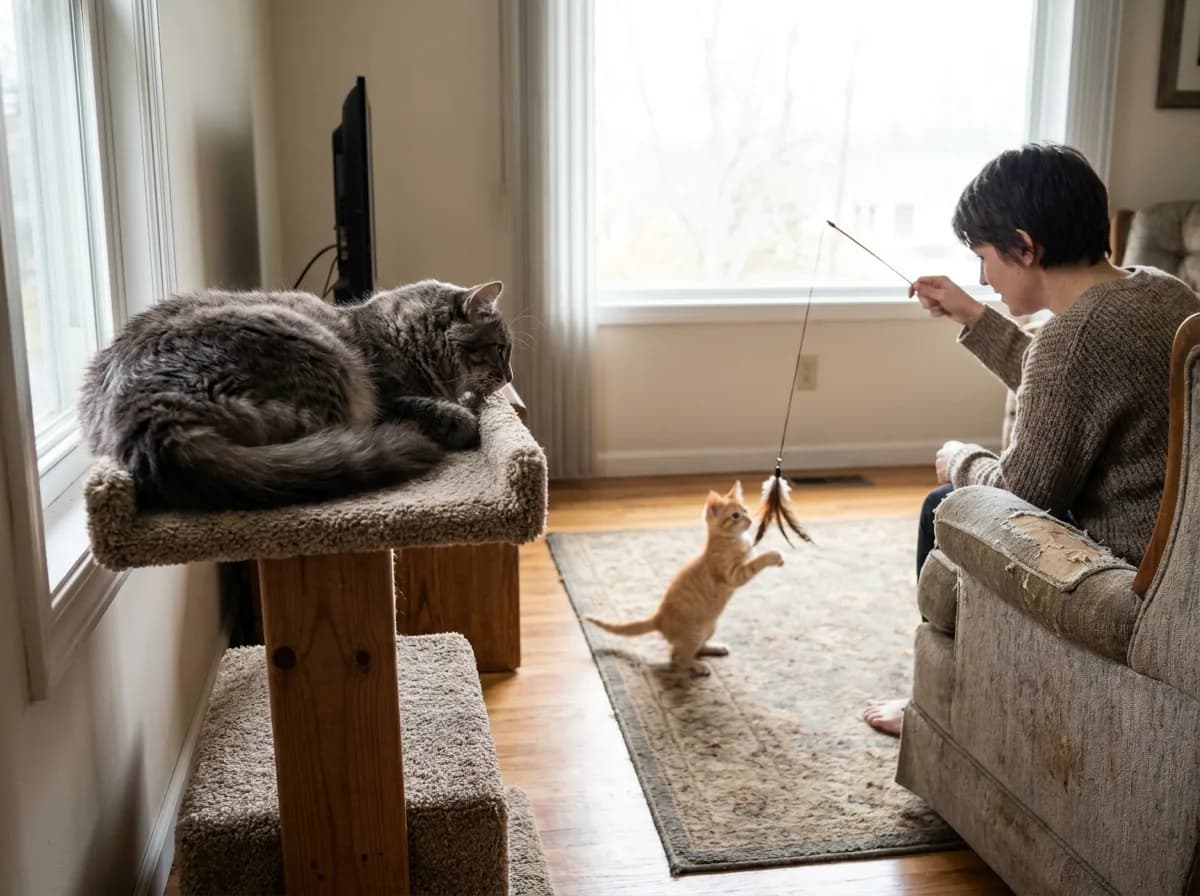
The older cat also needs an escape from kitten energy. An accessible perch or a suitable Yaheetech cat tree can provide a separate resting place if the resident cat can reach it comfortably and has an unobstructed route down. Height alone does not solve tension: a cat trapped on a high platform by another cat below still lacks a safe exit.

Consider a sturdy cat tree as one separate resting option. Match its steps and height to the resident cat’s mobility and place it where access cannot be guarded.
Petful may earn a commission when you click through to Chewy, at no extra cost to you.
There is no universal age at which it becomes too late to get a second cat. An older cat’s health and preferences, your ability to maintain separate spaces and the newcomer’s activity level are more informative than a birthday. Equally, two young male kittens are not guaranteed to remain equally compatible as they grow. Continue to observe their access to resources and their ability to disengage.
Benefits and drawbacks of a second cat
Before getting a second cat, consider both the pros and cons. A compatible pair may enjoy play and companionship, but two cats also mean more cost, separate resources and a possible long introduction. One thing worth knowing in advance is that the resident cat may never want a close friendship. A kitten is not automatically easier for an adult to accept than another adult cat.
Does your cat actually want another cat?
It is okay to have just one cat. Following you, meowing or wanting more play does not prove that a cat needs a feline companion. A single cat can have a satisfying life with appropriate attention, play and resources. To assess whether your cat might accept a new cat, look at previous relaxed friendships and repeated distress around unfamiliar cats. Neither predicts acceptance of a particular kitten.
- Describe your resident cat’s normal activity, rest and play rather than choosing a companion by sex alone.
- Ask whether you have space to separate cats for as long as their introduction requires.
- Consider a compatible pair already bonded to each other if you are adopting two cats into a home without a resident cat.
- Do not add a third cat to fix conflict between two existing cats. More cats add relationships and resource needs.
If your question is whether two boys are better than a boy and a girl, start with compatibility rather than a preferred combination. The same gradual approach applies to a female kitten joining a male cat or a male kitten joining a female cat. Our guide to male and female cat personality differences explores the broader trait question.
Neither gender is best for every pair. Two female cats are not inherently a bad combination, and an older male cat may get along with a new female kitten, but choosing a girl does not remove the need to match personalities and introduce them gradually. Boys do not universally do better with other boys.
Prepare a Separate Room and a Family Care Plan
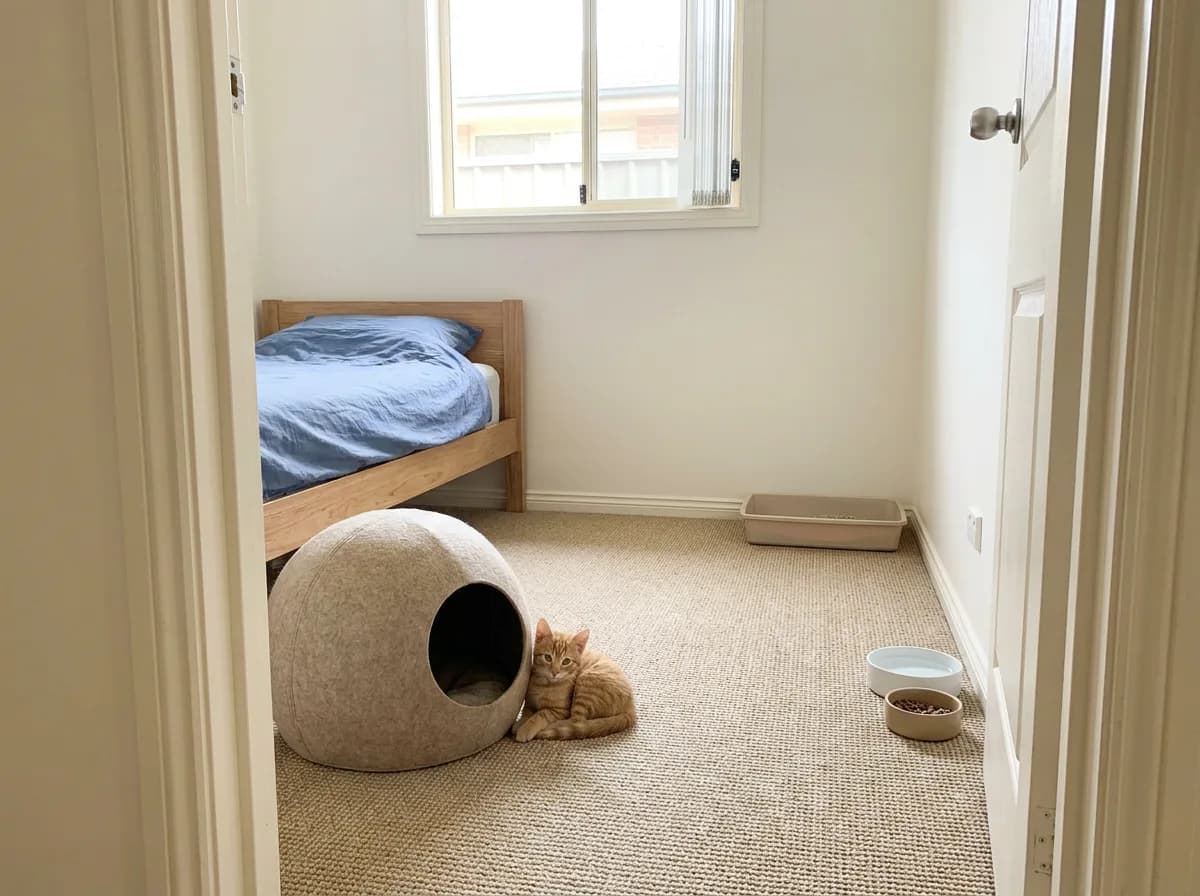
When bringing a new kitten home, prepare a quiet separate room with a closable door, a hiding place, comfortable bedding, food, water, a litter tray and suitable play opportunities. Provide safe retreat rather than making the cats share resources immediately. Keep the feeding and toileting areas apart. Check windows, loose cords, small gaps and furniture before the kitten arrives. The resident cat should retain familiar resources and routes through the rest of the home.
Agree who does what before adoption
A good setup also needs a workable household routine. Decide who closes the kitten-room door, checks food and litter, gives each cat individual attention and supervises meetings. Explain the plan to visitors and children so that a helpful person does not open the door for a surprise “hello.”
If the family has not agreed on the commitment, use our guide to discussing a dog or cat with your parents to build a shared care plan first. Adding a kitten means extra daily work and costs while the cats are separated, as well as after they share the home.
- Arrange a veterinary assessment and discuss vaccinations, parasites and any need for separation on health grounds.
- Keep the cats physically apart until the kitten’s room and the household routine are ready.
- Prepare distinct resources for both cats instead of moving the resident cat’s favorite bed or litter box into the kitten room.
- Allow the kitten to explore the room at their own pace; leave the open carrier as an optional familiar hiding place once safely inside.
Introduce the Cats in Gradual Steps
Introducing cats means managing scent, sight and physical access in stages. When introducing a new cat to existing cats, begin with separation and scent swapping before a secure barrier or shared meeting. Even a friendly resident needs the option to withdraw.
The AAFP step-by-step introduction guide treats introductions as a sequence that can move backward when needed. A calendar cannot tell you that the cats are ready. Progress at each cat’s pace, based on whether both can remain comfortable at the current level of exposure.
| Stage | Ready to continue | Pause or go back |
|---|---|---|
| Separate rooms | Each cat eats, rests and explores normally in their own area | Persistent hiding, poor appetite or difficulty accessing essentials: address the cause before adding contact |
| Scent exchange | Brief investigation or calm indifference; relaxed body afterward | Repeated agitation around the item: remove it and reduce intensity |
| Secure barrier | Both can look away, play or eat at a comfortable distance | Fixed staring, crouching or repeated hissing: increase distance and shorten sessions |
| Shared room | Loose bodies, voluntary approach and easy retreat | Pursuit, cornering or escalation: return to separate rooms and rebuild calmly |
1. Let the kitten settle before scent exchange
Begin with the door closed and each cat living comfortably in their own area. A kitten who has just traveled may need quiet and sleep before meeting anyone new. Continue the resident cat’s normal routines, including one-to-one time with you. Do not repeatedly carry the kitten out for the older cat to inspect.
Once both are settled, offer scent without a confrontation. Cats Protection describes exchanging scent on soft cloths, allowing each cat to investigate voluntarily. Do not push the cloth against a cat’s face or place a strongly scented item where the cat cannot avoid it. Calm indifference is a useful response, not a failed introduction.
2. Give each cat controlled access to the other’s space
When scent is tolerated, allow exploration of shared areas at separate times, with the other cat securely elsewhere. This lets each learn about the home without a direct meeting. Check that your door arrangement cannot accidentally release both cats into a narrow hallway together.
Keep early sessions brief and end while things are going well. Separate play sessions are useful before expecting the cats to share an activity. A Frisco feather wand is one option for supervised play with an individual cat; put string and feather toys away afterward, and do not make two unfamiliar cats compete for the same target.

Use a wand for short, individual supervised play sessions. Let each cat catch the toy and finish calmly before putting it out of reach.
Petful may earn a commission when you click through to Chewy, at no extra cost to you.
Food and play can help make these sessions pleasant, but only at a distance where the cats remain comfortable. If one stops eating or playing to watch the other’s door, reduce the challenge. Feeding cats so close to a barrier that they feel they must choose between hunger and safety misses the purpose.
3. Add a secure visual barrier
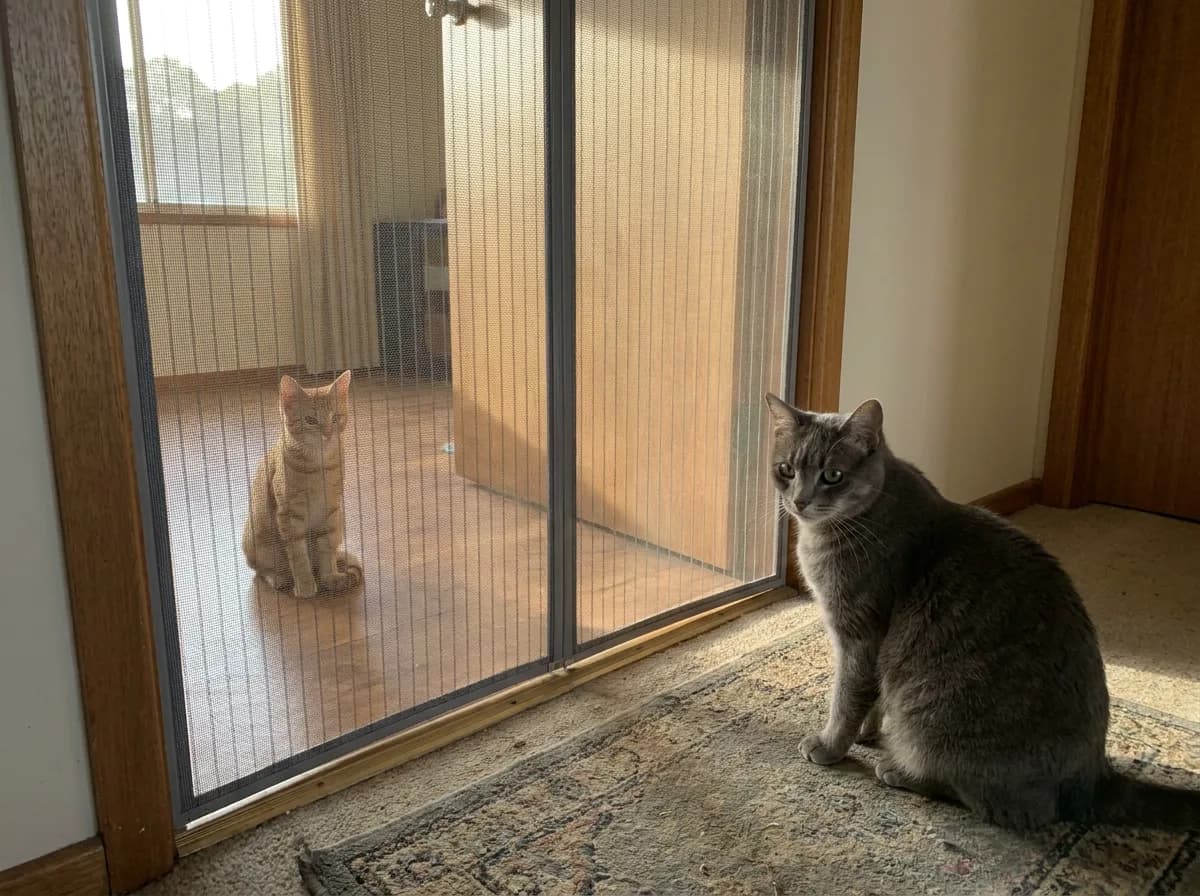
Use a closed glass door or a secure mesh barrier that the kitten cannot squeeze through, climb over or dislodge. Start with room to move away on either side. A standard low baby gate may be inadequate for a tiny kitten or a cat who jumps. Supervise the barrier itself as well as the animals.
4. Try short supervised meetings
When both cats repeatedly remain relaxed around the barrier, try a brief meeting in a room with clear escape routes and several places to rest. Keep the kitten from repeatedly pursuing the older cat. Having another calm adult present can help you observe both animals without grabbing either one.
Never let cats fight it out. Do not hold them face-to-face or close them in a small enclosure together. End the session before either becomes overwhelmed. A successful first meeting is often uneventful: a glance, some exploration and a quiet return to separate areas.
- Repeat manageable sessions rather than making one session dramatically longer.
- Let the resident cat choose distance; do not block a retreat to encourage bonding.
- Keep unsupervised separation until there is a sustained pattern of comfortable shared time.
- If either cat escalates, return to an earlier stage and reduce the intensity rather than punishing the reaction.
Where a calming diffuser fits
A feline pheromone diffuser, such as Feliway Optimum, may be considered as an adjunct to environmental changes, but it cannot make an incompatible pair safe or replace gradual introductions. Ask your veterinarian whether it fits your situation and follow the specific product instructions. Keep judging the cats’ actual behavior rather than assuming that plugging in a diffuser completes the introduction.
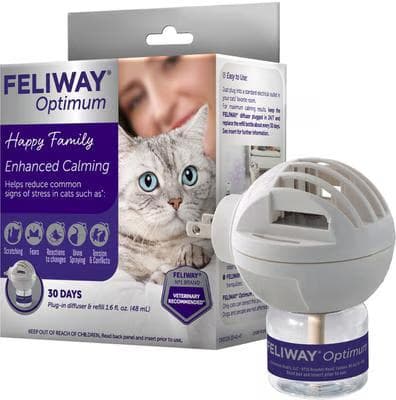
If a pheromone diffuser fits your veterinary behavior plan, check the Feliway Optimum starter kit’s placement and replacement instructions. Continue separation and gradual introductions as needed.
Petful may earn a commission when you click through to Chewy, at no extra cost to you.
Read the Cats’ Body Language
Male cats can groom, play with or rest near kittens, but the meaning depends on the whole interaction. A kitten rolling onto their back is not a guaranteed submission signal that will switch off an adult cat’s aggression. Grooming is encouraging when both cats appear comfortable and can leave; it is not permission to ignore restraint, struggling or pursuit.
| What you see | What to check | Useful response |
|---|---|---|
| Wrestling or chasing | Do roles change, are there pauses and does each return voluntarily? | Supervise; interrupt if one repeatedly tries to escape |
| Grooming | Is the recipient relaxed and free to move away? | Allow comfortable contact without treating it as proof all tension is gone |
| Hissing or growling | Is the other cat too close or blocking an exit? | Increase distance; do not punish the warning |
| Quiet staring or doorway blocking | Can the other cat reach food, litter and rest without detouring? | Separate resources and reduce opportunities to guard them |
| Parallel resting | Can both settle without watching each other constantly? | Recognize comfortable coexistence even if they never cuddle |
The 2024 AAFP Intercat Tension Guidelines emphasize subtle conflict as well as obvious fights. One cat may avoid rooms, wait to use the litter box or stay hidden while the other appears calm. Observe the quieter cat rather than measuring success by the absence of noise.
Does a male cat know or care for his kittens?
An adult male may behave gently toward kittens, including unrelated kittens, as the friendships in my household showed. That does not establish recognition of fatherhood or a universal paternal instinct. Do not assume that a biological father, a neutered male or a previously friendly cat can safely be left with unfamiliar kittens.
Neutering and age do not settle the compatibility question
Two neutered male cats can live together, but neutering does not erase fear, pain, guarding or a history of stressful encounters. An intact male also needs an individualized veterinary plan. Discuss neutering and reproductive risks with your veterinarian, especially when cats of different sexes share a household, rather than using an introduction to test whether hormones are the only problem.
Keep a small observation record
A brief record can make a gradual change easier to recognize. Note the length and setting of a meeting, what each cat did and how quickly they returned to normal activities afterward. “Both ate in their own rooms after a two-minute barrier session” is more useful than “they were good.” Record avoidance as well as obvious clashes.
- Track each cat’s appetite, litter use, rest and willingness to enter familiar areas.
- Note whether a chase was reciprocal or one cat repeatedly fled.
- Share persistent patterns with your veterinarian, including any video taken without provoking an interaction.
Help Both Cats Share the Home
Once meetings are comfortable, maintain separate choices. Distribute food, water, litter, scratching surfaces and resting spaces so that one cat cannot guard the only access point. A row of bowls in one corner or several litter boxes behind the same narrow doorway may still function as one contested resource.
- Give the older cat predictable individual attention and quiet time.
- Provide the kitten with suitable active play instead of expecting the adult to supply all entertainment.
- Feed life-stage-appropriate diets separately when necessary so the cats receive their own food.
- Keep more than one usable route through important areas of the home.
- Reassess the arrangement when a kitten grows, either cat becomes unwell or household routines change.
Three male cats can live together, but a third cat adds two new relationships to an existing pair. Evaluate each relationship and your available space. Choosing a female instead does not automatically balance the group. Introduce the newcomer gradually, and avoid turning a comfortable pair into a crowded group that must compete for essentials.
Apparent jealousy between cats can involve disrupted routines, attention and resource competition. Notice what changed and restore practical choices. Extra affection can support a cat who enjoys it, but it does not compensate for being chased away from a litter box or resting place.
When Introductions Are Not Working
If your older cat keeps hissing at a new kitten, first reduce proximity and give the adult a reliable break. If the kitten repeatedly rushes the older cat, increase individual play and supervision. Do not repeatedly stage the same stressful meeting in the hope that familiarity alone will solve it.
A tom cat can seriously injure or kill a kitten; do not treat an intact male, a neutered male or a biological father as automatically safe. Newborn kittens are especially vulnerable and need their own appropriate care arrangement. If a cat stalks, pins or repeatedly attacks a kitten, separate them and seek professional guidance rather than testing whether the adult will eventually adopt a fatherly role.
For a fight, protect yourself as well as the cats. Do not reach between them or pick up an aroused cat. Use a solid visual barrier to help separate them if it is safe, then let them settle in different rooms. Contact a veterinarian about injuries, pain, appetite changes or persistent distress; urgent injury needs prompt care.
- 1Pause direct contact after repeated pursuit, cornering or fights.
- 2Check health and access to resources before restarting the introduction at an easier stage.
- 3Ask your veterinarian for qualified behavior support if progress stalls or either cat remains distressed.
- 4A permanent separate arrangement or a carefully planned different home may sometimes protect welfare better than repeated forced meetings.
It is understandable to regret getting a second cat when the home becomes tense. That feeling is a reason to ask for help, not to rush the cats together or secretly return an animal. Work with the rescue, veterinarian and household on realistic options. Some pairs become friends slowly; some tolerate each other with good management; some cannot comfortably share the same space.
Questions About Male Cats and Kittens
For introducing cats, the 3-3-3 rule is a popular shorthand for stages of settling into a new home, not a scientifically validated timetable for introductions. Three days, three weeks or three months cannot tell you when two cats are ready to meet. Watch their behavior: eating, resting, exploring and disengaging comfortably are more useful than reaching a date.
They may become friends or achieve peaceful coexistence, but neither outcome is guaranteed. Compatibility, health, space and a gradual introduction matter. Neutering does not guarantee compatibility or remove learned conflict. If either cat remains distressed, seek veterinary and qualified behavior advice instead of waiting indefinitely for a breakthrough.
A healthy kitten may rest in a secure kitten-safe room with appropriate bedding, food and water arrangements, litter access and checks suited to their needs. Keep an unfamiliar resident cat out of that room. Very young, ill or newly rescued kittens may need additional care; ask your veterinarian about their overnight needs. A first night is not the time to test unsupervised introductions.
Use the prepared separate room and offer a comfortable bed or hiding place. Washable bedding can help, but a blanket is not a substitute for an appropriate room temperature or needed care. Avoid loose threads, cords and items the kitten could swallow or become caught in. Let the kitten choose a safe resting spot rather than forcing them into the adult cat’s bed.
The phrase is an informal label for concerns about a kitten growing up without suitable social interaction, not a diagnosis proving that every single kitten needs another cat. Discuss the individual kitten’s social history and needs with the rescue or veterinarian. Human play and attention matter, and adding an incompatible resident cat does not solve a kitten’s need for safe social experiences.

T.J. Banks is the author of several books, including Catsong, which received a Merial Human–Animal Bond Award. A contributing editor to laJoie, T.J. also has received writing awards from the Cat Writers’ Association (most recently a Certificate of Excellence in 2019), as well as from ByLine and The Writing Self. Her work has appeared in numerous anthologies, including Chicken Soup for the Single Parent’s Soul and A Cup of Comfort for Women in Love, and T.J. has worked as a stringer for the Associated Press, as an instructor for the Writer’s Digest School and as a columnist.
Sign up for expert-backed reviews and safety alerts all in one place.