Cats and Horses: Friendship, Similarities and Safety
Some cats and horses become comfortable companions. Learn how to read their behavior, protect the cat’s escape route, and provide separate care without forcing a friendship.
Petful is reader supported. As an affiliate of platforms like Amazon and Chewy, we may earn a commission when you buy through links on this page. There is no extra cost to you.
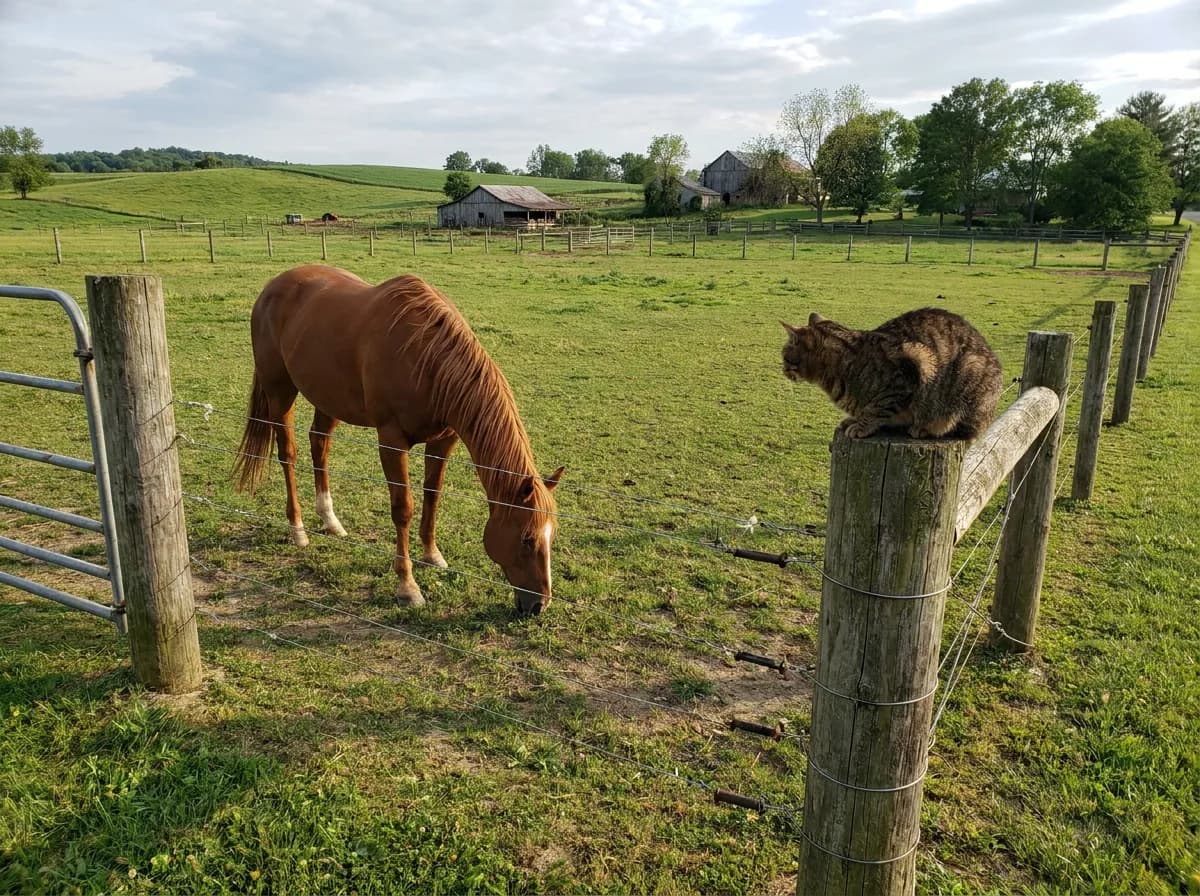
Cats and horses can become comfortable companions, but friendship depends on the individual animals and their surroundings. A quiet moment together is lovely to watch; it is not a reason to arrange close contact or overlook the difference in their size.
My interest started with the barn cats at my grandparents’ farm. My first horse ride, at age ten, added another animal to watch and learn from. Both experiences taught me to pay attention before reaching out.
- 1Keep a safe distance and a clear escape route available to the cat.
- 2Calm coexistence is enough; neither animal needs to accept touching, grooming or riding.
- 3Provide separate daily care, and meet the horse’s need for equine companionship.

Sign up for expert-backed reviews and safety alerts all in one place.
Do Cats and Horses Get Along?
Some cats and horses get along very well. Others tolerate one another at a distance, and some should remain separated. Familiarity, previous experiences and the immediate setting all matter. A horse that stands quietly while a familiar cat crosses the yard may react differently to a cat suddenly landing on its back.
For a socialized cat traveling to a new home or veterinary appointment, a correctly sized Frisco travel carrier can help with transport. It is not an introduction chamber: never place a confined cat beside a horse and expect it to become comfortable. Ask the placing organization about appropriate transport for a cat that cannot be handled.

Soft-sided travel safety carrier that keeps a stressed cat secure and well-ventilated on the way to the vet, with mesh panels for airflow and a seat-belt loop.
Petful may earn a commission when you click through to Chewy, at no extra cost to you.
Seeing cats on horses in a video can make riding look like a natural next step. It should not be a goal for your pair: a sudden movement could injure either animal. Keep their contact voluntary at a safe distance, and provide stable cat-only resting places instead.
Watching without interfering can be useful. An optional INSTACHEW Purrsight indoor camera may help you see whether a cat settles in a dry, secure cat-only room. Check the product’s power and connection requirements; this is not outdoor barn equipment or a replacement for being present during introductions.

360-degree Wi-Fi pet camera so you can watch your cat's resting breathing rate and behavior from your phone and catch worrying changes early.
Petful may earn a commission when you click through to Chewy, at no extra cost to you.
Start with a modest goal: both animals can carry on with ordinary activities without watching, pursuing or avoiding the other constantly. That is a more useful measure than whether they touch noses. Do not interpret the absence of a fight as consent to closer contact.
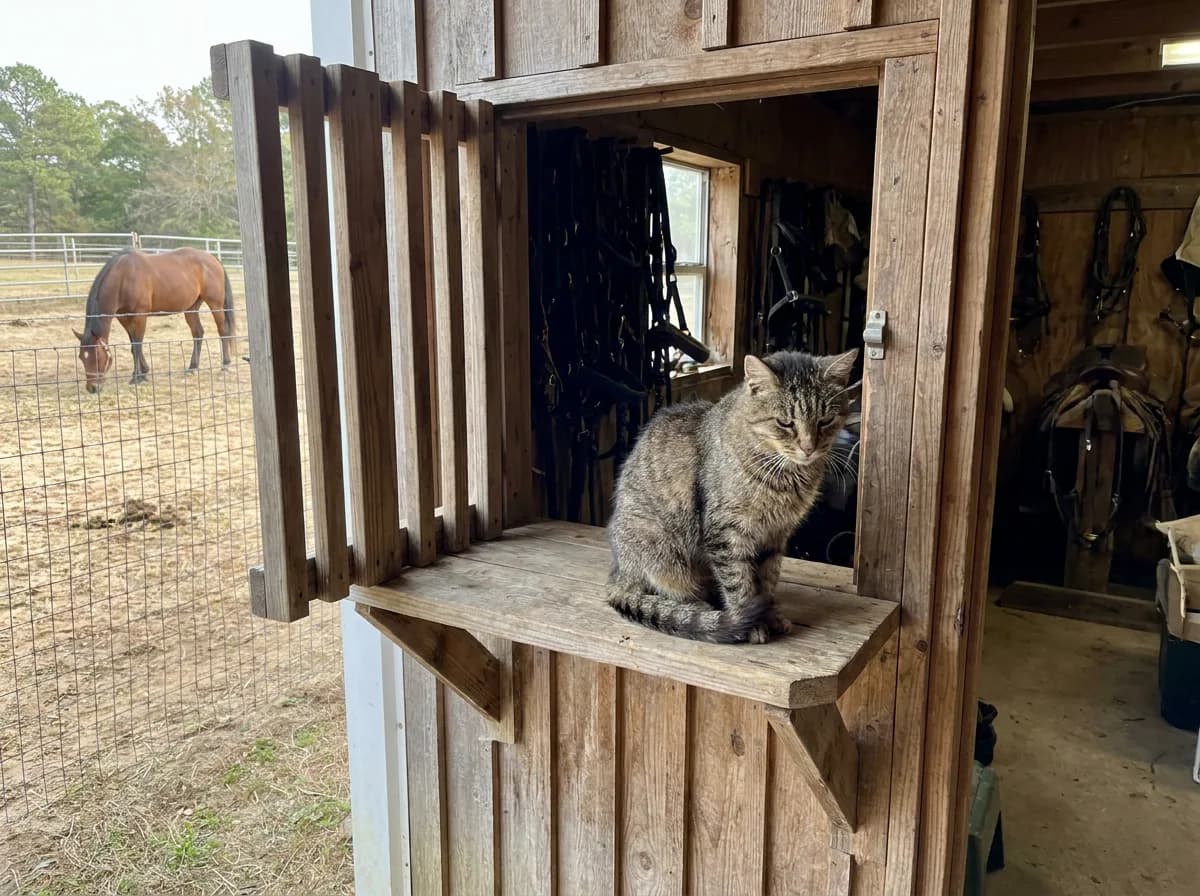
- Give each animal a way to move away without being followed.
- Keep the cat out of hoof traffic, narrow gateways and feed handling areas.
- Use distance and secure separation when either animal is unfamiliar or unsettled.
Why Some Cats and Horses Become Friends
A cat and a horse may become friends after repeated, uneventful encounters. Sharing a familiar space can make the other animal less surprising. An individual may choose to rest nearby or approach, but that choice is different from a rule that horses love cats or cats naturally love horses.
One friendship does not prove that every pair will be safe together. Keep evaluating the animals in front of you, including whether both can withdraw.
Their different diets may reduce one obvious kind of competition, yet space still matters. A cat can be in a horse’s path even when neither wants the other’s food. Grooming, sniffing or resting together in one pair does not tell us what an unfamiliar pair will do.
| What you notice | What it may mean | What to do |
|---|---|---|
| Both animals resume their own activities at a distance | They may be comfortable with the current arrangement | Keep that distance and preserve a clear escape route. |
| One keeps approaching while the other withdraws | The interaction is not equally welcome | End access rather than waiting for a confrontation. |
| They rest near one another on several calm occasions | Familiarity may be developing | Allow voluntary proximity without arranging touching or riding. |
| Attention changes around meals or busy work | The setting is affecting behavior | Use separate feeding areas and keep the cat away from moving horses. |
Petful’s stories of cross-species friendships show how varied animal relationships can be. Enjoy those individual examples while keeping the practical question separate: can these particular animals share this particular space safely?
How Cats and Horses Are Alike and Different
Cats and horses share the ability to learn routines and respond to what happens around them. A familiar person’s approach, a door opening or the preparation of food can acquire meaning through experience. Consistent handling makes your own actions easier to predict. It does not give either species a special ability to judge a person’s character.
The differences between a cat and a horse are equally important. Cats are small carnivorous hunters; horses are large grazing herbivores with strong social needs. Their movement, feeding arrangements and appropriate companions differ. Feline and equine body language also need to be read in context rather than translated gesture for gesture.
- Shared need: room to withdraw from an interaction. Different provision: a cat-sized retreat cannot solve a horse’s housing needs.
- Shared need: suitable daily food and water. Different provision: keep cat meals separate from horse feed and feeding traffic.
- Shared ability: learning from familiar routines. Different response: a quiet cat does not guarantee a quiet horse, or vice versa.
A Meow Hut covered cat bed can provide a resting option inside a dry, protected cat-only room. Its water-resistant bottom does not make it an outdoor shelter. The building and access arrangement must provide the actual protection from weather, horses and other animals.
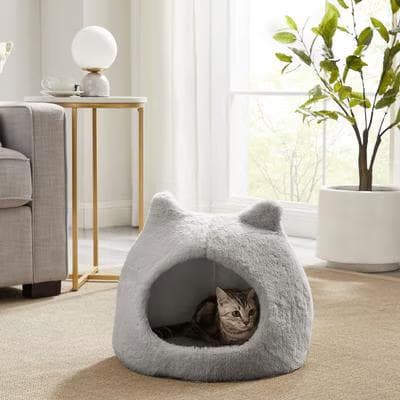
Covered, igloo-style cat bed in soft plush with a water-resistant bottom, giving cats a cozy enclosed spot to curl up. Grey.
Petful may earn a commission when you click through to Chewy, at no extra cost to you.
What to Notice When Cats and Horses Share a Space
Look at the whole encounter before calling it friendship. Notice where each animal was, which one approached, whether the other could leave, and what happened afterward. Pictures of cats and horses capture one instant; repeated observations reveal more about how they share space.
The useful detail in a shared-space photograph is the arrangement: a cat-only retreat, a separate enclosure for the horse and an unobstructed route away. A high perch helps only if it is secure and the cat can reach safety without jumping into the horse’s path. Check the route from the cat’s level, including doors that someone might close.
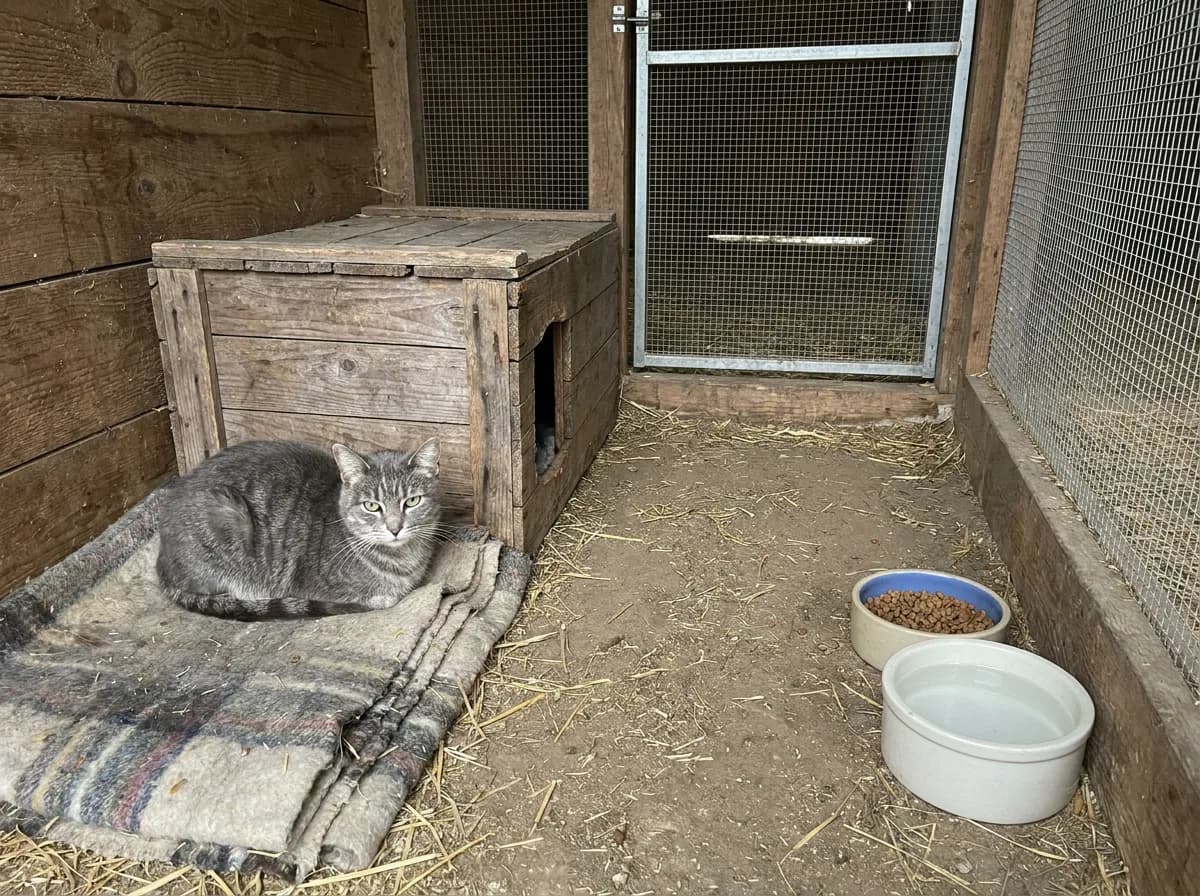
Stop an encounter if either animal stiffens, repeatedly retreats, threatens, pursues or cannot disengage. Do not get between frightened animals to obtain a better look or photograph. Ask an experienced horse handler to assess the horse, and seek veterinary or qualified behavior help when reactions persist.
- Before contact: identify the nearest safe retreat and who controls each area.
- During observation: watch for changes in movement and attention, not just a single ear or tail position.
- Afterward: check whether both animals return to eating, resting or their ordinary routine.
For a cat comfortable playing with people, offer supervised play away from horses. A Frisco feather teaser wand gives you an activity to share in the cat-only area. Put the string and feathers away afterward; do not wave a toy around a horse to encourage the animals to play together.

Feathered teaser wand with catnip-stuffed bird. Pairs perfectly with the no-bite training policy: redirect Bengal play drive into a 10-minute interactive session with the wand.
Petful may earn a commission when you click through to Chewy, at no extra cost to you.
Introducing a Cat to a Horse Safely
A safe introduction begins with the environment, not with bringing two faces together. Settle a newly arrived cat according to the rescue or barn-cat program’s acclimation instructions first. Do not release it into an unfamiliar stable and assume it will find a hiding place or learn the horse’s movements.
- Prepare a secure cat-only base with appropriate resources and no horse access.
- Have an experienced adult manage the horse while another person observes from a safe position.
- Allow awareness from a distance through suitable separation. Avoid trapping or holding the cat within reach.
- End while both are calm. Increase access only when the setting and their behavior justify it.
There is no universal introduction schedule. A cat that hides should not be carried out to meet the horse, and a horse that reacts strongly should not be made to stand over a confined cat. Choosing continued separation can be a successful outcome, especially in a busy barn where movement is difficult to control.
The same patience applies to human contact. Petful’s guide to letting a cat set the pace explains why forced handling can undermine trust. A settling-in rule of thumb is not a deadline for a cat-horse friendship.
Barn Life: Separate Spaces and Daily Care
Barn cats need regular care whether or not they hunt. King County’s Barn Cats R Us program requires dependable food and water, safe warm shelter and a planned acclimation period. Its specific program instructions should not be replaced with the assumption that a cat will live on mice and sleep wherever it finds room.
Walk through a normal workday: doors open, feed is carried, horses leave their stalls and vehicles arrive. The protected arrangement needs to work during those moments, not only when the barn is quiet. Keep chemicals, medications, machinery and unsecured feed inaccessible, and check hiding places before closing a room or moving equipment.
- Check appetite, water access, general behavior and the condition of the retreat each day.
- Keep routine veterinary care and identification current with advice suited to the cat’s life and location.
- Tell everyone working in the barn which doors, feeding spaces and routes must remain protected.
Can a Cat Be a Horse's Companion?
A cat may be welcome company, but it should not be treated as a substitute for another suitable equine companion. The British Horse Society emphasizes horses’ social needs and opportunities to form bonds with other horses. An affectionate cat cannot provide all of those same-species interactions.
If you are choosing a companion animal for a horse, begin with the horse’s management, health and temperament, and seek advice from your veterinarian or an experienced equine professional. Suitable introductions and adequate resources matter even between horses. Adding a barn cat to solve isolation skips that assessment.
The most satisfying cat-horse relationship may look uneventful: a horse grazing, a cat resting somewhere protected and neither animal needing to monitor the other. My early experiences made me appreciate both species. Respecting their differences is part of that appreciation, whether they become close companions or simply good neighbors.
Questions About Cats and Horses
A photograph of a cat on a horse does not establish a safe activity. The horse may move or startle, and the cat may fall or scratch while trying to escape. Do not put or feed a cat on horseback to recreate a scene. The safe choice is a stable cat-only perch outside the horse’s path.
Cats and horses are both mammals, but they belong to different animal families and have different diets, movement patterns and social needs. Similar-looking habits or an individual friendship do not make them closely related. Choose their housing and care according to each species rather than assuming what works for one will work for the other.
No. A barn cat needs a dependable, appropriate diet and fresh water even when it catches rodents. Hunting does not reliably supply its daily needs, and withholding food is not a humane pest-control strategy. Follow the placing organization’s care instructions and ask a veterinarian about feeding the individual animal.

T.J. Banks is the author of several books, including Catsong, which received a Merial Human–Animal Bond Award. A contributing editor to laJoie, T.J. also has received writing awards from the Cat Writers’ Association (most recently a Certificate of Excellence in 2019), as well as from ByLine and The Writing Self. Her work has appeared in numerous anthologies, including Chicken Soup for the Single Parent’s Soul and A Cup of Comfort for Women in Love, and T.J. has worked as a stringer for the Associated Press, as an instructor for the Writer’s Digest School and as a columnist.
Sign up for expert-backed reviews and safety alerts all in one place.