How Much Protein Does a Dog Need? A Practical Guide for Every Life Stage
How much protein does a dog need? Learn the AAFCO minimums for adults and growing dogs, how to compare wet and dry food labels, and when individual needs matter.

BVMS, MRCVS
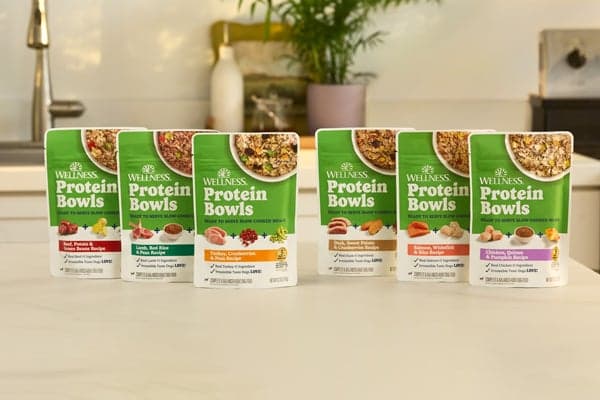
Protein matters most as part of a complete diet formulated for the dog's life stage.
Petful is reader supported. As an affiliate of platforms like Amazon and Chewy, we may earn a commission when you buy through links on this page. There is no extra cost to you.
How much protein does a dog need? For a complete dog food, the clearest starting point is the life-stage standard behind the label: the Association of American Feed Control Officials lists a minimum of 18% crude protein on a dry matter basis for adult maintenance and 22% for growth and reproduction. Those are minimum formulation benchmarks, not a universal prescription for every dog.
Your dog's age, calorie needs, activity, body condition, health, and the digestibility of the food all affect the practical answer. A higher number is not automatically better, and a wet food's as-fed percentage cannot be compared directly with a dry food's number because moisture changes the math.

Sign up for expert-backed reviews and safety alerts all in one place.
How much protein does a dog need?
The short answer is enough high-quality protein to supply all essential amino acids while the full diet remains complete, balanced, and calorie-appropriate. Protein provides amino acids that dogs use to maintain muscle, skin, coat, enzymes, hormones, antibodies, and many other tissues and body processes.
How much protein does a dog need daily or each day? AAFCO's current consumer guidance gives two practical dry-matter minimums for complete dog food: 18% crude protein for adult maintenance and 22% for growth and reproduction. The second category covers puppies as well as pregnant or nursing dogs. The percentages describe the food after moisture is removed, which makes foods with very different water contents easier to compare.
These numbers are useful baselines, but they do not mean every adult dog should eat exactly 18% protein. A food can sit above the minimum because of its recipe, energy density, or intended use. The more important first question is whether the diet is complete and balanced for your dog's life stage. WebVet's guide to what complete and balanced dog food means explains that label standard in more detail.
- 1AAFCO's dry-matter minimum is 18% crude protein for adult maintenance.
- 2The growth and reproduction minimum is 22% crude protein on a dry matter basis.
- 3Check the nutritional adequacy statement before comparing the guaranteed analysis.
- 4Compare wet and dry foods on a dry matter or calorie basis, not by the as-fed percentage alone.
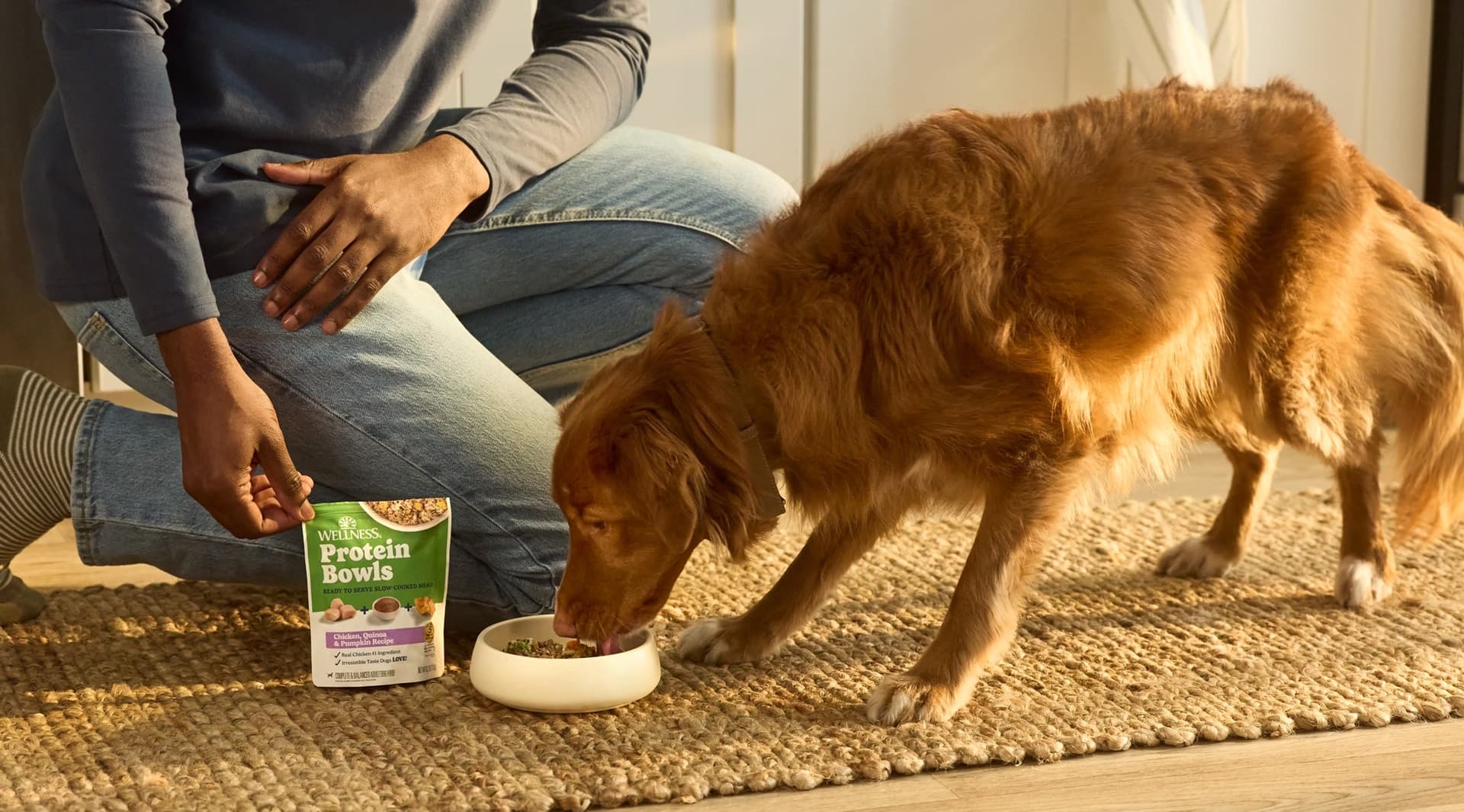
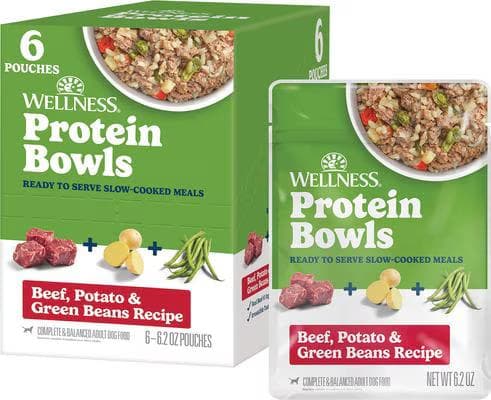
Case of six 6.2-oz pouches at $27.98 ($0.76/oz). New Autoship orders save 35%, dropping the first delivery to $18.19.
Petful may earn a commission when you click through to Chewy, at no extra cost to you.
How much protein should you feed a dog each day?
How much protein should you feed a dog? There is no responsible one-line grams-per-day answer based only on body weight. Dogs eat food to meet calorie needs, and two dogs of the same weight can burn very different amounts of energy. A young working dog, a sedentary adult, and a nursing mother may need very different amounts of food and therefore different total protein intake.
For most healthy dogs eating a commercial complete diet, use the feeding guide as a starting point, measure the actual portion, and adjust it to maintain an appropriate body condition. The protein comes with that calorie-controlled portion. Do not add a separate protein target on top unless your veterinarian or a veterinary nutritionist has designed a specific plan.
A calorie-normalized number, such as grams of protein per 1,000 calories, is more useful for technical comparisons than grams per pound of dog. Most pet parents do not need to calculate that number at home if the label carries the correct nutritional adequacy statement and the portion maintains the dog's weight and condition.
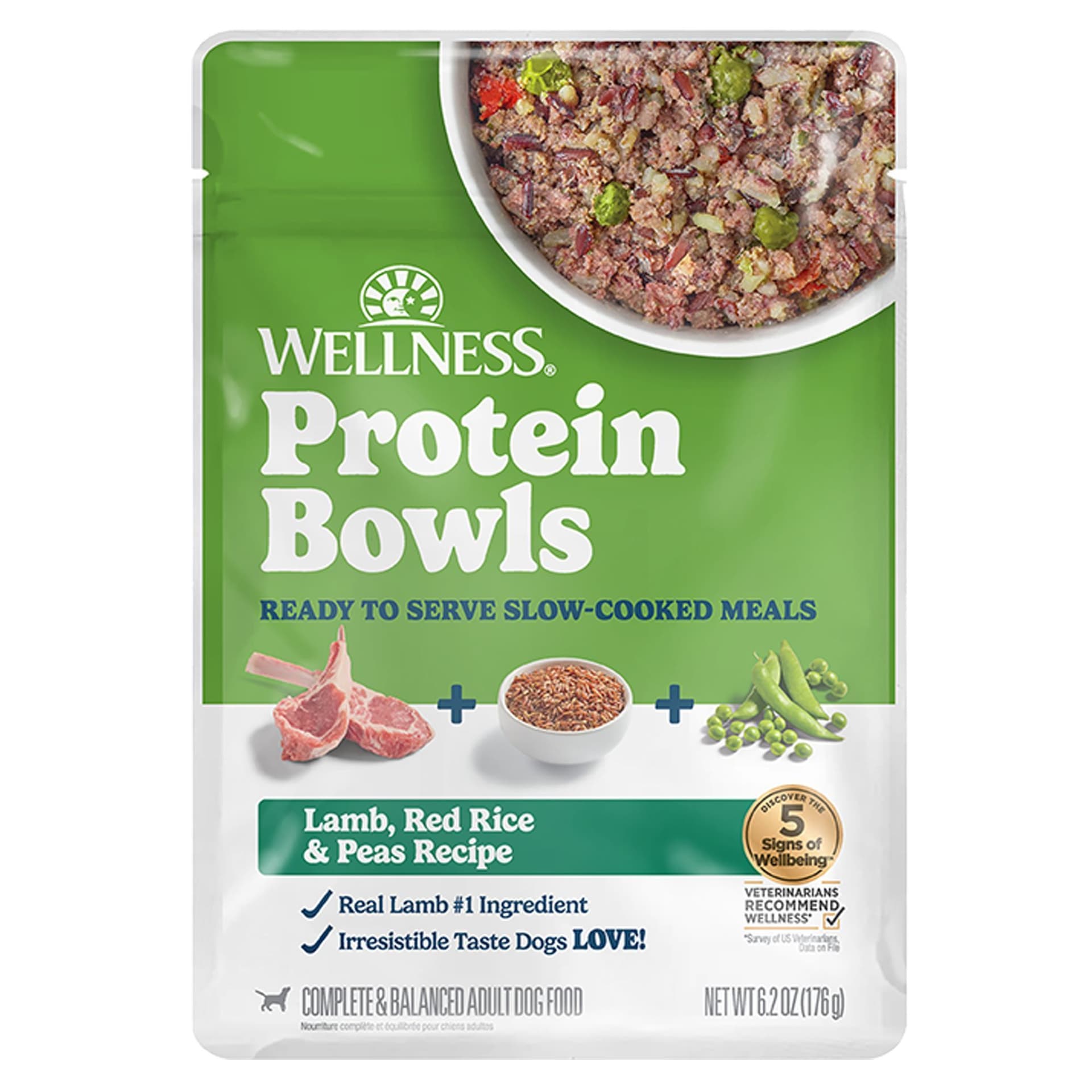
Single 6.2-oz pouch at $4.99 SRP. Mix-and-match any 3 flavors for $12 (about $4 each). Available in-store and online.
Petful may earn a commission when you click through to PetSmart, at no extra cost to you.
Protein needs by life stage
Protein needs change most clearly when a dog moves between growth, reproduction, and adult maintenance. This table separates AAFCO minimums from individualized feeding decisions for puppies, adults, seniors, active dogs, and pregnant or nursing dogs. Seniors and highly active dogs require more individual judgment because AAFCO does not publish a separate senior maintenance profile or one universal sport-dog percentage.
| Life stage or situation | Useful benchmark | How to apply it |
|---|---|---|
| Healthy adult maintenance | At least 18% crude protein on a dry matter basis | Choose a complete adult-maintenance food and portion it to body condition. |
| Puppies, growth, pregnancy, nursing | AAFCO growth and reproduction: at least 22% crude protein on a dry matter basis | Use a food labeled for growth or gestation/lactation, not an adult-maintenance food by default. |
| Healthy senior dog | No separate AAFCO senior-protein profile | Protect muscle with adequate high-quality protein while accounting for calories, appetite, and health. |
| Highly active or working dog | No single universal percentage | Evaluate total calories, recovery, workload, digestibility, and the complete nutrient profile together. |
| Dog with kidney, liver, or other medical needs | Individual veterinary plan | Do not raise or restrict protein based on age or a label percentage alone. |
Puppies and growing dogs
Puppies are building muscle, organs, skin, coat, enzymes, and immune tissues while their calorie needs are high. That is why the growth and reproduction profile starts above the adult-maintenance minimum. The entire nutrient package matters, especially for large-breed puppies, so a high protein percentage does not make an adult food an appropriate puppy food.
Look for a nutritional adequacy statement for growth, including the large-size growth qualification when relevant. Follow the puppy feeding guide, monitor growth and body condition, and avoid adding meat or supplements that can unbalance the complete formula.
Adult dogs
A healthy adult generally needs a food formulated for adult maintenance, enough calories to hold a healthy weight, and enough digestible protein to maintain lean tissue. The exact guaranteed-analysis number varies among complete foods because recipes differ in moisture, energy density, and ingredient mix.
The practical test is broader than a percentage. Your dog should maintain muscle, body condition, a healthy coat, normal energy, and consistent digestion on a properly portioned food. Changes in those areas can have many causes, so they should not be self-diagnosed as protein deficiency.
Senior and active dogs
Healthy older dogs still need protein to preserve muscle. Age alone is not a reason to choose the lowest-protein food on the shelf. At the same time, seniors differ widely in appetite, activity, calorie needs, dental comfort, and medical history, so the best formula is individualized rather than selected by one age-based percentage.
Athletic and working dogs may eat more total food because they burn more energy, which can raise total protein intake even when the label percentage stays similar. We leave the deeper senior- and active-dog discussion to our guide to high-protein food for senior and active dogs so this article does not turn one benchmark into a rule for every dog.
Case of six 6.2-oz pouches at $27.98 ($0.76/oz). New Autoship orders save 35%, dropping the first delivery to $18.19.
Petful may earn a commission when you click through to Chewy, at no extra cost to you.
What is the best protein source for dogs?
The best protein source for dogs is one that contributes the needed amino acids, is digestible in the finished food, agrees with the individual dog, and sits inside a complete and balanced recipe. Chicken, beef, turkey, lamb, fish, eggs, and some plant ingredients can all contribute protein. The ingredient list alone cannot tell you the amino-acid balance or digestibility of the final diet.
Use this order of questions:
- Is the food complete and balanced for the correct life stage?
- Does the manufacturer provide clear nutrition and quality-control information?
- Does the food supply appropriate calories for the portion your dog needs?
- Does your dog maintain muscle, body condition, appetite, stool quality, skin, and coat on it?
- Is there a medical reason to use or avoid a particular ingredient or nutrient level?
A named meat in the first ingredient position can make a label easier to understand, but it is not a complete quality score. Water weight, ingredient processing, the rest of the recipe, and the finished nutrient profile all matter.
How to read protein on a dog food label
Use a two-step label check. First, start with the nutritional adequacy statement, not the largest number on the front of the package. AAFCO explains that this statement tells you whether the product is complete and balanced and identifies the life stage for which it was formulated. A food can be complete for adult maintenance, growth and reproduction, or all life stages.
Second, read crude protein and moisture in the guaranteed analysis. Crude protein is usually listed as an as-fed minimum, which includes the water in the food. That makes a wet food's number look lower than a dry food's number even when the foods may be much closer after moisture is removed. A search for a “how much protein does a dog need per day calculator” cannot replace these two checks because the right daily intake also depends on calories and the individual dog.
- To estimate protein on a dry matter basis, divide the as-fed crude protein percentage by the food's dry-matter percentage, then multiply by 100. Dry matter equals 100 minus moisture. The result is still a label minimum, not a measure of protein quality or digestibility.
For example, a wet food with 9% crude protein and 78% moisture contains 22% dry matter. The estimate is 9 divided by 22, multiplied by 100, or about 41% crude protein on a dry matter basis. A dry food with 26% crude protein and 10% moisture works out to about 29% on a dry matter basis. The example shows why 9% and 26% cannot be compared as if moisture were equal.
| Example food | As-fed crude protein | Moisture | Estimated protein on a dry matter basis |
|---|---|---|---|
| Wet food | 9% | 78% | About 41% |
| Dry food | 26% | 10% | About 29% |
Use dry-matter math to compare concentration, then return to the life-stage statement, calories, serving size, and your dog's individual needs. If you want to change foods, switch your dog's food gradually so the digestive system has time to adapt.
Single 6.2-oz pouch at $4.99 SRP. Mix-and-match any 3 flavors for $12 (about $4 each). Available in-store and online.
Petful may earn a commission when you click through to PetSmart, at no extra cost to you.
Do dogs need a lot of protein?
Dogs need enough complete, digestible protein, but “a lot” is not a useful universal target. AAFCO minimums protect against inadequate formulation for the named life stage. Foods above those minimums may fit many healthy dogs, yet the highest percentage on the shelf does not guarantee better ingredients, better digestibility, or a better match for calorie needs.
If your concern is low intake, weight loss, muscle loss, coat changes, or poor recovery, do not assume protein is the only cause. For protein-deficiency signs and corrective next steps, use our dedicated signs of protein deficiency in dogs guide. A veterinarian can evaluate the whole diet and rule out medical causes before you add protein or replace a complete food.
Where Wellness Protein Bowls fit
Wellness Protein Bowls offer a useful example of why feeding format and nutritional adequacy matter together. Wellness describes the line as slow-cooked, shelf-stable wet dog food that can be served as a complete meal for adult dogs or mixed with dry food as a topper. That distinction matters: a complete meal can supply the full adult diet when fed as directed, while a topper is only part of the bowl.
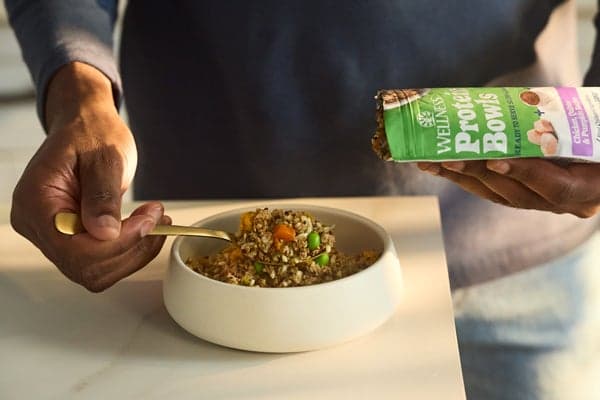
The line includes beef, salmon and whitefish, lamb, and chicken recipes. Protein is the first ingredient, and the pouches add moisture, aroma, visible ingredients, and a softer texture to the meal. Those qualities can make the food appealing, but the reason it fits this guide is simpler: it is labeled as a complete adult meal rather than a protein add-on that leaves the rest of the diet to guesswork.
If you use a Protein Bowl over kibble, account for the calories and follow feeding directions instead of simply adding the whole pouch to the existing ration. Pet parents using it to encourage a selective eater can follow our dog food toppers for picky eaters guide for texture, routine, and portioning decisions. If you are considering it as the main diet, our Wellness Protein Bowls worth-it review covers cost, format, and everyday fit in more detail. The official Wellness Protein Bowls guide lists the current recipes and feeding information.
Protein questions from dog owners
How do you know if your dog is getting enough protein? Start with a complete and balanced diet for the correct life stage, feed enough to maintain healthy body condition, and monitor muscle, energy, skin, coat, appetite, and digestion over time. Those signs are not specific to protein, so a change does not prove deficiency. Unexplained weight loss, muscle loss, chronic digestive trouble, or coat changes deserve veterinary evaluation rather than an automatic protein supplement.
Can a dog eat too much protein? More is not automatically better, even though many healthy dogs can eat complete foods above AAFCO minimums. The whole recipe, calorie density, digestibility, life-stage adequacy, and individual health needs matter. A dog with a medical condition may need a specifically formulated diet. Do not add meat, eggs, powders, or supplements if they displace a balanced portion of the main food or conflict with a veterinary plan.
Is 30 protein too much for a dog? A label showing 30% crude protein is not enough information to decide. Check whether that number is as fed or on a dry matter basis, identify the food's moisture and calories, and read the nutritional adequacy statement. For many healthy dogs, a complete food at that level may be appropriate. For an individual dog with unusual calorie or medical needs, the correct choice depends on the full formula and veterinary guidance.
Two eggs a day can be too much extra protein and too many extra calories for some dogs, and they can crowd out a complete diet, especially for a small dog. Eggs also add fat and change the overall nutrient balance when they become a regular large share of the bowl. Treat eggs as an extra unless a veterinary nutritionist built them into a complete recipe, and keep all extras within the dog's calorie plan.
The bottom line
The most useful answer to how much protein a dog needs begins with life stage and label context. AAFCO sets dry-matter minimums of 18% for adult maintenance and 22% for growth and reproduction, while seniors, athletes, and dogs with medical needs require more individualized decisions.
Choose a complete and balanced food, compare wet and dry formulas on an equal basis, feed a measured portion, and watch the dog in front of you. Wellness Protein Bowls can fit as a complete adult meal or a calorie-accounted topper, giving pet parents a practical way to add protein-rich variety without treating one percentage as the whole nutrition story.
BVMS, MRCVS
Dr. Pippa Elliott, BVMS, MRCVS, is a veterinarian with nearly 30 years of experience in companion animal practice. Dr. Elliott earned her Bachelor of Veterinary Medicine and Surgery from the University of Glasgow. She was also designated a Member of the Royal College of Veterinary Surgeons. Married with 2 grown-up kids, Dr. Elliott has a naughty Puggle named Poggle, 3 cats and a bearded dragon.
Sign up for expert-backed reviews and safety alerts all in one place.

A Final Word (Disclaimer)
At Petful, our review integrity is paramount; we never exchange special treatment in our reviews for monetary or material rewards.
Nonetheless, when our readers click through to online merchants (including Chewy or Amazon), we receive a referral commission. This supports the running of our free blog, and we appreciate your backing.