Homemade Dog Food Supplements: How to Close Nutrient Gaps
Learn why homemade dog food needs recipe-specific supplementation and how to close nutrient gaps without guessing at amounts.
Petful is reader supported. As an affiliate of platforms like Amazon and Chewy, we may earn a commission when you buy through links on this page. There is no extra cost to you.
This article is sponsored by JustFoodForDogs. Petful maintains editorial control over its educational content and may earn a commission from qualifying purchases, at no extra cost to you.
A homemade dog food supplement should be chosen from an analysis of the entire recipe, not by guessing at a few popular nutrients. A homemade meal can contain recognizable meat, vegetables, and grains and still fall short of a dog's long-term nutritional needs. The solution is not to add a random multivitamin or a few popular powders. Supplements for homemade dog food must be used in the exact amount the formula requires.
That distinction is the difference between supplementing a tested recipe and guessing at nutrients. A recipe-matched blend can close the specific gaps created by a specific batch. The same blend cannot be assumed to balance a different protein, different ingredients, or a different batch size.
There is no universal supplement list for every homemade dog food recipe. Start with a complete formula, then use only the nutrient blend or supplements specified for that formula.

Sign up for expert-backed reviews and safety alerts all in one place.
Why homemade dog food develops nutrient gaps
Ingredients contribute nutrients as a package, not one at a time. Ground meat supplies protein and phosphorus, for example, but that does not mean it provides calcium in the proportion a dog needs. Vegetables may provide fiber and selected vitamins without supplying all trace minerals. An oil may contribute fatty acids but cannot correct a mineral imbalance.
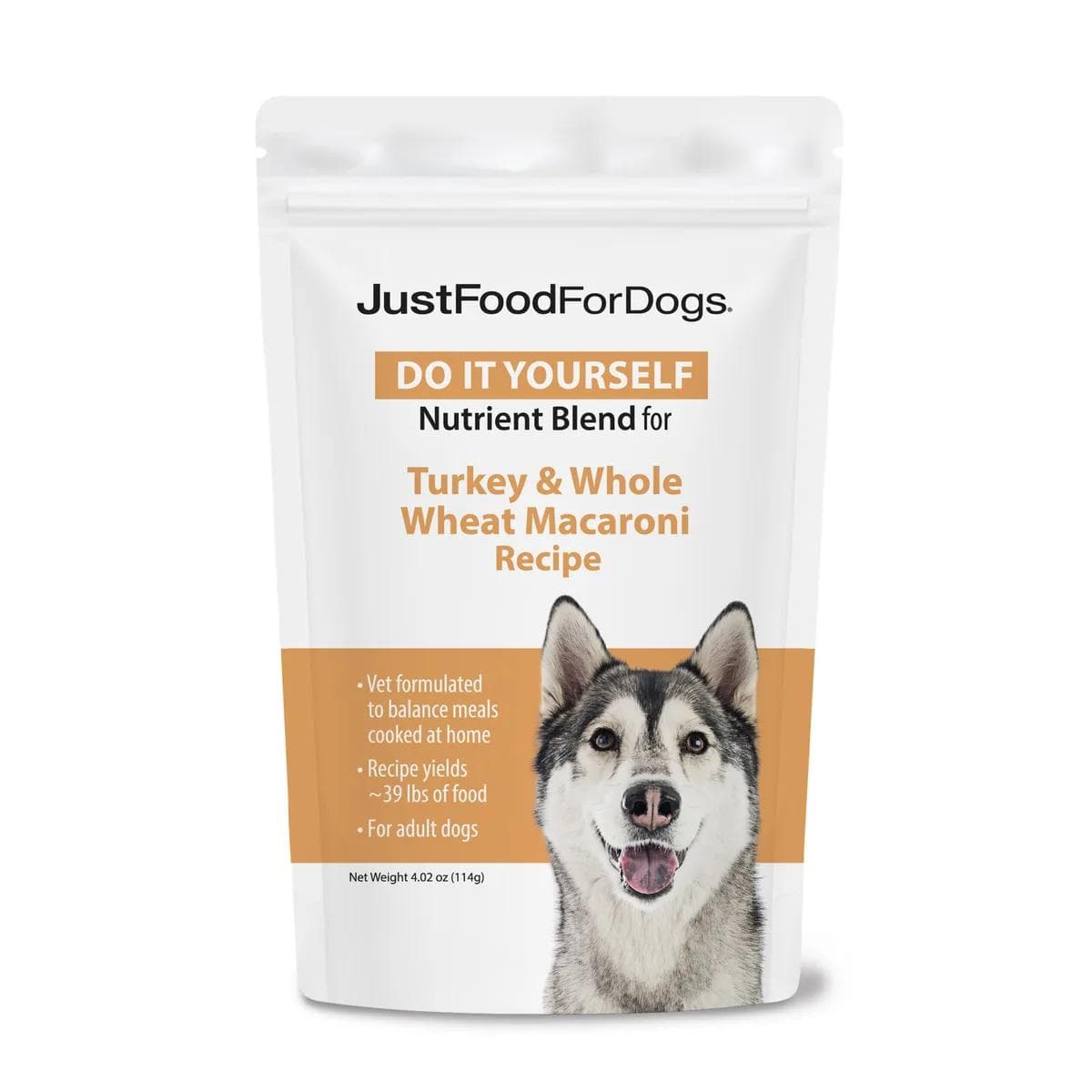
Match this nutrient blend to its official recipe and batch size before you shop or cook.
- Made for the Turkey & Whole Wheat Macaroni recipe
- Pair with the exact official cooking guide
- Measure every ingredient and the blend as directed
Recipe-specific blend; follow the complete recipe exactly.
Petful may earn a commission when you click through to JustFoodForDogs, at no extra cost to you.
Recipes can also change when cooks substitute ingredients, eyeball quantities, drain cooking liquid, or scale a batch incorrectly. Each change can alter calories and nutrient density. A supplement selected by its front label cannot account for those variables.
| Common approach | What it can miss | Safer decision |
|---|---|---|
| Meat, rice, and vegetables only | Calcium and other micronutrient gaps | Use a complete, veterinary-formulated recipe |
| A general dog multivitamin | Recipe-specific amounts and nutrient ratios | Use the exact supplements named by the formula |
| Eggshell or calcium added by eye | Correct calcium amount and full nutrient adequacy | Measure the specified calcium source and complete the whole formula |
| Fish oil added to every recipe | Formula-specific fatty-acid and calorie requirements | Use only the oil and amount specified |
| A nutrient blend mixed into different ingredients | The blend was calculated for another batch | Match the blend to its exact cooking guide |
Calcium-phosphorus balance is a useful example, but it is not the only consideration. A complete diet must address the recipe as a whole. Adding one missing nutrient does not prove that everything else is adequate, and adding too much of a nutrient can create a different imbalance. A recipe-matched nutrient blend is useful only when it is paired with the exact ingredients, amounts, preparation method, and batch size it was designed to complete; moving it to another recipe changes the nutrient calculation.
Do dogs need supplements when eating homemade food? A professionally balanced recipe often includes precisely measured additions, but the need and dose come from that recipe's analysis. Whole-food ingredients alone do not prove that calcium, trace minerals, vitamins, or essential fatty acids meet the dog's requirements.

What supplement do I need to add to homemade dog food?
The answer comes after a recipe analysis identifies the exact nutrient gaps. A homemade dog food supplement should close those measured gaps without duplicating or oversupplying nutrients already present. The gap-to-consequence table above separates nutrient problems from products: it shows why the recipe must be evaluated before a matched supplement is selected.
Use only the exact supplement and amount specified by the qualified formulator for that recipe. If the formula has no supplement instructions, request a recipe analysis instead of choosing a general powder by its front label.
Why random vitamins cannot balance a recipe
The word “multivitamin” sounds comprehensive, but products differ in both ingredients and amounts. A general supplement may duplicate nutrients already present, omit a mineral the recipe needs, or supply an amount that bears no relationship to the calories your dog eats.
The same problem applies to assembling a homemade stack from internet advice. Calcium, fish oil, vitamin E, kelp, and other commonly discussed additions each affect a formula. Combining them without a recipe analysis does not demonstrate that the resulting food is complete and balanced.
Do dogs need supplements when eating homemade food? A complete home-prepared formula commonly includes specified vitamin, mineral, fatty-acid, or other additions, but the correct products and amounts belong to that exact recipe. Random multivitamins can overcorrect one nutrient while leaving another deficient. A label with many ingredients is not evidence that the blend matches the batch or the dog's daily calorie intake.
Supplements cannot repair an improvised base recipe
A nutrient blend is calculated with assumptions about the base ingredients. Change the meat, liver, starch, vegetables, oil, or batch size and those assumptions no longer hold. If your dog cannot eat an ingredient in a formula, choose another complete recipe or ask a veterinarian with nutrition expertise to formulate one.
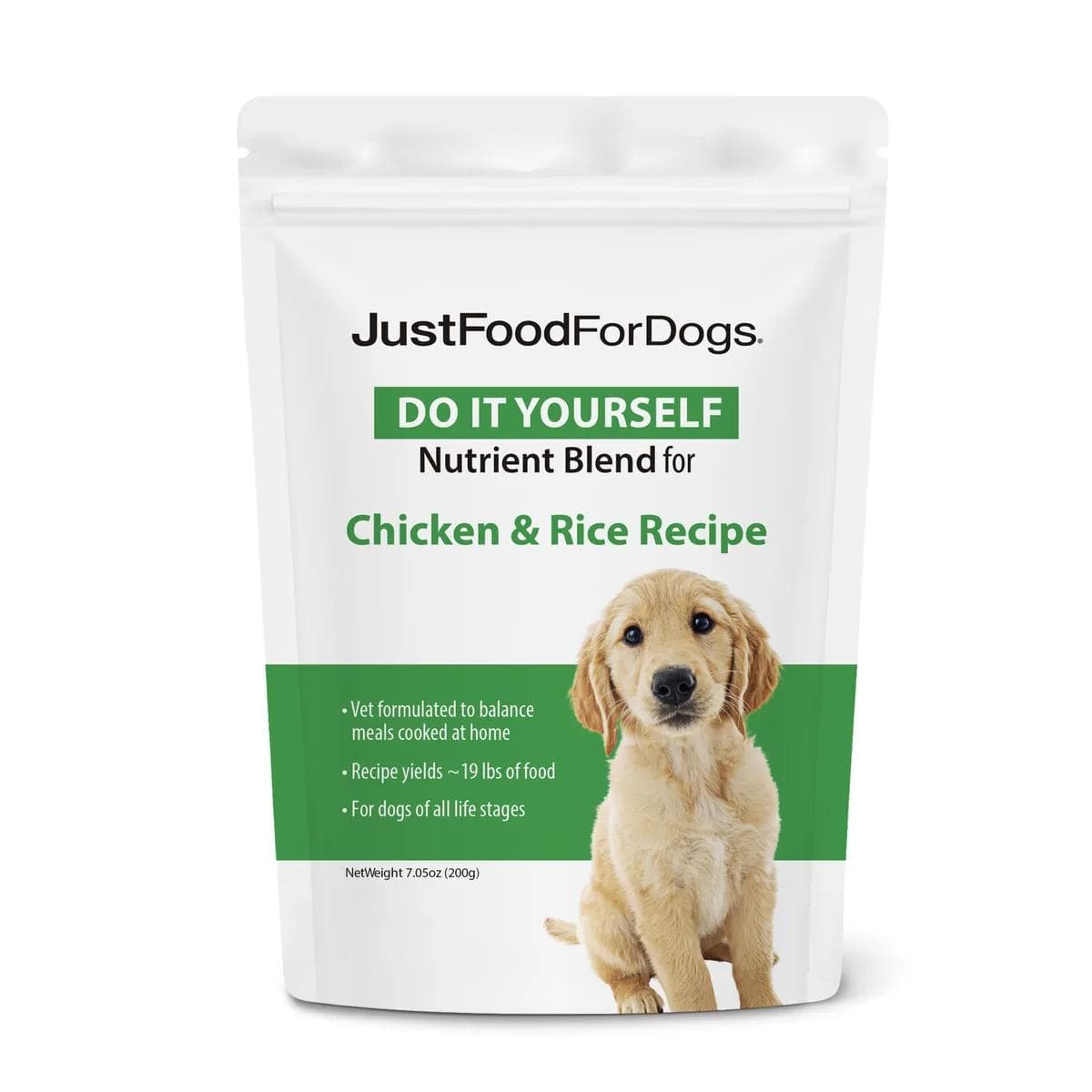
Match this nutrient blend to its official recipe and batch size before you shop or cook.
- Made for the Chicken & Rice recipe
- Pair with the exact official cooking guide
- Measure every ingredient and the blend as directed
Recipe-specific blend; follow the complete recipe exactly.
Petful may earn a commission when you click through to JustFoodForDogs, at no extra cost to you.
More is not a safety margin
Doubling a blend or adding extra vitamins does not make a diet “more complete.” Nutrients have intended amounts and relationships. Follow the label and cooking guide precisely, and never combine multiple vitamin-mineral products unless the dog's veterinarian has reviewed the full diet.
A topper and a complete diet are different jobs
Small amounts of home-cooked food may be used as a topper, but the more unbalanced additions displace a complete diet, the more they can affect overall nutrient intake. Without a matched nutrient blend or a veterinary-formulated equivalent, a homemade mixture should not be treated as a complete long-term meal.
How recipe-specific DIY Nutrient Blends work
The recipe-to-blend pairing is the central strength of the JustFoodForDogs DIY approach. Each DIY Nutrient Blend is paired with a specific cooking guide, named recipe, and batch size, giving home cooks a structured way to close the nutrient gaps identified in that formula. The blend is not a standalone meal or a universal powder for unrelated ingredients.
Current recipe-specific JustFoodForDogs options include:
- Turkey DIY Nutrient Blend, SKU 60030105
- Beef DIY Nutrient Blend, SKU 60030101
- Chicken DIY Nutrient Blend, SKU 60030102
- Fish DIY Nutrient Blend, SKU 60030103
Match this nutrient blend to its official recipe and batch size before you shop or cook.
- Made for the Turkey & Whole Wheat Macaroni recipe
- Pair with the exact official cooking guide
- Measure every ingredient and the blend as directed
Recipe-specific blend; follow the complete recipe exactly.
Petful may earn a commission when you click through to JustFoodForDogs, at no extra cost to you.
Use the cooking guide supplied for the selected blend. Weigh the stated ingredients, preserve the batch ratios, and follow the ordered cooking method. Once the cooked food has cooled until it is warm to the touch, add the specified oil and slowly mix in the blend until it is distributed evenly.
What nutrients do I need to put in homemade dog food? The matched nutrient blend question cannot be separated from the base ingredients. Balancing homemade dog food requires the formulator to account for the nutrients in the meat, organs, starches, produce, oil, and supplements together. The named DIY blend supplies the additions calculated for its companion recipe; it is not a general nutrient menu for another batch.
- Dogs with special dietary or medical needs require a veterinarian-guided formula.
What a recipe analysis needs to account for
Supplement planning begins with the calories the recipe supplies and the amount the dog will actually eat. Nutrients have to be evaluated in relation to the complete daily intake, not simply detected somewhere on an ingredient list.
A useful analysis accounts for:
- the exact identity and weight of every ingredient;
- whether each weight is raw, cooked, drained, or dry;
- the fat percentage and cut of meat;
- cooking losses, retained liquid, and finished batch yield;
- the dog’s daily calorie intake from the recipe;
- nutrients supplied by oils, powders, treats, and other foods;
- life stage and any medical nutrient targets;
- the amount and chemical form of each supplement nutrient.
Match this nutrient blend to its official recipe and batch size before you shop or cook.
- Made for the Chicken & Rice recipe
- Pair with the exact official cooking guide
- Measure every ingredient and the blend as directed
Recipe-specific blend; follow the complete recipe exactly.
Petful may earn a commission when you click through to JustFoodForDogs, at no extra cost to you.
This is why copying a supplement list from a visually similar recipe is unreliable. Two turkey-and-rice recipes can use different meat ratios, yields, oils, vegetables, and daily serving sizes. The correct supplement amounts may therefore be different even when the ingredient names look familiar.
What nutrients do I need to put in homemade dog food? The analysis must account for every required nutrient across the full daily intake, including calcium and phosphorus, trace minerals, vitamins, essential fatty acids, amino acids, and calories. The result identifies what the base recipe already supplies and which precise additions are still needed.
How to read a homemade dog food supplement label
A front label may emphasize calcium, omega-3s, or a long list of vitamins. The formulation question is whether the product supplies the exact nutrients and amounts required by the chosen recipe.
Check the full product name, recipe match, serving instructions, unit of measure, lot and expiration information, and storage directions. Keep the current cooking guide with the product. Do not substitute a scoop from another container or assume two scoops of different sizes are equivalent.
| Label check | Why it matters |
|---|---|
| Exact recipe name | Confirms the blend belongs with the selected ingredient list |
| Batch amount | Connects the supplement dose to the full batch, not an arbitrary bowl |
| Separate oil requirement | Some formulas need an oil that is not supplied by the powder |
| Mixing sequence | Protects the preparation method used by the formulator |
| Storage and use date | Helps preserve product quality and traceability |
If a label or guide is missing, unclear, or different from the recipe on hand, pause before cooking. The manufacturer or veterinarian should confirm the current instructions.
Keep a batch record
A short batch log makes homemade feeding easier to audit and repeat. Record the recipe and blend name, preparation date, batch size, ingredient weights, any problem encountered, finished yield, storage dates, and the dog’s daily portion.
The log should show zero substitutions for a formula intended to be complete and balanced. If an ingredient was unavailable or measured incorrectly, note that the batch was not used as the main diet rather than silently treating it as equivalent.
Keep photographs of the product label and lot number until the batch has been fed. When a dog develops a digestive sign or refuses the food, this record gives the veterinarian more useful information than “homemade turkey food.”
- Decision checkpoint: Petful’s [vet-approved homemade dog food recipe](https://www.petful.com/spotlight/vet-approved-homemade-dog-food/) shows how exact ingredient weights, cooling, oil, and a recipe-matched blend work together in one complete formula.
A practical checklist before supplementing homemade food
1. Define what the food is meant to be
Decide whether the homemade food is an occasional extra or the dog's primary diet. A primary diet requires a complete formulation. If it is only a topper, keep its share modest enough that it does not crowd out the complete food your dog relies on.
2. Start with one documented recipe
Choose a formula with exact ingredient weights, batch yield, supplement amounts, and preparation instructions. “Protein plus vegetables” is a meal concept, not a nutrition formula.
3. Match every supplement to that recipe
Confirm the product name and recipe name, and use the current cooking guide. If the formula calls for a separate oil, that oil is part of the formula too.
4. Measure the entire batch accurately
Use a kitchen scale and the ingredient state described by the guide, such as raw meat or dry pasta. Scale every component proportionally only when the guide provides a supported batch size. If a raw diet itself is under consideration, weigh what the safety evidence says about feeding dogs raw meat before building the plan around it.
5. Preserve the preparation sequence
Cooking changes weights and water content. Follow the guide's directions about what is cooked together, what is drained, and when supplements are added. For the JFFD DIY recipes in this source set, the oil and blend are added after the cooked food has cooled until warm to the touch.
6. Recheck your dog's response
Monitor weight, body condition, appetite, stool, coat, and general wellbeing, but do not use visible signs as proof that a diet is nutritionally complete. Some deficiencies or excesses may not be obvious early. Keep your veterinarian informed when homemade food is a substantial part of the diet.
When to involve your veterinarian
Ask for veterinary guidance before making homemade food the main diet for a puppy, pregnant or nursing dog, senior with weight or muscle loss, or dog with a health condition. Dogs with kidney, liver, pancreatic, gastrointestinal, urinary, allergy, or other medical needs may require restrictions or nutrient targets that a general adult-maintenance recipe does not provide.
Bring the exact recipe, ingredient brands when relevant, supplement labels, batch quantities, and your dog's daily portion to the appointment. That gives the veterinarian a concrete formula to evaluate.
Petful's guide to essential ingredients in home-cooked pet food offers more background on building a sound base diet.
Questions about homemade dog food supplements
Use the supplements specified by a complete recipe that has been formulated for your dog's needs. There is no universal list or dose. If a recipe does not include a nutrient analysis or precise supplement instructions, do not assume a general multivitamin will balance it. What supplement do I need to add to homemade dog food? Use only the exact product, amount, and preparation method named by the qualified formulator. If no supplement instructions exist, the safe next step is recipe review, not choosing a popular powder by its front label.
Not necessarily. A multivitamin's nutrient profile may not match the gaps, quantities, or ratios in a particular recipe. Balance depends on the whole formula, not the presence of a product labeled “complete” or “multivitamin.”
No. Each blend is paired with a specific recipe and batch. Use the matching cooking guide without substitutions.
No, not if the blend is part of the complete formula. Healthy individual ingredients do not demonstrate that a full diet supplies every required nutrient in the correct amount.
Calcium often needs careful attention in home-prepared diets, but the source and amount must come from the complete formulation. Adding eggshell, bone meal, or another calcium product by eye does not establish the right calcium level or calcium-to-phosphorus relationship.
No. An oil may supply selected fatty acids and calories, but it does not provide every vitamin and mineral a recipe may need. Use the exact oil and dose named by the formula, along with every other required component.
Not without an individualized formulation. Kidney, liver, pancreatic, gastrointestinal, urinary, endocrine, and other conditions may require specific nutrient targets. A standard blend should not be modified at home to imitate a therapeutic diet.
Review it whenever the recipe, supplement product, dog’s health, life stage, weight, or daily portion changes. Regular veterinary nutrition assessments are also useful because a dog’s needs and product instructions can change over time.

Coreen Saito is a pet writer and longtime shelter volunteer with more than a decade in animal rescue. She covers cat behavior, breed care, and the small, ordinary science of sharing a life with companion animals, with a particular focus on honest takes about the products and decisions that actually matter. At home in Arizona, she's outranked by Mac (a dog with the loudest opinion in the house), Rebel (a cat who governs by quiet authority), and Meri (an orange tabby who runs the late shift and the laundry basket). She writes about all three, plus the rescues that keep coming through her life, at LifeWithMinty.com.
Sign up for expert-backed reviews and safety alerts all in one place.


A Final Word (Disclaimer)
At Petful, our review integrity is paramount; we never exchange special treatment in our reviews for monetary or material rewards.
Nonetheless, when our readers click through to online merchants (including Chewy or Amazon), we receive a referral commission. This supports the running of our free blog, and we appreciate your backing.