From Kibble to Kitchen: How Fresh Thinking Is Changing Pet Food
A practical guide to reading dog food labels, understanding AAFCO naming rules and complete-and-balanced claims, and transitioning safely from kibble to fresh food.

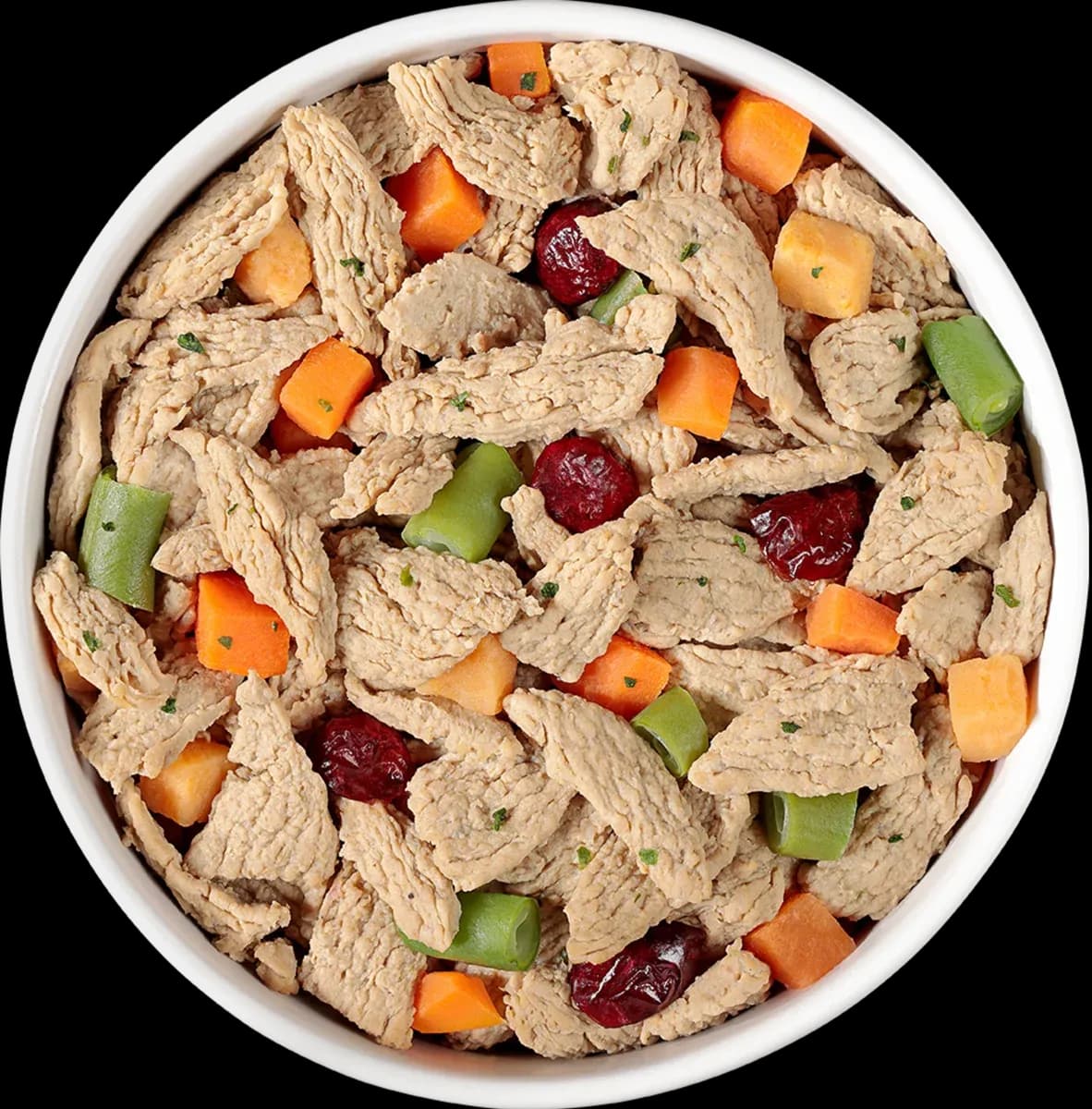
A fresh dog food bowl with chicken, rice, carrots, and green beans.
Petful is reader supported. As an affiliate of platforms like Amazon and Chewy, we may earn a commission when you buy through links on this page. There is no extra cost to you.
In years gone by, dogs and cats primarily lived outside and ate table scraps from their owners' plates. Over time, pet owners have shifted to "pet parents" who want the very best for their furry children. Pets are sharing beds with their owners, receiving top veterinary care, and even attending birthday parties.
That same scrutiny pet parents apply to their own food now extends to their pets' bowls, driving demand for fresher options like Freshpet. In fact, CoBank agricultural finance research reports an 86.5% increase in fresh dog food purchases since 2021, reflecting the growing interest in a new way to feed pets.
Many pet parents are looking for fresh ingredients that are easy to understand and identify. These ingredients should be as natural and unprocessed as possible to garner trust in pet food companies. They're also questioning whether less familiar, more processed ingredients are acceptable for their pets if their own diet doesn't include them, and they're hungry for more knowledge about what goes into pet food.
That knowledge starts with the package. This guide will walk you through how to read a dog food label, what it actually tells you, and how to transition your dog to a fresher diet with confidence.

Sign up for expert-backed reviews and safety alerts all in one place.
How to Read a Dog Food Label
Pet parents can learn more about what their dog food consists of by reading the product name, the ingredient list, the guaranteed analysis, and the nutritional adequacy statement on the label. Together, these sections of the label answer how much of the headlining ingredient(s) it contains, what’s actually in the food, what nutrients it delivers, and whether it’s built to serve as a dog’s complete diet. Once you know where to look, the label tells a clear story.
Build a personalized Freshpet meal plan and have fresh food delivered on a recurring schedule.
- Personalized meal plans for your dog
- Fresh meals delivered to your door
- Recipes designed by veterinary nutrition experts
Freshpet affiliate link
Petful may earn a commission when you click through to Freshpet, at no extra cost to you.
What the Product Name Tells You
A dog food's name is tied to how much of the named ingredient it must contain. The Association of American Feed Control Officials (AAFCO) naming rules set four thresholds: 95% for products like "Chicken Dog Food," 25% for "recipe" or "dinner" labels, 3% for "with chicken" claims, and no set minimum for "flavor" claims.
| What the Name Says | What It Must Contain | Example |
|---|---|---|
| The 95% rule | At least 95% of the named ingredient (not counting water for processing), or 70% including water | "Beef Dog Food" |
| The 25% "dinner" rule | At least 25% of the named ingredient excluding added water (and at least 10% of the total product) | "Chicken Recipe," "Salmon Dinner" |
| The 3% "with" rule | At least 3% of the named ingredient | "Dog Food With Chicken" |
| The "flavor" rule | A recognizable flavor source only; no specific minimum | "Chicken Flavor Dog Food" |
These thresholds compound when a name lists two ingredients under the 95% rule. "Chicken and Liver Dog Food" requires both named ingredients together to reach 95%, with chicken listed first because it appears in the larger amount. Watch for this pairing on simple protein-forward names, because order signals proportion.
The Ingredient List, Read by Weight
Dog food labels list ingredients by weight, from largest to smallest. The first few entries are the main ingredients of the food. Look for a recognizable whole protein like chicken, beef, or salmon leading the list, rather than a vague filler or a string of fractioned grains. Freshpet recipes, for example, lead with specific whole proteins like fresh chicken or beef and skip meat meals and by-products entirely.

What 'Chicken' vs. 'Chicken Meal' Really Means
"Chicken" refers to muscle from chickens, with or without bone. "Chicken meal" is the same animal, rendered and heat-processed to remove water and fat, concentrating it into a shelf-stable protein powder. "Chicken by-product meal" is a heat-processed ingredient made from chicken parts remaining after the meat eaten by people is harvested.
Build a personalized Freshpet meal plan and have fresh food delivered on a recurring schedule.
- Personalized meal plans for your dog
- Fresh meals delivered to your door
- Recipes designed by veterinary nutrition experts
Freshpet affiliate link
Petful may earn a commission when you click through to Freshpet, at no extra cost to you.
All three supply nutrition, but they aren't interchangeable in what they signal about processing. Some pet parents may feel more comfortable feeding a food that clearly identifies its ingredients instead of relying on vague terms. When in doubt, your veterinarian can help tailor choices to your dog’s needs.
The Guaranteed Analysis
The guaranteed analysis is a small table on every label stating four required figures: minimum crude protein, minimum crude fat, maximum crude fiber, and maximum moisture. Many brands voluntarily add extra figures, like omega-3 and omega-6 fatty acid levels, beyond what's required.
One thing worth understanding when comparing a fresh, refrigerated food to a dry kibble is moisture. Fresh foods naturally carry much more water, so the back-of-package percentages for a fresh food and a dry food aren't directly comparable at face value.
A fair comparison looks at both foods on the same "dry matter" basis, which strips out water content to compare nutrient levels apples-to-apples. Freshpet reports that its energy density (kcal per 100 grams) runs comparable to canned food and considerably lower than dry kibble, with roughly half the carbohydrate content of a typical dry diet. That gap illustrates just how differently the two formats compare once you're accounting for what's actually in the bowl.
The Nutritional Adequacy Statement
The AAFCO nutritional adequacy statement tells you whether a food is "complete and balanced," meaning it supplies every nutrient a dog needs, in the right proportions, to serve as the only thing in the bowl. It's often the smallest sentence on the package, but the one that matters most for confirming a food can stand on its own as a full diet.
If a food is complete and balanced, the statement also names the life stage it's formulated for:
- Adult maintenance: Formulated for healthy adult dogs, meaning dogs that have stopped growing, are not pregnant, and are not raising puppies.
- All life stages: Formulated to meet the needs of puppies and pregnant or nursing dogs. These needs are more specific than what is required for healthy adult dogs but still provide the nutrition they need.
If the statement instead says a product is "intended for intermittent or supplemental feeding only," that food is not a stand-alone diet. Reading this line first is the fastest way to confirm a food can truly be your dog's main meal.
Build a personalized Freshpet meal plan and have fresh food delivered on a recurring schedule.
- Personalized meal plans for your dog
- Fresh meals delivered to your door
- Recipes designed by veterinary nutrition experts
Freshpet affiliate link
Petful may earn a commission when you click through to Freshpet, at no extra cost to you.
AAFCO allows manufacturers to confirm adequacy through lab analysis alone, but some go a step further. Feeding trials that test real-world digestibility and palatability are often considered close to the gold standard for confirming a food performs as intended, not just on paper. Freshpet complements its lab work with feeding trials of this kind rather than relying on formulation analysis on its own.
These guidelines are outlined by AAFCO, and while AAFCO lacks regulatory power, many states have adopted its recommendations as regulations. AAFCO defines ingredient terms and labeling guidelines, ensuring consistency across the pet food industry, and pet parents can use these guidelines to decipher ingredient lists and compare across similar foods.
Benefits of Fresh, Recognizable Ingredients
Fresh, minimally processed ingredients offer digestibility benefits beyond transparency.

Researchers in Brazil found that whole ingredients, such as corn and rice, were more digestible for dogs than processed versions like corn germ and rice bran. Separately, researchers at the University of Illinois found that steamed chicken's amino acids were more digestible than chicken meal's. Freshpet adopted this philosophy and steam-cooks its recipes for a minimal-processing approach, rather than cooking with a harsher or more intense method. Freshpet keeps meats at or below 40°F until steam-cooking them and monitors temperature throughout to protect both food safety and the nutrient bioavailability this research points to.
Ingredients with greater digestibility contain more nutrients the dog can extract, which translates to improved diet digestibility. Scientists observed that a diet with 16% chicken had higher protein digestibility than diets with 0% or 8% chicken. Feeding a more digestible food may mean dogs need to consume less to get the same nutrition.
- Pet parents may notice differences in the backyard and home. One study showed that dogs who ate fresh diets with familiar ingredients left less waste in the backyard than dogs eating dry kibble with less familiar ingredients.
Fresh diets often are more palatable than dry kibble and may help picky eaters or dogs with low appetites. Many pet parents discover their picky eater wasn't actually picky, just uninterested in heavily processed food. A pet who once stared at kibble hoping for something different may now run to the fridge expecting the food to be for them, with dogs who nibbled reluctantly suddenly anticipating mealtime with excitement.
How to Transition From Kibble to Fresh Food
Build a personalized Freshpet meal plan and have fresh food delivered on a recurring schedule.
- Personalized meal plans for your dog
- Fresh meals delivered to your door
- Recipes designed by veterinary nutrition experts
Freshpet affiliate link
Petful may earn a commission when you click through to Freshpet, at no extra cost to you.
Transitioning a dog to fresh food takes about 10 days for most healthy adults, following a steady mix that increases the new food and decreases the old food every few days. This gradual pace, the same one Freshpet recommends for its own recipes, helps avoid gastrointestinal upset like vomiting, diarrhea, or decreased appetite.
| Days | Current (Old) Food | New Fresh Food |
|---|---|---|
| Days 1–3 | 75% | 25% |
| Days 4–6 | 50% | 50% |
| Days 7–9 | 25% | 75% |
| Day 10 | 0% | 100% |

This pacing suits most healthy adult dogs. Dogs with sensitive stomachs, food allergies, or a history of digestive issues often do best planning for a slower pace from the start, stretching the transition over two to four weeks instead of 10 days. There's no prize for rushing. A calm, gradual switch is what sets a dog up to thrive on the new food, and the right pace depends on your dog's baseline sensitivity more than the calendar.
Keeping the Switch Smooth
Reading the early signs makes switching to a new food easy to navigate day by day. Slightly softer stool or mild changes in frequency and more interest in mealtime are all normal during the transition as digestion adjusts. Loose or liquid stool, appetite loss, or ongoing stomach upset signal it's time to slow down rather than push forward.
The fix is easy: Drop back to the previous ratio for a couple of extra days, let things settle, then resume increasing the new food more slowly. Some pet parents add a probiotic or digestive enzyme during the transition to help things along. Keeping fresh water available and feeding on a consistent schedule both help the gut find its rhythm.
- Call your veterinarian if you see repeated vomiting, diarrhea that isn't improving, lethargy, complete loss of appetite, or symptoms that are getting worse rather than better.
Match the Food to Your Dog's Specific Needs
The right fresh food depends on the individual dog, starting with life stage. Puppies need a food formulated for growth or all life stages; healthy adults do well on an adult-maintenance formula; senior dogs and active pets benefit most from highly digestible ingredients that deliver more nutrition per bite.
Pet parents caring for dogs with allergies or ingredient sensitivities may find fresh foods with shorter, cleaner ingredient lists easier to decipher and easier to match to their dog's needs. Pay attention to changes in energy levels, eating enthusiasm, coat condition, and backyard cleanup after switching to a fresh food.
Full transition isn't the only valid endpoint either. Some pet parents land on a long-term mix of fresh food and a quality kibble rather than going 100% fresh, which can make sense for large dogs, multi-dog households, or anyone balancing budget and convenience. What matters most is a consistent routine your dog tolerates well, rather than abrupt day-to-day switching between entirely different diets.
Putting Label-Reading Into Practice
Reading a dog food label comes down to four checks: the product name, the ingredient list, the guaranteed analysis, and the nutritional adequacy statement. Together, they turn a confusing package into a clear picture of what's actually in the bowl, without relying on front-of-package marketing claims.
These same values pet parents apply to their own health and nutrition extend naturally to their dogs, and the research backs that instinct. Fresher, less processed ingredients offer measurable benefits in digestibility and other health indicators. For dogs who seem uninterested in their food or need a highly digestible diet, a transition to fresher ingredients may offer solutions pet parents didn't realize were within reach.
The growing market for fresh pet food tells the story. When it comes to canine nutrition, quality matters just as much as it does for our own meals.
Plan on about 10 days for most healthy adult dogs, moving from mostly old food to mostly new food in steady phases. Dogs with sensitive stomachs, allergies, or a history of digestive issues may need two to four weeks. Going slower is always fine. The goal is comfort, not speed.
The 25% rule is an AAFCO product-naming rule. When a food's name includes a qualifier such as "dinner," "recipe," "platter," "entree," or "formula" (for example, "Chicken Recipe"), the named ingredient must make up at least 25% of the product, excluding added water, and at least 10% of the total product. It's a quick way to gauge how much of the headlining protein is actually in the food.
Many pet parents prefer to skip vague or heavily processed ingredients in favor of those that are recognizable and whole. That means looking for a named whole protein high on the list and favoring shorter, clearer ingredient lists. Your veterinarian can help tailor choices to your dog’s needs.
💡Key Takeaways
- Pet parents have become more aware of the ingredients in their pet's food as they've become more aware of what goes into their own.
- Knowing how to read a dog food label (AAFCO naming rules, the ingredient list by weight, the guaranteed analysis, and the nutritional adequacy statement) lets pet parents see exactly what's in the bowl.
- Less processed ingredients may have higher digestibility in some studies, meaning dogs may extract more nutrients from their food.
- A gradual 10-day transition (longer for sensitive dogs) keeps the switch to fresh food smooth and comfortable.
- Pet parents may notice less stool in the backyard and more excitement at the bowl with certain fresh diets, especially when the food is highly digestible and appealing to the dog.

Ph.D.
Amanda Dainton, Ph.D., is a Product Development Scientist at Freshpet, where she formulates and develops new fresh recipes for dogs and cats. Dr. Dainton's focus was on micronutrients and hydrocolloids in canned pet foods while earning her doctorate at Kansas State University. Amanda also holds a master's degree in Nutritional Science from the University of Illinois at Urbana-Champaign and a bachelor's degree in Feed Science and Management from Kansas State University. She has presented her research at various industry conferences, guest lectures to university classes, and serves on the Companion Animal Program Committee for the American Society of Animal Science conference.
Sign up for expert-backed reviews and safety alerts all in one place.


A Final Word (Disclaimer)
At Petful, our review integrity is paramount; we never exchange special treatment in our reviews for monetary or material rewards.
Nonetheless, when our readers click through to online merchants (including Chewy or Amazon), we receive a referral commission. This supports the running of our free blog, and we appreciate your backing.