Best Dog Food for Dobermans: Puppy and Adult Feeding Choices
Compare JustFoodForDogs meals for Doberman puppies and adults using life-stage labels, individual activity, measured portions, storage requirements, and current food-cost examples.

A black-and-rust Doberman stands in a residential garden.
Petful is reader supported. As an affiliate of platforms like Amazon and Chewy, we may earn a commission when you buy through links on this page. There is no extra cost to you.
This article is sponsored by JustFoodForDogs. Petful maintains editorial control and may earn a commission from qualifying purchases, at no extra cost to you.
The best dog food for Dobermans starts with complete nutrition for the dog's life stage, followed by a portion that fits the individual. A growing puppy needs a growth-appropriate recipe. A mature Doberman needs an appropriate complete food and a feeding routine based on actual activity, rather than the athletic image of the breed.
JustFoodForDogs offers fresh choices that make those decisions concrete. Chicken & Rice and Fish & Sweet Potato cover growth and adulthood, while Beef & Russet Potato and JustFresh Home-Cooked Chicken are adult-maintenance options. Their published calories help you compare serving amounts, with frozen and unopened shelf-stable formats offering different household conveniences.
Start with the exact food's life-stage statement, then measure an individual daily allowance. A Doberman's activity matters to feeding, but neither a muscular appearance nor a high protein percentage supplies a calorie target. Compare recipes using the same assumed calories before planning portions and cost.

Sign up for expert-backed reviews and safety alerts all in one place.
Food choices for Doberman puppies and adults
What Dobermans eat should be a complete diet appropriate for their individual life stage. Chicken & Rice is a practical starting choice for a grain-inclusive fresh meal suitable for growth and adulthood. Fish & Sweet Potato offers a fish-based alternative. For adults, Beef & Russet Potato provides another complete protein choice, while JustFresh Chicken adds unopened pantry-storage convenience. Choose the feature that fits your dog and household, then calculate the amount.
This comparison uses current manufacturer labels and serving requirements. It is a recipe-suitability analysis, not a hands-on feeding trial or a claim that one food is universally veterinarian-recommended. The useful differences are life-stage eligibility, ingredients, calories, and the ability to maintain the serving routine.
| Food | Practical reason to consider it | Life-stage statement | Calories per ounce | Main planning consideration |
|---|---|---|---|---|
| Chicken & Rice Fresh Frozen | Grain-inclusive starting choice | All life stages, including large-size growth | 43 | Frozen storage and refrigerator thawing |
| Fish & Sweet Potato Fresh Frozen | Complete fish-based alternative | All life stages, including large-size growth | 26 | More ounces at the same calorie allowance |
| Beef & Russet Potato Fresh Frozen | Beef-based adult meal | Adult maintenance | 44 | Similar calorie density to Chicken & Rice, different life-stage purpose |
| JustFresh Home-Cooked Chicken | Unopened pantry convenience | Adult maintenance | 36 | Refrigerate after opening and use within three days |
The two recipes with nearly identical calories per ounce are not interchangeable for every dog. Chicken & Rice covers growth; Beef & Russet Potato is adult maintenance. That difference illustrates why the adequacy statement comes before the portion calculation. For a mature dog eligible for both, the close calorie density makes ingredient preference and handling practical comparison points.

Chicken & Rice: a clear starting point for puppies and adults
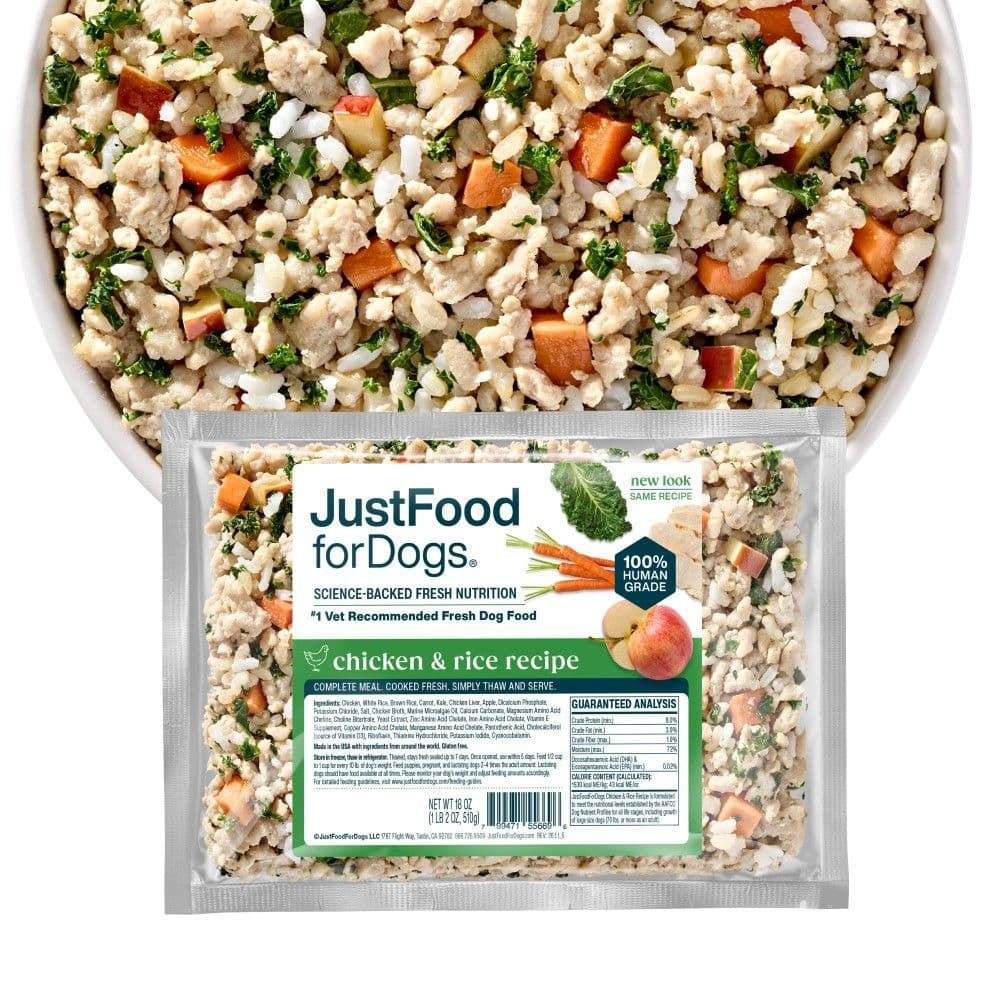
Chicken & Rice combines chicken thighs and liver with white and brown rice, kale, carrots, and apples within a formulated complete recipe. It is a useful choice to consider when you want a grain-inclusive fresh meal and have the freezer space to support that routine.
The manufacturer's product information lists 1,530 calories per kilogram, or about 43 calories per ounce. Its all-life-stages adequacy statement includes growth of large-size dogs. For a Doberman puppy, that is a meaningful label detail; for an adult, it provides another eligible complete-food option.
Consider it when:
- You want a chicken-based fresh recipe with grains.
- The household includes a growing puppy.
- You can weigh the serving and follow frozen-food handling instructions.
- You want a clearly labeled recipe to compare with adult alternatives.
For an adult receiving an illustrative 1,200 calories from this food, the calculation gives about 27.9 ounces daily. At an illustrative 1,600 calories, it gives about 37.2 ounces. These are examples of what the label means, not standard amounts for ordinary days and training days. Your dog's established allowance supplies the starting number.
If two household dogs use this recipe, measure each one's portion separately. A puppy and an adult might share an eligible product without sharing an amount or meal schedule. Label the prepared portions so the convenience of buying one recipe does not create confusion at feeding time.
Petful may earn a commission when you click through to JustFoodForDogs, at no extra cost to you.
Fish & Sweet Potato: a fish-based choice with a different serving weight
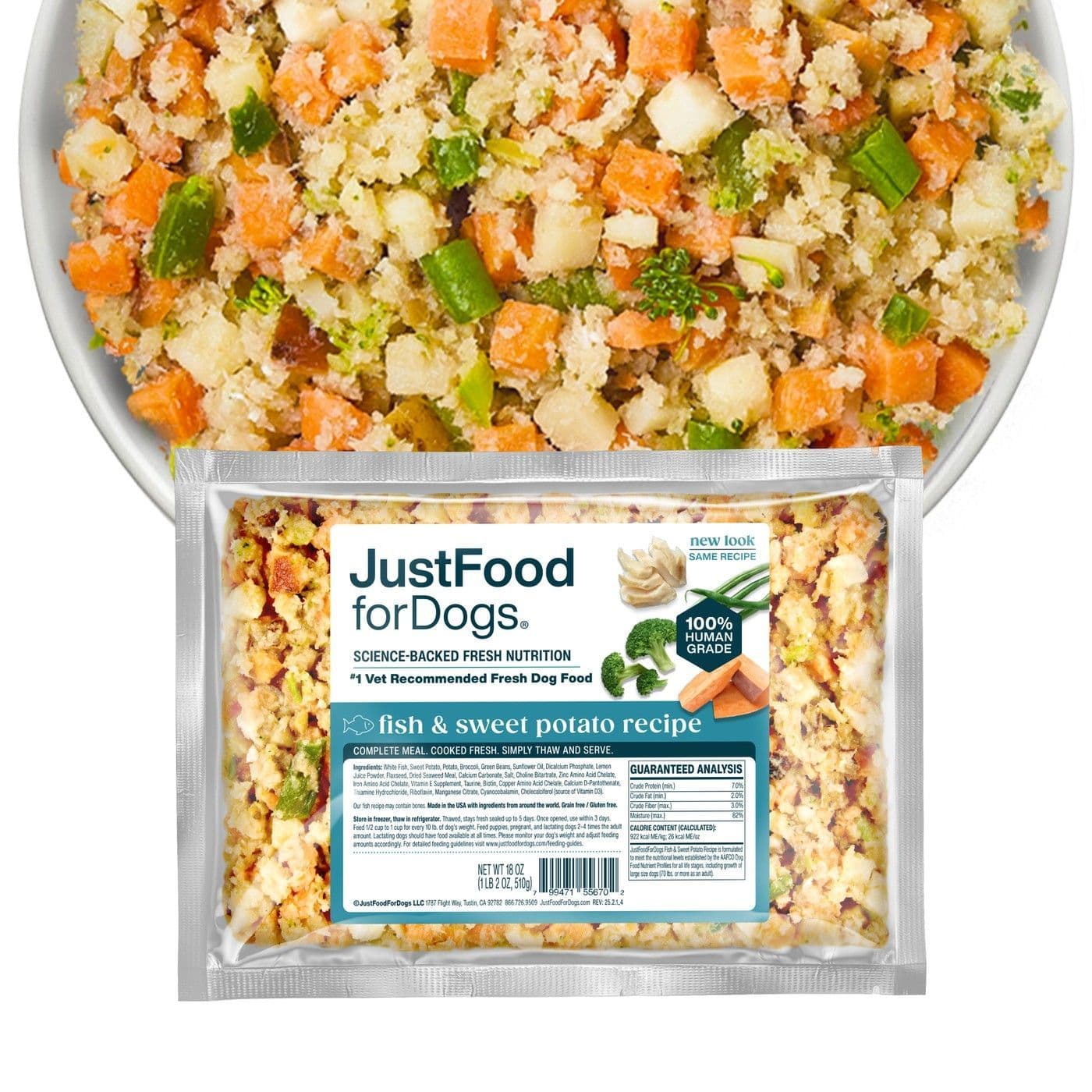
Fish & Sweet Potato provides another complete option that includes growth in its current adequacy statement. Its ingredients include whitefish, sweet and russet potatoes, green beans, broccoli, and oils. That offers a distinct recipe preference for owners comparing the available fresh meals.
The manufacturer lists 922 calories per kilogram, or about 26 calories per ounce. At the same assigned calories, it requires more ounces than Chicken & Rice or Beef & Russet Potato. That is useful information when comparing how much food to store and how quickly a package will be used.
Its practical fit includes:
- A complete fish-based recipe.
- Growth eligibility for a puppy discussion.
- A larger food weight at the same calorie allowance.
- A frozen-food routine that needs to fit available storage space.
The current recipe is grain-free, which describes its ingredient composition. It does not establish that every Doberman needs to avoid grains or that fish is automatically the best protein for the breed. Use the complete recipe and any individual feeding guidance when making that choice.
If you move to this food from a more calorie-dense recipe, calculate the new amount before serving. Reusing the previous food's ounce amount would change the calories delivered. The visible difference in the bowl is an expected result of the label calculation, not a reason to abandon measurement and serve by appearance.
Petful may earn a commission when you click through to JustFoodForDogs, at no extra cost to you.
Beef & Russet Potato: an adult recipe with comparable calorie density
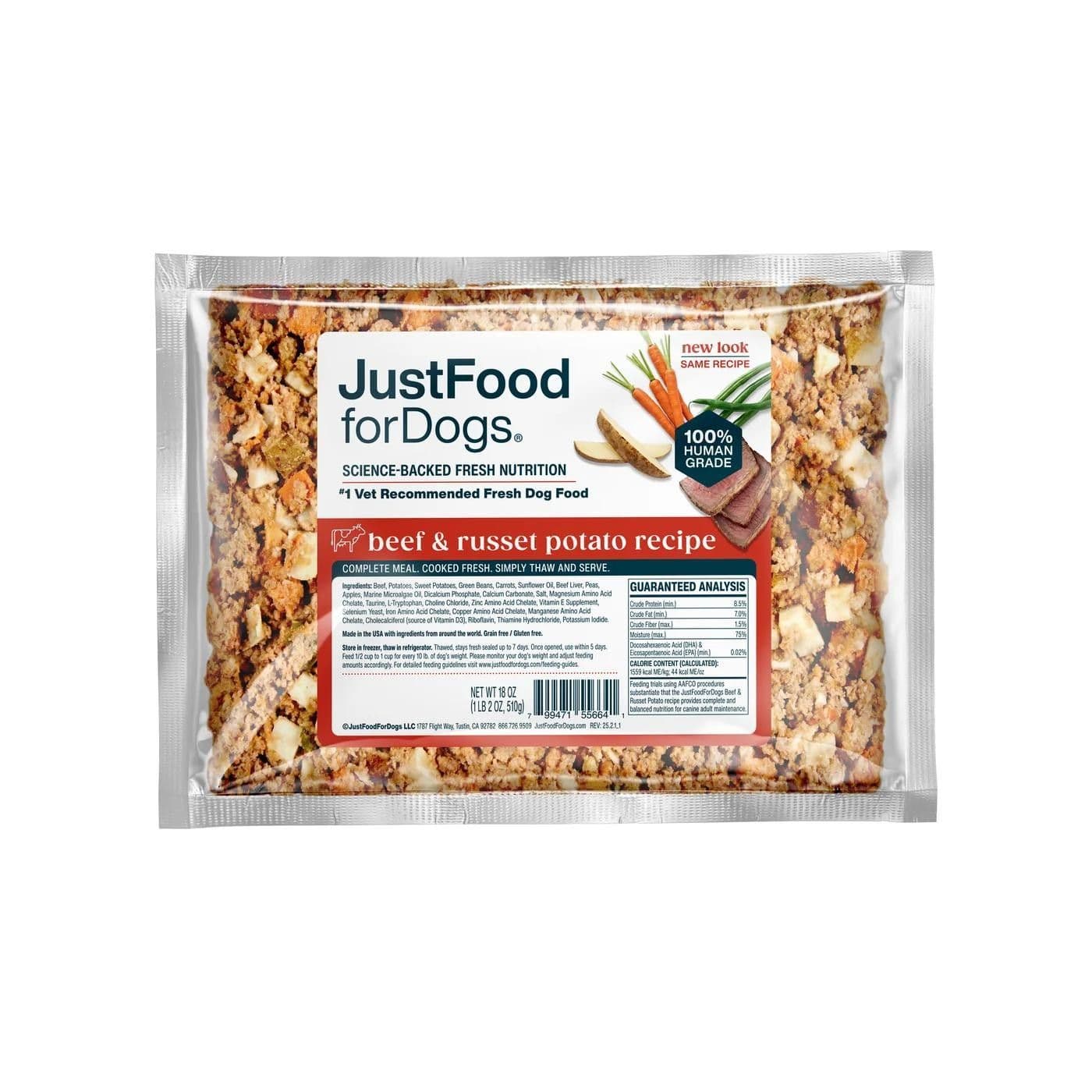
Beef & Russet Potato provides adult-maintenance nutrition at about 44 calories per ounce. For a mature Doberman, it offers a beef-based alternative with a calorie density close to Chicken & Rice's 43 calories per ounce. The ingredient choice changes more than the required food weight at a fixed allowance.
That makes it useful for an owner comparing two adult-eligible recipes without assuming that the richer-sounding protein requires a larger serving. At an illustrative 1,200 main-food calories, Beef & Russet Potato requires about 27.3 ounces, compared with about 27.9 ounces of Chicken & Rice. The difference is small, but the exact recipe should still appear in the feeding instructions.
Choose it for an adult when:
- A beef-based recipe fits the dog's feeding history.
- You want complete fresh meals with a measurable calorie declaration.
- Frozen storage is practical at home.
- You can keep adult food distinct from a puppy's growth diet.
Life-stage eligibility remains the important boundary. An adult-maintenance food does not become growth-appropriate because the puppy looks almost as large as a mature dog. In a mixed-age household, identify the recipe as well as the dog's name on each portion container.
For an adult's routine, compare the whole formula, current price, and storage requirements with the other eligible options. A one-calorie-per-ounce difference does not prove a performance advantage. It simply gives you a more accurate amount to serve once the food is selected.
Petful may earn a commission when you click through to JustFoodForDogs, at no extra cost to you.
JustFresh Home-Cooked Chicken: adult meals with pantry convenience
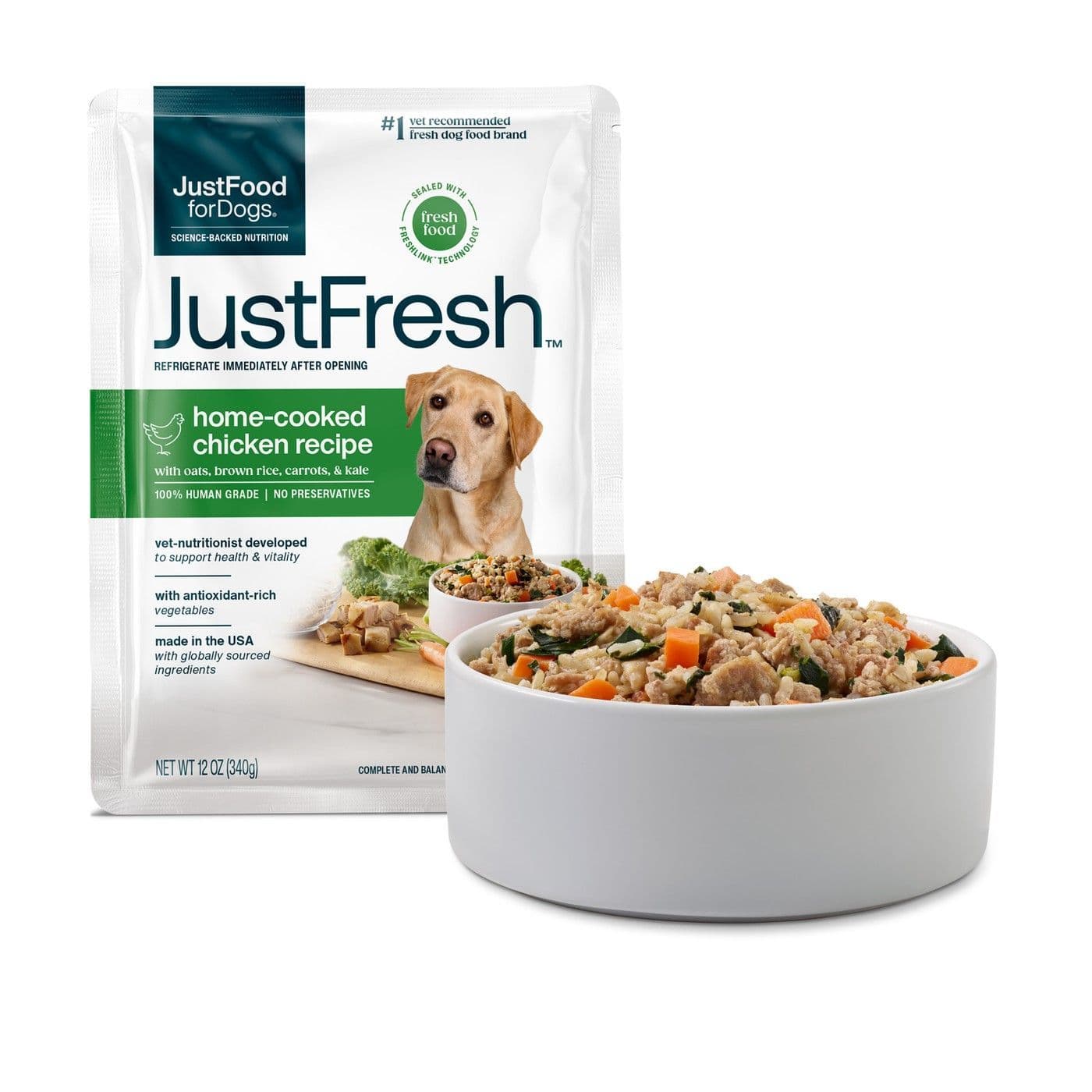
JustFresh Home-Cooked Chicken is a complete adult-maintenance option that is shelf-stable before opening. This can make inventory easier when freezer space is limited or another caregiver needs a readily identified meal. The unopened storage format is the practical distinction from the Fresh Frozen recipes.
The current product information lists 1,254 calories per kilogram, or about 36 calories per ounce. Ingredients include chicken and liver, oats, brown rice, carrots, kale, oils, potato starch, and a nutrient blend. Use that recipe's own calorie figure when planning the amount.
Check these details before choosing it:
- Adult-maintenance suitability for your dog.
- How much the established allowance requires each day.
- Space for opened food in the refrigerator.
- Whether the household can use opened food within three days.
Once opened, refrigerate the food and follow the manufacturer's three-day use instruction. A package that can sit unopened in the pantry is not an opened meal that can remain in a warm car or a training bag. Include refrigeration in any plan involving travel or another household.
For a sitter, leave the exact recipe name and the amount per meal, not just an instruction to give a pouch. Package sizes and individual allowances can differ. A short written note preserves the convenience of the format while making the actual serving unambiguous.
Petful may earn a commission when you click through to JustFoodForDogs, at no extra cost to you.
Growth-appropriate food for a Doberman puppy
A Doberman puppy needs a complete growth diet, with large-size growth eligibility checked where relevant to expected adult size. Current Chicken & Rice and Fish & Sweet Potato statements explicitly include growth of dogs expected to weigh 70 pounds or more as adults. That provides a clear starting point for comparing fresh puppy choices.

The puppy's present weight is not the only consideration. A young dog that will become large is still growing even when it already looks substantial. Adult-maintenance Beef & Russet Potato and JustFresh Chicken should not replace the puppy's complete growth food simply because their ingredients appeal to the household.
- For a Doberman puppy, verify that the exact recipe supports growth and includes the relevant large-size category. Adult-maintenance nutrition serves a different stage. Use the puppy's individual feeding plan when calculating its daily portion.
Establish the puppy's own calorie and meal plan
There is no single gram amount that fits every Doberman puppy at a given age. Current weight, expected growth, the exact food, and the individual feeding assessment affect the calculation. Start with the product's feeding guidance and your veterinarian's recommendations, then track the amount actually served as the puppy grows.
The adult 1,200- and 1,600-calorie examples in this guide are not puppy recommendations. Once the puppy's appropriate allowance is established, the same conversion method applies: divide the calories assigned to its growth food by that food's calories per gram or ounce. Revisit the starting allowance as growth changes the puppy's needs.
For an arithmetic-only example, imagine a puppy's established plan assigned 700 calories to Chicken & Rice. Dividing 700 by 1.53 calories per gram gives about 458 grams for the day. If that individual plan used three equal meals, each would contain about 153 grams. The numbers demonstrate the method; they do not prescribe a 700-calorie intake or a three-meal schedule for every puppy.
Separate frequency from quantity
The AKC's puppy-feeding timeline describes a common progression from four meals for young puppies toward three during the three-to-six-month period and toward two as dogs mature. Confirm the schedule for your puppy and divide the established daily amount accordingly.
An eight-week-old puppy and a six-month-old puppy should not automatically share one feeding instruction. Record the puppy's current stage, food, daily allowance, and meal division. Changing the number of meals changes the amount at each meal; it does not mean adding another full daily portion.
At the first handoff from a breeder or rescue, collect:
- The food's full product name.
- The amount served in a clearly stated unit.
- The existing meal times and reward routine.
- Recent weight information and any feeding advice already given.
This baseline makes a planned transition easier to follow. If you choose Chicken & Rice as a growth-eligible fresh option, compare it with the current puppy food using calories rather than equal scoops. Follow the product's transition guidance and the individual veterinary plan.
Keep growth balanced rather than chasing size
A large-looking puppy is not a reason to add supplements to an already complete growth recipe. The AKC's breed-size puppy nutrition guidance explains the importance of balanced large-breed puppy nutrition. Extra calcium should not be a routine attempt to improve a complete puppy food.
Use a growth record to inform a feeding discussion rather than aiming for the largest possible puppy at each age. Bring the exact food, current amount, extras, and recent observations to routine veterinary visits. Those details help the feeding plan follow the individual dog's development.
For broader early-life context, Petful's Doberman puppy guide covers the puppy stage beyond food selection. Keep that wider care routine connected with meals: everyone helping with the puppy should know which food and amount are currently being used.
Match food quantity to the individual Doberman
Choosing a complete recipe and choosing its amount are separate decisions. A Doberman's size, stage of growth, condition, and actual routine help determine the allowance. Descriptions such as European, blue, or fawn do not supply an automatic calorie number or establish a special recipe requirement.
Use the exact recipe's nutritional adequacy statement first. The FDA explains complete and balanced pet food through nutrient profiles or feeding trials using AAFCO procedures. Adult maintenance and growth describe different purposes; a broad brand claim cannot substitute for the statement on the food you intend to buy.
Record what the dog actually receives
- Before making a change, write down the current food and measured amount, along with treats, chews, and other additions. Record whether the quantity is daily or per meal. This creates a useful baseline for a veterinary feeding discussion and helps explain differences between the planned routine and the food actually consumed.
Record the recipe, measured meals, treats, and any food used during training. For a Doberman doing structured work, include the duration and frequency of those sessions. This gives the veterinary team a useful basis for assessing the amount; the breed's athletic appearance alone does not set its calories.
- Age and whether growth is ongoing.
- Current weight and recent changes.
- Exact recipe, measured food amount, and meal schedule.
- The usual week's activity, including quiet days.
- Calories from rewards and other additions.
Use the label units consistently
Write the recipe's calorie value beside its unit, such as kcal/kg or kcal/oz, and distinguish a daily amount from a per-meal amount. A package is a purchasing unit, not a serving. Use the worked calculations below to translate the individual allowance into weight.
Choose a measurable calorie unit
Use grams when a large serving spans packages: divide the recipe's kcal/kg by 1,000, then divide the assigned calories by that result. Keep the same unit throughout the plan. Weight ounces are also workable when paired with kcal/oz; fluid ounces measure volume and are not interchangeable.
Adult food for ordinary and active days
For an adult Doberman, the best food choice is an eligible complete recipe you can portion consistently within the individual's feeding plan. Beef & Russet Potato provides an adult-maintenance fresh option; Chicken & Rice remains another suitable complete choice. Actual activity helps inform the allowance, rather than requiring a recipe change for every busy day.

Describe the ordinary week before assigning labels such as highly active. Regular walks, play, training sessions, and sustained physical work provide different context. A dog that has one unusually long outing does not automatically need a permanent increase in every day's portion.
Use an activity record that can guide a real decision
A useful activity record can be brief: note the usual routine, the food offered, the food consumed, and any sustained change. This helps you discuss the existing allowance with your veterinary team. It is more informative than deciding that every Doberman must eat like a working dog because the breed is athletic.
For a household with varied days, ask whether the established feeding plan needs a specific adjustment for a meaningful workload change. Do not turn the two illustrative calorie amounts below into an ordinary-day and training-day rule. They exist to compare calculations, not to assign energy needs from a calendar label.
| Observation | What it helps clarify | What it does not establish by itself |
|---|---|---|
| A new sustained exercise routine | Whether the existing allowance should be reviewed | A universal extra scoop |
| Food used throughout training | Calories already supplied outside meals | Permission to ignore rewards |
| More quiet days than usual | A change to discuss with condition and weight trends | A specific calorie reduction |
| A different recipe | The need to recalculate food weight | A change in the dog's calorie needs |
Compare two individual feeding plans
Imagine two mature Dobermans whose established main-food allowances happen to be 1,200 and 1,600 calories. Both eat Chicken & Rice. The higher allowance requires about 9.3 additional ounces per day, which is roughly 65 ounces more food over a week. The difference follows from those individual plans, not from assigning one dog to a superior activity category.
This is useful for a household buying for two dogs. Shopping can be combined, but serving instructions stay separate. Together, the examples require about 65.1 ounces of Chicken & Rice daily. A shared order therefore needs to cover that combined use, while each dog still receives its own measured amount.
If one dog's established allowance changes, revise only that dog's instruction and then update the combined inventory calculation. Do not increase both bowls because the same food is being used. Separate records make a multi-dog routine easier to understand when activity, life stage, or the feeding plan changes for just one animal.
Reserve the planned extras first
The AAHA nutrition guidelines address the whole diet, including extras. Treats and additions generally should remain within 10 percent of daily calories. Use any more specific limits in the individual dog's established plan.
If rewards come from the already measured complete-food portion, set them aside before serving the bowls. If they are separate treats, record their calories as extras. These are two different accounting methods, and combining them carelessly can either count the same food twice or leave extra food uncounted.
For an illustrative total of 1,200 calories, reserving 120 for extras leaves 1,080 for the main food. At 43 calories per ounce, that is about 25.1 ounces of Chicken & Rice daily. At 44 calories per ounce, it is about 24.5 ounces of Beef & Russet Potato. Neither calculation establishes that 1,200 calories is appropriate for your dog.
Make the reward supply visible to everyone
Set aside the day's training allowance before exercise or a class. A Doberman receiving rewards from several handlers needs one shared allowance, not a new allowance per handler. Record whether rewards are separate treats or food reserved from the already measured meals.
Measure rewards with irregular pieces
Weigh an irregular reward portion when the label supplies kcal/kg: divide that value by 1,000 for kcal/g, then multiply by grams used. A handful is not a repeatable unit. Keep these calories in the same daily extras allowance used for the meal calculation.
Assess everyday preference without constant changes
A Doberman may have preferences about texture, a particular recipe, or the feeding environment. When comparing appropriate foods, keep the routine steady enough to see what the dog actually accepts. Changing meals, treats, and toppers together makes it difficult to identify which change mattered.
Choose a suitable complete recipe, follow the planned transition, and record what is eaten. A quiet feeding space away from another pet may also make observations clearer. These are practical ways to evaluate an ordinary preference without claiming that a fresh meal will solve every reluctance to eat.
An unexplained appetite change, persistent refusal, or difficulty eating deserves veterinary assessment. Once the cause is understood, the food choice can follow that information. Repeatedly switching proteins is not a substitute for understanding a new feeding problem.
Keep the older adult's routine individual
An older Doberman may continue to use a suitable adult food, with the amount and serving routine reviewed as circumstances change. Age alone does not identify one special recipe or calorie level. Consider current condition, actual activity, comfort eating, and any individual feeding advice.

A moist fresh meal can be convenient to portion, while JustFresh Home-Cooked Chicken may simplify unopened storage for an adult household. Choose those features for their practical fit. A storage format or soft texture does not establish that a food addresses a senior dog's individual health needs.
Fresh meals, kibble, and home cooking
Fresh cooked, dry, and canned describe food formats. Each exact food needs an appropriate nutritional adequacy statement if it supplies the main diet. Petful's food-label guide explains how to assess the label rather than relying on a familiar ingredient or a broad marketing term.
For owners interested in a grain-inclusive choice, Chicken & Rice includes white and brown rice, and JustFresh Chicken includes oats and brown rice. Fish & Sweet Potato offers a different grain-free composition. Compare the whole formulation and life-stage purpose without assigning a breed-wide requirement to either choice.
Compare protein information on a fair basis
Moisture affects the nutrient percentages printed on labels. A fresh meal and a dry food can show different protein percentages partly because their water content differs. Comparing those percentages directly can therefore misrepresent the difference between the foods.
The FDA describes a dry-matter calculation: subtract moisture percentage from 100, divide the listed nutrient percentage by the resulting dry-matter percentage, and multiply by 100. For an invented example, 8 percent protein with 75 percent moisture equals 32 percent protein on a dry-matter basis.
That calculation helps compare one stated nutrient on a common basis. It does not identify the best complete recipe by itself. Nutritional adequacy, life stage, the whole formulation, and the amount eaten still matter. The highest protein number is not an independent feeding goal for every Doberman.
Distinguish a home-prepared diet from a prepared complete meal
Home cooking can supply a dog's whole diet when an appropriately formulated recipe is followed precisely. Meat, rice, and vegetables chosen informally are not automatically balanced. The recipe may depend on specific ingredient quantities and supplements that should not be replaced or omitted casually.
The decision includes practical workload. Can you obtain the specified ingredients, weigh them accurately, follow preparation directions, include required supplements, and store portions as directed? A puppy's formulation also needs to meet growth requirements; reducing an adult homemade portion does not establish puppy suitability.
Commercially prepared complete fresh food offers another route. With a growth-eligible recipe such as Chicken & Rice or an eligible adult recipe such as Beef & Russet Potato, the owner can focus on the labeled portion and handling routine. That is a concrete reason to consider JustFoodForDogs when you prefer cooked meals without taking on original recipe formulation.
Compare raw and cooked as separate choices
A raw-food diet also needs complete nutritional formulation for the intended life stage. Raw meat alone does not establish that, and a puppy requires a growth-appropriate plan. If you are considering a home-prepared raw diet, obtain qualified formulation advice rather than constructing one from a protein preference or a breed-specific online ratio.
Raw feeding also adds handling considerations. The FDA's raw pet-food guidance discusses microbial risks to pets and people. Consider whether everyone who stores, serves, and cleans up the food can follow the necessary precautions consistently.
An owner seeking fresh food can instead choose a formulated cooked recipe with a clear life-stage statement and calorie declaration. That preserves the practical appeal of cooked meals while providing specific information for portions. Raw and fresh cooked are different categories; choosing one does not require adopting the other.
Translate a calorie allowance into a feeding routine
How much a Doberman eats follows its established individual allowance. The feeding calculation becomes manageable: calories assigned to the recipe divided by calories per ounce equals ounces per day. For gram-based serving, divide by calories per gram instead. Subtract planned extras or calories supplied by a second food first.
The feeding chart below helps a Doberman Pinscher owner compare measured diet amounts. A European Doberman uses the same label-based calculation, with an individually established allowance. The 1,200- and 1,600-calorie figures are adult arithmetic examples only. They are not ordinary-day and training-day recommendations. Their purpose is to show how a changed calorie allowance affects the serving of the same recipe, and how two recipes compare at the same allowance.
| Assumed adult main-food allowance | Chicken & Rice at 43 calories per ounce | Beef & Russet Potato at 44 calories per ounce | Difference in daily food weight |
|---|---|---|---|
| 1,200 calories | About 27.9 ounces | About 27.3 ounces | About 0.6 ounce |
| 1,600 calories | About 37.2 ounces | About 36.4 ounces | About 0.8 ounce |
The close values show why calorie density and life-stage suitability need separate attention. For adults eligible for both foods, ingredient preference and practical handling can guide the choice. For puppies, the adult-maintenance restriction on Beef & Russet Potato remains decisive even though its calorie figure is similar.
Divide the daily amount into actual meals
Divide the calculated daily food between the dog's planned meals. For two equal meals, halve the total; a different schedule needs a different division. Keep the daily amount fixed unless the individual feeding plan changes, and do not treat each additional feeding opportunity as an extra meal allowance.

- For a caregiver, list the recipe, amount, unit, meal time, and where the next portion is stored. Include the reward allowance separately. The notebook is useful only if the instruction matches the food currently in the refrigerator, so update it when the recipe or established portion changes.
Compare different fresh-food densities
The same assumed 1,200 calories requires about 46.2 ounces of Fish & Sweet Potato at 26 calories per ounce, or 33.3 ounces of JustFresh Chicken at 36 calories per ounce. At 1,600 calories, those quantities become about 61.5 and 44.4 ounces respectively.
Those larger differences affect inventory more than the small gap between Chicken & Rice and Beef & Russet Potato. Compare the amount required for the intended calories, then assess storage and cost. A larger food weight does not automatically mean a larger calorie intake when the recipes have different densities.
Calculate a measured mixed-food plan
Suppose an adult's illustrative 1,200 main-food calories are divided equally between Chicken & Rice and another suitable complete food. The fresh share is 600 calories divided by 43, or about 14.0 ounces daily. The second food supplies the other 600 calories, not its previous full serving plus the fresh portion.
If that second food hypothetically contains 400 calories per cup, its share would be 1.5 cups daily. That calorie figure is invented to demonstrate the calculation. Use your actual product's label, and divide both daily components according to the agreed meal schedule.
When treats use part of the total allowance, subtract them before calculating the split. A 1,200-calorie total with 120 calories reserved for extras leaves 1,080 main-food calories. An equal split would assign 540 to each complete food, so the Chicken & Rice share would be about 12.6 ounces instead.
Turn the amount into days of food
Using an 18-ounce pack of Chicken & Rice as the package example, the 1,200-calorie main-food allowance uses about 1.55 packs per day. The 1,600-calorie example uses about 2.07 packs per day. A day's portion therefore does not necessarily line up with one unopened package.
At those amounts, a 252-ounce order supplies approximately 9.0 or 6.8 days respectively. These are calculated supply durations, not refrigerated-use periods. Keep unopened frozen stock separate from the quantity made ready for the next meals and follow the current product's thawing and opened-use instructions.
This distinction matters when you choose an order size. Buying enough food for a week does not mean thawing all of it at once. Plan the total inventory, the portions needed soon, and the storage space for each stage of the routine.
Compare regular daily feeding cost
On September 28, 2026, the official Chicken & Rice listing displayed a regular price of $153.99 for fourteen 18-ounce packs, or 252 ounces. Fish & Sweet Potato displayed $167.99 for the same quantity. These are observed regular list prices, excluding tax and shipping, and do not guarantee a current checkout total.
| Assumed main-food calories daily | Chicken & Rice daily cost | Fish & Sweet Potato daily cost |
|---|---|---|
| 1,200 | About $17.05 | About $30.77 |
| 1,600 | About $22.74 | About $41.02 |
The calculation is regular price divided by package ounces, multiplied by daily ounces. It compares the food consumed at the same calorie allowance. A package-price comparison alone would miss the larger amount of Fish & Sweet Potato required to supply those calories.
For the illustrative 600-calorie Chicken & Rice share in the mixed plan, its component costs about $8.53 daily at the observed regular price. Add the actual cost of the second food and any rewards to compare the whole day. Do not count a promotion that applies only to an initial order as the ordinary recurring budget.
Check the order before relying on the estimate
Check recipe, pack weight, and number of packs against the order calculation. Separate inventory left in the freezer from food consumed that month. For a large adult Doberman, that distinction prevents a bundle's purchase price from being mistaken for a reliable monthly feeding cost.
Check the current purchase details
Compare the regular price for the exact recipe and pack size, including shipping where applicable. Keep introductory discounts separate from the ongoing budget. A two-Doberman household should calculate each dog's food requirement first, then combine the purchasing quantity.
- Exact recipe and package quantity.
- Current regular price and any limited promotion.
- Main-food calories after extras or another food.
- Calculated daily use and remaining inventory.
- Whether tax, shipping, and other foods are included.
Petful's Doberman cost guide places food spending in the broader ownership budget. Keeping this feeding calculation separate makes it easy to update when the dog's established amount or the product price changes.
Keep handling instructions with the prepared portion
When dividing food for several meals, identify the recipe and the date it was opened or thawed, using the manufacturer's instructions for that product. Do not replace those instructions with an assumption that every fresh food has the same refrigerated life. The JustFresh three-day opened period belongs to that specific format.
A practical handoff can keep the next meal in an identified container while leaving later inventory in its required storage. The caregiver should know which portion to use first and where to find the current serving note. This helps a calculated allowance remain the amount actually served, even when the usual feeder is away.
Prepare food for a sitter
Give the sitter one current instruction per dog: recipe, grams per meal, meal times, reserved treats, and storage directions. Preportioning can simplify a short trip, but the containers must remain within the product's handling limits. Confirm refrigerator and freezer space before transferring a large supply.
- Which exact food belongs to this dog?
- Is the stated amount one meal or the whole day?
- What food is already reserved for rewards?
- Which opened portion should be used next, and how is it stored?
Frequently asked questions
Keep unsafe human foods such as chocolate, grapes, raisins, onions, and xylitol-containing products out of the diet. The ASPCA's toxic-food guidance provides a useful reference. Unbalanced additions also should not replace complete daily nutrition. Contact a veterinarian or animal poison service promptly after a suspected hazardous exposure.
Many adults have a regular two-meal routine, while puppies commonly eat smaller meals more frequently as they grow. Use the individual puppy or adult feeding plan, then divide the established daily allowance across those meals. The schedule determines when the food is served, not a separate calorie allowance for every feeding.
Chicken, beef, and fish can appear in suitable complete recipes, but a meat choice alone does not establish balanced nutrition. Consider complete recipe balance, individual protein tolerance, and life-stage suitability together. The JustFoodForDogs choices here offer concrete protein options with recipe-specific labels, so owners can compare the whole food rather than assume one meat suits every Doberman.
No. Overall nutritional adequacy and appropriate energy intake matter alongside the complete formulation. Moisture differences also affect label percentages. Compare foods on a fair basis and choose a recipe for the individual dog's needs, rather than treating the maximum protein number as the goal or expecting it to produce muscle gain.
Use an individual maturity assessment and veterinary guidance rather than switching solely because the puppy looks large. A growth-appropriate all-life-stages recipe may remain suitable, with the amount revised. If choosing an adult-maintenance recipe, first confirm that the dog is ready for adult feeding and calculate from the new food's calorie information.

Coreen Saito is a pet writer and longtime shelter volunteer with more than a decade in animal rescue. She covers cat behavior, breed care, and the small, ordinary science of sharing a life with companion animals, with a particular focus on honest takes about the products and decisions that actually matter. At home in Arizona, she's outranked by Mac (a dog with the loudest opinion in the house), Rebel (a cat who governs by quiet authority), and Meri (an orange tabby who runs the late shift and the laundry basket). She writes about all three, plus the rescues that keep coming through her life, at LifeWithMinty.com.
Sign up for expert-backed reviews and safety alerts all in one place.

A Final Word (Disclaimer)
At Petful, our review integrity is paramount; we never exchange special treatment in our reviews for monetary or material rewards.
Nonetheless, when our readers click through to online merchants (including Chewy or Amazon), we receive a referral commission. This supports the running of our free blog, and we appreciate your backing.