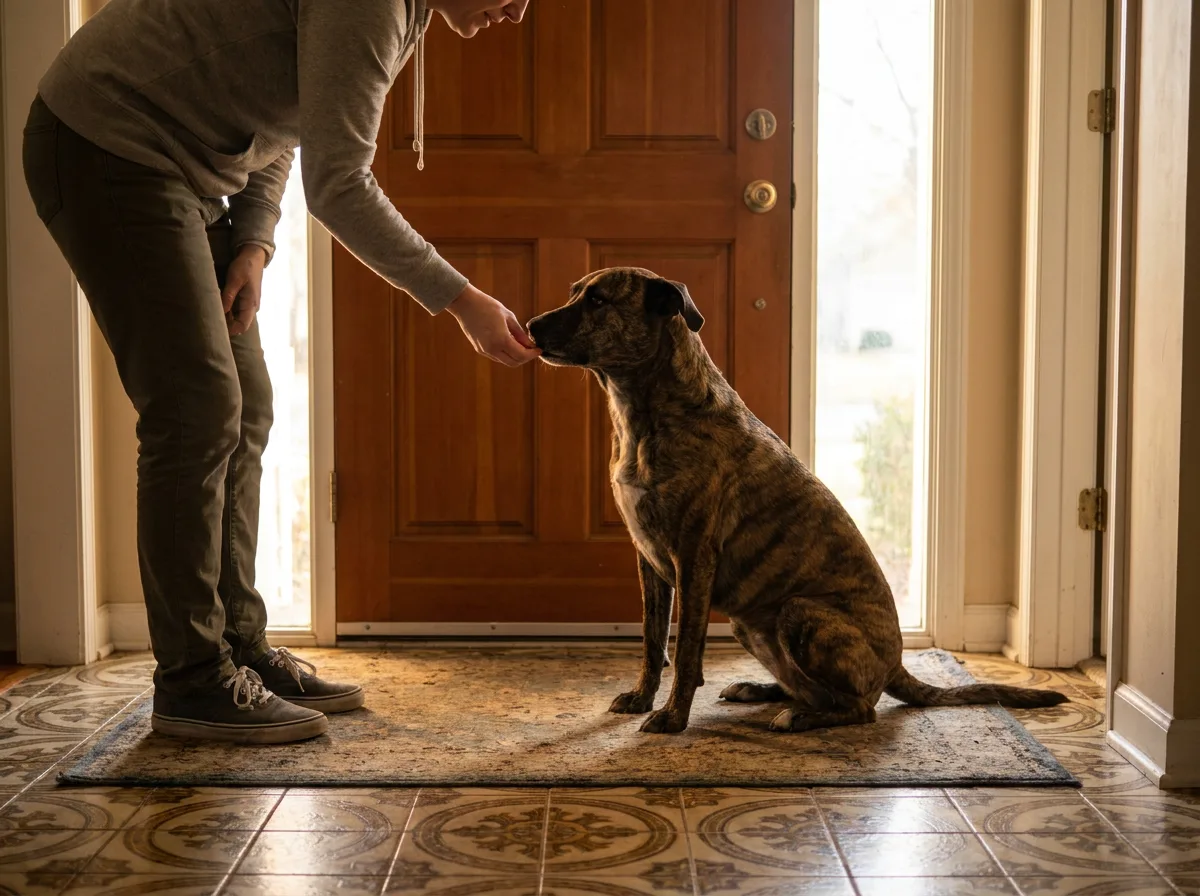
Cat Brain vs Human Brain: Size, Memory and Intelligence
Compare cat and human brains through anatomy and cognition research. Learn what brain size, cortical neurons, memory and familiar-voice experiments reveal, and what popular intelligence claims cannot prove.
Petful is reader supported. As an affiliate of platforms like Amazon and Chewy, we may earn a commission when you buy through links on this page. There is no extra cost to you.
Petful may earn a commission if you click on our links and make a purchase. This comes at no extra cost to you.
A cat brain vs human brain comparison reveals shared mammalian structures and very different scales and abilities. Cats have a cerebral cortex, cerebellum and brainstem, but a smaller brain is not a miniature human mind. Brain size, neuron counts and responses to a familiar voice each tell us something different. None provides a human IQ score for a cat.

Sign up for expert-backed reviews and safety alerts all in one place.
Cat Brain vs. Human Brain: What Is Similar?
- 1Cats and humans share the broad mammalian brain plan, including structures involved in sensation, movement, learning and memory.
- 2A published neuron study measured one cat’s brain at 34.8 grams and estimated about 250 million cortical neurons; a single cat is not a species-wide average.
- 3Brain size is not an IQ score. Claims that cats equal a particular human age or store a fixed amount of computer data go beyond the evidence.
- 4Look at what a study actually tested before treating its result as a rule about your own cat.
The feline brain and human brain both belong to a nervous system that receives sensory information and coordinates responses. A cat processes information from the world, learns from experience and changes behavior in response. The same broad description applies to people, but it does not mean that our sensory priorities, language or reasoning are identical. A cat noticing faint movement near a chair is solving a different problem from a person reading a sentence.
How Cats Learn and Solve Problems
You can observe learning without trying to assign a score. A cat may discover where a toy disappears, learn that a particular cupboard predicts food or repeat an action that was rewarded. When offering a food puzzle, such as the Catit Play Treat Puzzle, begin with an easy task and a small amount of the cat’s usual ration. Interest, hunger, experience and comfort all affect whether the cat participates.
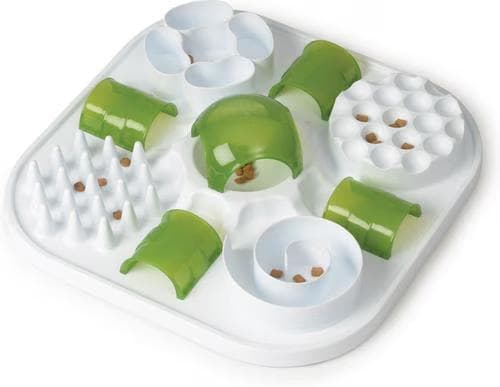
An easy Catit Play Treat Puzzle can provide a supervised food-search activity. Start with accessible food and adjust to the individual cat rather than treating completion speed as an IQ test.
Petful may earn a commission when you click through to Chewy, at no extra cost to you.

A result depends on the task
A puzzle asks whether a cat will investigate that particular object in that particular setting. It does not measure every ability the animal possesses. A cat may ignore food when full, avoid an unfamiliar surface or prefer a moving toy. Before calling a cat unintelligent, ask whether the task makes sense to them and whether they feel safe enough to try.
The FelineVMA feeding consensus statement supports feeding arrangements that consider foraging, play and safe access. That practical recommendation does not require a claim that one toy raises intelligence. Keep food quantities appropriate, make the starting task achievable and seek veterinary advice if feeding needs are complicated by illness.
Attention and movement are different from a speed ranking
People often compare a cat’s fast paw movement with a human reaction. Reflexes, voluntary movement, anticipation and experience are different parts of behavior. There is no useful universal statement that a cat’s entire brain works a fixed number of times faster than a human’s. A hunting-style game shows coordinated attention and movement, not a computer-processing benchmark.
For supervised play, move a Frisco feather wand like an object the cat can watch, stalk and catch, with pauses suited to their interest. Let the cat choose whether to join. Put strings and feathers away after play and adapt the activity if age, pain or mobility limits make chasing uncomfortable.

Use a feather wand for supervised, adaptable play. Participation tells you what the cat enjoys in that moment, not how they rank against another animal.
Petful may earn a commission when you click through to Chewy, at no extra cost to you.
How Big Is a Cat’s Brain?
The answer depends on the individual and the measurement. In a 2017 study comparing brains across several carnivoran species, the single domestic cat’s brain weighed 34.8 grams. That is a measured specimen, not a universal weight for every house cat and not a reason to estimate your own cat’s intelligence from head size.
Human brains are much larger, but body size, brain mass and the numbers and distribution of neurons are different variables. A heavier brain does not automatically yield a higher count in every region. Comparing whole-brain numbers with cortical numbers is also misleading because the regions contain different kinds and densities of cells.
| Feature | What the comparison supports | What it does not establish |
|---|---|---|
| Cerebral cortex | Cats and humans have this outer cerebral tissue; the cat cortex has folds | Identical reasoning, language or a fixed percentage of identical minds |
| Cerebellum and brainstem | Shared parts of the mammalian nervous system with important movement and basic regulatory roles | That all brain regions work in exactly the same way across species |
| Brain mass | The 2017 study measured 34.8 g in its single cat | A universal cat-brain weight or an individual intelligence score |
| Cortical neurons | The same study estimated about 250 million in that cat’s cerebral cortex | The whole-brain total; a cortical neuron count is not an IQ score |
| Behavioral experiments | A defined task can test discrimination, learning or memory under stated conditions | Every skill the cat has, or a guarantee of how a different cat will respond |
Walnuts, fruit and centimeters are rough shortcuts
A description such as “walnut-sized” can help someone imagine a small organ, but walnuts and fruit are not standardized measuring tools. A photograph also needs a scale and a clear orientation before it can establish dimensions. A brain viewed from above and one viewed from the side will look different without being different sizes.
The primary neuron study used here reports mass; it does not establish one universal length in centimeters for all domestic cats. An anatomical atlas can show the shape and relative locations of structures, but it should not be converted into a precise household measurement without checking its scale and the individual specimen.
Do Cats Have a Human IQ or Mental Age?
There is no validated feline IQ level or conversion from feline behavior to a human IQ score. Human IQ tests are designed and standardized for people; a cat cannot meaningfully be placed on that scale by counting neurons or completing a toy. Claims that the average cat has a specific IQ or equals a two-year-old child should not be treated as measured universal facts.
A comparison to a child can describe a limited task, such as remembering a hidden object, but it does not make a cat a child across language, social understanding and reasoning. Cats also have abilities and motivations that do not fit a human developmental checklist. Ask what was tested rather than accepting a single “mental age.”
Individual preferences are not intelligence grades
A cat who avoids a new object, ignores a cue or reacts differently to a smell is not necessarily failing to understand. In a behavioral study of responses to cat-attracting plants, researchers described variation among individual cats. A response to catnip is a particular behavioral response, not an IQ test or a measure of how much a cat likes their person.
A catnip toy such as the Yeowww banana is an optional play item for a cat who enjoys it. Watch their response, supervise use and remove a damaged toy. If a cat prefers a plain ball or a different activity, that is a reason to adapt play rather than keep trying to produce the “right” response.

Consider a catnip toy only if your cat enjoys that kind of play. Individual interest varies; the toy is not a supplement or a test of cognitive ability.
Petful may earn a commission when you click through to Chewy, at no extra cost to you.
Are cats getting smarter? An individual cat can learn through experience, but that does not establish a rise in intelligence across the species over generations. The studies discussed here test specific abilities; they do not track a population-wide IQ trend. Better recognition of feline abilities by humans is also different from a biological change in cats.
What Cats Remember About People

Cats can retain information and respond differently to familiar and unfamiliar experiences. The evidence is more specific than the popular claim that a cat remembers everything for exactly 16 hours. Different experiments examine different kinds of memory, use different delays and ask different questions. There is no universal timer after which a cat forgets a person.
Familiar voices and names
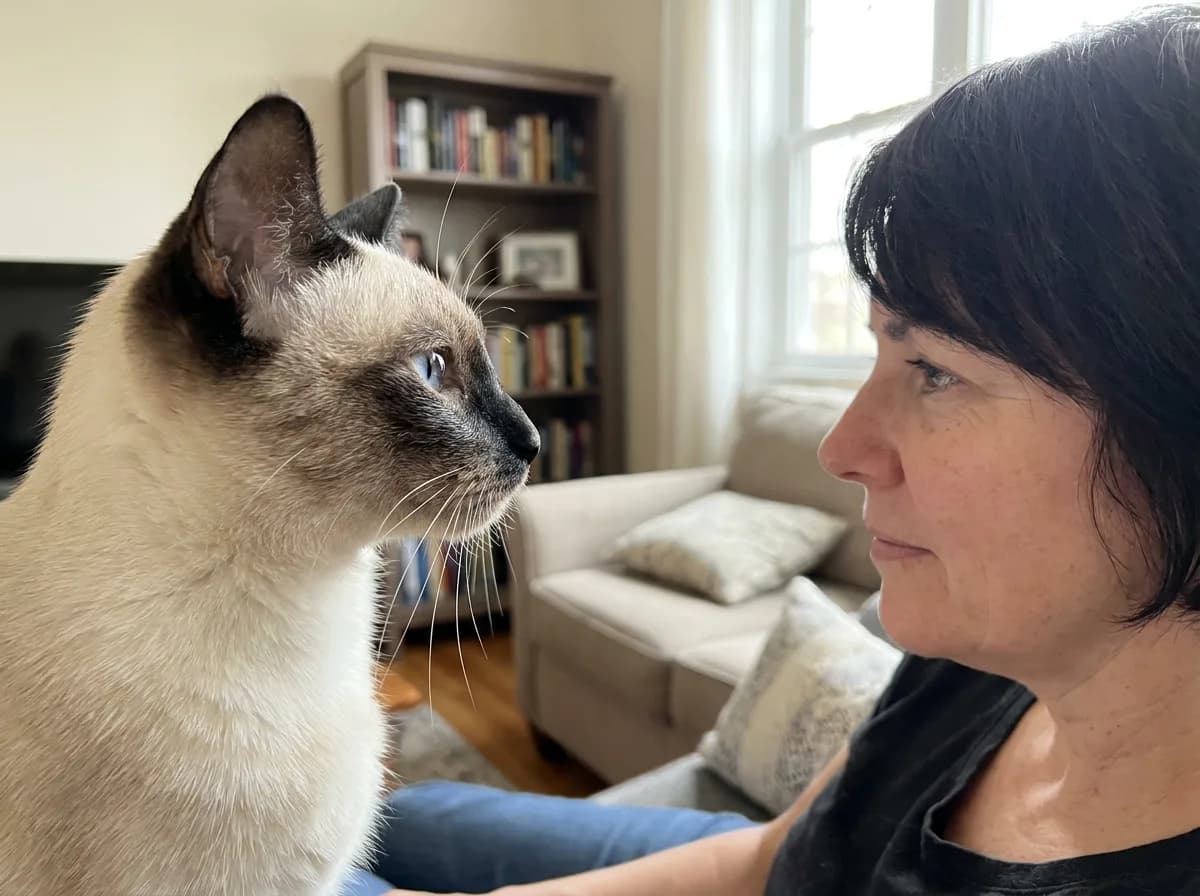
In Saito and Shinozuka’s 2013 voice-recognition experiment, cats showed different orienting responses to recordings of their owners and strangers. Recognition did not require the cat to walk over or vocalize. Looking, turning the head or moving the ears can be a meaningful response in an experiment.
A 2019 study by Saito and colleagues found that cats could discriminate their own names from other words under the study’s conditions. This supports auditory discrimination. It does not establish that a cat understands a name exactly as a person does, or prove that a cat who does not approach is deliberately insulting the caller.
Remembering places and a single experience
In a 2017 study of incidentally encoded information, cats used information from a single food-related experience after a delay. Researchers described this as evidence relevant to episodic-like memory. The term matters: it does not prove that cats consciously relive personal events in the same way humans describe doing.
A 2021 experiment about an owner’s location used recorded voices to examine cats’ expectations about where that familiar person was. Together, these studies show why memory is best discussed through particular abilities. They do not supply an exact number of years a cat will remember every previous caregiver.
Keep familiar places available
At home, pay attention to the settings in which your cat is comfortable. Provide stable resting and retreat options while allowing voluntary exploration. A Frisco play tunnel can be one choice for a cat who likes enclosed spaces, provided it is suitable for their size and used safely. It does not need to be expensive or novel to be useful.
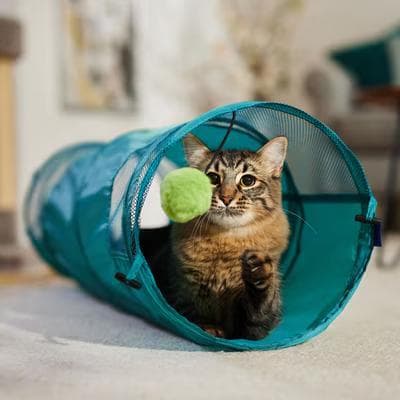
Offer an accessible tunnel as an optional retreat or supervised play space. Keep routes open and let the cat decide whether to explore it.
Petful may earn a commission when you click through to Chewy, at no extra cost to you.
Do not test attachment by frightening a cat or repeatedly moving them between unfamiliar homes. Familiarity, behavior and the relationship develop in context. If a kitten follows you frequently, our guide to why kittens follow their people explores that everyday behavior without assuming that one action reveals every emotion.
What a Cat’s Brain Looks Like
A cat’s brain is located inside the skull, connected to the spinal cord. It has paired cerebral hemispheres with a folded outer surface, a cerebellum toward the back and a brainstem below and behind the cerebrum. “Feline brain” refers to this actual organ, not a special second brain associated with a cat’s reflexes.
For real images, the 2020 domestic feline brain atlas by Johnson and colleagues includes MRI-based views and labeled structures. It was developed from eight healthy cats and is a much better anatomical reference than a generic cat photograph with a decorative brain overlay. Use the authors’ figure orientation and labels when looking at it.
Do cats have frontal lobes and a prefrontal cortex?
Cats have frontal regions of the cerebral cortex, including prefrontal areas documented in anatomical research. Having a structure with a comparable name does not make its extent, connections or contribution to behavior identical to a human’s. Human prefrontal reasoning cannot simply be assigned to a cat because both brains have frontal tissue.
The same caution applies to statements that a cat’s brain is “biologically most similar” to a human brain or “90 percent the same.” Similarity depends on what is being compared: shared structures, cells, genes, connections or behavior. The studies cited here do not provide a single percentage that measures how alike a cat’s mind and a human mind are.
Are Cats Smarter Than Dogs?
- 1Compare the same brain region when discussing neuron counts.
- 2Separate anatomical measurements from actual performance on a defined task.
- 3Check how many animals were studied and what their individual characteristics were.
- 4Avoid turning a pet’s cooperation, motivation or preferred activity into a universal intelligence ranking.
There is no single scientific league table that captures all feline and canine intelligence. The 2017 neuron-counting study estimated about 250 million cortical neurons in its cat, compared with approximately 429 million and 623 million in its two dogs. Those are different individual animals, not a large representative sample of every breed or a direct test of all thinking abilities.
Neuron counts are informative anatomy. Turning them into “dogs are exactly twice as smart” changes a measurement into a conclusion the number alone cannot support. Cats and dogs differ in body size, sensory priorities, social behavior and the tasks people have studied. A fair comparison must specify the ability, the method and the limits of the sample.
This is also why a list of “ten reasons cats are smarter than dogs” is not a scientific verdict. A cat may excel at a particular activity and a dog at another. Enjoy the species’ differences without using a convenient number or one entertaining video as proof of overall superiority.
Support Your Cat’s Brain Through Everyday Care
The useful takeaway from cognition research is to provide an environment in which a cat can use their abilities comfortably. The AAFP and ISFM Environmental Needs Guidelines emphasize safe places, appropriate resources, play, positive interactions and attention to the cat’s sensory environment. Those needs matter whether a cat is quick or hesitant with a new toy.

- Start new activities simply, allow success and stop before frustration or fatigue.
- Offer separate resting, feeding and toileting choices appropriate to the household.
- Use short, positive interactions and respect a cat who chooses to move away.
- Adjust play and access for age, comfort and mobility instead of assuming reduced activity means reduced intelligence.
- When bringing in another cat, use a gradual introduction rather than expecting shared scents or a similar species to guarantee friendship.
Our guide to introducing a kitten to a resident cat explains how scent and controlled exposure can support that last decision. Knowing that cats learn from experience is useful only if the experiences you provide are manageable for both animals.
Sudden behavior changes need veterinary assessment rather than an online intelligence label. A new change in responsiveness, coordination, activity or familiar routines should not be dismissed as a cat becoming “less smart.” Ask your veterinarian about changes, especially when they are accompanied by other signs of illness. Observations about your individual cat are useful; an online intelligence label is not a diagnosis.
Questions About Cat Brains
No validated human IQ score exists for cats. Their performance can be studied on specific learning or memory tasks, but those results are not interchangeable with human IQ tests. A claimed toddler age or exact human-equivalent IQ is not a reliable summary of feline cognition.
Research supports recognition of familiar voices and other learned information. It does not establish one fixed duration for remembering every person. A cat’s approach, avoidance or quiet attention also depends on the situation, so the absence of an obvious greeting does not prove that someone has been forgotten.
Cats show several memory-related abilities, including using information from past experiences and responding to familiar cues. Episodic-like findings come from defined experiments; they do not prove human-like conscious recollection. There is no universal timer or computer-storage equivalent that describes all feline memory.

Gayle Hickman has been researching and writing about pet behaviors since 2011. In addition to Petful, her articles have appeared on Reader's Digest, YAHOO Shine and WebVet, to name a few.
Sign up for expert-backed reviews and safety alerts all in one place.